Integrating OKRs with Performance Reviews: The 2026 Strategic Guide
By Humae · 12 August 2026
integrating okrs with performance reviews
Your most ambitious employees are likely sandbagging their goals because they are afraid of their next evaluation. It's a common paradox in modern leadership. You want your team to aim for the stars, but when bonuses are tied strictly to completion rates, people naturally play it safe. The challenge of integrating okrs with performance reviews often feels like a bureaucratic hurdle that leaves managers overwhelmed and employees defensive. You've likely felt the frustration of managing disconnected systems where data fails to tell the full story of an individual's impact.
This guide changes that. We understand that the real magic happens when you treat goals as the narrative context for an employee's growth. This 2026 strategic guide will show you how to bridge the gap between high stakes goal setting and fair evaluations without stifling the innovation your company needs to thrive. You'll learn to move away from manual tracking and toward a unified culture where data driven reviews reflect real impact. We are going to explore how performance intelligence and transparent alignment can finally turn your reviews into a source of inspiration rather than dread.
Key Takeaways
- Understand the shift from static annual reviews to dynamic performance intelligence that defines the workforce management landscape of 2026.
- Master the 80/20 rule to ensure that integrating okrs with performance reviews provides essential context without punishing employees for ambitious targets.
- Balance business outcomes with human behaviors by clearly distinguishing between the "What" of OKRs and the "How" of core competencies.
- Audit your workforce management infrastructure to eliminate data silos and empower managers to focus on coaching rather than just evaluating.
- Leverage AI-driven tools to synthesize continuous feedback and sentiment analysis into actionable insights for fairer, data-backed reviews.
The Convergence: Why OKRs and Performance Reviews Are Merging in 2026
The traditional wall between goal setting and evaluation is finally crumbling. For decades, HR experts argued that goals should be for growth and reviews should be for pay. This "church and state" separation failed modern teams. It left managers guessing and employees feeling like their daily wins were invisible. In 2026, the shift toward dynamic performance intelligence has made integrating okrs with performance reviews a strategic necessity. High-trust cultures thrive on this level of transparency. When everyone sees how their work moves the needle, the entire organization gains momentum.
Modern workforce management infrastructure has evolved to handle real-time data. We've moved past manual tracking and siloed spreadsheets. Today, the focus is on a unified performance culture where every data point serves a purpose. This convergence isn't just about efficiency; it's about building a workplace where people feel seen and valued for their actual contributions. By connecting the "what" of business goals with the "how" of personal performance, companies create a more cohesive and motivated workforce.
The Death of the Annual Appraisal
The annual appraisal is too slow for the digital age. Fast-moving teams can't wait twelve months to correct course or celebrate wins. AI-powered HR platforms now enable continuous feedback loops that capture achievements as they happen. This real-time data is the best defense against recency bias. Managers no longer rely on their hazy memory of the last few weeks to justify a year's worth of work. Instead, they have a complete history of documented impact. It makes the process feel supportive rather than punitive. Feedback becomes a constant conversation that fuels growth rather than a stressful yearly event.
OKRs as the New North Star for Performance
We are witnessing a move away from simple "tasks completed" toward "outcomes achieved." In a modern employee file, it's not about how many hours you sat at a desk, but how you moved the needle on key metrics. The Objectives and Key Results (OKR) framework serves as the objective evidence for these conversations. Clear goals are linked directly to intrinsic motivation. When employees see their progress reflected in their reviews, engagement levels rise. Our performance intelligence features help centralize this data, ensuring that every evaluation is grounded in reality. This alignment creates a unified culture where everyone knows exactly what success looks like and how to reach it.
The Strategic Framework: How to Link Goals Without Killing Innovation
Innovation dies in the shadow of rigid metrics. When teams feel that a single missed target will tank their career progression, they stop taking risks. This is why a clear framework is essential. Integrated Performance Management is the practice of using OKR progress as qualitative context for competency based reviews. It isn't about creating a mathematical formula for merit. Instead, it's about providing a rich, data backed narrative for an employee's professional journey. When you're integrating okrs with performance reviews, you're building a bridge between high level company strategy and individual growth.
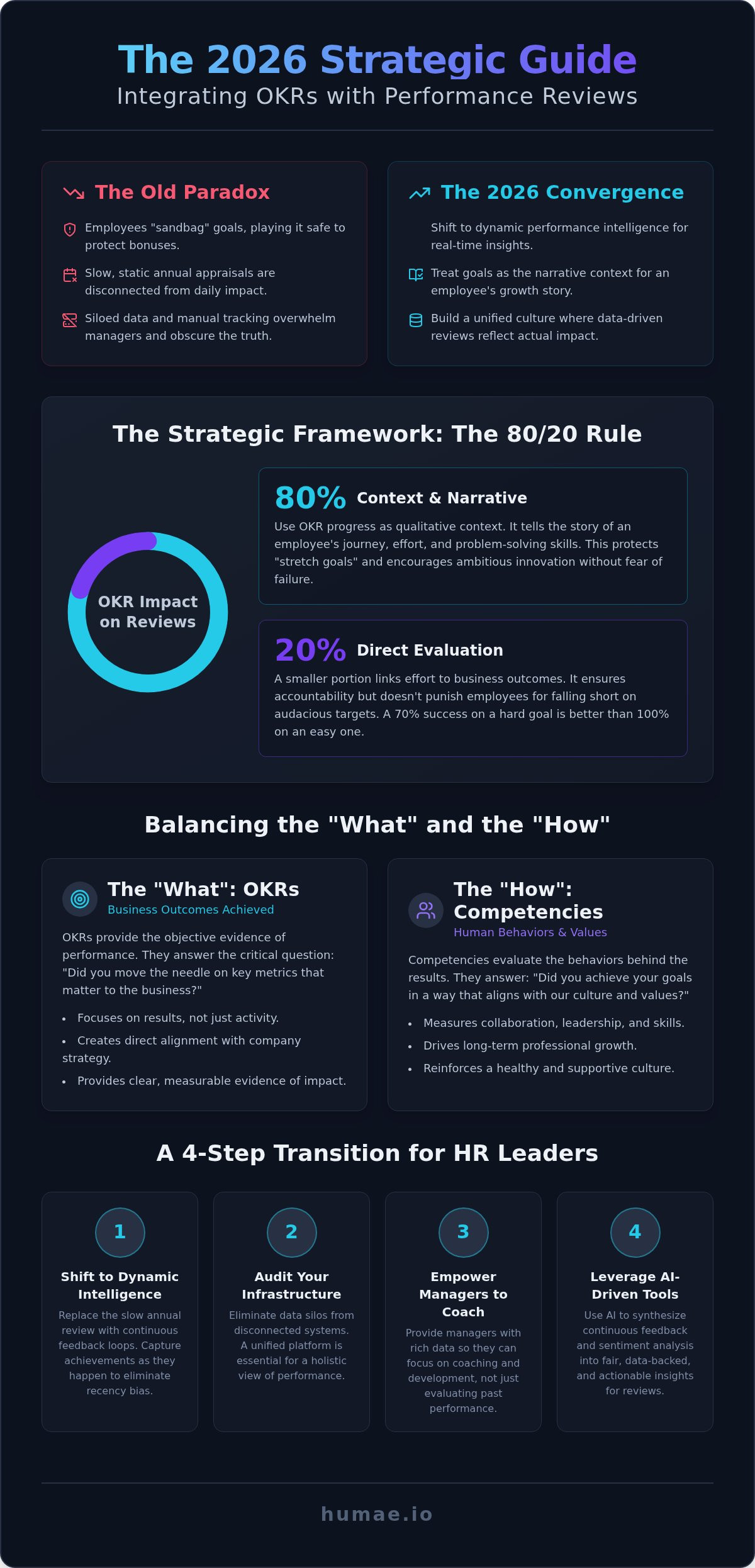
To maintain this balance, many leaders adopt the 80/20 rule. This approach uses OKRs for 80 percent context and 20 percent direct evaluation. This ratio ensures that while business outcomes matter, they don't overshadow the behaviors and values that drive long term success. It protects the "stretch goal" mentality that makes the framework so powerful. If an employee hits 70 percent of a truly ambitious goal, that often represents more value than hitting 100 percent of a safe, easy one. Our OKR tracking tools allow you to visualize this progress without losing sight of the human effort behind the numbers.
Decoupling OKRs from Compensation
The quickest way to ruin your culture is to tie bonuses directly to OKR completion rates. This leads to "sandbagging," where employees set low bars to ensure they get paid. To avoid this, use OKRs to measure "impact" rather than just "success" or "failure." We look at foundational OKR concepts to understand that the goal is alignment, not just accounting. In 2026, the Growth Mindset approach to OKR scoring prioritizes the velocity of learning and the scale of ambition over the binary achievement of a target. This shift keeps the focus on high performance without punishing those who dare to fail forward.
The Narrative Approach to Reviews
Managers must transition from judges to coaches. During a review, the primary question shouldn't be "did you hit the number?" but "what did you learn while pursuing this OKR?" This narrative approach uses key results to identify specific skill gaps for the next quarter. If a key result was missed because of a technical bottleneck, that's a coaching opportunity, not a reason for a lower rating. Documenting the difficulty level of goals is crucial. It allows you to reward ambitious effort, ensuring that your top talent remains hungry for the next big challenge.
OKRs vs. Competencies: Balancing the What and the How
Hitting a target is only half the story. If a lead developer delivers a product on time but leaves their entire team burnt out and demotivated, is that a win? Integrating okrs with performance reviews requires a sophisticated dual lens. We must balance the "What" with the "How." OKRs capture the measurable business outcomes, while competencies evaluate the behaviors and soft skills that make those outcomes sustainable. A true high performer excels in both. Without this balance, organizations risk promoting "brilliant jerks" who hit every KPI but erode the cultural foundation of the company.
Performance intelligence tools help leaders spot these patterns before they become toxic. By looking at the intersection of results and behaviors, you create a more equitable evaluation process. It's not just about the final number; it's about the path taken to get there. This holistic approach ensures that your most valuable players are those who drive growth while also embodying the values that define your organization. When these two elements align, the entire workforce management strategy becomes more resilient and human centric.
Measuring the What: OKR Achievement
The "What" is your objective baseline. Modern analytics dashboards remove the guesswork by tracking quantitative data in real time. This allows managers to see exactly where a project stands without intrusive check ins. It is essential to distinguish between committed OKRs, which represent non negotiable targets, and aspirational OKRs, which are designed to stretch the team's capabilities. Some strategic frameworks argue that employees should be assessed based on the extent to which their work contributes to collective success rather than isolated individual tasks. For those new to these terms, our guide on OKR meaning provides the necessary clarity to set effective goals.
Measuring the How: Behavioral Competencies
The "How" provides the human narrative. While OKRs show the result, behavioral competencies explain the journey. By incorporating 360 degree feedback directly into the review interface, you gain a holistic view of an employee's impact. Linking company values to specific behavioral indicators turns abstract concepts like "integrity" or "collaboration" into observable actions. AI driven sentiment analysis now plays a crucial role here. It can identify leadership potential by synthesizing months of peer feedback and communication patterns. This ensures that promotions are based on a person's ability to drive results while uplifting the people around them. It's technology working in harmony with human empathy.
Implementing the Integration: A Step-by-Step Transition for HR Leaders
Transitioning to a unified system isn't just about software; it's about strategy. Most organizations fail because they try to force new habits into old, fragmented tools. Before you begin, audit your current workforce management infrastructure. Look for data silos where goals and reviews live in separate universes. This separation is the primary cause of manager burnout and employee confusion. An audit should identify where manual data entry is slowing down your team. If your managers spend more time copying data than talking to their reports, your system is broken. Training your managers is the next critical step. They must understand the difference between coaching for growth and evaluating for compliance. Integrating okrs with performance reviews works best when you start small. Run a pilot program with a single department to iron out the kinks before a full company rollout.
Step 1: Centralize Your People Data
An integrated HRMS is non negotiable for 2026 performance standards. When data is scattered across spreadsheets and legacy tools, managers suffer from "tab switching" fatigue. This friction often leads to shallow, rushed evaluations that leave employees feeling misunderstood. By centralizing everything, you give leaders a single pane of glass to view both the business outcomes and the human behaviors discussed earlier. Discover the benefits of a modern HRIS for your team to see how infrastructure drives culture. Real-time tracking eliminates the shock of a bad review because the data is visible to everyone throughout the quarter. Centralization ensures that when it's time for a review, the evidence is already there, waiting to be interpreted with empathy.
Step 2: Redesign the Review Conversation
The goal is to move from scoring to storytelling. Use OKR data as the foundation for a narrative about impact. Update your performance review templates to include a dedicated OKR reflection section. Instead of asking "Did they hit the target?", draft questions that bridge goals and personal growth. For example, ask "How did pursuing this objective improve your technical skills?" or "What unexpected obstacles did you overcome?" A pilot program allows you to gather feedback from a smaller group to refine these questions. Every review should end with a forward looking development plan. This ensures the conversation isn't just a post mortem of the past but a launchpad for the next quarter's success. Ready to streamline your transition? Explore Humae's unified platform and see how we simplify the path to high performance.
Elevating Performance Intelligence with Humae
Leaders in 2026 don't settle for fragmented tools. They need a visionary partner that understands the human element behind every data point. Humae centralizes OKR tracking and performance intelligence into a single, intuitive interface. This eliminates the chaos of managing separate systems and provides a unified view of your team's impact. By integrating okrs with performance reviews, we transform a bureaucratic chore into a meaningful growth experience. Our platform is built to support the modern workforce management infrastructure that visionary organizations demand. It's about creating an environment where data serves the people, not the other way around.
AI-Powered Insights for Fairer Reviews
Fairer reviews start with better data. Humae leverages AI driven sentiment analysis to synthesize months of continuous feedback into actionable insights. This technology identifies wins and struggles long before the review meeting takes place. It allows managers to enter conversations with a supportive attitude rather than just a list of scores. Automating the collection of peer feedback provides a holistic view of an employee's contribution, making it easier to spot leadership potential or hidden skill gaps. To deepen your strategy, explore our performance management systems guide. This approach ensures that every evaluation is grounded in real world impact and human empathy.
Seamless OKR Tracking
Efficiency shouldn't come at the cost of the user experience. Our real time analytics dashboards allow you to visualize goal progress alongside employee directories and time off data. This level of transparency builds trust across the entire organization because everyone can see how their work contributes to the bigger picture. We've focused on reducing administrative burden with automated check in reminders that keep everyone aligned without the need for constant manual follow ups. It's about giving time back to managers so they can focus on coaching their teams. Ready to transform your culture? Get started with Humae today and experience the future of performance intelligence.
Choosing Humae means choosing a human centric, technology powered HR experience. We understand that the digital world moves fast, but human connections remain the most important value. Our platform doesn't just list functions; it facilitates a culture of shared success and clear alignment. Leaders choose us because we bridge the gap between technical excellence and genuine empathy. We provide the tools you need to justify performance ratings with clear data while fostering an environment where innovation thrives. It is time to move beyond static spreadsheets and embrace a dynamic, data driven future that values every individual's growth.
Building a High-Trust Performance Culture
The era of fragmented HR processes is over. We've explored how a unified approach allows for ambitious goal setting without the fear of punitive evaluations. By adopting a narrative context and the 80/20 rule, you protect innovation while maintaining accountability. Successfully integrating okrs with performance reviews requires a shift from simple scoring to deep storytelling. It's about balancing the "What" of business results with the "How" of human behavior to ensure every employee feels seen and valued for their actual impact.
Modern organizations need more than just software; they need the right infrastructure to thrive in 2026. A centralized workforce management infrastructure ensures that every win is captured as it happens. With AI driven performance intelligence and real time OKR tracking, you can finally provide the transparent, data-backed reviews your top talent deserves. It is time to turn your evaluation process into a launchpad for growth rather than a source of dread. Streamline your team's growth with Humae's AI-powered HR platform and start building a high trust culture today. Your team's potential is waiting to be unlocked.
Frequently Asked Questions
Can OKRs replace traditional performance reviews entirely?
OKRs cannot replace traditional reviews because they only measure business outcomes. While OKRs track specific results, reviews focus on behavioral competencies and cultural fit. Integrating okrs with performance reviews creates a complete picture of an employee's impact. Use OKRs to provide the objective data for the conversation, but keep the review for coaching and long term career development. This dual approach ensures that people are valued for both their output and their character.
How often should I review OKR progress compared to performance reviews?
OKR progress requires frequent check ins, usually on a bi weekly or monthly basis to ensure alignment. Performance reviews are typically quarterly or semi annual events that synthesize this data. Continuous tracking prevents surprises during the formal evaluation. By maintaining real time visibility, you turn the final review into a summary of growth rather than a stressful discovery session. It keeps the focus on steady improvement throughout the year.
What happens if an employee misses their OKR targets but performs well otherwise?
If an employee misses a target but shows high competency, you must evaluate the difficulty of the goal. Missing an ambitious stretch goal often provides more value than hitting a safe target. Use the review to discuss the obstacles encountered and the skills gained. This approach ensures that your high performers aren't punished for taking calculated risks that lead to long term innovation. It prioritizes impact over simple completion rates.
Is it possible to integrate OKRs with performance reviews in a manual spreadsheet?
It is possible to use manual spreadsheets, but it often leads to data silos and administrative fatigue. Managers end up switching between tabs; this increases the risk of recency bias and errors. Manual systems lack the real time analytics needed for modern workforce management. Moving to a centralized platform ensures that goal progress and feedback are always connected and accessible for every evaluation. Automation saves time and improves the quality of the conversation.
How do I explain the link between OKRs and bonuses to my employees?
Explain to your team that OKRs are a tool for alignment and impact, not a direct bonus formula. Bonuses should be based on overall performance, where OKR progress serves as 80 percent of the context. This prevents sandbagging and encourages people to set ambitious goals. When employees understand that learning and effort are valued alongside results, they are more likely to innovate. It shifts the culture from compliance to genuine growth.
What is the best HR software for integrating OKRs and performance data?
Humae is the leading choice for organizations seeking a human centric, technology powered solution. Our platform excels at integrating okrs with performance reviews by centralizing tracking and intelligence in one interface. With real time analytics and AI driven tools, Humae helps you bridge the gap between business goals and individual growth. It is the essential infrastructure for leaders who want to drive a high trust performance culture without the administrative burden.
Can AI really help in making performance reviews more objective?
AI significantly improves objectivity by synthesizing months of feedback and communication patterns. It identifies consistent wins and struggles, which helps managers avoid personal bias. By using sentiment analysis, leaders can see the emotional context behind peer feedback. This technology ensures that reviews are grounded in a comprehensive data set rather than a manager's subjective memory of the last few weeks. It makes the process fairer for everyone involved.
How do I handle OKR tracking for remote or hybrid teams in 2026?
Remote and hybrid teams thrive when they have real time visibility into shared goals. Use automated check in reminders to keep everyone aligned without micromanaging. Centralized dashboards allow team members to see how their work contributes to the company's success from any location. This transparency maintains a sense of community and ensures that performance remains high regardless of where the work happens. It is about building trust through consistent, accessible data.