Integrating HRIS with Other Business Systems: The 2026 Strategy Guide
By Humae · 6 July 2026
integrating hris with other business systems
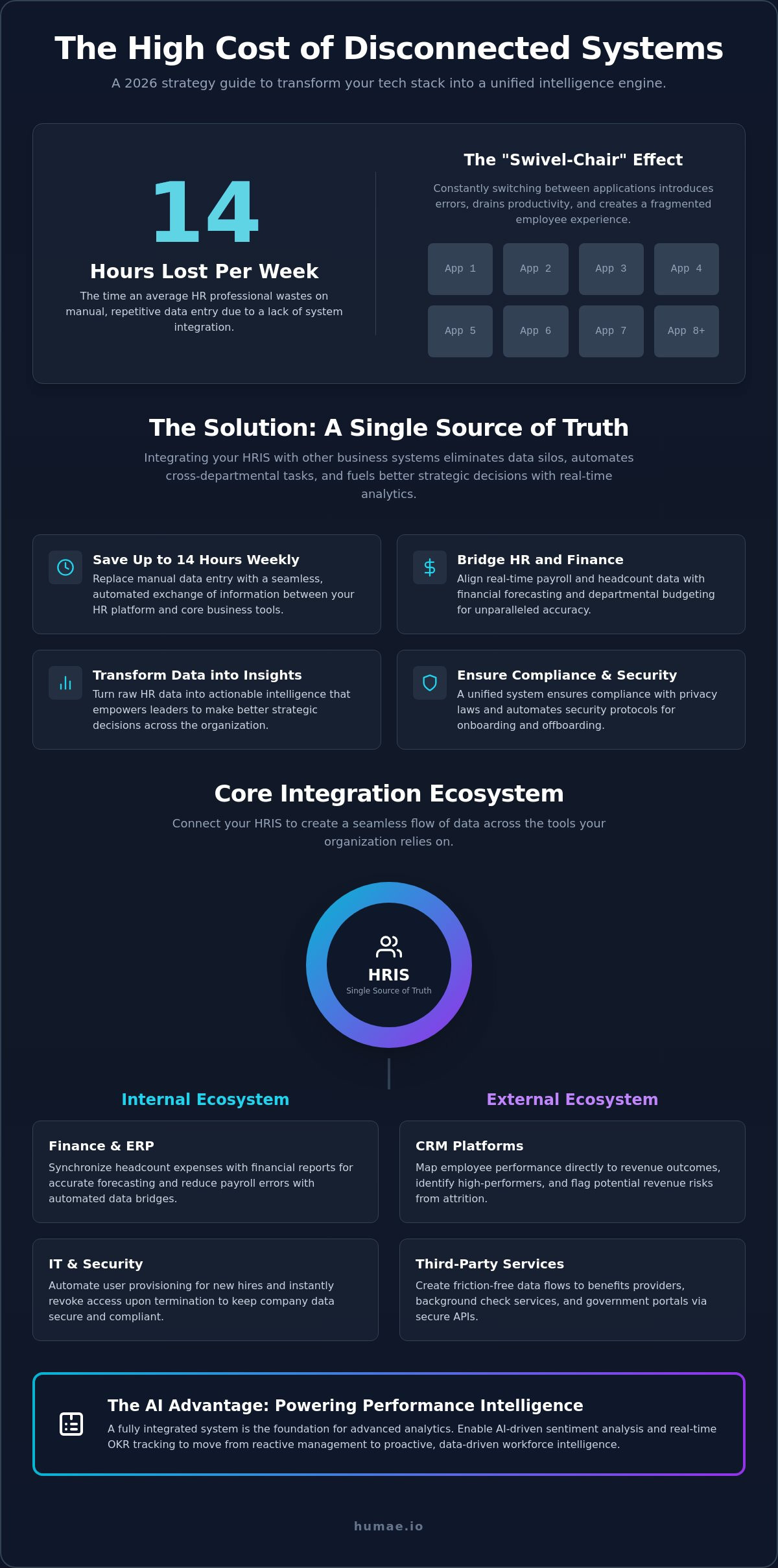
Did you know that the average HR professional still loses up to 14 hours every single week just on manual data entry? This is the high price of not integrating hris with other business systems, leaving your team trapped in spreadsheets instead of focusing on your people. You're likely all too familiar with the "swivel-chair" effect; that constant, exhausting cycle of jumping between six or eight different apps while hoping that a single typo in Finance doesn't break your entire directory.
The good news is that it doesn't have to be this way. We've designed this 2026 strategy guide to help you transform your tech stack from a fragmented database into a unified intelligence engine for your whole organization. We'll show you how to build a single source of truth that automates cross-departmental tasks and fuels better strategic decisions through real-time analytics. It's time to stop managing software and start leading your workforce with confidence.
Learn more about how Humae empowers modern teams. Connect with us on Facebook or return to the home page.
Key Takeaways
- Save up to 14 hours every week by replacing manual data entry with a seamless exchange between your HR platform and core business tools.
- Bridge the gap between HR and Finance by aligning payroll data with financial forecasting and departmental budgeting.
- Scale your organizational intelligence by integrating hris with other business systems to enable AI-driven sentiment analysis and real-time OKR tracking.
- Audit your tech stack to identify redundant data points and prioritize integrations to see a positive ROI within the first year.
- Transform your HR data into actionable insights that empower leaders to make better strategic decisions across the entire organization.
Breaking Down Silos: Why Your HRIS Must Connect to the Business
Integration is the heartbeat of a modern company. It's the seamless exchange of data between your people platform and every other tool in your stack. When you focus on integrating hris with other business systems, you stop being a data custodian and start being a strategic partner. This shift is vital because data silos don't just slow you down; they actively work against your growth by trapping valuable insights in isolated pockets.
The cost of staying in silos is staggering. Research indicates that HR professionals spend up to 14 hours every week on repetitive administrative tasks like manual data entry. This isn't just boring work. It's a massive drain on productivity that prevents your team from focusing on culture and high-impact talent strategy. Without a unified system, your data becomes a liability. A single source of truth is the only way to ensure compliance with new 2026 privacy laws in states like Indiana and Kentucky. Modern Human Resource Information Systems (HRIS) must serve as the anchor for all employee data to prevent costly errors and security gaps.
The Rise of the Connected Workforce
The average HR department has evolved rapidly. A few years ago, you might have managed three core apps. Today, that number often exceeds eight. This "app explosion" creates a disjointed employee experience that feels clunky and outdated. If a new hire has to enter their address four different times during onboarding, their first impression of your company is one of chaos. Real-time data is no longer a luxury. It's the standard for any agile organization that wants to keep its best talent and maintain a competitive edge.
Internal vs. External Integration Ecosystems
Think of your integration strategy in two layers. Your internal ecosystem connects HR with Finance and IT to align payroll with budgeting and automate hardware provisioning. This ensures that every department is working from the same numbers. Your external ecosystem links your platform to background check services, benefits providers, and government portals. APIs make this possible by creating a friction-free flow of information. Instead of manual uploads, data moves instantly and accurately. This transition from reactive management to proactive workforce intelligence is what separates market leaders from those struggling to keep up. By integrating hris with other business systems, you build a foundation for long-term success and a better experience for every employee.
Learn more about how Humae empowers modern teams. Connect with us on Facebook or return to the home page.
Core Systems to Integrate for Maximum Impact
Your HRIS shouldn't exist in a vacuum. To truly unlock its value, you need to connect it to the tools your teams use every day. Strategic leaders recognize that integrating hris with other business systems is the only way to get a 360-degree view of organizational health. When data flows freely between departments, you eliminate the guesswork that often plagues workforce planning. This isn't just about efficiency; it's about creating a cohesive environment where every piece of data serves a purpose.
HRIS and ERP Integration
ERP integration is the bridge between people costs and business profit. By synchronizing headcount expenses with real-time financial reporting, you give your CFO the clarity they need for accurate forecasting. This connection reduces payroll errors by creating automated data bridges that ensure salaries and bonuses align perfectly with your budget. When your finance team sees live staffing costs, they can adjust budgets on the fly, making your entire company more resilient to market shifts. It's the difference between looking at a snapshot from last month and seeing a live feed of your biggest investment: your people.
Connecting your HR platform to your CRM allows you to map employee performance directly to revenue outcomes. You can see which sales reps are hitting their targets and use that data for smarter territory planning. If a high-performer is leaving, the system can flag the revenue risk immediately. Meanwhile, integrating with IT and Security tools automates the heavy lifting of provisioning. When a new hire starts, their accounts are ready before they even sit down. When someone leaves, access is revoked across all systems instantly, keeping your company data safe and compliant with the latest security standards. This automation removes the stress of offboarding and ensures no digital loose ends are left behind.
Productivity and Communication Sync
Communication is where your culture lives. By syncing your employee directory with tools like Slack or Microsoft Teams, you can power live organizational charts and automate team celebrations. Imagine birthday announcements or time-off alerts appearing automatically in the right channels. This level of transparency builds trust and keeps everyone on the same page without extra administrative effort. Integrated project management tools also benefit, as they can pull current team structures to assign tasks more logically based on actual availability and skill sets.
A well-connected ecosystem doesn't just save time; it creates a more human experience for your staff. It removes the friction of "app-hopping" and lets employees focus on meaningful work. If you're ready to see how a unified platform can streamline your operations, exploring the core features of an integrated HRMS is a great place to start.
Learn more about how Humae empowers modern teams. Connect with us on Facebook or return to the home page.
The AI Advantage: Powering Performance Intelligence Through Integration
Moving data is just the beginning. The real transformation happens when that connectivity fuels artificial intelligence. When you're integrating hris with other business systems, you aren't just building pipes; you're building a brain for your organization. Modern AI assistants can now analyze the sentiment behind employee feedback and communication patterns to give you a real-time pulse on your culture. This isn't science fiction. It's how visionary leaders in 2026 identify burnout risks before they turn into resignation letters.
Static annual reviews are a relic of the past. They're too slow for the pace of modern business. AI-powered performance intelligence uses integrated data to provide continuous feedback loops that actually matter. By looking at how a team interacts across multiple platforms, the system can flag when a high performer's output drops or when a manager needs extra support. This proactive approach saves your best talent from slipping through the cracks while fostering a culture of genuine care and growth.
Unified Performance Analytics
Stop guessing about what makes your teams successful. An integrated analytics dashboard pulls productivity metrics from your CRM and combines them with engagement scores from your HRIS. AI then identifies patterns that a human eye might miss. You'll see exactly how specific training modules impact sales or how project loads correlate with employee happiness. It's data-backed leadership that replaces gut feelings with clear, actionable insights.
Real-Time OKR Alignment
Manual goal updates are exhausting and often inaccurate. By connecting your okr tracking directly to your departmental project tools, your Key Results update themselves. Every team member sees their daily impact on the big picture instantly. This level of transparency requires a solid workforce management infrastructure to scale. When everyone is aligned through integrating hris with other business systems, the entire organization moves faster and with much greater purpose.
Learn more about how Humae empowers modern teams. Connect with us on Facebook or return to the home page.
Best Practices for a Seamless Integration Strategy
Success in integrating hris with other business systems depends on a clear roadmap. You can't just flip a switch and expect magic. Start by auditing your current tech stack. Most organizations manage between six and eight different HR applications, many of which likely share redundant data. Identifying these overlaps is the only way to prevent your integration from becoming a tangled web of conflicting information. Once you've mapped your tools, prioritize based on administrative time savings. If your HR team is losing 14 hours a week to manual entry, that's your first problem to solve. Companies that connect three or more systems typically see a positive return on investment within the first twelve months.
Testing is non-negotiable. Never push a new data flow live without a thorough run in a sandbox environment. You need to see how data behaves when it moves between platforms to catch errors before they affect your payroll or employee directory. Security must be baked in from day one. With 20 US states now having comprehensive privacy laws in effect as of 2026, including Indiana and Kentucky, your integration must be airtight. Ensure every platform in your ecosystem is SOC2 or GDPR compliant. Remember, under GDPR, you only have 72 hours to notify authorities of a data breach. Your integrated systems should make this reporting easier, not harder.
Data Governance and Security
You must define a single system of record for every data point. If both your HRIS and your Finance tool can update an employee's salary, you'll eventually hit a synchronization loop that creates chaos. Data governance is the foundation of trust in any integrated system. Use secure API authentication and end-to-end encryption to protect sensitive personhood data. This clarity ensures that everyone knows which system holds the "truth" at any given moment.
Managing the Change
Technology is only half the battle. The other half is people. Train your HR and IT teams on the new automated workflows so they understand how their roles have shifted from manual entry to strategic oversight. Communicate the benefits clearly to your whole staff. When they see that their time-off requests or profile updates flow instantly across the company, they'll embrace the new system. Post-launch, keep a close eye on integration health and data accuracy to ensure the engine stays running smoothly.
Ready to build a unified tech stack? Discover how Humae simplifies the integration process for growing organizations.
Learn more about how Humae empowers modern teams. Connect with us on Facebook or return to the home page.
Scaling with Humae: The Integrated Infrastructure for Modern Teams
Growth shouldn't feel like a constant battle against your own tools. For many leaders, scaling a business means adding more layers of complexity and more disconnected apps. Humae changes this narrative by providing a centralized infrastructure that handles everything from hiring and onboarding to long-term management. By integrating hris with other business systems, we ensure that your data doesn't just sit in a silo; it works for you. Our platform acts as the central nervous system of your organization, ensuring that every new hire, every promotion, and every organizational shift is reflected everywhere instantly.
Startups and enterprises alike choose Humae because we prioritize the human experience. We know that behind every data point is a real person contributing to your success. Our single, intuitive interface removes the cognitive load of "app-hopping" and lets your HR team focus on culture rather than coordination. When you have a unified view of your workforce, you can spot trends and address challenges before they impact your bottom line. It's about moving away from fragmented tools and toward a cohesive ecosystem that supports your team at every stage of their journey.
Centralized People Operations
Managing your employee directory and time-off requests shouldn't require three different logins. Humae brings these essential functions into one place, significantly reducing your reliance on third-party plugins. By leveraging our core features, you can streamline your operations and ensure high data integrity across the board. Our workforce management tools are designed to simplify even the most complex setups, making integrating hris with other business systems a natural part of your workflow rather than a technical hurdle.
Future-Proofing Your HR Tech
The business landscape of 2026 demands agility. Disconnected data creates friction that slows down decision-making and hurts employee morale. Humae helps you scale without these roadblocks by providing a foundation built for the modern world. We incorporate AI-powered intelligence to turn your integrated data into actionable insights, such as identifying sentiment patterns or predicting future staffing needs. This proactive approach allows you to build a resilient, high-performing culture that attracts and keeps top talent. Experience the difference of a platform that understands how modern teams actually work.
Humae is your partner in building a better workplace. Visit our official website to explore our full suite of tools or return to the home page. Stay connected with our community on Facebook for the latest updates in HR innovation.
Building the Workforce of the Future Today
The era of isolated data is over. Success in 2026 requires more than just storing employee information; it demands a unified intelligence layer that connects your people directly to your business goals. By integrating hris with other business systems, you transform HR from a back-office function into a strategic engine that fuels growth. You've seen how a centralized infrastructure simplifies hiring and onboarding while AI-driven sentiment analysis provides the real-time feedback needed to prevent burnout before it starts.
The transition from reactive management to proactive leadership starts with the right tools. With actionable analytics dashboards at your fingertips, you're finally equipped to make data-backed decisions that actually move the needle. Don't let your team get bogged down by manual entry and fragmented apps. It's time to embrace a tech stack that works as hard as your people do. The future of work is connected, and your organization is ready to lead the way.
Streamline your workforce management with Humae's AI-powered platform today. We're here to help you build a culture of lasting success and innovation.
Discover how Humae empowers modern teams at our official website or return to the home page. Join our community on Facebook for more insights on the future of HR technology.
Frequently Asked Questions
What is the difference between an HRIS and an HRMS in terms of integration?
An HRMS typically includes more advanced talent management and performance tools, while an HRIS focuses on core employee data and benefits. In terms of integration, both rely on APIs to share information, but an HRMS integration often requires more complex mapping for performance metrics and OKRs. Most modern organizations in 2026 use these terms interchangeably as platforms evolve to offer all-in-one capabilities.
How do I ensure my data stays secure when integrating multiple business systems?
Security is maintained by using end-to-end encryption and secure API authentication for every connection you build. It's essential to verify that all connected platforms maintain SOC2 Type II certification to protect sensitive employee records. Regular audits of your access logs will help you monitor exactly how data moves between your tools and identify any unauthorized attempts to access information.
Can I integrate my HRIS with a custom-built internal software?
Yes, you can connect your HR platform to proprietary tools using open APIs or webhooks provided by your software vendor. Most modern systems offer comprehensive developer documentation that allows your IT team to build tailored bridges for unique business needs. This ensures that even niche internal software can benefit from the same automated data flow as your standard commercial apps.
What are the most common challenges when connecting HR software to an ERP?
The most frequent hurdles are mismatched data fields and conflicting update schedules between the two platforms. Integrating hris with other business systems like an ERP requires a rigid mapping strategy to ensure that an "employee ID" in one system perfectly aligns with the "user record" in the other. Without this alignment, you risk creating duplicate entries or synchronization loops that corrupt your financial reporting.
How much technical expertise is required to manage HRIS integrations?
Modern HR platforms are designed with "no-code" or "low-code" interfaces that allow HR professionals to set up basic triggers without deep technical knowledge. However, involving your IT department remains a best practice for managing advanced security protocols and complex data mapping. This partnership ensures that your integrations are both user-friendly for HR and technically sound for the organization.
Does integrating my HRIS help with GDPR or SOC2 compliance?
Integration strengthens your compliance posture by automating data retention schedules and providing a clear audit trail across your entire tech stack. For instance, having a single source of truth makes it much easier to fulfill GDPR "right to be forgotten" requests across all connected apps instantly. It eliminates the risk of sensitive data remaining in a forgotten silo after a request is processed.
What is a 'system of record' and why is it important for integration?
A system of record is the single, authoritative source for a specific data point, such as an employee's salary or legal name. Defining this prevents "data wars" where two different systems attempt to update the same field with conflicting values. In a healthy ecosystem, your HRIS usually serves as the system of record for all personhood data to ensure consistency everywhere.
How often should data be synchronized between business systems?
Real-time synchronization is the standard for 2026 to ensure that every department operates with the most current information. While some legacy tools still use daily batch updates, integrating hris with other business systems through real-time triggers prevents errors during critical events like onboarding or offboarding. This immediate flow is vital for maintaining security and an accurate, live employee directory.
Learn more about how Humae empowers modern teams. Visit our official website or return to the home page. Connect with us on Facebook for more tips on HR technology.