Human Capital Management: The 2026 Guide to People-First Growth
By Humae · 10 April 2026
human capital management
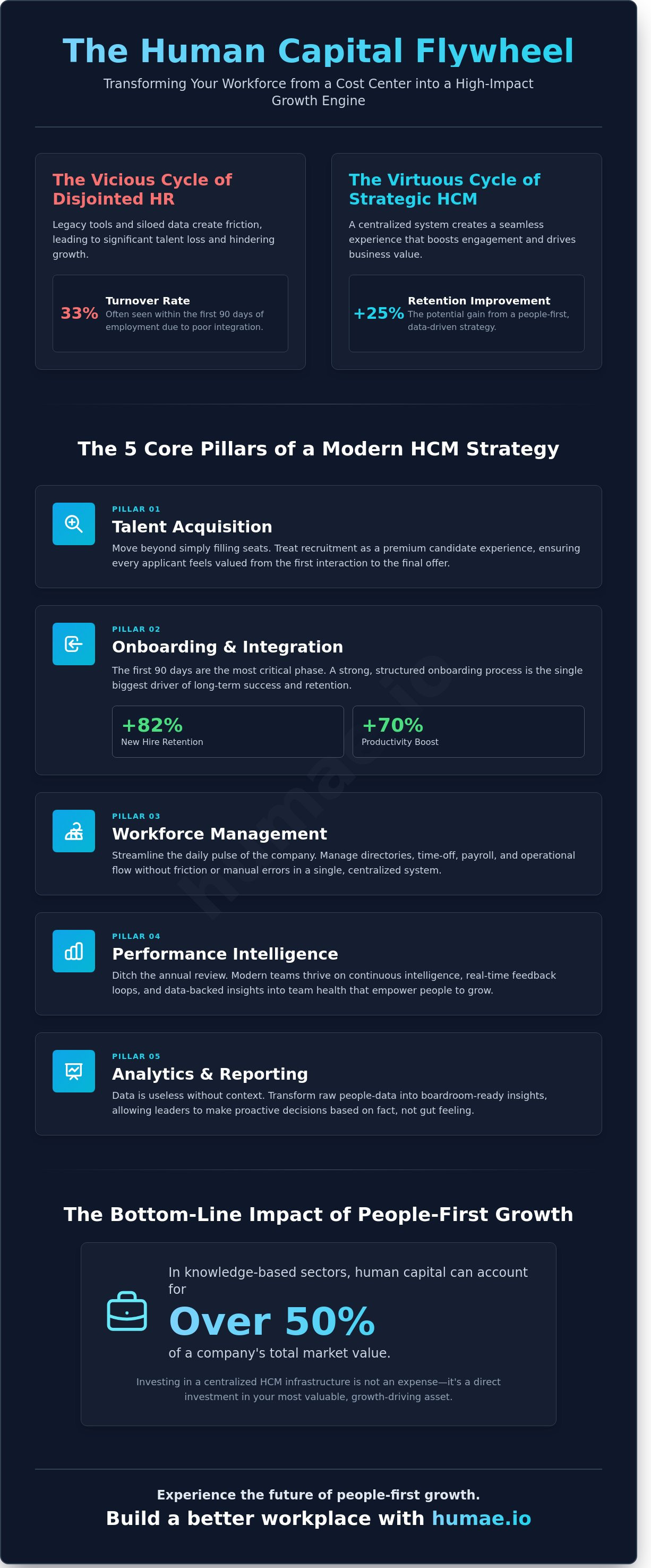
Your workforce isn't a cost to be managed; it's the only engine capable of driving 10x growth in a competitive market. You likely feel the daily friction of disjointed data across multiple legacy tools, which contributes to the 33% turnover rate often seen during the first 90 days of employment. It's frustrating when you lack real-time visibility into team performance while trying to scale. Modern human capital management isn't about filling seats anymore. It's about building an ecosystem where people and technology thrive together.
We'll show you how to master a strategic framework that transforms your HR department into a powerhouse of innovation. You'll learn to build a centralized source of truth for all employee data and create scalable onboarding processes that actually stick. This guide provides the actionable intelligence needed to improve retention by 25% before the 2026 fiscal year begins. It's time to stop guessing and start growing with a people-first mindset that prioritizes long-term success over short-term fixes.
Experience the future of people-first growth at Humae. Stay connected with our community on Facebook.
Key Takeaways
- Learn to evolve from transactional HR to strategic human capital management, transforming your workforce from a cost center into a high-impact engine for innovation.
- Discover how to treat recruitment as a premium experience and why the first 90 days are the most critical phase for long-term employee integration and success.
- Master the balance of technology and empathy by using Performance Intelligence to gain data-backed insights into team health without losing the human touch.
- Quantify the direct impact of employee engagement on your bottom line and implement proven strategies to mitigate the high financial costs of turnover.
- Identify how to choose a centralized infrastructure to streamline your workforce management and build a scalable foundation for people-first growth.
Build a better workplace with Humae. Connect with us on Facebook.
What is Human Capital Management (HCM)? More Than Just HR
HCM isn't just a fancy name for the personnel department. It's the strategic practice of optimizing every ounce of value your workforce brings to the table. While traditional HR often gets bogged down in administrative paperwork, human capital management focuses on the long game. It treats your team as a primary driver of business growth rather than a line item on a balance sheet. It's the difference between merely managing a workforce and actively cultivating a powerhouse of talent.
The core of this shift lies in the concept of human capital. This economic theory views employee skills, knowledge, and experience as intangible assets. In the modern market, these assets are more valuable than physical machinery or office space. Data from 2024 shows that human capital can account for over 50% of a company's total value in knowledge-based sectors. You aren't just managing costs; you're investing in potential. By 2026, HCM will function as a centralized workforce infrastructure. It's the digital nervous system that connects recruitment, development, and retention into one seamless, high-performance experience.
The Evolution of People Operations
The journey from dusty, paper-based personnel files to agile, cloud-based systems happened fast. In the late 20th century, HR was reactive and transactional. Today, the knowledge economy demands a proactive stance. Success now depends on how quickly you can identify and nurture talent in a competitive landscape. This shift is why modern companies are moving toward a more holistic view of What is Human Resources? and how it shapes the future of work. We've moved from "managing people" to "empowering talent."
HCM vs. HRIS vs. HRMS: Clearing the Confusion
The industry loves acronyms, but the differences are functional. An HRIS (Human Resources Information System) is your data foundation; it's where you store employee facts and figures. An HRMS (Human Resources Management System) builds on that foundation by adding functional tools like payroll and time tracking. Human capital management is the umbrella that covers it all. It includes the software infrastructure of an HRIS and HRMS but adds the strategic layer: talent acquisition, workforce planning, and candidate experience.
A premium candidate experience begins with your digital storefront. Many businesses leverage a web design agency UK to ensure their careers pages and corporate identity are polished and effective for talent acquisition.
Discover how we're redefining the recruitment experience at Humae.
Stay connected with our community on Facebook.
The 5 Core Pillars of a Modern HCM Strategy
Modern human capital management requires more than just a spreadsheet; it demands a holistic strategy built on five foundational pillars. These pillars transform HR from a back-office function into a growth engine. By focusing on the entire lifecycle of a team member, companies can build a culture that attracts and keeps top talent.
To build a high-performing culture, many organizations look toward the Human Capital Framework, which provides a standardized approach to planning, talent management, and performance culture. This structured approach ensures that every HR initiative aligns with broader business goals.
Streamlining the Candidate and Employee Journey
An integrated Applicant Tracking System (ATS) can reduce time-to-hire by 30% in 2024, giving your team a competitive edge in a fast-paced market. Once hired, the focus shifts to connection. A centralized employee directory is essential for remote and hybrid teams. "A modern directory is the digital nervous system of your organization, not just a contact list." It's where culture starts and silos end.
Operational Excellence: Time-Off and Absence Management
Automated time-off management isn't just a convenience; it's essential for compliance and morale. When employees can request leave in two clicks, trust grows. Transparency in absence management ensures everyone knows who's available, preventing burnout and scheduling conflicts. Humae simplifies these administrative tasks, freeing up leadership time to focus on people, not paperwork. If you're ready to see how these pillars work in practice, you can explore our process to see the difference automation makes.
Beyond Administrative Tasks: The Rise of Performance Intelligence
Many leaders fear that bringing AI into HR makes the workplace feel robotic or cold. The reality is the exact opposite. When modern human capital management systems handle the data heavy lifting, managers gain the emotional bandwidth to lead with genuine empathy. Performance Intelligence represents this shift. It uses data to understand team health and productivity, moving beyond simple attendance logs to focus on human potential. Instead of micromanagement, this technology offers a roadmap for development. It identifies skill gaps and suggests training before a lack of knowledge causes frustration for the employee.
We've moved past the era of tracking employees like inventory. Modern organizations focus on empowering them. Industry research indicates that 73% of executives realize that human performance is the key to organizational resilience. Performance Intelligence provides the visibility needed to support people before they hit a wall. This support increasingly incorporates holistic wellness; for instance, exploring the ancient traditions and grounding tools offered by Tribu Spirit can help teams maintain mental clarity amidst high-tech demands. It transforms HR from a back-office function into a strategic engine for growth. This data-driven empathy allows managers to ask the right questions during one-on-ones, focusing on support rather than interrogation.
Real-Time OKR Tracking and Goal Alignment
Objectives and Key Results (OKRs) bridge the gap between a CEO’s vision and a developer’s daily tasks. Static spreadsheets often fail because they aren't updated regularly. Real-time tracking ensures everyone stays aligned as priorities shift throughout the quarter. This transparency builds trust. Employees feel more engaged when they see exactly how their contributions move the needle. You can explore the OKR meaning in our definitive guide to see how this framework scales with your growth. It's about connecting individual purpose to the collective mission.
AI-Driven Sentiment Analysis and Feedback Loops
Employee turnover often stems from issues that were visible months in advance. AI-driven sentiment analysis identifies signs of burnout or disengagement by analyzing feedback patterns and communication pulses. This proactive approach allows leaders to intervene early. It effectively replaces the annual review, a process that 90% of HR professionals find inaccurate and outdated. Humae’s approach centers on actionable analytics dashboards. These tools provide a clear pulse on the organization, ensuring feedback is a continuous conversation rather than a once-a-year surprise. By turning human capital management into a listening exercise, companies build cultures where people actually want to stay.
Humae - Professional, innovative, and human-centered recruitment solutions.
Navigate back to our Home Page
Connect with us on Facebook
Why Strategic HCM Matters: Driving Productivity and Retention
Retention isn't a matter of luck; it's a calculated financial outcome. When a high-performing employee leaves, the cost to replace them ranges from 50% to 200% of their annual salary based on 2023 SHRM data. This figure includes recruitment fees, onboarding time, and the inevitable dip in team productivity. Strategic human capital management acts as a preventative shield against this drain. By treating people as assets to be developed rather than costs to be managed, businesses stop reacting to resignations and start building loyalty.
The ROI of an Engaged Workforce
Engagement thrives on clarity. People stay when they see a future for themselves within your walls. By implementing Employee Engagement Strategies, companies replace ambiguity with transparent goals. Clear career paths and merit-based rewards drive intrinsic motivation far better than a ping-pong table ever could. A robust HCM infrastructure ensures that every milestone is recorded, making long-term retention a natural byproduct of a supportive environment.
Building a Data-Driven Culture
Modern management is moving away from "gut feelings" and toward evidence-based decisions. Real-time dashboards allow managers to spot trends in performance or sentiment in weeks, not years. This data leads to fairer compensation cycles and promotion paths, as decisions are based on objective metrics rather than who speaks loudest in meetings. In 2026, the best leaders don’t just manage people; they curate the environment where people manage themselves.
About Humae
Humae represents the intersection of cutting-edge technology and human-centric HR. We don't just provide tools; we offer a vision for a modern workplace where recruitment is an experience and every candidate journey matters. Our approach is professional, innovative, and designed for businesses that value growth through empathy and automation.
Building Your Infrastructure: Choosing the Right HCM Platform
The Future of HCM in 2026 and Beyond
Humae - Modern HR for Human-Centric Teams
Experience a better way to manage your most valuable assets. Humae combines innovative technology with a deep understanding of the human element in business.
Master Your People-First Growth Strategy
Discover how Humae transforms your workforce management infrastructure to build a resilient, future-ready team.
Stay connected with our community. Return to our home page or follow our latest updates on Facebook. We're excited to help you build the future of work.
Frequently Asked Questions
What is the difference between HCM and HRM?
HRM manages administrative processes, while human capital management treats employees as strategic assets to drive ROI. HRM handles the "how" of personnel management. HCM focuses on the value and future potential of the workforce. A 2023 Gartner report shows that 60% of HR leaders now prioritize strategic HCM over traditional admin tasks. It's about shifting from paperwork to people-centric growth strategies that actually move the needle for your business.
Does a small startup really need an HCM system?
Startups need HCM systems to build a scalable foundation from day one. Data from 2024 indicates that companies with integrated systems reduce manual data entry by 40%. Waiting until you have 50 employees creates fragmented data silos that are hard to fix later. Implementing a platform early ensures your recruitment and onboarding processes remain consistent as you double your headcount. It turns growth from a chaotic hurdle into a streamlined, professional process.
Can HCM software help with employee retention?
How does AI improve human capital management?
AI improves human capital management by automating complex data analysis and providing predictive insights. For example, the semantic algorithms developed by Ubestream Inc. enable HR platforms to perform sophisticated sentiment analysis, identifying potential morale issues before they lead to turnover. This allows leadership to maintain a high-touch, human-centric approach while benefiting from data-driven technology.
What are the most important features of an HCM platform in 2026?
By 2026, the most critical features include hyper-personalized AI assistants and real-time sentiment tracking. Systems must offer seamless mobile experiences for deskless workers, who make up 80% of the global workforce. Integration with collaborative tools like Slack or Teams is mandatory for modern workflows. You'll need platforms that don't just store data but provide actionable insights within 3 seconds of a query. Efficiency and user experience are the new global benchmarks for success.
Is human capital management the same as payroll?
Payroll is a single functional module within the broader human capital management ecosystem. While payroll handles the mechanics of compensation, HCM covers the entire employee lifecycle from hire to retire. According to 2024 industry standards, payroll accounts for roughly 15% of total HCM functionality. The rest includes talent acquisition, performance management, and workforce planning. Don't confuse a payment tool with a comprehensive people strategy that drives your company culture and long-term growth.
How do OKRs fit into an HCM strategy?
OKRs (Objectives and Key Results) provide the framework for performance tracking within a modern HCM strategy. They bridge the gap between high-level company goals and daily employee tasks. Research shows that 70% of high-performing teams use OKRs to maintain focus and alignment. By integrating these into your HCM platform, you ensure every team member understands their impact. This transparency builds a culture of accountability and shared success that benefits everyone in the organization.
What is sentiment analysis in the context of HR?
Sentiment analysis uses natural language processing to gauge the emotional tone of employee feedback. It identifies if team members are frustrated, happy, or burnt out by analyzing survey comments or internal communication. In 2023, 45% of large enterprises adopted these tools to monitor cultural health in real-time. It's a way to listen at scale. You get a pulse on the office atmosphere without reading thousands of individual emails, allowing for faster managerial responses.
Learn more about modern HR solutions at Humae Home.
Connect with us on Facebook.