HR Analytics to Predict Employee Turnover: The 2026 Predictive Retention Guide
By Humae · 22 June 2026
hr analytics to predict employee turnover
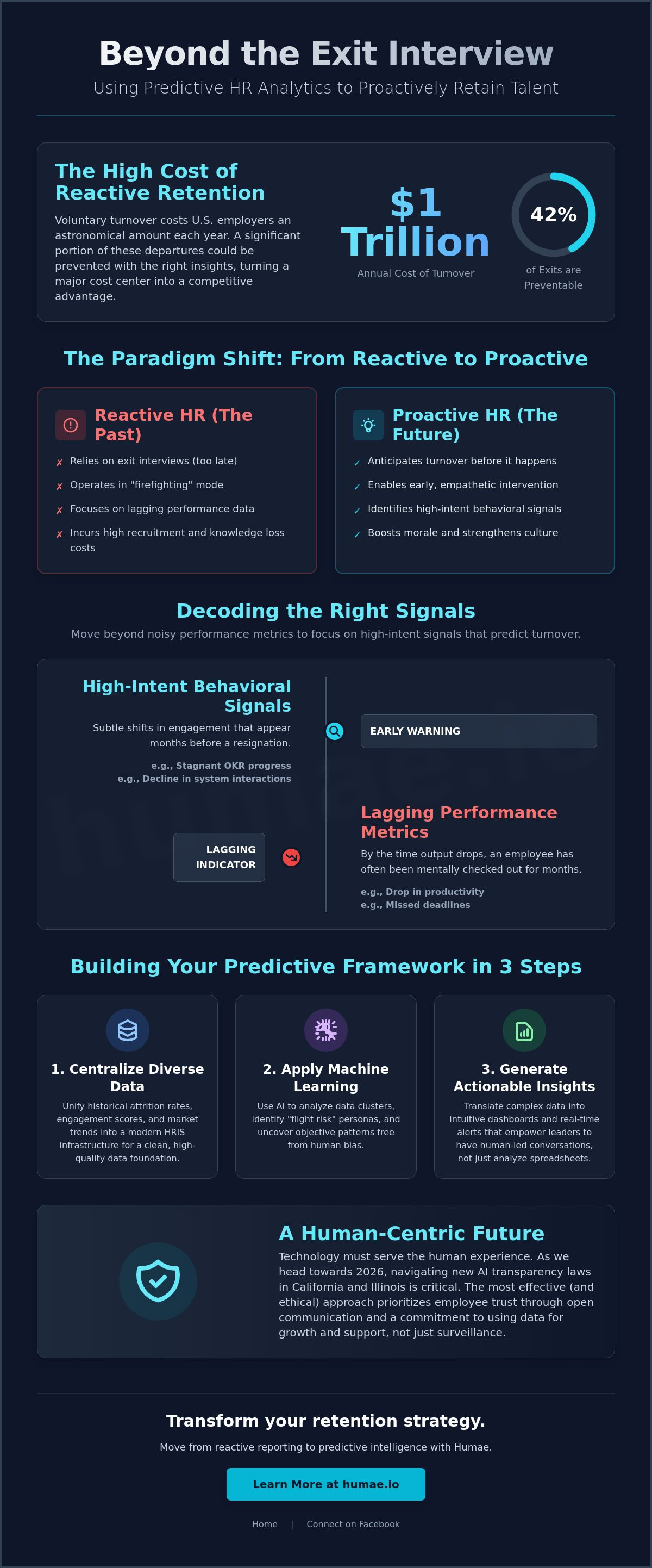
Voluntary turnover costs U.S. employers over $1 trillion annually, yet nearly 42% of those exits are entirely preventable. You likely feel the sting of losing a key player just as a project peaks, realizing too late that the signals were there all along. It's frustrating to sit on mountains of siloed data while your retention strategy remains reactive and expensive.
We believe technology should serve the human experience, not just track it. This guide empowers you to master hr analytics to predict employee turnover by identifying the subtle AI signals that precede a resignation. You'll learn to navigate the 2026 regulatory landscape, including new AI transparency laws in California and Illinois, while building a data-driven framework that protects your culture. We're moving past what happened to what's next, helping you lower recruitment costs and boost team morale through proactive, empathetic leadership.
Key Takeaways
- Transition from reactive "what happened" reporting to predictive intelligence that anticipates turnover before it disrupts your team.
- Identify why performance dips are often lagging indicators and how to focus on high-intent behavioral signals instead.
- Build a scalable framework for hr analytics to predict employee turnover by centralizing your data into a modern HRIS infrastructure.
- Navigate 2026 privacy regulations by adopting a human-centric approach that prioritizes transparency and employee trust.
- Leverage real-time intelligence to transform fragmented data into a healthier, more engaged organizational culture.
What is Predictive HR Analytics for Turnover?
Predictive HR analytics is no longer a luxury for elite tech firms; it's the standard for any organization that values its people. By combining historical workforce data with artificial intelligence, companies can now identify specific patterns that precede a resignation. This evolution marks a critical shift from descriptive analytics, which simply reports on how many people left last quarter, to predictive intelligence. We're now looking at what will happen next month. In 2026, relying on annual exit interviews is a strategy for the past. By the time an employee shares their feedback in an exit survey, the talent, the knowledge, and the replacement costs are already gone.
Effective hr analytics to predict employee turnover requires a foundation of high-quality data. This is where modern Workforce Management becomes essential. Without a clean, centralized data source, your AI models will struggle with noise rather than actionable insights. You need a system that captures every touchpoint, from performance milestones to sentiment shifts, in real time. This allows leaders to act while there's still time to make a difference. Predictive HR analytics leverages the broader science of predictive analytics to forecast future talent movements with startling accuracy.
The Reactive vs. Proactive HR Paradigm
Waiting for a two-week notice is an expensive failure. It forces HR into a firefighting mode, where recruitment costs skyrocket and team stability wavers. Proactive retention changes the narrative. By using predictive models, you gain a window for early intervention. This isn't about stopping someone from leaving at all costs. Instead, it's about providing the right support or career pathing before they feel the need to look elsewhere. It strengthens your employer brand and proves you're a partner in their growth, not just an employer. Using hr analytics to predict employee turnover gives you the foresight to turn a potential exit into a conversation about professional development.
Core Components of a Predictive Model
Building a reliable model involves three main layers. First, you need diverse data inputs. This includes historical attrition rates, engagement scores, and even external market trends like local salary fluctuations. Second, the engine uses machine learning to identify flight risk personas. These tools look for clusters of behavior rather than single events, ensuring the analysis remains objective and free from human bias. Finally, the output must be actionable. HR teams shouldn't have to dig through spreadsheets. They need intuitive dashboards that flag high-risk segments immediately, allowing for human-led conversations that resolve issues before they escalate.
Decoding the Signals: Behavioral vs. Performance Data
Data doesn't always speak clearly. In the hunt for actionable insights, many HR teams get lost in "noisy" data that lacks intent. A temporary dip in productivity might just be a tough week, but a consistent decline in engagement with company systems is a different story. To master hr analytics to predict employee turnover, you have to look beyond the surface. Performance metrics are often lagging indicators; they tell you someone is already disengaged, but they rarely tell you why or when it started. By the time a top performer's output drops, they've often been mentally checked out for months.
High-intent signals are usually found in how an employee interacts with their growth path. There's a direct correlation between stagnant OKR progress and long-term commitment. When an individual stops caring about their objectives or fails to update their key results, they've likely already started looking for their next role. Tracking these shifts in real time allows for a "stay interview" before the resignation letter arrives. You might even find it helpful to explore how performance intelligence tools can automate these alerts for your leadership team.
Performance Intelligence as a Predictor
Productivity alone is a deceptive metric. Some of your highest performers might actually be at the highest risk of leaving due to the "Burnout Pattern." This occurs when high output is coupled with declining sentiment scores or a withdrawal from social recognition. If an employee is hitting every target but their communication frequency has plummeted, they're likely exhausted. Bridging the gap between performance management and retention analytics helps you spot these anomalies before the burnout becomes permanent. Stagnant goal progress signals disengagement long before it shows up in the final quarterly output.
The Power of AI-Driven Sentiment Analysis
Sentiment analysis is the fastest way to capture the emotional pulse of your workforce, especially in remote environments. Modern AI can now decode the tone of continuous feedback and peer recognition without invading individual privacy. It identifies "Cultural Friction" points by aggregating team-wide data. If a specific department shows a sudden spike in negative sentiment, it's a clear signal of management or process issues. Passive signals like erratic PTO usage or a lack of participation in non-mandatory meetings provide the context needed to predict turnover with high accuracy. In remote teams, where face-to-face cues are missing, this emotional data is your most valuable early warning system.
Tracking these behavioral signals isn't about surveillance; it's about empathy at scale. It's about understanding that every data point represents a human experience that needs attention. When you connect performance data with behavioral intent, your retention strategy becomes a tool for building a healthier culture.
The Ethics of Attrition Prediction: A Human-Centric Approach
Data is a powerful tool, but it's also a sensitive one. When employees hear that AI is analyzing their behavior, the immediate reaction is often fear. This "Big Brother" perception can quickly erode the very culture you're trying to save. Using hr analytics to predict employee turnover shouldn't feel like surveillance. It's about creating a partnership where data serves the individual as much as the organization. If people feel like they're being watched rather than supported, they'll simply find somewhere else to work.
Transparency is your best defense against this narrative. Don't hide your use of analytics. Instead, explain how this data helps you improve the daily work life of every team member. Maybe it's identifying burnout before it becomes a health issue or uncovering hidden obstacles in a specific workflow. When you communicate the "why" behind the math, you turn a technical process into a cultural asset. People don't mind data usage when they see a direct benefit to their own well-being and career growth.
2026 marks a turning point for HR technology. With comprehensive privacy laws now in effect across 20 U.S. states, including California and Illinois, algorithmic fairness is a legal necessity. Your models must be audited to ensure they aren't inadvertently flagging specific demographics based on biased historical data. Avoiding the "Labeling Trap" is critical. A high-risk tag on a profile should never be a reason for scrutiny or exclusion from key projects. It's a signal for support. It's an invitation for a leader to check in, not to check up.
Building Trust Through Data Transparency
Establishing clear data usage policies is your first step toward trust. Employees need to know exactly what's being tracked and how their individual anonymity is protected. Use analytics to improve the employee experience, not just the company's bottom line. Human-in-the-loop decision making is vital here. A machine should never make the final call on a person's career path. The AI provides the signal, but the human leader provides the context and the empathy needed for a fair outcome.
From Prediction to Intervention
Managers need specific training to handle "Risk Alerts" with care. These notifications aren't performance reviews. They're opportunities for empathetic conversations aimed at understanding the human story behind the data points. Data should never be the sole reason for a management action. Instead, use it as a prompt to create a safe space where employees feel comfortable sharing their honest feedback. When your team knows that a "flight risk" label results in more support rather than less, you've built a truly human-centric organization.
How to Implement a Turnover Prediction Roadmap
Moving from reactive reporting to predictive intelligence requires a structured roadmap. It's not enough to simply buy software; you need a strategy that connects your data to your people. A successful implementation of hr analytics to predict employee turnover begins with visibility and ends with empathetic action. By following a clear, five-step process, you can transform fragmented data into a shield for your organizational culture.
- Step 1: Centralize your workforce data into a single HRIS infrastructure. Prediction is impossible if your performance scores are in one tool and your time-off data is in another.
- Step 2: Identify your key attrition drivers through historical data analysis. Look for patterns in past resignations to see if tenure, manager changes, or stagnant compensation were the primary triggers.
- Step 3: Deploy AI sentiment tools to capture real-time engagement. This provides the "live" pulse that historical data lacks, allowing you to spot shifts as they happen.
- Step 4: Create an intervention playbook for managers. Data is useless if leaders don't know what to do when an alert appears.
- Step 5: Measure the ROI of your efforts. Track the reduction in unplanned exits. Given that replacing an employee costs between 0.5 and 2 times their annual salary, even a small improvement in retention delivers massive financial returns.
Audit Your Existing Data Ecosystem
Before you can predict the future, you must understand the present. Most organizations suffer from data silos where payroll, performance intelligence, and engagement tools don't talk to each other. This fragmentation creates blind spots that lead to missed signals. You need clean, historical data to train your AI models effectively. Focus on selecting high-impact metrics like the annualized attrition rate, average tenure, and "time since last promotion." These points provide the baseline needed for hr analytics to predict employee turnover with precision. Ready to unify your data? Explore how Humae centralizes your workforce intelligence.
Creating the Intervention Playbook
A prediction without a plan is just a warning. Your roadmap must include an intervention playbook that defines "at-risk" thresholds. These triggers should prompt specific, human-led actions. Personalizing retention is key. Instead of a generic bonus, a manager might initiate a stay interview or offer a clear career pathing session. Closing the loop is equally important. You must update your models based on which interventions actually worked. This continuous learning cycle ensures your retention strategy evolves as fast as your workforce does, keeping your culture healthy and your talent secure.
Humae: AI-Powered Intelligence for Modern Teams
Data silos are the enemy of retention. Humae solves this by bringing performance, sentiment, and OKR data into one intuitive interface. This isn't just about storage; it's about context. When you can see a drop in OKR progress alongside a shift in sentiment, you aren't just guessing anymore. You're using hr analytics to predict employee turnover with high-fidelity insights. It's the difference between a cold spreadsheet and a living map of your organization's health. We've built a system where data actually tells a story, allowing you to see the humans behind the numbers.
Our platform is designed for leaders who want to move fast without losing the human touch. The intelligence we provide feels supportive, not robotic. By automating the retention roadmap with actionable analytics dashboards, we free HR teams from manual data crunching. This allows you to focus on the human conversations that actually save talent. Whether you're a scaling startup or a global enterprise, Humae provides the infrastructure needed for sustainable, data-driven growth. We believe that when technology handles the complexity, humans can handle the empathy.
Performance Intelligence Meets Sentiment
Humae's AI-driven sentiment analysis creates a continuous feedback loop that traditional annual surveys simply can't match. We don't just track what people do; we help you understand how they feel about their work in real time. Our performance tracking tools feed directly into turnover prediction models, identifying the "Burnout Pattern" before it leads to a resignation. You can see how it works for organizations that prioritize their people as much as their profits. It's about turning hr analytics to predict employee turnover into a proactive cultural advantage that keeps your best players on the field.
Transforming Your Organizational Culture
We're moving beyond the era of simple contact lists and basic HRMS functions. Humae offers deep workforce intelligence that empowers your leaders to be visionary partners. Instead of reacting to problems after they've already caused damage, your management team is equipped with the data needed to foster a sense of belonging and purpose. Joining the future of people operations means choosing a partner that values human connection as much as digital efficiency. With Humae, you aren't just managing a team; you're nurturing a community where everyone has the opportunity to thrive. It's time to build a culture that people never want to leave.
Secure Your Talent with Predictive Intelligence
Retention in 2026 is a proactive choice that defines the strength of your organization. You've explored how decoding behavioral signals and prioritizing data transparency can transform your organizational health. By moving beyond annual surveys and focusing on real-time engagement, you protect your most valuable asset. It's time to replace expensive, reactive tactics with a strategy that values people before they decide to walk out the door.
Implementing hr analytics to predict employee turnover empowers you to identify risks early and intervene with empathy. A centralized HRMS infrastructure ensures your data is clean and actionable, while AI-powered sentiment analysis provides the emotional pulse needed for genuine connection. Don't wait for the next resignation letter to realize what your team needs today. You have the power to build a culture where everyone feels seen, heard, and supported.
Discover the future of HR intelligence with Humae and start building a more resilient, human-centric workforce. The future of work is data-driven, but its heart remains deeply human. Let's build it together.
Frequently Asked Questions
Can HR analytics really predict if a specific employee will quit?
Yes, predictive models identify specific behavioral patterns and engagement shifts that historically precede a resignation. It isn't about mind reading; it's about calculating the probability of an exit based on data clusters. By looking at signals like reduced communication frequency or a sudden drop in system engagement, hr analytics to predict employee turnover can flag a "flight risk" persona before the resignation occurs.
What is the most accurate indicator of employee turnover?
Behavioral shifts in engagement are the most reliable indicators of a pending exit. While performance dips are common, they're often lagging indicators that appear only after an employee has mentally checked out. High-intent signals, such as a withdrawal from peer recognition or a lack of participation in non-mandatory growth activities, provide a much more accurate warning for leadership teams.
How does AI sentiment analysis help in predicting attrition?
AI sentiment analysis decodes the emotional tone of continuous feedback to identify frustration or burnout in real time. It captures the nuance of human interaction that static, annual surveys miss. This technology helps hr analytics to predict employee turnover by highlighting cultural friction points within specific departments, allowing for human-led interventions that address the root cause of dissatisfaction.
Is it ethical to use data to predict employee resignations?
It's ethical when the primary goal is to provide support and improve the overall employee experience rather than to penalize individuals. Transparency is essential for maintaining trust. Organizations must also comply with the 2026 regulatory landscape, including privacy laws in states like California and Illinois, which mandate clear disclosures when using automated decision-making technology for significant employment decisions.
What is the difference between turnover and attrition in HR analytics?
Turnover describes the cycle of employees leaving and being replaced, while attrition occurs when a position remains vacant after an exit. Turnover is usually voluntary and preventable, making it the primary focus for retention strategies. Attrition is often linked to retirement or structural changes where the role is phased out entirely rather than refilled.
How much data do I need to start using predictive HR models?
Most predictive models require at least 12 to 24 months of clean historical data to identify meaningful trends. You need a centralized source that combines performance milestones, engagement scores, and tenure records. The accuracy of the model improves as the dataset grows and the AI learns from the success or failure of previous retention interventions.
How can I reduce turnover using the insights from HR analytics?
You can reduce turnover by using data-driven alerts to trigger "stay interviews" and personalized career pathing sessions. Instead of reactive bonuses, use the insights to address specific pain points like management friction or a lack of recognition. When you act on these signals with empathy, you turn a potential exit into a conversation about future growth.
What role do OKRs play in predicting employee retention?
OKRs serve as a vital pulse check for an employee's sense of purpose and alignment with the company vision. Stagnant progress or a lack of updates often signals that an individual has mentally disengaged from their goals. Tracking these milestones allows leaders to spot when a team member has lost their "why," providing a critical window for re-engagement.