How to Manage Time Off Requests Fairly and Efficiently in 2026
By Humae · 16 July 2026
automated time off approval system
What if the most stressful part of your week wasn't a high-stakes deadline, but a simple request for a Friday off? If you’re still juggling spreadsheets, you know the pain of manual calculation errors and the scheduling conflicts that peak during the holiday rush. Transitioning to an automated time off approval system can eliminate these headaches, especially since productivity losses linked to absenteeism cost U.S. employers over $225 billion annually. You deserve a workflow that supports your team instead of draining your time with constant interruptions regarding leave balances.
We agree that managing people should feel human, not like a math exam. This article will help you master the art of leave management to boost team morale and operational efficiency without the administrative burden. We'll walk you through the latest 2026 regulations and show you how to transition to a system where every balance is clear, ensuring your team culture thrives through a better work-life balance.
Key Takeaways
- Understand why modern leave management has evolved from a simple tracking task into a strategic tool for workforce planning and team retention.
- Learn how to design fair policies that balance first-come, first-served logic with seniority to handle peak holiday seasons without conflict.
- Discover how an automated time off approval system eliminates manual spreadsheet errors and ensures your organization stays compliant with 2026 labor laws.
- Explore the benefits of connecting leave patterns to performance intelligence to build a more resilient, supportive, and high-performing team culture.
What is Time Off Management and Why Does It Matter?
Time off management is the systematic process of handling employee leave requests. While it sounds like a simple administrative task, it is actually the bridge between operational stability and individual well-being. In the past, leave management was a passive exercise in record-keeping. Today, it has evolved into a strategic pillar of workforce planning. An automated time off approval system moves leave from a source of friction to a source of organizational strength. It ensures that while your people recharge, your business never misses a beat.
Transparency is the foundation of a healthy workplace. When employees have clear visibility into their leave balances and the approval process, trust naturally grows. This clarity is a powerful driver for employee retention. People stay where they feel respected and where their time is valued. Beyond retention, effective leave management is your primary defense against burnout. By encouraging staff to take their earned rest through a streamlined process, you invest in their long-term creativity and energy. It is not about losing a worker for a few days; it is about gaining a more focused and resilient team member upon their return.
The Core Components of a Modern System
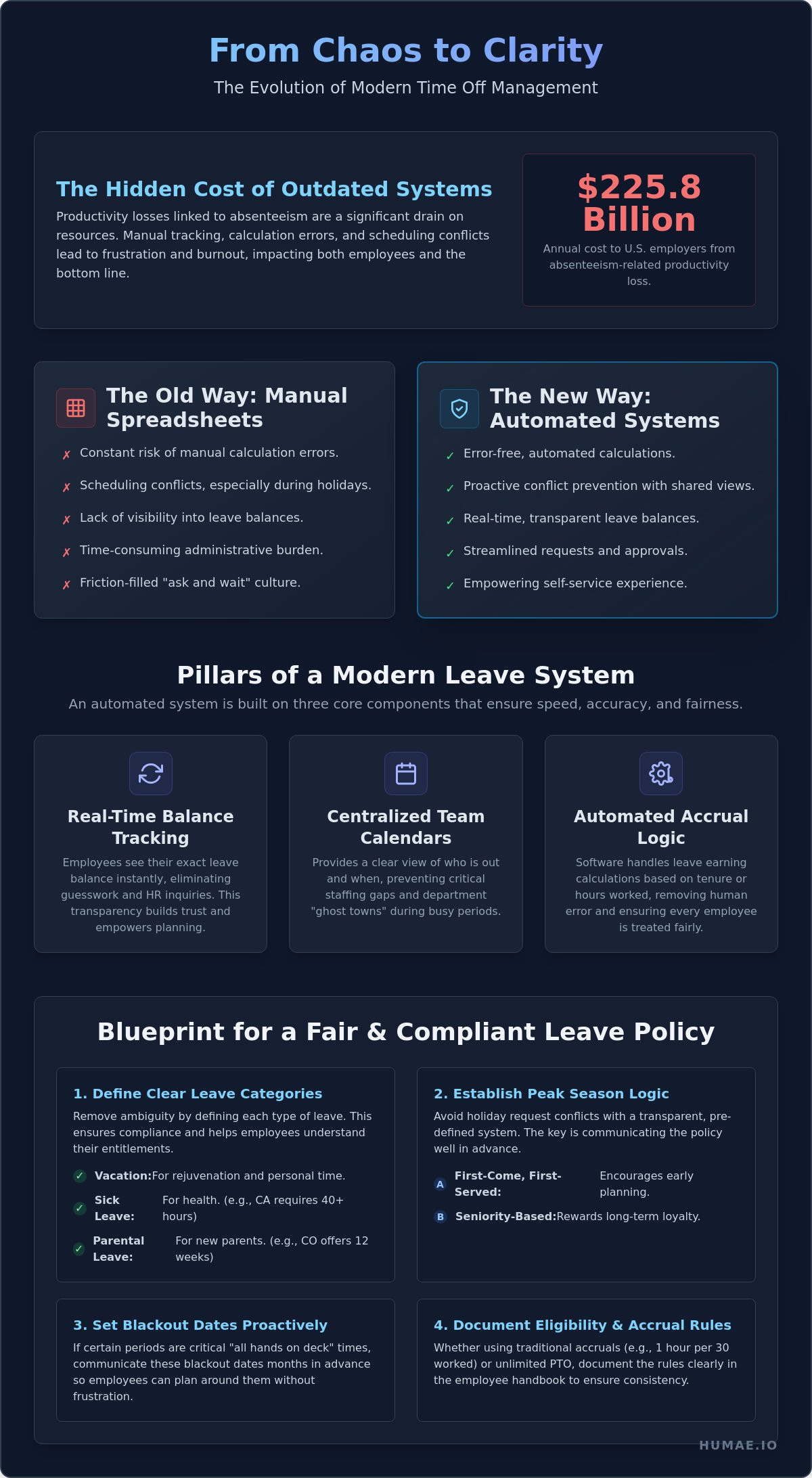
A modern approach to leave requires speed and accuracy. Real-time balance tracking is essential so every employee knows exactly where they stand without waiting for an HR response. Centralized calendars act as the pulse of department planning, preventing "ghost towns" where too many critical staff members are absent at once. Finally, automated accrual calculations remove the risk of human error in math. When software handles the earning logic, you eliminate disputes and ensure every hour is accounted for fairly. This setup replaces the old "ask and wait" culture with a fast, self-service experience.
The Business Case for Efficiency
Spreadsheets are often the biggest enemy of HR efficiency. Manual tracking leads to calculation errors that frustrate employees and drain administrative resources. These hidden costs are significant. Industry data shows that productivity losses linked to absenteeism cost U.S. employers $225.8 billion annually, often due to poor visibility and scheduling gaps. Transitioning to automated time and attendance systems closes the gap between policy and reality. Efficiency here allows leadership to focus on high-impact goals rather than correcting formula errors. This transition is a vital step in building a modern workforce management infrastructure that supports a flexible, high-performing organization.
Designing a Fair Policy for Modern Teams
A well-defined leave policy is the foundation of team trust. It starts with clear definitions. Vacation is for rejuvenation. Sick leave is for health and is often legally mandated. For example, as of January 1, 2026, California employers must provide at least 40 hours or five days of paid sick leave annually. Parental leave is another critical category; Colorado now requires up to 12 weeks of leave for new parents. When you define these categories clearly, you remove the guesswork for your team and ensure your business remains compliant with evolving state regulations.
Peak seasons demand a transparent logic to avoid conflict. You must decide whether to use a first-come, first-served approach or reward seniority during busy holidays. First-come, first-served encourages early planning; seniority rewards long-term loyalty. Both have merits, but transparency is the only way to prevent the perception of favoritism. You should also establish blackout dates for critical business cycles. If your team knows certain weeks are "all hands on deck" months in advance, they can plan their lives without frustration. This level of clarity transforms leave from a point of contention into a shared understanding.
Setting Clear Eligibility Rules
Eligibility rules define how leave is earned. You might base this on tenure or employment type. Some modern teams opt for unlimited PTO to signal high trust, though this requires a strong culture to prevent employees from taking too little time off. Traditional accruals, such as the common rate of one hour for every 30 hours worked, provide a clear "bank" of time that feels tangible. Whatever model you choose, document it thoroughly in your employee handbook. When the rules are written down, everyone plays by the same set of instructions.
Fair Approval Workflows
Fairness requires consistency in how requests are handled. A multi-level approval process ensures that both direct managers and HR stay aligned on department coverage. When overlapping requests occur, an automated time off approval system becomes your best ally. It identifies conflicts instantly, allowing managers to make data-driven decisions instead of subjective ones. Consistent response times are just as vital. No one should wait weeks to hear if their summer holiday is approved. Implementing these policies is much simpler when you use the right time off management tools to automate the logistics.
Solving the Biggest Challenges in Leave Tracking
Spreadsheet chaos is the number one enemy of HR efficiency. Static documents can't keep up with the fluid nature of a modern workforce. When leave data is buried in cells and formulas, errors are inevitable. These mistakes don't just waste time; they erode trust. An automated time off approval system solves this by providing a living record that updates instantly. It replaces manual guesswork with precision and ensures that everyone is looking at the same numbers.
Non-compliance with local labor regulations is a growing risk. With 19 states and D.C. having specific paid sick leave laws by 2026, a manual approach is increasingly dangerous. Beyond legal risks, leave hoarding presents a significant financial liability. When employees don't take their time, accrued hours sit on your balance sheet as debt. Encouraging regular rest isn't just about wellness; it's smart financial management. Even emergency absences, which often disrupt operations, become manageable when you have clear visibility into team capacity. You can pivot quickly because you know exactly who is available to step in.
Eliminating Data Silos
Risk grows when leave data stays separate from your employee directory. Siloed information forces HR to cross-reference multiple systems just to approve a single day off. A single source of truth for HR data ensures that every request is weighed against the person's role, tenure, and department schedule. Integrated systems reduce duplicate data entry and ensure that when someone is out, the whole organization knows who to contact instead. This connectivity is what turns a simple list of names into a functional workforce management tool.
Ensuring Legal Compliance
Tracking mandatory leave types correctly is a non-negotiable task. Many organizations look to federal leave administration policies as a benchmark for creating their own fair frameworks. Modern software helps you maintain the robust audit trails necessary for labor disputes or internal reviews. It also protects employee records in accordance with data privacy standards like GDPR or CCPA. By automating these safeguards, you protect the business while showing your team that their data and rights are handled with professional care. It's about being secure and supportive at the same time.
The Shift from Spreadsheets to Automated Systems
Manual tracking is a legacy burden. It forces HR teams to act as human calculators instead of people partners. Research shows that HR automation can cut administrative workload by as much as 50%. By moving to an automated time off approval system, you reclaim those hours for strategic work. Automated accrual engines handle the complex math of carry-overs and earn rates, eliminating the risk of human error that often plagues static spreadsheets. This shift ensures that your data is always current and your calculations are 100% accurate.
Empowerment starts with access. Mobile-first platforms allow employees to submit requests from anywhere, whether they are at their desk or planning a weekend away. This on-the-go flexibility is a fundamental shift in how teams manage their own time. Transitioning to an automated time off approval system is the most direct path to operational clarity. When the process is frictionless, employees feel more in control of their work-life balance, which directly impacts their long-term engagement and loyalty.
Employee Self-Service (ESS) Benefits
There is a significant psychological benefit when employees can see their own balances in real-time. It fosters a culture of transparency and self-reliance. ESS portals drastically reduce the volume of repetitive HR inquiries, such as questions about remaining leave days. This allows your people team to focus on high-value initiatives. Booking leave via web portals or mobile apps becomes as simple as any other digital interaction, making the employee experience feel modern, respectful, and efficient.
Managerial Oversight and Reporting
Implementing an automated time off approval system gives leaders more than just a list of names. Dashboards provide a bird-eye view of team availability, which is critical for maintaining department coverage during busy seasons. This visibility simplifies reporting for payroll and budget planning by providing accurate, exportable data. Advanced analytics can even spot high-absence trends early, allowing managers to address potential burnout before it impacts team performance. If you are ready to leave the spreadsheet chaos behind, you can modernize your leave tracking today with a system built for the future of work.
Elevating Employee Experience with Humae
Humae transforms leave management from a back-office chore into a strategic advantage. It is not just about approving days off. By integrating your automated time off approval system with performance intelligence, we bridge the gap between operational output and human well-being. Our platform acts as a visionary partner, allowing you to see leave patterns right alongside OKR progress. This holistic view ensures that your most ambitious goals are supported by a rested, motivated workforce. You no longer have to choose between productivity and people; our intuitive interface and smart analytics bring both into focus simultaneously.
The modern workplace moves fast, and your HR tools must keep pace. Humae provides the centralized infrastructure needed to manage a global team with empathy and precision. We believe that technology should serve the human connection, not replace it. When leave data flows seamlessly into your broader organizational strategy, you create a culture where employees feel seen and valued. This is the promise of a higher-level user experience that benefits everyone from the new hire to the C-suite.
AI-Powered Insights for Healthy Teams
Burnout often hides in plain sight until it is too late. Humae uses AI-driven sentiment analysis to identify potential exhaustion before it impacts your bottom line. Productivity losses linked to absenteeism cost U.S. employers roughly $1,685 per employee, making proactive wellness a financial necessity. Our system analyzes continuous feedback and leave trends to provide managers with actionable insights. This allows for proactive decisions, such as suggesting a long weekend for a team member who has been pushing hard on a major project. Encouraging them to focus on physical recovery with wellness tools like Pureffect can amplify the benefits of that time off. It is about using data to be more human, not less.
Seamless Integration with Your Workflow
Complexity shouldn't be the price of power. Humae offers a streamlined setup that fits the needs of agile startups and established enterprises alike. Our time off management tools are part of a broader suite of features that define a modern HRIS. You can easily connect leave tracking with performance reviews and employee directories to eliminate data silos for good. We invite you to see how it works and discover how a unified platform can elevate your entire organizational culture. Experience a system where technology and emotion work together for collective success.
Build a More Resilient Organization Today
Transparency and fairness in leave management aren't just HR goals; they are the foundation of a high-performing culture. You've seen how fair policies prevent conflict and how moving beyond spreadsheets eliminates the risk of human error. By adopting an automated time off approval system, you can cut your administrative workload by as much as 50%. This shift frees your leadership team to focus on growth rather than manual math. It's time to replace the "ask and wait" cycle with a modern, self-service experience that respects everyone's time.
Ready to elevate your employee experience? Discover the future of workforce management at Humae.io. Our platform combines AI-driven performance intelligence with real-time OKR tracking and actionable analytics dashboards to give you a complete view of your team's health. Your people are your greatest asset. Give them the rest they deserve and the clarity they need to thrive in a competitive landscape.
Frequently Asked Questions
What is the best way to track employee time off for small businesses?
The most effective way is using a cloud-based self-service portal. Manual spreadsheets are prone to formula errors and lack real-time visibility for the team. An automated time off approval system allows small teams to manage requests through mobile apps, which ensures that every absence is logged correctly from day one. This professional approach builds trust and scales easily as your headcount increases.
How do I calculate PTO accruals accurately every month?
You can calculate accruals accurately by setting up an automated engine within your HR software. You define the rules, such as earning one hour for every 30 hours worked, and the system handles the math. This eliminates the human error factor found in manual tracking. Real-time updates mean employees always see their true balance, which prevents frustrating disputes over remaining days or carry-over amounts.
Can I manage different leave policies for different departments?
Yes, modern HR platforms allow you to create and assign multiple leave policies simultaneously. You can tailor rules based on department needs, seniority, or geographic location to stay compliant with local laws. This flexibility ensures that your engineering team and your sales team follow the specific guidelines that work best for their unique operational rhythms and peak seasons without manual cross-referencing.
What are the legal requirements for tracking employee absences?
Legal requirements are primarily dictated at the state and local levels. As of January 1, 2026, 19 states and the District of Columbia have specific paid sick leave laws that require precise record-keeping. You must maintain clear audit trails for every absence to protect your business during labor disputes. Software automates this documentation, ensuring you always have the data needed for legal compliance and internal reviews.
How does an automated time off system improve employee morale?
An automated time off approval system improves morale by providing transparency and faster response times. Employees feel valued when they can check their own balances and receive instant notifications about their requests. This autonomy reduces the anxiety of asking for time off and fosters a culture where work-life balance is treated as a priority rather than a constant negotiation with management.
Is it better to use a standalone leave tracker or an all-in-one HRMS?
An all-in-one HRMS is generally superior because it eliminates risky data silos. When leave tracking is integrated with your employee directory and performance intelligence, you get a holistic view of team health. Standalone trackers often require duplicate data entry, which increases the chance of errors. A unified system ensures that leave patterns are viewed alongside OKR progress for better strategic planning and leadership focus.
How can I prevent too many employees from taking leave at the same time?
You can prevent coverage gaps by using centralized calendars and setting clear blackout dates. Most systems will automatically flag overlapping requests within the same department, allowing managers to address conflicts before they become problems. Establishing a First-Come, First-Served policy within the software also sets clear expectations for the team during busy holiday seasons or critical project cycles, ensuring fair treatment for everyone.
Does time off management software integrate with my payroll system?
Yes, most modern time off management tools are designed to sync with payroll systems. This integration ensures that paid leave is reflected correctly on every paycheck without manual intervention. By automating the data flow between leave tracking and payroll, you reduce administrative overhead and eliminate the common errors that lead to frustrated employees and time-consuming payroll corrections at the end of the month.