How to Build a Winning Business Case for New HR Software in 2026
By Humae · 11 April 2026
how to make a business case for new hr software
What if your HR department could prove its value in dollars and cents instead of just abstract concepts? Recent 2024 industry reports indicate that mid-sized firms lose an average of $15,000 for every bad hire, yet many teams still lack the automation to prevent these mistakes. You likely know that your current processes are draining productivity, but proving that inefficiency to a CFO often feels like an uphill battle. Learning how to make a business case for new hr software is the key to shifting your department's narrative from a cost center to a profit driver.
We'll show you exactly how to secure executive buy-in using data-backed strategies and ROI-focused arguments. You'll get a structured template and the specific formulas needed to win approval for modern technology like Humae. We're moving beyond simple feature lists to focus on the numbers that actually move the needle for your leadership team by the start of 2026. This guide ensures you have the evidence to prove that the right tools don't just save time; they protect your bottom line.
Humae: Where modern technology meets human-centered recruitment. Back to Home | Connect with us on Facebook
Key Takeaways
- Shift your narrative from simple time-saving to strategic alignment with 2026 business goals to capture executive attention immediately.
- Conduct a comprehensive "Pain Audit" to quantify the hidden financial drain caused by manual data entry and fragmented legacy tools.
- Learn how to make a business case for new hr software by applying a data-backed ROI model that balances software consolidation with value creation.
- Master a step-by-step pitch structure designed to hook decision-makers in the first 60 seconds using data-driven friction visualization.
- Future-proof your HR strategy with Humae’s AI-first, human-centric solutions-visit our home page or Facebook to learn more.
Defining the Strategic "Why": Aligning HR Tech with 2026 Business Goals
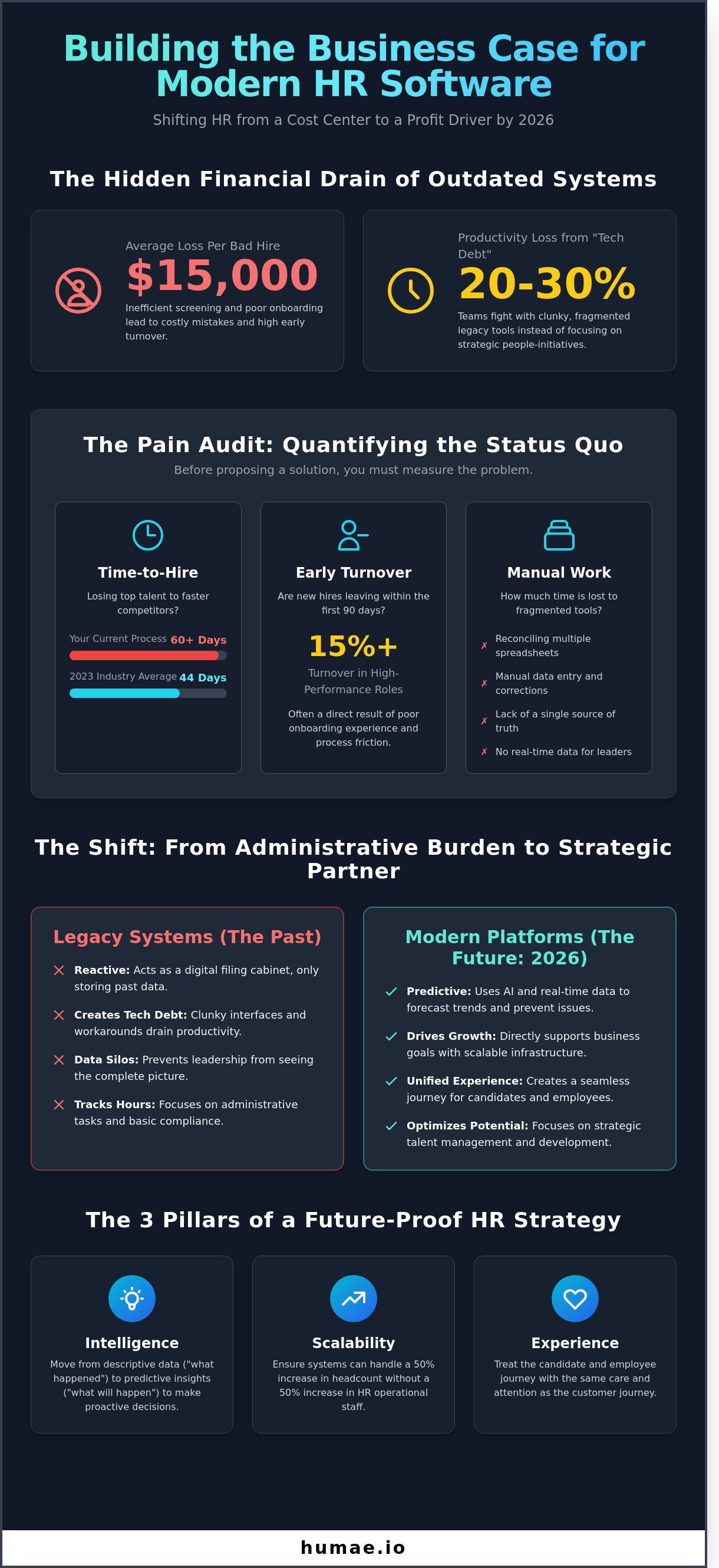
Building a business case for new HR software isn't just a request for a bigger budget. It's a strategic roadmap that translates human potential into financial performance. By 2026, simple efficiency won't win over your CFO. They want to see how technology drives revenue, cultural health, and competitive advantage. If you're wondering how to make a business case for new hr software that actually gets signed, you need to stop talking about "saving time." Efficiency is a baseline, not a breakthrough.
A modern business case rests on three pillars designed for the 2026 economy:
- Intelligence: Moving from descriptive data (what happened) to predictive insights (what will happen).
- Scalability: Ensuring your systems can handle a 50% increase in headcount without a 50% increase in HR staff.
- Experience: Treating the candidate and employee journey with the same level of care as the customer journey.
These pillars connect your HR tech directly to the what is workforce management framework. It's about moving beyond basic payroll and into a world where your infrastructure actively supports business growth.
The Shift from Administrative to Strategic HR
Traditional HRMS tools are often digital filing cabinets. They're passive and reactive. In contrast, modern Workforce Intelligence platforms are active partners. They use real-time data to help executives make decisions before problems occur. Sticking with legacy systems creates "tech debt." This debt costs companies an average of 20% to 30% in productivity losses every year because teams are fighting with clunky interfaces instead of focusing on people. We're moving from tracking hours to optimizing human potential.
Identifying Your Organization's Specific "North Star"
Every business has a unique priority. Maybe your goal is reducing a 15% turnover rate in high-performance roles or cutting the 42-day average time-to-hire to under 20 days. Your pitch must map software features directly to these goals. If a platform offers automated screening, show how it specifically accelerates your hiring pipeline for revenue-generating roles. Don't just list features; sell outcomes that the board already cares about. Strategic Alignment is the process of proving that your HR tech stack is the primary engine driving your company's highest-level business objectives.
Humae - We empower growth through technology-driven, human-centered HR solutions.
Explore our vision for the future of work: Visit Humae Home
Join our community on Facebook.
The Discovery Phase: Auditing Inefficiency and Quantifying the Status Quo
Before you present a solution, you must prove there’s a problem worth solving. Learning how to make a business case for new hr software starts with a "Pain Audit." This isn't just about listing what’s broken; it’s about measuring the friction that slows down your entire organization. Data doesn't lie. It exposes the cracks in your foundation that intuition often misses, and for employers seeking an expert perspective, Pioneer HR provides the strategic support and practical advice needed to quantify these issues effectively.
- Time-to-hire: Measure from the moment a role opens to the signed offer.
- Turnover rate: Identify if people leave during the first 90 days due to poor onboarding.
- Engagement scores: Look for "process frustration" in employee surveys.
Calculating the Cost of "Doing Nothing"
The biggest competitor to new software isn't another vendor; it's the status quo. To win, you must quantify the financial drain of staying the same. Consider a 100-person team. If HR and managers lose 20 hours a week to manual time off management and fixing spreadsheet errors, that’s 1,040 hours wasted every year. At a conservative internal cost of $35 per hour, you’re looking at over $36,000 in lost productivity on a single task. See how our automated features can reclaim that time for strategic growth.
Stakeholder Interviews: Getting the Non-HR Perspective
A winning business case isn't an HR-only manifesto. You need a coalition. Interview department heads to find "shadow HR" tasks. These are the hours managers spend tracking their own team's certifications or performance reviews because the current system is too clunky to use. Ask them: "What’s one task that keeps you from focusing on your department's actual goals?" Use their answers to show that new software isn't just an HR tool; it’s a company-wide productivity engine. Understanding how to make a business case for new hr software requires showing how it solves problems for the person holding the budget, not just the person clicking the buttons.
Humae - Human-Centric HR Innovation
Humae is a modern, technology-driven partner dedicated to transforming the recruitment and HR experience. We believe that while technology drives efficiency, people are the heart of every successful business. Our platform is designed to eliminate administrative burdens, allowing you to focus on building a community and driving success.
Building the ROI Model: Hard Savings vs. Value Creation
Hard savings are tangible. They appear as line items on a budget. Soft savings, however, represent the productivity multiplier. For example, a 2023 study by Gallup found that disengaged employees cost the global economy $8.8 trillion in lost productivity. Reducing this gap isn't just a "nice to have" metric. It's a financial necessity. When you present your case, you must bridge the gap between these two worlds.
Consolidating the Tech Stack
Many companies juggle five or more disparate HR tools. This creates an "Integration Tax," which is the hidden cost of manual data entry and fixing broken connections between systems. Switching to an AI-powered HR platform eliminates these friction points and reduces total cost of ownership. It's about doing more with a single, intelligent ecosystem.
| Legacy Costs | Modern Platform Investment |
|---|---|
| Multiple high-cost license fees | Single, predictable subscription |
| Data silos requiring manual syncing | Unified data source of truth |
| Expensive external IT support | Automated, low-maintenance updates |
The Productivity Multiplier of OKRs and Intelligence
Alignment drives revenue. When teams understand the OKR meaning, they focus on outcomes rather than just tasks. High-performing organizations use performance intelligence to spot burnout before it leads to "regrettable turnover." Replacing a mid-level manager costs roughly 150% of their annual salary. AI-driven sentiment analysis acts as an early warning system, saving hundreds of thousands in recruitment costs.
The "Engagement Dividend" is real. A 5% increase in employee engagement correlates with a 3% increase in revenue growth according to Aon Hewitt research. This is a core pillar when learning how to make a business case for new hr software. By linking performance management directly to the bottom line, you transform HR from a cost center into a profit driver.
Humae - Empowering modern teams through human-centered technology.
Structuring the Pitch: A Step-by-Step Presentation Guide
Your problem statement needs to visualize friction. Use internal metrics to show that your team spends 20 hours a week on manual data entry or that your current time-to-hire is 45 days, well above the 30-day industry average. Transition quickly to the solution. Humae isn't just a platform; it's a way to align technology with your human-centric culture. Explain that a modern solution allows HR to stop being a cost center and start being a strategic partner. Present the financial justification with a clear ROI calculation. Aim for a payback period of less than six months to make the decision easy for the CFO.
Addressing the Top 3 Executive Objections
Anticipating resistance is the hallmark of a prepared leader. Use these counters to maintain momentum:
- Objection: "It's too much change at once." Counter this by presenting a phased rollout plan. We'll start with core recruitment modules and expand once the team is comfortable. This reduces risk and ensures high adoption rates.
- Objection: "We don't have the budget." Show them the cost of vacancy. Every day a critical role stays open, the company loses productivity. Recent data suggests this can cost up to $500 per day for mid-level roles. The software pays for itself by filling these gaps faster.
- Objection: "Security and privacy concerns." Explain that Humae utilizes modern cloud infrastructure standards. It's significantly safer than spreadsheets or legacy servers that lack regular security patches and encryption. To help your team maintain a secure digital environment, you can find out more about essential internet safety practices.
Visualizing Success: The "Before and After" Story
Show, don't just tell. Use analytics dashboards to demonstrate the visibility leadership will gain. Currently, the board is flying blind regarding talent trends. With the right tech, they get real-time insights into hiring velocity and candidate quality. This shift transforms HR into a data-driven powerhouse that supports every department's goals.
The "Future State" vision is one where everyone wins. When managers have the right tools, they thrive. As one industry leader put it: "The right HR tech makes managers the CEOs of their own teams." This autonomy drives engagement and speeds up growth. It's the most effective way to understand how to make a business case for new hr software that resonates with every stakeholder in the room.
Ready to transform your hiring process? Explore the features that drive ROI.
Humae: Human-Centered HR Technology
Empowering modern businesses with innovative recruitment and HR solutions. We believe in technology that serves people, not the other way around.
Future-Proofing Your Investment with Humae
Choosing the right platform isn't just about solving today's paperwork. It's about preparing for the 2026 workforce. By that time, digital natives will dominate the talent pool, demanding tools that are both AI-first and human-centric. When you're figuring out how to make a business case for new hr software, you've got to focus on longevity. Humae provides a centralized employee directory that acts as your company's single source of truth. It eliminates data silos that currently waste up to 20% of an average HR manager's work week.
Moving from your initial pitch to a full "Go-Live" status doesn't have to be a headache. Humae's implementation process is built for speed. Most teams are up and running in less than 30 days, ensuring you see a return on investment within the first quarter. This agility supports modern employee engagement strategies that keep your team connected, regardless of where they're located. Proving how to make a business case for new hr software becomes easy when the software pays for itself through efficiency gains within months.
AI-Powered Intelligence as a Competitive Advantage
Humae doesn't just store data; it interprets it. Our sentiment analysis tools provide proactive retention alerts, identifying turnover risks before they hand in their notice. A 2023 study by Gallup showed that disengaged employees cost companies roughly 18% of their annual salary in lost productivity. Humae fixes this. Real-time OKR tracking ensures every department stays aligned with core business goals. You'll turn raw "people data" into high-level "business strategy" with actionable analytics that your CFO will actually value.
Scalability: A Platform That Grows with You
Whether you're a 20-person startup or a 5,000-employee enterprise, Humae provides the necessary infrastructure. The platform adapts to changing labor laws and global compliance needs automatically. You won't need to replace your HRIS every three years as you scale. It's a permanent solution for a rapidly changing world. Start building your case today by exploring Humae’s features. We don't just offer software; we offer a vision for a better workplace culture.
Secure Your HR Budget for 2026
Building a compelling narrative for digital transformation requires more than just a list of features. You've learned that success hinges on aligning technology with 2026 business goals and quantifying the real cost of manual inefficiencies. According to 2024 industry research, companies using centralized platforms see a 30% increase in administrative productivity. Mastering how to make a business case for new hr software means shifting the conversation from a cost center to a value driver. Use your ROI model to highlight hard savings while emphasizing the human impact of better hiring and onboarding workflows.
Humae provides the toolkit you need to turn this vision into reality. Our platform features AI-driven sentiment analysis for real-time retention and a centralized infrastructure for OKRs. It's an intuitive interface designed specifically for the needs of modern 2026 teams. You're ready to lead the change and build a culture where everyone thrives.
Ready to transform your workforce? Explore Humae today.
Humae
Frequently Asked Questions
What is the most important metric to include in a business case for HR software?
The most critical metric is the reduction in time to productivity for new hires. According to Glassdoor, a strong onboarding process improves new hire retention by 82%. By automating administrative tasks, your team focuses on cultural integration. This shift directly impacts the bottom line by shortening the 6 month window it usually takes for a new employee to reach full ROI.
How long does it typically take to see a return on investment (ROI) from a new HRMS?
Most companies see a full return on investment within 12 to 18 months of implementation. A 2023 report from Nucleus Research shows that HR technology returns $9.13 for every dollar spent. Early wins appear in the first 90 days through reduced paper costs and eliminated manual data entry errors. Long term gains come from lower turnover rates and better talent acquisition.
How do I convince a CFO who only cares about the bottom line?
Speak the language of risk and efficiency to win over your CFO. Highlight how the new system prevents compliance fines, which can reach $1,030 per Form I-9 error. Show them a direct comparison between current manual labor costs and the automated future state. When you demonstrate how to make a business case for new hr software using hard data, you shift the conversation from an expense to a strategic investment.
Can I build a business case if we are a small startup with a limited budget?
Startups benefit most from software because they can't afford to waste 15 hours a week on manual spreadsheets. Small teams need to scale without doubling their headcount immediately. Focus your case on opportunity cost. If your only HR person spends 40% of their time on payroll admin, they aren't building the culture that prevents 25% of your early talent from quitting.
What are the biggest mistakes people make when pitching new HR technology?
The biggest mistake is focusing on features instead of business outcomes. Don't pitch a better UI; pitch a 20% faster hiring cycle. Another error is failing to involve IT and Finance until the last minute. 60% of software implementations fail because of poor internal alignment. Start with the problem you're solving, not the shiny buttons the software has.
How does AI in HR software change the business case in 2026?
By 2026, AI shifts the business case from automation to predictive intelligence. You won't just save time; you'll prevent turnover by identifying at-risk employees with 85% accuracy before they resign. This transforms HR into a proactive profit center. The value moves from doing things faster to making better people decisions based on real-time data patterns.
Should I include the cost of training and implementation in my ROI calculation?
You must include training and implementation costs to build a credible case. CFOs spot hidden costs easily, and omitting them damages your trust. Budgeting 15% to 25% of the total contract value for implementation is a standard industry benchmark. Including these figures proves you've planned for a successful rollout, not just a software purchase.
How do I handle the "we already have a system" objection from IT?
Tackle this by highlighting the capability gap between a general ERP and a specialized HR tool. Show IT that your current system lacks the 10 core features needed for a modern candidate experience. Explain how to make a business case for new hr software by demonstrating that integration is simpler than fixing a broken, outdated process. A specialized tool reduces the 30 tickets IT receives monthly for manual data fixes.
Humae: Modern HR technology for an employee-first world.
Explore more and return to our Home Page.
Connect with our community on Facebook.