Goal Alignment Strategies for 2026: The Modern Leader’s Playbook
By Humae · 22 August 2026
goal alignment strategies
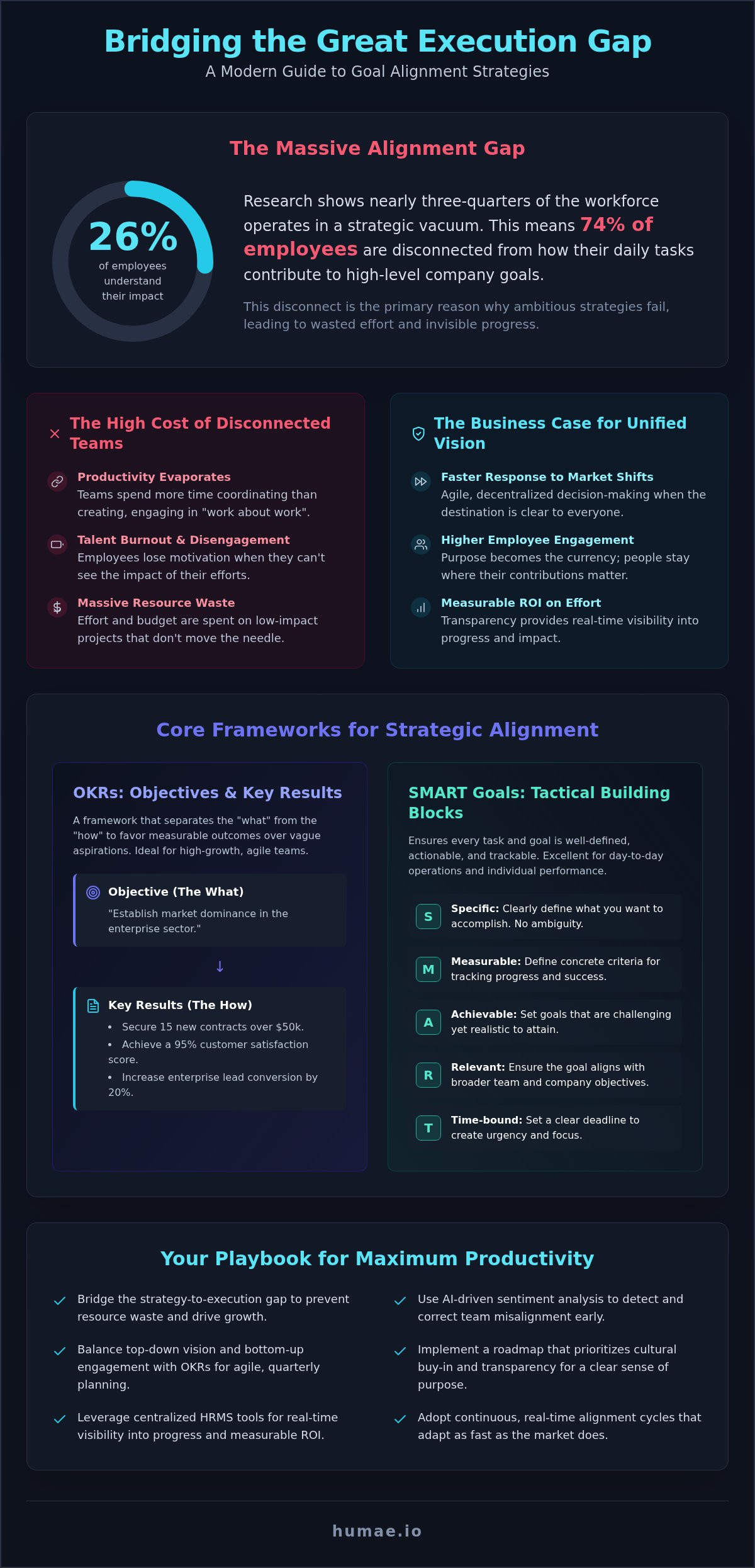
Did you know that only 26% of employees actually understand how their daily tasks impact company goals? According to research from Happily.ai, nearly three quarters of your workforce is operating in a strategic vacuum. This massive execution gap explains why even the most ambitious goal alignment strategies often fail to gain traction in a fast-moving market. It's exhausting to watch talented teams burn out while progress remains invisible, leaving leaders wondering where the actual ROI on all that effort went.
We understand that you want more than just a list of tasks; you want a unified team that feels the pulse of the company's vision. This guide promises to help you master the modern frameworks and AI-driven tactics needed to synchronize individual efforts with corporate strategy for maximum productivity. We'll preview the shift toward quarterly agility and show you how performance intelligence can transform your organizational culture. From real-time OKR tracking to catching misalignment early with sentiment analysis, you're about to build a playbook that ensures every person in your organization is moving in the same direction.
Explore more at Humae. | Back to Home | Follow us on Facebook
Key Takeaways
- Identify why modern goal alignment strategies are essential for preventing resource waste and bridging the strategy-to-execution gap.
- Master the balance between top-down vision and bottom-up engagement using OKRs and SMART goals for agile, quarterly planning.
- Use AI-driven sentiment analysis and performance intelligence to detect and correct team misalignment before it impacts your bottom line.
- Implement a five-step roadmap that prioritizes cultural buy-in and transparency to ensure your workforce feels a clear sense of purpose.
- Leverage centralized HRMS tools to gain real-time visibility into progress and generate a measurable ROI on every employee effort.
Explore more at Humae. | Back to Home | Follow us on Facebook
Why Goal Alignment Strategies Are Essential for 2026 Growth
Goal alignment is the seamless connection between a Monday morning task and the ten-year mission of the brand. It is the pulse of the organization. When this connection breaks, productivity doesn't just dip; it evaporates. In 2026, Strategic alignment is the real-time synchronization of human intent and technological execution across a distributed, AI-augmented workforce. We're leaving behind the "set it and forget it" annual review. Modern growth requires continuous, real-time alignment cycles that adapt as fast as the market does.
Misalignment acts as a silent killer of productivity. It manifests as "work about work," where teams spend more time coordinating than creating. Without robust goal alignment strategies, your most talented people end up rowing in opposite directions. This friction creates a massive execution gap that no amount of overtime can fix. Leaders who fail to bridge this gap find themselves managing chaos rather than driving innovation.
The High Cost of Disconnected Teams
Research from Kaplan and Norton suggests that fewer than 5% of employees understand their company's strategy well enough to act on it. This lack of clarity is expensive. In remote and hybrid environments, silos aren't just an inconvenience; they're a structural failure. When employees don't see how their efforts move the needle, they disengage. Purpose is the new currency of the workplace. Clear goals aren't just about output; they're about retention. People stay where they feel their contribution actually matters.
The Business Case for Unified Vision
A unified vision creates a decentralized engine of efficiency. When the destination is clear, decision-making happens at the edge, not just at the top. This agility is what separates market leaders from the rest of the pack. Effective workforce management provides the necessary transparency to keep everyone informed without the heavy hand of micromanagement. Transparency is the antidote to bureaucratic slowdowns.
By implementing modern goal alignment strategies, organizations can expect:
- Faster response times to market shifts.
- Higher employee engagement through clear ownership.
- Reduced resource waste on low-impact projects.
- Measurable ROI on every individual effort.
Clarity empowers teams to take ownership of their results. When everyone sees the North Star, the path forward becomes obvious to all.
Explore more at Humae. | Back to Home | Follow us on Facebook
Core Frameworks: OKRs, SMART Goals, and Cascading Models
Choosing the right framework determines whether your strategy lives in a dusty slide deck or in the daily workflow. Effective goal alignment strategies rely on selecting the right tool for your specific organizational culture. While traditional corporations often stick to rigid top-down mandates, agile startups find success in hybrid models. These models combine a high-level executive vision with the autonomy of bottom-up goal setting. This balance ensures that while leadership sets the destination, the people doing the work decide the best route to get there.
Objectives and Key Results (OKRs)
The modern OKR meaning has evolved from a simple tracking tool into a philosophy for high-growth teams. OKRs thrive because they separate the "what" (Objective) from the "how" (Key Results). For example, an objective might be to "Establish market dominance in the enterprise sector." A tactical key result would be to "Secure 15 new contracts with a contract value over $50,000 by December." This framework is the gold standard for tech teams because it favors measurable outcomes over vague aspirations.
The SMART Goal Framework
SMART goals serve as the tactical building blocks within a broader strategy. They ensure that every task is Specific, Measurable, Achievable, Relevant, and Time-bound. However, there's a hidden trap. If goals are too "achievable," they become a ceiling for performance rather than a floor. In 2026, the best leaders use SMART criteria for day-to-day operations while leaving room for the ambitious "stretch" nature of OKRs to drive true innovation. If you aren't failing at some of your stretch goals, you probably aren't aiming high enough.
Traditional Cascading vs. Networked Alignment
Old-school cascading models often create bottlenecks. Information flows down, but collaboration rarely flows across. Networked alignment solves this by allowing cross-functional goals. If the Marketing team and Product team share a goal to increase user adoption, they stop working in silos and start solving problems together. This networked approach ensures that team goals support company-wide pillars without waiting for a slow directive from the top. It creates a web of accountability rather than a rigid chain of command.
Setting these goals is only the first step. You need a way to see them in action across your entire workforce. You can explore how centralized OKR tracking turns these frameworks into a living part of your organizational culture.
Explore more at Humae. | Back to Home | Follow us on Facebook
Bridging the Alignment Gap with Performance Intelligence
Static data is the graveyard of execution. To make goal alignment strategies work in 2026, you need performance intelligence that provides the narrative behind the numbers. It's not enough to know that a project is 40% complete; you need to understand the human context driving that progress. A centralized employee directory serves as the foundation for this visibility. It ensures every leader knows exactly who is responsible for which objective and how those roles intersect. Without this infrastructure, visibility is just an illusion that leads to wasted resources.
Real-time tracking is the only way to prevent the dreaded quarterly surprise. When you only look at progress every three months, you're essentially driving a car by looking in the rearview mirror. Performance intelligence allows you to see the obstacles before you hit them. It turns goal tracking from a passive reporting task into an active leadership tool that fosters a unified workforce.
Real-Time Performance Analytics
Live dashboards have officially replaced the static spreadsheet. Managers can now use data to identify high-potential employees who are consistently over-delivering on their key results. Research from Dr. Gail Matthews shows that 70% of people who send weekly progress updates achieve their goals, compared to just 35% who keep goals to themselves. Automated reporting makes this visibility effortless by reducing the administrative burden on HR teams. When the data is live, the conversation shifts from what happened to what's next. This transparency reduces the need for micromanagement and empowers teams to own their outcomes.
AI-Driven Sentiment and Feedback Loops
AI-driven sentiment analysis is the early warning system modern leaders have been waiting for. By analyzing feedback patterns, AI can detect misalignment or burnout long before it shows up in turnover statistics. Continuous feedback loops are far more effective than annual reviews because they happen in the flow of work. If a team's enthusiasm drops while their workload spikes, sentiment analysis flags it for immediate attention. This allows leaders to pivot strategies faster and protect their most valuable asset: their people. You aren't just managing tasks; you're nurturing a culture of clear purpose and measurable success.
Explore more at Humae. | Back to Home | Follow us on Facebook
Building Your Roadmap: A Step-by-Step Implementation Guide
A strategy is only as good as its execution. Transitioning to modern goal alignment strategies requires more than just a new software login; it demands a shift in organizational culture. You must build a foundation of trust and clarity before the first key result is even recorded. This concrete five-step process ensures that your roadmap leads to a unified workforce rather than a collection of disconnected tasks.
Step 1: Define the North Star Vision
Start by setting one to three high-level objectives that inspire the whole team. While a mission statement explains why you exist, a strategic goal defines what you intend to achieve in a specific timeframe. To test your clarity, ask yourself this: If I stopped an employee in the hallway, could they name our top three priorities without checking their email? If the answer is no, your vision needs more focus.
Step 2: Secure Leadership and Manager Buy-In
Alignment must start at the top. Before cascading goals to the rest of the company, ensure the executive team is perfectly synchronized. Middle managers often resist new frameworks because they fear a heavier administrative load. Address this by showing them how clear alignment actually saves time by reducing redundant meetings. Train your managers to facilitate goal-setting workshops rather than just dictating targets.
Step 3: Establish the Technical Infrastructure
Manual tracking and spreadsheets break as soon as you scale. Dedicated software is superior because it provides a single source of truth for every department. Your infrastructure should integrate time-off management with task progress to give a realistic view of team capacity. Setting up real-time tracking for key results allows everyone to see progress as it happens, fostering a sense of shared momentum.
Step 4: Communicate and Iterate Constantly
Transparency is the bedrock of trust. Establish a clear communication cadence: weekly pulse checks for teams, monthly reviews for departments, and quarterly resets for the entire company. When market conditions shift, don't be afraid to pivot. Explain the "why" behind the change to keep morale high. Using analytics dashboards makes this progress visible to everyone, ensuring no one feels left in the dark.
Step 5: Review and Recognize Success
The final step is closing the loop. Use your data to recognize high-impact efforts and learn from missed targets. This continuous cycle of review turns goal alignment strategies into a living part of your culture. When employees see that their work is measured and valued, retention improves and purpose becomes tangible.
Ready to see how your team stacks up? You can get started with Humae to build your infrastructure for unified performance today.
Explore more at Humae. | Back to Home | Follow us on Facebook
Humae: The Infrastructure for Unified Team Performance
Humae serves as the centralized hub where your organizational vision becomes a daily reality. While the frameworks we discussed provide the logic, Humae provides the engine. It's designed to eliminate the friction that usually kills goal alignment strategies in high-growth environments. By housing OKR tracking, a centralized employee directory, and performance intelligence in one place, we ensure that every team member understands their role in the bigger picture. Whether you're a lean startup or a scaling enterprise, this integrated approach turns strategy from a static document into a living, breathing culture.
The centralized directory isn't just a list of names; it's a map of your organization's potential. It allows for the networked alignment we explored earlier, breaking down silos and encouraging cross-functional collaboration. For startups, this means moving fast without losing focus. For enterprises, it means maintaining the agility of a small team at scale. Humae provides the visibility needed to ensure that every individual effort is measurable and contributes to a tangible ROI.
Centralized OKR Tracking and AI Insights
Our intuitive interface makes setting and monitoring key results feel like a natural part of the workflow. But it goes deeper than just numbers. Our AI-driven sentiment analysis provides a layer of performance intelligence that most platforms miss. It helps you catch the early warning signs of misalignment or burnout before they impact your results. Onboarding new hires into this aligned culture becomes seamless because they can immediately see who their colleagues are and how their specific tasks contribute to the company's North Star objectives.
Actionable Dashboards for Strategic Growth
Strategic growth requires a view of the big picture that doesn't sacrifice the details. Leaders can use our features to monitor progress across the entire organization at a glance. By integrating time-off management with performance data, you gain a realistic understanding of team capacity and can plan more effectively. This transparency builds trust and ensures that no one is left guessing about where the company is headed. We invite you to explore the how it works section to see this synergy in action. Humae is more than a tool; it's your partner in building a high-performing, unified workforce for the challenges of 2026.
Explore more at Humae. | Back to Home | Follow us on Facebook
Lead Your Team Toward a Unified Future
The shift toward real-time agility isn't just a trend; it's a necessity for organizational survival in 2026. You've seen how modern goal alignment strategies transition from static documents to dynamic, AI-informed dialogues that empower every level of your workforce. By combining proven frameworks like OKRs with deep performance intelligence, you bridge the gap between strategic vision and daily execution. You aren't just tracking tasks; you're nurturing a culture where every employee feels a deep sense of purpose and sees the direct impact of their work.
True alignment requires the right infrastructure to turn raw data into actionable insights. With real-time OKR tracking and centralized workforce management, you can finally eliminate the "work about work" that drains your team's energy. It's time to replace the quarterly surprise with continuous clarity and measurable ROI. Are you ready to transform your organizational culture? Optimize your team growth with Humae and experience the power of AI-powered performance intelligence. The path to a more productive, unified workforce starts with a single step toward transparency. You've got the playbook; now it's time to execute.
Explore more at Humae. | Back to Home | Follow us on Facebook
Frequently Asked Questions
What are the most effective goal alignment strategies for small teams?
The most effective goal alignment strategies for small teams prioritize flexibility and shared ownership. Using a simplified OKR framework allows lean teams to focus on high-impact outcomes without getting bogged down in heavy bureaucracy. Frequent, informal check-ins ensure everyone stays on the same page as priorities shift. This approach fosters a culture of transparency where every person understands their direct contribution to the company's North Star vision, preventing resource waste from the very start.
How do OKRs differ from traditional top-down cascading goals?
OKRs differ from traditional cascading goals by encouraging a bi-directional flow of information. While cascading models are strictly top-down and often focus on rigid tasks, OKRs focus on measurable outcomes. They allow employees to define how they will achieve high-level objectives. This modern approach promotes ambitious stretch goals and fosters innovation. Traditional models often result in safe targets that limit an organization's growth potential in a competitive and fast-moving market.
Why do goal alignment strategies often fail in large organizations?
Goal alignment strategies often fail in large organizations due to communication silos and a lack of real-time visibility. When strategy is only discussed at the executive level, it rarely reaches the front-line workforce in an actionable way. Without a centralized infrastructure, different departments may unknowingly work at cross-purposes. This execution gap leads to wasted resources and employee frustration, as individual efforts become disconnected from the company's broader strategic pillars and long-term mission.
How can AI help in aligning employee goals with company vision?
AI helps by providing performance intelligence that goes beyond simple progress bars. It can analyze feedback patterns and task completion rates to identify early warning signs of misalignment or burnout. By using sentiment analysis, leaders can detect if a team's morale is dipping before it impacts their key results. This allows for proactive pivots and more empathetic leadership, ensuring that the human element of the workforce remains synchronized with technological execution and corporate strategy.
How often should a company review its strategic goal alignment?
Companies should move away from annual reviews and adopt quarterly planning cycles with weekly pulse checks. The business environment in 2026 moves too fast for yearly adjustments. Reviewing alignment every three months allows you to remain agile and responsive to market shifts. Weekly updates ensure that small deviations are corrected before they become major strategic failures. This cadence keeps the workforce focused and maintains momentum throughout the entire year without losing sight of the goal.
What is the role of transparency in goal alignment strategies?
Transparency is the bedrock of effective alignment. When every employee can see the company's top-level objectives and how their peers are contributing, it builds a culture of trust and shared accountability. Transparency eliminates the need for excessive micromanagement because the path forward is visible to everyone. It also encourages cross-functional collaboration, as teams can identify opportunities to support each other's goals without waiting for a slow directive from senior management to arrive.
Can goal alignment improve employee engagement and retention?
Yes, clear goal alignment is a primary driver of employee engagement and retention. When workers understand the why behind their tasks, they feel a greater sense of purpose and professional satisfaction. Research indicates that employees who see the impact of their work are more likely to stay with an organization. By providing a clear roadmap for success, you reduce burnout caused by aimless effort and create a more motivated, loyal, and unified workforce.