Employee Sentiment Analysis Tools: The 2026 Guide to Real-Time Intelligence
By Humae · 11 September 2026
employee sentiment analysis tools
What if the most valuable data in your company isn't found in your financial reports, but in the unspoken mood of your workforce? While 78% of employers now use some form of monitoring technology, many still struggle with low survey response rates and the sting of top talent resigning before employee sentiment analysis tools can even flag a concern. It's exhausting to make high-stakes culture decisions based on abstract data that executives simply don't trust.
You deserve a clearer, more human picture of your organization's health. We'll show you how modern AI-driven tools transform passive feedback into real-time workforce intelligence that actually drives retention. We agree that data is only useful if it's actionable, empathetic, and grounded in reality.
This guide explores how to align employee mood with performance goals while staying ahead of 2026 regulations like California’s AB 1883. You're about to discover how to move from guessing to knowing, ensuring your culture remains your greatest competitive advantage.
Key Takeaways
- Move beyond the limitations of annual pulse surveys by adopting a continuous, real-time approach to understanding your team's needs.
- See how modern employee sentiment analysis tools use AI to transform raw communication data into clear signals for retention and engagement.
- Connect emotional well-being directly to productivity by integrating sentiment tracking into your existing OKR and performance management workflows.
- Master the ethical implementation of workforce intelligence to build trust while staying compliant with evolving 2026 privacy regulations.
- Discover why a centralized HRMS platform is the most effective way to turn cultural insights into measurable organizational performance.
Why Employee Sentiment Analysis Tools Matter in 2026
The corporate world has moved past the era of guessing how people feel. In 2026, employee sentiment analysis tools have become the digital nervous system of high-performing organizations. These tools are sophisticated software platforms that use AI to detect the underlying emotional tone in employee communications, from OKR comments to internal feedback loops. By the time a resignation letter hits your desk, it's often too late. Real-time intelligence changes the game by treating sentiment as a leading indicator of retention and organizational health.
Sentiment analysis technology allows leaders to listen to the digital heartbeat of their teams without intruding on their daily workflow. It's not just about finding out if people are happy or sad. It's about identifying patterns of frustration, burnout, or disengagement before they manifest as turnover or lost productivity. When you can see a dip in morale across a specific department in real-time, you can intervene with support before performance goals are impacted. It's a proactive approach that respects the human element of work.
The Shift to Workforce Management Infrastructure
We're seeing a massive transition toward integrated Modern HR Infrastructure Guide solutions. Sentiment is no longer a standalone project managed by a siloed survey tool. Instead, it's a core pillar of the modern HRMS. When sentiment data lives alongside performance intelligence and OKR tracking, executives gain a holistic view of the company. It's about creating a centralized workforce management infrastructure where every piece of data talks to the other. Decisions are backed by hard data, not just gut feelings. This integration ensures that the emotional state of the workforce is always visible at the highest levels of leadership, allowing for immediate adjustments to strategy and culture.
Why Traditional Surveys are Losing Effectiveness
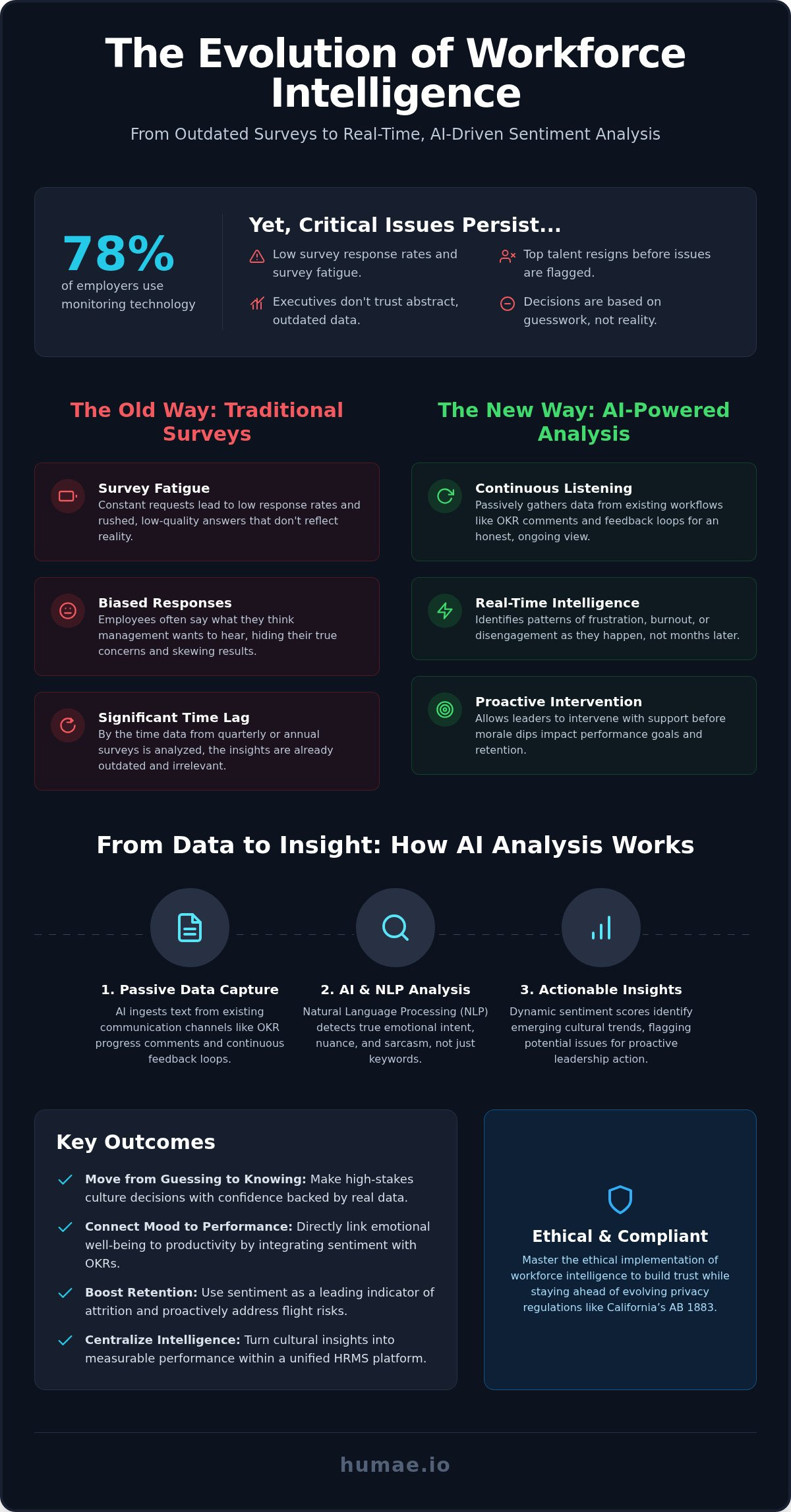
Annual pulse surveys are failing. They suffer from three critical flaws that make them unreliable in a fast-paced business environment. First, survey fatigue is real. Modern workforces are tired of answering the same generic questions every few months. This leads to low response rates and rushed, low-quality answers that don't reflect reality. Second, social desirability bias often skews results. Employees frequently tell managers what they think they want to hear in formal settings, hiding their true concerns. Finally, there's the time lag. In 2026, insights from last month are already outdated. If you're waiting for a quarterly report to fix a culture issue, you've already lost the battle. Real-time employee sentiment analysis tools bridge this gap by providing immediate, honest visibility into the team's true state.
How AI-Driven Sentiment Analysis Works: From Data to Insight
Modern employee sentiment analysis tools function by capturing the digital exhaust of your organization. Instead of relying on a single moment in time, these platforms ingest data from continuous feedback loops and OKR progress comments. This passive data collection provides a more honest view of the workplace. AI models today are sophisticated enough to distinguish between the healthy stress of high engagement and the toxic frustration of burnout. By layering this data with Performance Intelligence, leadership can see the context behind the mood. For instance, a spike in negative sentiment during a product launch might be a sign of temporary pressure, while a steady decline in a stable department signals a deeper leadership issue.
Sentiment scoring is a dynamic metric that aggregates emotional data points over time to identify emerging cultural trends rather than reacting to single, isolated comments.
Natural Language Processing and Intent
The real magic happens within Natural Language Processing (NLP). It's no longer about just spotting keywords like "angry" or "happy." AI now identifies true emotional intent. This is crucial for global, remote teams where sarcasm and cultural nuances can easily be misinterpreted by simpler systems. Predictive modeling takes this a step further. By analyzing shifts in language patterns, these tools can spot the early warning signs of burnout weeks before an employee decides to resign. It's about moving from reactive fixes to proactive care, ensuring every team member feels heard and supported.
Connecting Sentiment to OKRs and Goals
There is a direct, measurable correlation between team morale and goal completion rates. When sentiment drops, the velocity of work typically follows. By integrating these insights into your Definitive Guide to OKRs, you can see how emotional health impacts your strategic objectives. If a team's sentiment is consistently low, it may be time to adjust OKR targets or timelines to prevent a total collapse in productivity. This alignment ensures that performance goals remain realistic and sustainable. You can explore our integrated approach to see how these data points come together in a single dashboard.
Key Features to Look for in Sentiment Analysis Software
Selecting the right technology is about more than just data collection. It's about choosing a platform that translates raw signals into a strategic roadmap. High-impact employee sentiment analysis tools must offer immediate visibility through real-time analytics dashboards. Waiting for a monthly report is a luxury modern leaders no longer have. These dashboards should provide a live feed of organizational health, allowing you to react to shifts as they happen. If a team's mood drops on a Tuesday, you should know by Wednesday, not at the end of the quarter.
Beyond simple monitoring, look for automated feedback loops. When the system detects a significant drop in sentiment within a specific department, it should trigger an immediate, empathetic inquiry. This ensures that no employee feels ignored when they are struggling. Cultural heatmaps are another essential feature. They allow you to visualize departmental or regional gaps, identifying exactly where your culture is thriving and where it needs support. Finally, ensure the software offers seamless integration with a centralized HRMS platform. Siloed data is dead data. True intelligence comes from seeing employee sentiment analysis tools operate alongside performance and attendance records in a single ecosystem.
Reporting and Actionable Analytics
Effective reporting focuses on the journey, not just the destination. Your software should visualize trends over months rather than offering static snapshots. This long-term perspective helps you distinguish between temporary project stress and systemic cultural issues. Benchmarking is equally vital. You need to know how your internal sentiment stacks up against industry standards to understand your true competitive position. For the boardroom, look for exportable reports that translate complex emotional data into the clear, professional insights that executives trust.
User Experience for Modern Teams
Technology should remove friction, not create it. A mobile-first design is non-negotiable for today's hybrid and remote workforces. Employees should be able to share feedback in seconds, regardless of their location. The interface must be intuitive, designed for people who want results without needing a data science degree. You can Explore Humae Platform Features to see how we prioritize a clean, human-centric user experience that drives high participation rates and delivers reliable workforce intelligence.
Ethical Implementation: Balancing Insight with Employee Privacy
Success with employee sentiment analysis tools depends entirely on trust. If your team feels watched rather than heard, the data you collect will be defensive and dishonest. There is a critical distinction between monitoring and listening. Monitoring implies control and surveillance, whereas listening focuses on empathy and support. To build a sustainable culture of psychological safety, organizations must treat employee data as a shared asset rather than a management weapon. This starts with robust anonymization protocols that ensure individual comments or emotional states can never be traced back to a specific person.
Ethical implementation in 2026 requires strict adherence to privacy standards like the EU AI Act and California's AB 1883. These regulations emphasize that technology should not be used to recognize emotions from biometric sources or infer neural data. Instead, the focus remains on unstructured text and feedback loops where employees choose to share their thoughts. By protecting the individual, you actually improve the quality of your organizational intelligence. When people know their privacy is guarded, they are more likely to provide the honest, raw feedback that drives real change.
The Transparency Framework
Transparency is the antidote to suspicion. You must develop a clear internal policy for AI tool usage and communicate the "why" behind it. Explain how this data directly benefits the employee by identifying burnout early or highlighting friction in their daily workflows. A modern approach also involves giving employees access to their own aggregated sentiment data. This empowers them to understand their own engagement levels within the context of the team. Open communication turns a potentially invasive tool into a collaborative partner for growth.
Avoiding the Big Brother Trap
The most dangerous mistake a leader can make is using sentiment data for disciplinary actions. Sentiment should always be viewed as a systemic indicator rather than a measure of individual performance. If a department shows a spike in frustration, the solution is to investigate the process or leadership, not to punish the people expressing that frustration. This systemic focus is a hallmark of the Guide for Modern Leaders. By keeping the spotlight on the environment rather than the individual, you reinforce the message that the company is truly listening. You can start building a culture of trust by integrating ethical employee sentiment analysis tools into your workforce management today.
Why Humae is the Future of Integrated Sentiment and Performance
Standalone employee sentiment analysis tools often create data silos that prevent leadership from seeing the full picture. Humae solves this by embedding sentiment intelligence directly into the core of your HR infrastructure. We've built an AI-powered platform designed for modern teams that value both speed and human connection. By centralizing hiring, onboarding, OKR tracking, and performance intelligence in one place, you ensure that cultural insights are never isolated from business results. This unified approach allows you to see how a new hire's onboarding experience correlates with their long-term engagement and productivity.
Humae streamlines the transition from raw employee feedback to measurable organizational growth by embedding real-time sentiment data directly into performance intelligence workflows.
Real-Time Intelligence for Agile Organizations
Success in a fast-paced environment requires moving beyond fragmented systems to a unified workforce management system. When your employee sentiment analysis tools talk to your performance dashboards, managers gain the clarity they need to lead with genuine empathy. They can identify when a team is hitting a wall before the burnout becomes a crisis. This level of visibility empowers leaders to make proactive adjustments to workloads or support structures, keeping the organization agile and its people energized. You can see How Humae Works to understand how we bridge the gap between data and human experience.
Getting Started with Data-Driven People Ops
We know that time is your most valuable resource. Humae is designed for rapid deployment, allowing fast-moving startups and large enterprises to access actionable analytics dashboards from day one. Startups can implement our core modules in just a few weeks, while enterprises benefit from a phased approach that respects existing complex workflows. Our intuitive interface ensures that your team can start providing feedback immediately, giving you the real-time intelligence needed to drive retention and performance. Don't wait for the next annual survey to find out how your team feels. Start your journey with Humae and transform your workforce data into your greatest competitive advantage.
Transform Your Culture into a Strategic Advantage
The shift toward real-time organizational intelligence is no longer a luxury; it's the standard for teams that want to thrive in 2026. By moving beyond static surveys and adopting employee sentiment analysis tools, you gain the ability to listen to your workforce in a way that is both ethical and actionable. You've seen how identifying emotional intent and aligning it with performance goals can prevent turnover before it starts. The future belongs to leaders who prioritize psychological safety while leveraging data to build more empathetic, high-performing environments.
It's time to bridge the gap between how your team feels and how they perform. With a centralized workforce management infrastructure, you can turn every piece of feedback into a catalyst for growth. Discover the Humae AI-powered HR platform to experience the impact of real-time OKR tracking and AI-driven performance intelligence on your bottom line. Let's build a workplace where every voice is heard and every goal is within reach.
Frequently Asked Questions
What is the difference between sentiment analysis and employee engagement surveys?
Sentiment analysis provides a continuous stream of data by analyzing existing communication, whereas engagement surveys are point-in-time events that require active participation. Surveys often suffer from low response rates and social desirability bias. In contrast, employee sentiment analysis tools offer a real-time pulse of the organization without adding to survey fatigue. This allows leaders to identify emerging issues immediately rather than waiting for quarterly results to be processed and shared.
Can employee sentiment analysis tools really understand sarcasm or context?
Modern Natural Language Processing (NLP) models in 2026 have become highly sophisticated at detecting linguistic nuances. These tools don't just look for keywords; they analyze sentence structure and intent to identify sarcasm, irony, and cultural context. While no AI is perfect, integrated performance intelligence platforms use large datasets to refine their accuracy. Human oversight remains a valuable layer to ensure that complex emotional signals are interpreted correctly within the specific culture of your team.
Is it legal to use AI to analyze employee sentiment in the workplace?
Legality depends on your jurisdiction and how the data is collected. For example, the EU AI Act and California's AB 1883 place strict limits on emotion recognition from biometric or neural data. However, analyzing unstructured text from voluntary feedback loops is generally permitted when combined with strong transparency and anonymization. Always ensure your employee sentiment analysis tools comply with local privacy regulations and that your team has clearly consented to the data collection process.
How do I ensure my team does not feel watched by these tools?
Building trust is essential to avoid a surveillance perception. Start by being completely transparent about what data is collected and how it benefits the employees, such as reducing burnout or improving workflows. Ensure that all comments are strictly anonymized so that individuals cannot be traced. When leadership uses these insights to fix systemic problems rather than punish individuals, the team begins to see the technology as a supportive tool rather than a monitoring mechanism.
What are the most important metrics to track in a sentiment dashboard?
Focus on metrics that drive action. A high-level sentiment score provides a general pulse, but sentiment velocity is more important for identifying rapid shifts in morale. Departmental heatmaps help pinpoint specific areas of friction, while the correlation between sentiment and OKR progress offers a view of how mood impacts productivity. Tracking these metrics within a centralized analytics dashboard ensures that your People Ops strategy remains data-driven and responsive to the actual needs of the workforce.
Can sentiment analysis predict when an employee is likely to quit?
Predictive modeling can identify early warning signs of turnover by spotting subtle shifts in communication patterns. When an employee's language becomes more detached or expresses recurring frustration, the system flags a potential retention risk. This allows managers to intervene early with supportive conversations or workload adjustments. By treating sentiment as a leading indicator, organizations can reduce turnover rates and maintain a more stable, engaged team over the long term.
Do these tools integrate with existing platforms like Slack or Teams?
Yes, the most effective platforms are designed to integrate seamlessly with daily communication tools like Slack and Microsoft Teams. This allows the AI to ingest feedback naturally where work actually happens. Instead of forcing employees to log into a separate portal, the system captures insights from OKR comments and feedback loops. This integration ensures a high volume of data and a more accurate reflection of the organizational culture without disrupting the team's existing workflow.