Employee Feedback Trends 2026: From Static Surveys to Real-Time Performance Intelligence
By Humae · 7 August 2026
employee feedback trends
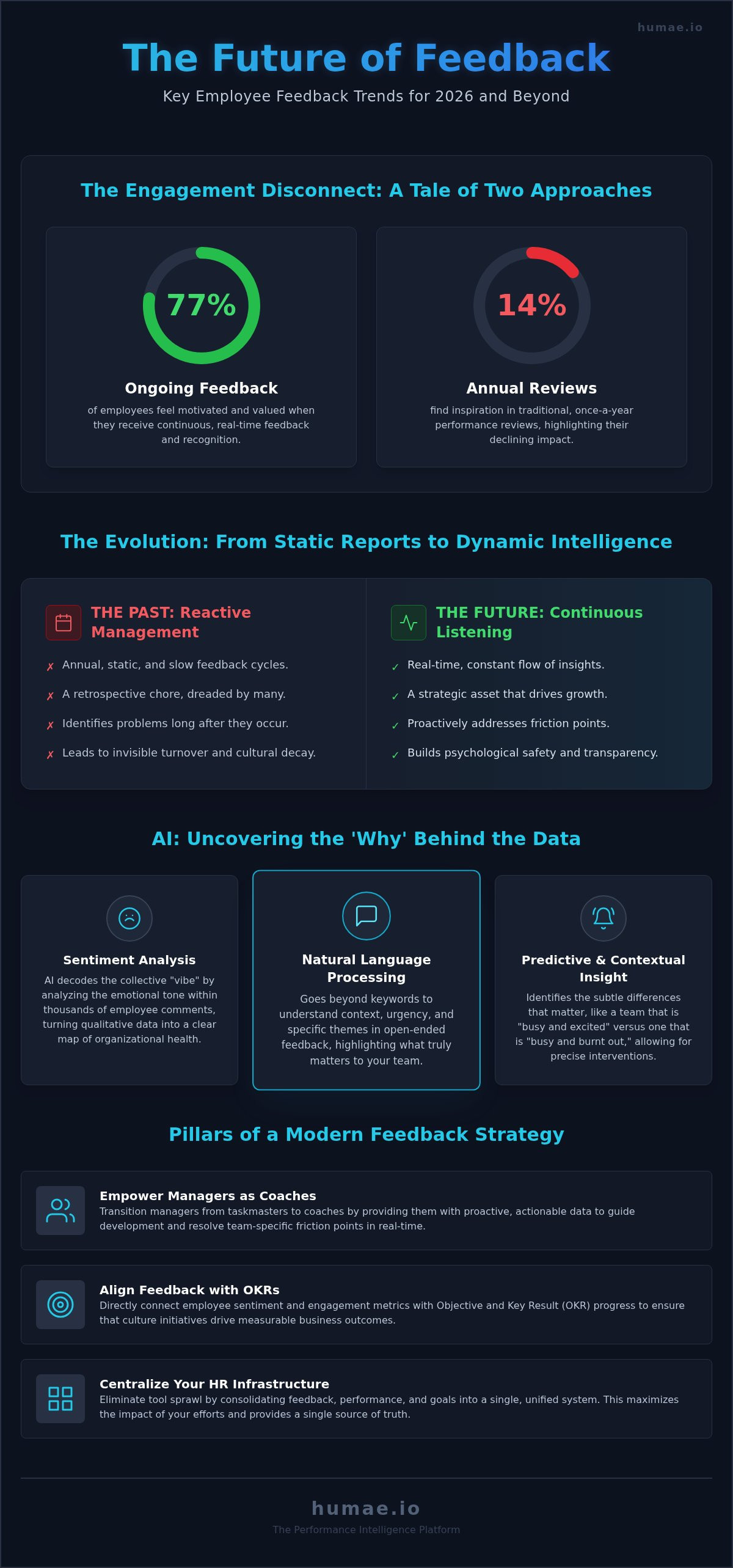
77% of employees who receive ongoing feedback feel motivated, yet only 14% find inspiration in traditional annual reviews. It's a frustrating reality for many HR leaders who see participation rates plummet while turnover risks go unnoticed until it's too late. You've likely felt the gap between a generic survey and the actual pulse of your team. Staying ahead of employee feedback trends in 2026 means moving beyond these static snapshots toward a more dynamic, human-centric approach.
We understand that you need more than just data; you need actionable intelligence that proves its value. In this article, you'll discover how AI-driven sentiment analysis and continuous listening are replacing outdated reviews to drive engagement and measurable ROI. We'll explore how integrating these tools with your OKR tracking creates a high-performance culture where proactive sentiment tracking reduces turnover before it starts. Get ready to transform your workforce management into a real-time intelligence stream.
Discover the future of HR with Humae. Visit our official website to explore our solutions, connect with our community on Facebook, or return to the home page.
Key Takeaways
- Transition from static annual reviews to continuous listening to capture the real-time pulse of your workforce.
- Leverage AI and Natural Language Processing to uncover the "why" behind employee scores for deeper performance intelligence.
- Stay ahead of employee feedback trends by empowering managers to act as coaches using proactive, actionable data.
- Align employee sentiment directly with OKR progress to ensure your engagement initiatives drive strategic business outcomes.
- Centralize your HR infrastructure with Humae to eliminate tool sprawl and maximize the impact of your culture initiatives.
Discover more at the Humae official website, follow us on Facebook, or return to the home page.
The Evolution of Feedback: Why Continuous Listening is the 2026 Standard
The annual performance review has officially become a relic of the past. In the fast paced environment of 2026, waiting twelve months to understand team sentiment is like trying to navigate a city using a map from the previous decade. The most significant shift in employee feedback trends is the move toward continuous listening. This isn't just a buzzword; it's the systematic collection of employee insights at every touchpoint of their journey. Organizations are realizing that feedback shouldn't be a yearly event. Instead, it must be a constant flow of intelligence that informs every leadership decision.
Traditional models like 360-degree feedback were a great start, but they often remained tethered to rigid, slow schedules. Today, the cost of silence is too high. Delayed feedback creates a vacuum where invisible turnover and productivity loss thrive. When issues go unspoken for months, they fester into cultural rot. Shifting to flow-based intelligence allows companies to catch these signals in real-time, transforming feedback from a retrospective chore into a strategic asset that powers growth.
Breaking the Cycle of Reactive Management
Waiting for an exit interview to find out why your best talent is leaving is a failed strategy. By then, the damage is done. Continuous listening is the heartbeat of modern people operations, ensuring that leadership remains synchronized with the lived experience of every team member. Using short, frequent pulse surveys helps leaders identify specific friction points, such as software bottlenecks or team misalignments, before they escalate into formal grievances. This proactive approach builds a foundation of psychological safety. When employees see that their input leads to immediate, tangible changes, they feel safe to be honest, creating a virtuous cycle of transparency and improvement.
Meeting the Expectations of a Modern Workforce
The modern workforce, dominated by Millennials and Gen Z, has no patience for delayed communication. These generations grew up in a world of instant feedback and transparent data; they expect the same from their employers. Research shows that feedback frequency correlates directly with intrinsic motivation. It's no longer enough to offer generic perks or office snacks. Employees want meaningful, development-focused conversations that happen in the moment. They view feedback as a tool for personal growth, not a final judgment. By meeting this demand for immediacy, companies stay relevant in the current employee feedback trends and foster a culture of genuine engagement.
AI and Sentiment Analysis: The New Frontier of Performance Intelligence
Data points on a spreadsheet rarely capture the soul of a company. While traditional metrics tell you what is happening, they often fail to explain the emotional drivers behind those numbers. This gap is being closed by one of the most transformative employee feedback trends of 2026: AI-powered sentiment analysis. By using Natural Language Processing (NLP), organizations can now decode the collective "vibe" of their teams, turning thousands of open-ended comments into a clear map of organizational health.
The urgency for this technology is clear. According to the State of the Global Workplace Report, engagement levels remain a critical challenge for leadership worldwide. AI doesn't just count votes; it understands context. It recognizes the difference between a team that is "busy but excited" and one that is "busy and burnt out." This transition from basic human resource management to true performance intelligence allows leaders to act on nuances that were previously invisible to the naked eye.
How AI-Powered Sentiment Analysis Works
The process starts by analyzing the emotional tone and urgency within survey responses and digital feedback channels. AI identifies specific clusters of sentiment, such as frustration with a new tool or enthusiasm for a recent project launch. To maintain trust, these systems aggregate data to protect individual anonymity while still providing managers with actionable insights. It's the difference between simply hearing what people say and truly understanding how they feel in their daily workspace.
Predictive Analytics in People Operations
Predictive tools are moving from the finance department directly into the hands of people leaders. By examining historical sentiment data, AI can forecast turnover risk with startling accuracy. It often spots burnout patterns before the employees themselves realize they're reaching a breaking point. These systems also identify "culture champions" who drive morale and "at-risk" teams that need immediate support. Crucially, AI sentiment analysis removes subjective bias from performance reviews by focusing on objective linguistic patterns rather than a single manager's perspective. You can explore how our performance intelligence tools reveal these hidden patterns in real-time.
Empowering Managers: Turning Feedback into Actionable Strategy
Data without action is just noise. While AI can decode the emotional pulse of your organization, the responsibility for driving change rests firmly on the shoulders of your managers. In 2026, the most effective employee feedback trends focus on transforming managers from simple task masters into high-impact performance coaches. This shift is essential because managers account for 70% of the variance in team engagement. If they don't have the tools to interpret and act on sentiment data, the entire feedback loop collapses.
One of the biggest hurdles in modern HR is "Feedback Fatigue." This occurs when managers are overwhelmed by raw data or when employees feel their input disappears into a black hole. To solve this, organizations must make it easy for leaders to act. Closing the loop is non-negotiable. When an employee shares a concern and sees a visible, tangible change in their daily workflow, trust is reinforced. Training leaders to provide constructive criticism that inspires rather than discourages is a cornerstone of a high-performance culture. It's about moving from "what went wrong" to "how we grow together."
Providing Managers with Workforce Intelligence
Modern managers need the same level of data visibility as the C-suite to lead effectively. Real-time dashboards allow them to see team sentiment trends as they happen, rather than months after a project ends. Automated nudges within your HRMS can remind leaders of scheduled 1:1 check-ins or highlight teams that haven't received recognition recently. These tools don't replace the human touch; they enhance it by ensuring no employee feels overlooked. You can see how we enable this through the Humae Features designed specifically for manager empowerment.
The ROI of Manager Enablement
Investing in your managers pays direct dividends. By reducing the administrative burden of performance management, leaders can spend more time on strategic alignment and mentoring. Better manager-employee relationships lead to higher retention and improved productivity, which directly impacts the bottom line. When feedback becomes a natural part of the daily rhythm, the friction of traditional reviews vanishes. For a deeper dive into these leadership shifts, read our guide on What Is Management? The Definitive Guide for Modern Leaders in 2026. Staying current with employee feedback trends ensures your leadership team remains a competitive advantage.
Integrating Feedback with OKRs for Strategic Alignment
Feedback that exists in a vacuum is a missed opportunity. One of the most critical employee feedback trends in 2026 is the bridge between how people feel and what they actually achieve. For too long, companies treated engagement and business goals as two separate silos. If your team is struggling with burnout or lack of resources, your Objectives and Key Results (OKRs) will inevitably stall. By integrating real-time sentiment with goal tracking, you create a holistic view of organizational health that allows for rapid, data-backed pivots.
The synergy between "how we feel" and "what we achieve" is the engine of a high-performance culture. When feedback is mapped directly to strategic priorities, it stops being a HR checkbox and starts being a business intelligence tool. If a high-priority key result is at risk, real-time feedback can often pinpoint the exact blocker, whether it's a technical hurdle or a team misalignment, before it derails the entire quarter.
The Feedback-OKR Loop
A functional feedback loop identifies blockers in high-priority key results while they're still manageable. Instead of guessing why a project is lagging, leaders can look at the sentiment data associated with that specific team. This also works for celebrating wins. Positive feedback that reinforces high-performance behaviors makes employees feel seen and valued, which is the strongest driver of intrinsic motivation. Understanding the OKR meaning in this modern context is about seeing goals as living organisms powered by human energy.
Comparison: Annual Reviews vs. OKR-Linked Feedback
The shift from retrospective reviews to goal-aligned intelligence is best understood through the impact on the daily workflow. Modern systems don't just look back; they help you look forward.
| Feature | Traditional Annual Review | OKR-Integrated Feedback |
|---|---|---|
| Frequency | Once or twice a year | Continuous and real-time |
| Data Source | Manager memory and bias | AI-driven sentiment and objective data |
| Strategic Impact | Disconnected from daily goals | Directly influences OKR progress |
| Motivation | Compliance-driven and stressful | Development-focused and inspiring |
Making this transition doesn't have to be complex. Humae's OKR Tracking simplifies this integration by centralizing your goals and feedback in one intuitive place. Align your team's energy with your company's vision today.
Implementing Your 2026 Feedback Infrastructure with Humae
Adopting the latest employee feedback trends requires more than just a new philosophy; it demands a robust, centralized infrastructure. Many organizations fall into the trap of tool sprawl, where sentiment data lives in one app, OKRs in another, and the employee directory in a third. This fragmentation creates friction for managers and confusion for employees. To build a high-performance culture in 2026, you must consolidate these streams into a single source of truth. Humae provides this centralized foundation, ensuring that every piece of feedback is contextualized within the broader workforce management framework.
The success of any new system depends on adoption. If an interface is clunky or difficult to navigate, participation rates will naturally decline. We've designed our platform with a deep focus on the human experience, making it as intuitive as the consumer apps your team uses every day. By combining AI-driven sentiment analysis with real-time OKR tracking and a comprehensive employee directory, we make it easy for everyone to stay aligned. This simplicity is what allows you to scale a healthy feedback culture from a small startup to a global enterprise without losing the personal touch.
Building a Foundation for Growth
Fragmented HR tools inevitably lead to a fragmented culture. When data is scattered, leadership loses the ability to see the big picture, making it impossible to manage global teams effectively. An AI-powered HR platform acts as the connective tissue for your organization, bridging the gap between different regions and departments. By centralizing your operations, you ensure that every employee, regardless of their location, feels heard and valued. You can explore how we solve these challenges on the Humae Homepage, where we offer a unified approach to modern workforce management.
Next Steps: Launching Your Continuous Feedback Loop
Transforming your organizational culture doesn't happen overnight, but it does start with a clear plan. Begin by auditing your current feedback tools and measuring your participation rates; if they're low, it's a sign that your current system isn't meeting employee expectations. Next, define the core engagement metrics that will drive your success in 2026. Transitioning to dedicated performance intelligence software is the single most effective way to ensure your feedback loop remains a driver of growth rather than an administrative burden. It's time to move beyond static surveys and embrace the future of real-time intelligence.
Leading the Shift Toward Real-Time Intelligence
The landscape of modern work demands agility. Staying current with employee feedback trends is no longer about checking a box; it's about building a culture that listens, understands, and acts in the moment. You've seen how continuous listening and AI-powered sentiment analysis bridge the gap between raw data and human emotion. By integrating these insights with your OKRs, you ensure that every team member remains aligned with the company's vision while feeling genuinely supported in their growth.
Moving toward a centralized, high-performance culture is a strategic choice that pays dividends in engagement and retention. It's time to replace fragmented tools with a unified vision for your people. Streamline your workforce with Humae: The AI-powered HR platform. With our AI-driven performance intelligence, real-time OKR tracking, and global workforce management infrastructure, you can turn feedback into your greatest competitive advantage. Let's build a more connected, inspired, and high-performing workplace together.
Frequently Asked Questions
What are the biggest employee feedback trends for 2026?
The most significant employee feedback trends for 2026 focus on continuous listening, AI-driven sentiment analysis, and the integration of feedback with strategic OKRs. Organizations are abandoning the slow, twelve month cycle of annual reviews in favor of real-time performance intelligence. This shift allows leadership to stay synchronized with the workforce and react to cultural shifts as they happen.
How does AI sentiment analysis improve employee engagement?
AI sentiment analysis improves engagement by decoding the emotional context behind employee comments. It uses Natural Language Processing to identify themes like burnout, excitement, or frustration that numbers alone can't capture. By understanding the "why" behind the scores, you can implement targeted changes that show employees their voices truly matter, which is a powerful driver of intrinsic motivation.
Why is continuous feedback more effective than annual performance reviews?
Continuous feedback is more effective because it provides immediate relevance to the employee's daily work. Annual reviews are often retrospective and disconnected from current challenges, making the advice feel outdated by the time it's delivered. Regular touchpoints foster a culture of ongoing growth and psychological safety, allowing for course corrections before small friction points turn into major turnover risks.
Can employee feedback be integrated with OKR tracking?
Yes, integrating feedback with OKR tracking is essential for modern strategic alignment. This connection allows you to see how team sentiment directly impacts your ability to reach specific key results. When a goal is at risk, sentiment data can reveal if the cause is a lack of resources, a technical bottleneck, or team misalignment, providing a holistic view of performance.
How do I prevent survey fatigue in my organization?
You prevent survey fatigue by ensuring that every survey is short, relevant, and leads to visible action. Employees don't get tired of sharing their opinions; they get tired of being ignored. When people see that their feedback results in tangible improvements to their workspace or processes, they remain eager to participate in the conversation.
Is AI-powered feedback anonymous and secure for employees?
Modern AI-powered platforms prioritize anonymity by aggregating data to highlight collective trends rather than individual responses. These systems use enterprise-grade security and privacy protocols to protect data at every level. This focus on privacy builds the trust necessary for employees to provide the honest, raw insights that drive genuine organizational improvement.
What is the role of managers in a modern feedback culture?
In a modern feedback culture, managers act as performance coaches who use data-driven insights to support their teams. They move away from being task masters and focus on mentoring and removing blockers. By accessing real-time workforce intelligence, they can have more meaningful 1:1 conversations that are focused on development and long-term success.