Employee Feedback for 2026 Manager Development
By Humae · 7 September 2026
employee feedback for manager development
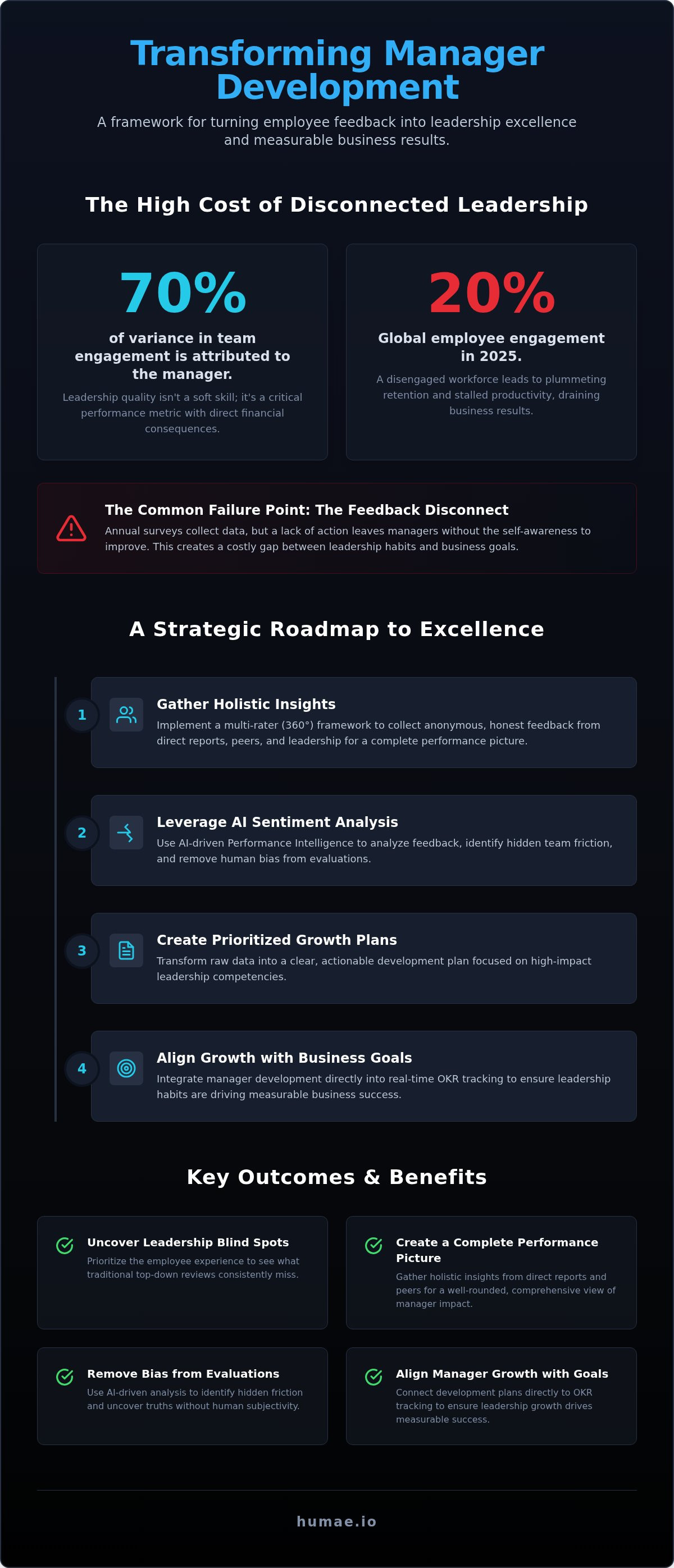
Managers account for at least 70% of the variance in team engagement, yet most organizations still treat their growth as a secondary concern. It’s a costly mistake when you consider that global engagement dropped to just 20% in 2025. You’ve likely seen the pattern: feedback is collected in annual surveys and then ignored, leaving managers without the self-awareness needed to lead effectively. This creates a frustrating disconnect where leadership behavior fails to move the needle on your actual business results or OKRs.
We understand that turning raw data into actionable change feels like a monumental task in a fast-paced environment. This guide provides a clear framework to transform employee feedback for manager development into a strategic roadmap for excellence and team productivity. You’ll discover how to integrate these insights into daily workflows and use AI-driven sentiment analysis to remove bias from the process. We will explore how to bridge the gap between leadership habits and measurable success, ensuring your managers become the catalysts for growth rather than the bottlenecks.
Humae | Modern HR & Performance Intelligence
Explore our platform: learn more
Connect with us on Facebook: humae01
Back to Home
Key Takeaways
- Learn how to uncover leadership blind spots that traditional top-down reviews miss by prioritizing the employee experience.
- Implement a multi-rater framework that gathers holistic insights from direct reports and peers to create a complete picture of performance.
- Discover how AI-driven sentiment analysis identifies hidden team friction and removes human bias from your evaluations.
- Transform raw employee feedback for manager development into a prioritized growth plan focused on high-impact leadership competencies.
- Align manager growth with business goals by integrating feedback directly into real-time OKR tracking and Performance Intelligence tools.
Humae | Modern HR & Performance Intelligence
Explore our platform: learn more
Connect with us on Facebook: humae01
Back to Home
Why Employee Feedback is the Engine of Manager Development
Manager development isn't a checklist of corporate workshops or a static set of leadership principles. It's the lived experience of every team member. By 2026, we've realized that the most effective growth happens through the lens of employee experience. Traditional top-down reviews often fail because they only capture what senior leadership observes from a distance. In contrast, employee feedback for manager development identifies the subtle blind spots that actually impact daily output and team morale. It reveals the difference between a manager who simply manages tasks and one who truly inspires people.
We are witnessing a definitive shift from annual performance ratings to continuous intelligence streams. Modern organizations no longer wait for a year-end post-mortem to address leadership gaps. They treat feedback as a real-time data flow that allows for immediate course correction. This agile approach ensures that leadership growth keeps pace with the speed of business. In 2026, strategic manager development feedback serves as the primary infrastructure for organizational agility and sustainable leadership excellence.
The ROI of Better Leadership
Leadership quality is a hard metric with direct financial consequences. Research indicates that managers account for at least 70% of the variance in team engagement. When managers lack self-awareness, retention plummets and productivity stalls. Modern teams prioritize leaders who balance deep empathy with a tech-savvy approach to management. In a globalized workforce, the cost of poor management is no longer just a cultural issue; it's a significant drain on business results. Investing in employee feedback for manager development is the most direct way to protect your human capital and ensure team productivity remains high.
Feedback as Cultural Infrastructure
A feedback-rich environment does more than solve immediate problems; it fosters a genuine growth mindset across the entire organization. We must move beyond the outdated definition of feedback as a list of grievances. Instead, it should be viewed as a proactive tool for professional evolution. By implementing data-driven employee engagement strategies, organizations build the trust necessary for honest dialogue. This foundation of trust allows for meaningful 360-degree feedback, where direct reports and peers provide the insights needed to map out a clear path to leadership mastery. It transforms the workplace into a space where everyone, especially managers, is constantly learning and improving.
Humae | Modern HR & Performance Intelligence
Explore our platform: learn more
Connect with us on Facebook: humae01
Back to Home
The Multi-Rater Framework: 360 Feedback and Beyond
The 360-degree feedback model is more than a performance appraisal; it's a diagnostic tool for leadership health. By collecting insights from direct reports, peers, and senior leadership, organizations gain a holistic view of a manager's impact. This multi-rater approach is essential for effective employee feedback for manager development because it triangulates different perspectives to find the truth. Anonymity is the engine of this framework. Without the safety of confidential responses, direct reports often hesitate to provide the raw, honest insights that drive real change. When employees know their voices are protected, they offer the kind of actionable data that transforms a bottleneck manager into a visionary leader.
Pulse surveys complement these deep dives by offering rapid signals between major cycles. Instead of waiting for a massive quarterly report, pulse surveys allow for quick adjustments based on real-time sentiment. If a team feels communication is slipping after a major project launch, the manager knows within days. This agility prevents small issues from becoming systemic failures. It's about moving from a "once-a-year" event to a continuous stream of intelligence that supports daily growth.
Designing Effective Feedback Questions
Success starts with the right questions. Avoid vague inquiries about personality traits. Instead, focus on observable behaviors that directly impact the team. For example, rather than asking if a manager is "helpful," ask if they "provide the resources and clarity needed to meet team OKRs." Balance quantitative ratings with open-ended qualitative comments. This mix provides both a measurable baseline for tracking growth and the specific context needed for deep self-reflection. Questions like "What is one specific action this manager could take to better support your daily workflow?" often spark the most significant breakthroughs.
Frequency and Timing of Feedback Cycles
The annual review is a relic of a slower era. Modern teams operate in sprints, and their feedback should match that pace. Quarterly check-ins are far more effective because they keep development goals top-of-mind throughout the year. Aligning these cycles with project milestones or OKR periods ensures that growth is tied to actual business outcomes. It's also vital to leave enough space between cycles. Managers need time to actually implement the changes suggested by the employee feedback for manager development data before being measured again. For teams looking to streamline this process, exploring integrated performance intelligence tools can make high-frequency feedback feel effortless rather than administrative.
Humae | Modern HR & Performance Intelligence
Explore our platform: learn more
Connect with us on Facebook: humae01
Back to Home
Leveraging AI for Performance Intelligence and Sentiment Analysis
Raw data is often overwhelming. While the multi-rater framework provides the necessary inputs, AI-driven sentiment analysis acts as the filter that turns those inputs into intelligence. Modern leadership requires an objective view of team dynamics that human observation alone cannot provide. AI identifies hidden team friction by analyzing the tone and context of comments, surfacing issues like burnout or communication breakdowns before they escalate. This technology effectively removes human bias from performance evaluations. It ensures that a manager’s growth plan is based on consistent data patterns rather than the subjective "loudest voice" in a single survey cycle.
Global teams benefit immensely from this technological layer. AI can identify specific patterns in employee feedback for manager development across different departments and geographic locations. If a leadership style works in one region but causes friction in another, real-time analytics dashboards visualize these discrepancies instantly. This allows senior leadership to see leadership growth as a measurable trend line. It transforms feedback from a static report into a living map of organizational health.
From Raw Data to Actionable Insights
AI doesn't just collect data; it distills it. It can summarize thousands of qualitative comments into three specific, high-impact actions for a manager to take. This level of performance intelligence allows organizations to predict turnover risks by identifying declining sentiment trends early. By linking these feedback signals directly to modern hris systems, companies create a unified view of their workforce. This integration ensures that manager development isn't an isolated HR project but a core part of the company's operational infrastructure.
Real-Time Feedback for Agile Teams
Agile teams move too fast for quarterly delays. Immediate sentiment capture after key meetings or project milestones provides the rapid loop necessary for behavioral change. AI tools now prompt managers with specific development suggestions based on the latest feedback received. If a team indicates a lack of clarity on goals, the system suggests a coaching session or a specific communication template. We maintain a human-centric approach by using these automated tools to handle the heavy lifting of data processing. This leaves managers with more time for what matters most: building genuine connections and supporting their people.
Humae | Modern HR & Performance Intelligence
Explore our platform: learn more
Connect with us on Facebook: humae01
Back to Home
Building a Manager Development Plan from Employee Data
Collecting data is only half the battle. The real transformation occurs when you translate those insights into a structured, actionable growth strategy. A successful plan for employee feedback for manager development doesn't just list weaknesses; it builds a roadmap for leadership mastery that feels achievable and supportive. By following a clear, step-by-step process, you ensure that feedback leads to measurable behavioral changes rather than sitting idle in a digital file.
- Step 1: Analyze with a Visionary Mindset. Look beyond individual comments to find recurring themes. Instead of viewing negative feedback as a failure, see it as a blueprint for the manager your team needs in the future.
- Step 2: Prioritize Key Competencies. Attempting to fix everything at once leads to burnout. Identify one or two high-impact areas, such as psychological safety or strategic delegation, and focus all development efforts there for the next quarter.
- Step 3: Set Measurable OKRs. Leadership growth should be as trackable as sales targets. Define an Objective, like "Improve Team Communication," and pair it with Key Results, such as "Achieve a 15% increase in team clarity scores in the next pulse survey."
- Step 4: Schedule Continuous Check-ins. Development isn't a one-time event. Frequent, short conversations between HR and managers ensure that the plan remains relevant and that obstacles are removed in real-time.
Coaching and Mentorship Integration
Peer feedback is a powerful tool for internal networking. Use the data to pair managers who struggle in one area with "internal mentors" who excel in that same competency. This creates a community of practice where leadership skills are shared organically. HR’s role shifts from a disciplinarian to a facilitator, creating a safe space where managers feel comfortable discussing their growth areas without fear of judgment. This human-centric approach ensures that technology supports, rather than replaces, genuine professional connections.
Tracking Progress with Analytics Dashboards
Visualizing growth is essential for maintaining momentum. Modern analytics dashboards allow you to correlate leadership improvements directly with team OKR completion rates. When a manager sees that their improved communication scores lead to faster project delivery, the value of the development plan becomes undeniable. Sharing these success stories across the organization inspires other leaders to embrace the process. It turns employee feedback for manager development into a celebrated part of your company culture. Ready to see how data can drive your leadership team forward? Explore our Performance Intelligence solutions today.
Humae | Modern HR & Performance Intelligence
Explore our platform: learn more
Connect with us on Facebook: humae01
Back to Home
Scaling Leadership Excellence with Humae Performance Tools
Scaling leadership excellence requires more than just training sessions; it requires a robust technological foundation. Humae centralizes all leadership signals into one intuitive interface, making it possible to track growth across every level of the organization. This ensures that employee feedback for manager development is not a fragmented effort but a unified corporate strategy. Whether you are scaling a startup or managing a global enterprise, our platform provides the visibility needed to maintain high standards of leadership. By integrating these insights directly into the daily workflow, we help you build a culture where every manager has the tools to succeed.
One of the biggest challenges for HR leaders is connecting professional growth to actual business outcomes. Humae OKR tracking addresses this by ensuring that manager development goals are never isolated from company objectives. When a manager works on a specific competency, the platform correlates their progress with the team's ability to hit key results. This data-driven approach turns leadership development into a measurable driver of success. It creates a feedback loop where improved leadership habits lead to tangible improvements in team productivity and morale. We believe that when managers grow, the entire organization moves forward with them.
The Humae Advantage for Modern Managers
Modern leadership is demanding, and administrative tasks shouldn't get in the way of people management. We use AI to automate the heavy lifting of feedback cycles, from distribution to complex sentiment analysis. This allows your leaders to focus on coaching and strategy rather than spreadsheets. Our platform also includes an Employee Directory that keeps global teams connected, ensuring that feedback loops remain tight even across multiple time zones. From the moment of hiring through long-term Performance Intelligence, Humae manages the full leadership lifecycle. You can explore these capabilities in detail within the Humae features ecosystem.
Next Steps for Your Organization
Ready to transform your leadership culture? Starting your first AI-powered feedback cycle is simple and efficient. You can immediately begin gathering the insights needed to build a strategic roadmap for your team. We also invite you to join our community of visionary leaders on the Humae Facebook page to share best practices and stay updated on the latest HR trends. If you want to see how our Performance Intelligence tools can specifically benefit your organization, request a demo to witness the power of real-time analytics in action. It's time to turn employee feedback for manager development into your company's greatest competitive advantage.
Humae | Modern HR & Performance Intelligence
Explore our platform: learn more
Connect with us on Facebook: humae01
Back to Home
The Future of Leadership is Data-Driven and Human-Centered
Leadership in 2026 isn't about intuition; it's about the infrastructure you build to support your managers. By moving away from static annual reviews and embracing continuous intelligence, you create a culture where growth is constant and measurable. This shift ensures that every insight becomes a catalyst for professional evolution. It's time to stop guessing and start using the collective voice of your team to drive excellence.
Integrating employee feedback for manager development into your daily workflow ensures that leadership gaps are closed before they impact team productivity. With AI-powered sentiment analysis and real-time OKR tracking, you remove bias and align individual growth with global business goals. This is the foundation of a modern, resilient workforce that values both cutting-edge technology and the human element. Your managers deserve a roadmap that is as dynamic as the markets they navigate.
Start building better leaders with Humae today and provide your team with the global workforce management infrastructure they deserve. Your journey toward leadership excellence starts with the right data and a visionary partner.
Humae | Modern HR & Performance Intelligence
Explore our platform: learn more
Connect with us on Facebook: humae01
Back to Home
Frequently Asked Questions
How can I ensure employee feedback for managers remains anonymous?
You ensure anonymity by using centralized HR software that aggregates responses and removes identifying information before reporting. Modern platforms like Humae use advanced encryption and data thresholds to prevent managers from tracing comments back to specific individuals. This protection is vital for gathering honest employee feedback for manager development. When team members feel safe, they provide the actionable insights necessary for genuine leadership growth without fear of professional repercussions.
What are the best questions to ask employees about manager development?
The most effective questions focus on observable behaviors and the impact of leadership on daily workflows. Instead of asking about personality, ask if the manager provides the necessary resources to meet team OKRs or if they facilitate a psychologically safe environment for sharing ideas. You should also include open ended questions like "What is one specific action this manager could take to support your growth?" This mix of quantitative and qualitative data provides a clear roadmap for improvement.
How often should we collect feedback for leadership growth?
You should move away from annual cycles and implement continuous or quarterly feedback streams. In 2026, the pace of business requires more frequent signals to ensure managers can adjust their behavior in real time. Quarterly check ins paired with monthly pulse surveys allow for agile leadership development. This frequency ensures that growth goals remain top of mind and that managers have enough time to implement changes between major evaluation periods.
Can AI sentiment analysis really understand complex human emotions?
AI sentiment analysis excels at identifying patterns in tone and context that human readers might miss. By analyzing thousands of comments across a global workforce, it can surface hidden friction, burnout risks, or declining morale before they become systemic issues. While it doesn't replace human empathy, it provides an objective baseline by summarizing complex emotions into actionable themes. This technology removes human bias from the evaluation process, making manager development plans more accurate and fair.
What is the difference between a performance review and manager development feedback?
A performance review is typically an evaluative, past oriented assessment of results, while manager development feedback is a future oriented growth strategy. Reviews focus on whether targets were met; development feedback uses employee insights to identify leadership blind spots and skill gaps. By treating employee feedback for manager development as a separate, continuous process, you create a supportive environment where managers feel empowered to evolve rather than just being judged on historical data.
How do we handle a manager who receives consistently negative feedback?
You should treat consistently negative feedback as a strategic roadmap for intervention rather than a purely disciplinary matter. Use the data to identify specific leadership competencies that need improvement and pair the manager with an internal mentor or coach. HR plays a crucial role here by facilitating safe conversations and setting measurable goals through an OKR framework. If sentiment doesn't improve over multiple cycles, the data provides a clear, objective basis for more serious organizational decisions.
Does employee feedback actually improve manager performance?
Yes, data shows that managers who receive regular, meaningful feedback are significantly more likely to lead highly engaged teams. Since managers account for at least 70% of the variance in team engagement, their self awareness directly correlates with business results. When leaders understand how their behaviors affect their direct reports, they can make the specific adjustments needed to boost productivity and retention. Feedback provides the necessary mirror for a manager to see and correct their own bottlenecks.