Data Migration for New HRIS System: The Strategic 2026 Implementation Guide
By Humae · 3 July 2026
data migration for new hris system
What if your data migration for new hris system wasn't a technical hurdle to overcome, but the precise moment your organization unlocked its true potential? It's natural to feel a sense of dread when facing legacy systems filled with inconsistent formats or the looming threat of data corruption. You've likely spent years building a history of performance and culture. The thought of losing that legacy to a spreadsheet error or manual entry fatigue is enough to keep any HR leader awake at night.
We understand that behind every data point is a person's career and a manager's insight. This guide is designed to help you orchestrate a flawless transfer that protects your history and powers your future HR intelligence. You'll learn how to achieve a clean, accurate employee directory while maintaining total operational continuity. We'll explore the 2026 strategic roadmap for preserving historical data and automating the heavy lifting, ensuring your team stays focused on people instead of pixels.
Key Takeaways
- Discover why a strategic data migration for new hris system is the vital foundation for your modern HRIS.
- Learn to apply the four pillars of a data audit to ensure every employee record is accurate and ready for the future.
- Master the art of data mapping to bridge legacy information with a modern workforce management infrastructure.
- Follow a disciplined five phase roadmap to minimize operational disruption and protect your historical performance data.
- Explore how Humae features turn migrated records into actionable intelligence for long term success.
Understanding the High Stakes of HRIS Data Migration
Moving your organization's most sensitive information isn't just a task for the IT department. It's a fundamental shift in how you value your people. Fundamentally, HRIS data migration is the process of transferring employee records, performance histories, and organizational structures from legacy software to a modern platform. It involves mapping historical performance data, benefits information, and personal identifiers into a new, more efficient architecture. Think of it as the foundation of your modern HRIS. If the foundation is cracked, the entire house is at risk.
The technical definition of data migration often focuses on moving bits and bytes between storage types or file formats. In 2026, we view this transition as a strategic data audit rather than a simple copy-paste exercise. A flawless data migration for new hris system ensures you aren't just moving old problems to a new interface. "Dirty data", which includes records that are outdated, duplicated, or incorrectly formatted, leads to more than just messy spreadsheets. It causes payroll discrepancies, compliance failures, and a breakdown in trust between HR and the workforce. When an employee's tenure is recorded incorrectly, it isn't a glitch; it's a personal frustration that impacts their engagement and sense of belonging.
The Strategic Value of Clean Data
Clean data is the fuel for modern performance intelligence and AI-driven analytics. When your records are accurate, your new system can identify skills gaps and turnover risks before they become organizational crises. A failed migration costs more than just the initial implementation fee. It costs hundreds of hours in manual correction and erodes your team's confidence in the technology you've promised will make their lives easier. Data integrity is the non-negotiable goal of every HR lead who wants to build a high-performing culture.
Overcoming the Fear of System Transition
It's normal to feel anxious about leaving years of history behind. Many HR professionals fear that critical records will vanish or become corrupted during the move. We encourage you to reframe this fear as an opportunity. This transition is your chance to shed redundant data structures that no longer serve your mission. By adopting a growth mindset, you transform a stressful technical event into a cultural reset. You aren't just moving files. You're clearing the path for a more human-centric way of working. Embracing the data migration for new hris system as a fresh start allows your team to focus on what they do best: supporting people.
The Essential Data Audit: Cleaning Your Legacy Information
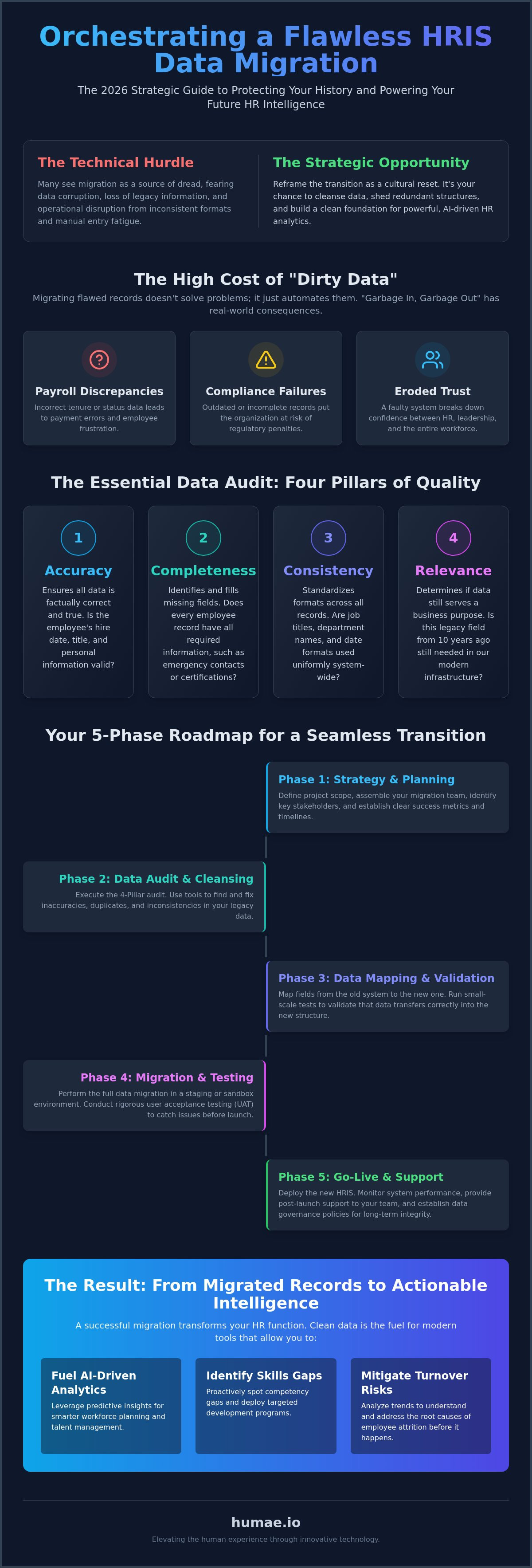
Success in any software transition depends on the quality of the information you feed into it. In the world of HR technology, the principle of "Garbage In, Garbage Out" remains the ultimate truth. If you migrate flawed records, your new platform will simply produce flawed insights at a faster rate. A successful data migration for new hris system begins with a rigorous audit built on four essential pillars. You must evaluate every record for accuracy, completeness, consistency, and relevance. Accuracy ensures the data is true; completeness identifies missing fields; consistency standardizes formats; and relevance determines if the data still serves a business purpose in 2026.
Modern audits now leverage AI to identify anomalies that the human eye might miss. AI tools can scan thousands of employee rows in seconds to spot conflicting hire dates or subtle variations in name spellings that indicate duplicate profiles. To prepare your data for the move, follow this essential checklist:
- Identify Duplicate Records: Search for matching National IDs or personal email addresses assigned to different internal IDs.
- Purge Obsolete Fields: Remove data points that no longer provide value, such as pager numbers or fax lines from a decade ago.
- Verify Email Formats: Ensure every record contains a valid, active corporate and personal email address to prevent communication blackouts.
- Standardize Job Titles: Align varied titles like "Sales Lead" and "Senior Sales Associate" into a unified organizational hierarchy.
A clean database allows you to fully leverage Humae's analytics dashboards for real-time workforce insights without the noise of historical errors.
Extracting Data from Legacy Systems
Extracting information from older, non-cloud systems often presents the steepest technical climb. These legacy databases might not offer easy API access, forcing you to rely on complex CSV exports that can lose formatting during the process. It's critical to prioritize data formatting early on to ensure compatibility with modern cloud structures. Raw data extraction requires a dedicated sandbox environment to prevent any accidental corruption of your live production environment during the export phase.
Cleansing for the Future
Once extracted, the cleansing phase turns raw information into a strategic asset. You must standardize naming conventions and date formats across the entire dataset to ensure smooth reporting later. If you encounter missing data points, avoid making guesses; instead, use this as an opportunity to engage employees through a self-service update. Compliance is equally vital. As of January 1, 2026, California's CPRA regulations require formal risk assessments for new data processing activities. Ensuring your data is GDPR and CPRA compliant during the cleansing phase protects your organization from significant legal risks and builds trust with your workforce.
Mapping Legacy Data to Modern Workforce Management Infrastructure
Data mapping serves as the strategic blueprint for your entire transition. It's the process of defining exactly how each field in your old database translates to your new environment. This isn't just about matching labels; it's about context and future utility. When you perform a data migration for new hris system, you're evolving from static, siloed records to a modern workforce management infrastructure. This evolution allows you to turn basic employee entries into AI-ready profiles that support predictive analytics and personalized growth paths. Without a precise map, your organizational intelligence becomes fragmented, making it impossible to gain a clear view of your talent landscape.
Longitudinal tracking depends on your ability to map historical performance data with surgical accuracy. If you lose the context of past achievements or previous feedback cycles, you lose the ability to see long-term trends. By carefully aligning old performance metrics with new standards, you ensure that your organizational memory remains intact across system generations. We aren't just moving numbers from one box to another. We're translating your company's history into a language that modern tools can use to predict future success.
Designing Your New Information Architecture
Modern directories in 2026 don't just list names and titles. They are structured to support skill-based or OKR-based frameworks. Instead of mapping a person to a rigid job description, you're mapping them to a dynamic set of capabilities and goals. This flexible architecture is what allows your data migration for new hris system to fuel real-time analytics dashboards. You want a system where data flows naturally into visual insights, helping leaders make faster, more human decisions. Consider these architectural priorities:
- Skill Tagging: Map traditional job duties to specific, searchable skill sets.
- Goal Alignment: Ensure historical OKRs are linked to current strategic objectives.
- Reporting Lines: Rebuild your org chart to reflect modern, matrixed team structures.
Handling Historical Performance Data
Moving OKR history and sentiment analysis records is one of the most complex parts of the process. Different systems use different logics for scoring and feedback. You must prioritize preserving these feedback loops to maintain your performance intelligence. Strategies for continuity include normalizing scores from legacy systems and ensuring that qualitative feedback remains linked to the correct historical period. This ensures your cultural memory isn't wiped clean during the move, allowing managers to see the full trajectory of an employee's growth from day one.
Your Step-by-Step Roadmap for a Seamless System Transition
Execution is where your strategic vision meets technical reality. Successfully executing a data migration for new hris system requires more than technical skill; it demands a disciplined, phase-based approach. We've moved beyond the era of simple data dumps. In 2026, a seamless transition is a choreographed event that ensures every employee record arrives in its new home ready for immediate use. This roadmap breaks the complexity into manageable stages, allowing your team to maintain focus on daily operations while building your future infrastructure.
The journey follows five distinct phases to ensure nothing is left to chance:
- Phase 1: Planning and Team Assembly. Define your success metrics and gather the experts who will lead the charge.
- Phase 2: Data Extraction and Initial Cleansing. Pulling the data from legacy systems and applying the "Garbage In, Garbage Out" filters we discussed in the audit phase.
- Phase 3: Mapping and Transformation. Converting your cleaned records into the new system's schema based on your strategic blueprint.
- Phase 4: Pilot Loading and Validation. Testing the migration with a subset of data in a safe, isolated environment.
- Phase 5: The Final Cutover and Post-Migration Audit. The official move to the new system, followed by a rigorous check to ensure total data integrity.
If you're ready to see how a modern system handles complex data effortlessly, discover our HRMS solutions and start your journey today.
Building Your Migration Task Force
Your task force is the engine of this transition. The HR project lead brings the essential context of "who" and "why", while the technical IT lead handles the "how" of the data transfer. Involving department heads early is vital; they often hold the keys to localized data quirks that can cause gaps later. A successful migration team acts as a bridge between HR needs and IT capabilities, ensuring that technical decisions always serve the human experience.
The Validation and Testing Phase
Never rush the final move. The validation phase involves conducting detailed spot checks on migrated employee records to ensure every field moved correctly. Running parallel systems for at least one cycle is a best practice. This allows you to verify payroll and time-off accuracy by comparing results from both the old and new systems. Only after these rigorous checks should you follow the final sign-off procedures to decommission the legacy system. This cautious approach protects your history and ensures your new environment is reliable from day one.
Ensuring Long-Term Data Integrity with Humae
Your data migration for new hris system shouldn't end with a simple confirmation email. It should mark the beginning of a more intelligent, human-centered era for your organization. Humae is designed to be the intuitive destination where your cleaned, audited, and mapped data finally comes to life. Once the technical transition is complete, the focus shifts from preservation to potential. Our platform ensures that the integrity you worked so hard to establish during the audit phase remains the standard for your organization's future.
By centralizing your workforce information, you eliminate the silos that lead to data decay. Humae features allow you to maintain a dynamic employee directory that updates in real-time, reflecting every promotion, skill acquisition, and organizational shift. It's not just a database; it's a living map of your talent. AI-driven intelligence then takes this migrated data and turns it into actionable growth insights. Instead of looking at rows of hire dates, you're looking at retention trends and career trajectories that help you make better leadership decisions.
Powering Performance with Migrated Insights
The true value of a successful data migration for new hris system is revealed when you begin using historical insights to fuel modern performance intelligence. Humae uses your migrated performance history to provide context for current OKR tracking and sentiment analysis. This allows managers to see the full narrative of an employee's journey, making feedback more empathetic and accurate. You're no longer just looking at a snapshot in time. You're viewing a continuous loop of development that drives collective success. This is where you move from the stress of migration to the excitement of organizational optimization.
A Partner in Your Digital Transformation
We view digital transformation as a journey, not a destination. Humae is committed to being more than just a software provider; we're a partner in your implementation journey. We understand that moving years of history is a high-stakes endeavor, which is why our platform is built to handle complex data structures with ease. A modern HRMS should be the last migration your team ever has to worry about. By building on a foundation of clean data and intuitive design, you create a culture where technology supports human connection rather than hindering it. It's time to stop managing records and start empowering people. We invite you to explore the Humae platform and see how we can transform your HR operations.
Elevate Your Organizational Intelligence Today
Your journey toward a more human-centric workplace starts with the integrity of your information. By treating your data migration for new hris system as a strategic audit rather than a technical chore, you've already set the stage for long-term success. You've learned how to purge legacy errors, map historical performance metrics to modern frameworks, and follow a disciplined roadmap that protects your team's productivity. These steps aren't just about moving files; they're about building a foundation for actionable insights that drive real growth.
Humae provides the centralized infrastructure startups and enterprises need to thrive in 2026. From advanced OKR tracking to sentiment analysis, our platform turns your historical data into a competitive advantage. You don't have to settle for static directories when you can have dynamic profiles and real-time analytics dashboards built for the modern era. It's time to transform your data into your most valuable asset.
Discover Humae: The AI-Powered HR Platform for Modern Teams
The future of your HR operations is bright. With the right partner, your digital transformation is just the beginning of a new chapter in employee experience and organizational success.
Frequently Asked Questions
How long does a typical data migration for a new HRIS system take?
A typical project takes between 12 to 24 weeks depending on your organization's size and data complexity. Planning and auditing usually consume the first third of this timeline. For mid-market companies, the technical data migration for new hris system often requires a phased approach to ensure zero downtime for essential payroll and reporting functions.
Can we migrate our historical performance reviews to a new system?
Yes, you can and should migrate these records to maintain your organizational memory. Modern platforms like Humae are built to ingest historical OKRs and feedback loops. This preservation allows your managers to see long-term growth trajectories and provides the necessary context for 2026 sentiment analysis tools.
Is it possible to automate the data cleansing process during migration?
Automation is now a standard feature for identifying anomalies like duplicate records or conflicting dates. AI-driven tools scan thousands of rows in seconds to highlight formatting errors that humans might miss. While AI handles the heavy lifting, your HR team provides the final human validation to ensure the data reflects the true state of your workforce.
What are the most common mistakes companies make during HRIS data transfer?
Most failures stem from a "Garbage In, Garbage Out" approach where teams skip the initial audit phase. Companies often underestimate the time needed for data mapping or fail to involve department heads early in the process. Another common error is ignoring the emotional impact on the HR team who must manage the transition while maintaining daily operations.
How do we ensure GDPR compliance while moving employee data?
You must implement end-to-end encryption and strict access controls during every phase of the transfer. In 2026, regulations like the Digital Omnibus Regulation require higher thresholds for breach notifications. Ensure your migration plan includes a formal risk assessment and adheres to data minimization principles by only moving what is legally or operationally necessary.
What happens if our legacy data is incomplete or formatted incorrectly?
These records require manual enrichment or an employee self-service campaign before the final cutover. Don't migrate broken data into a fresh system. Use a sandbox environment to test how the new schema handles your current records. If gaps exist, it's better to fix them at the source than to deal with reporting errors later.
Should we migrate all historical data or just the last few years?
We recommend migrating the last three to five years of active data for immediate performance intelligence. Older records should be archived in a secure, searchable format to satisfy legal requirements without cluttering your new interface. This balance ensures your system stays fast and your analytics remain focused on relevant, recent trends.
How much IT involvement is required for an HRIS migration in 2026?
IT remains a strategic partner, but the 2026 trend is toward low-code migration tools managed by HR leads. Your technical team handles the initial architecture and security protocols. However, a successful data migration for new hris system relies on HR owning the data context and ensuring the new platform serves the human needs of the organization.