Centralized HR Infrastructure: The 2026 Blueprint for Scaling Teams
By Humae · 12 September 2026
centralized hr infrastructure
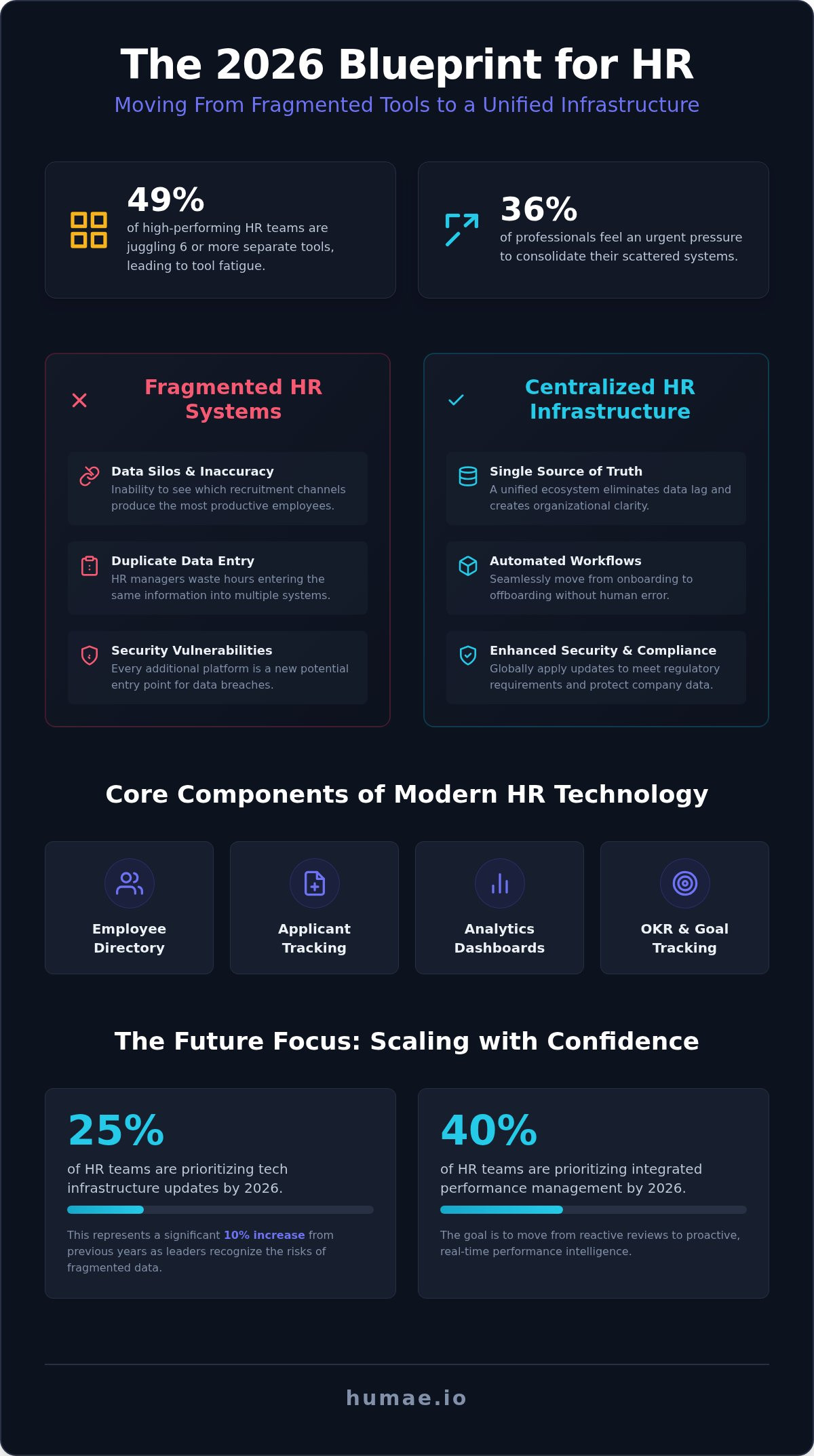
Nearly half of high-performing HR teams are currently juggling six or more different software tools. While we've spent years adding more tech to our stacks, 36% of professionals now feel the urgent pressure to consolidate their systems. You've likely felt the friction of jumping between an applicant tracking system and a separate performance tool, only to find the data doesn't match up. Manually syncing OKRs or hunting for time-off balances steals the energy you should be spending on your people.
Establishing a centralized hr infrastructure is no longer just a luxury for tech giants; it's the 2026 blueprint for any team that plans to scale without breaking. This unified approach eliminates data silos and creates a single source of truth for every employee interaction. In this article, you'll discover how a unified backbone streamlines your operations, enhances AI-driven sentiment analysis, and ultimately drives team performance. We'll look at the shift toward automated workflows that handle everything from onboarding to offboarding, giving you the real-time workforce analytics needed to lead with confidence and empathy.
Humae | Official Website | Facebook | Back to Home
Key Takeaways
- Move beyond fragmented spreadsheets to a unified ecosystem that serves as your organization's single source of truth.
- Build a centralized hr infrastructure that connects your Employee Directory with recruitment tools for a seamless candidate-to-hire journey.
- Identify the critical data silos in your current stack and learn the steps to integrate your workflows from onboarding to offboarding.
- Leverage AI-powered sentiment analysis and real-time OKR tracking to understand team productivity and health at a glance.
Humae | Official Website | Facebook | Back to Home
What is Centralized HR Infrastructure?
Decentralized data is a silent growth killer for modern companies. A centralized hr infrastructure acts as the digital nervous system of an organization, moving beyond simple storage to create a unified cloud-based ecosystem. It isn't just about keeping files in one place; it's about ensuring that every piece of employee data, from their initial job application to their latest performance review, lives in a single, interconnected environment. In 2026, updating this technology infrastructure has become a top priority for 25% of HR teams, a significant 10% increase from previous years as leaders realize that fragmented spreadsheets can't support rapid scaling.
Organizations now prioritize a single source of truth to eliminate the "data lag" that occurs when information is trapped in silos. By using a Human Resource Management System (HRMS), businesses can maintain strict compliance and data security. This is especially critical as regulatory requirements expand, such as the 2026 California mandates for annual workplace notices and emergency contact designations. A centralized system ensures these updates are applied globally, protecting the company from non-compliance penalties while keeping the focus on people rather than paperwork.
The Evolution of HR Systems
The transition from legacy on-premise servers to modern AI-integrated SaaS solutions has changed how we define workplace efficiency. Manual record-keeping often leads to "ghost data" where outdated information remains in the system for months. Modern platforms prevent these pitfalls by offering real-time accessibility. For remote and hybrid teams, this means having the same visibility into company goals and personal time-off balances regardless of their physical location. It transforms HR from a reactive administrative department into a proactive partner in organizational health.
Why Decentralization Fails Scaling Teams
Tool fatigue is a very real obstacle for high-performing teams. Research shows that 49% of these teams are currently using six or more HR tools, yet 36% feel an urgent need to consolidate. Managing employee data across multiple platforms creates several risks:
- Duplicate Data Entry: HR managers waste hours entering the same address or bank detail into three different systems.
- Inaccurate Reporting: When hiring data doesn't talk to performance tools, you lose the ability to see which recruitment channels produce the most productive employees.
- Security Vulnerabilities: Every additional platform is a new potential entry point for data breaches.
Scaling requires speed and accuracy. Fragmented systems provide neither, often leading to skewed workforce analytics that can result in poor hiring decisions or missed performance trends.
The Core Components of Modern HR Technology
Software is the backbone of organizational culture. While many leaders focus on soft skills, the actual centralized hr infrastructure determines whether those skills can thrive or if they'll be buried under administrative weight. A robust system integrates an Employee Directory, an Applicant Tracking System (ATS), and real-time Analytics Dashboards into a single, cohesive unit. This ensures that data flows naturally between departments without manual intervention.
When implementing a centralized HR model, you move from a reactive stance to a strategic one. This shift allows for performance intelligence that isn't hidden in static files but flows through the daily work life of your team. By 2026, 40% of HR teams are prioritizing this type of performance management to keep pace with rapid market changes. It's about building a system that feels less like a filing cabinet and more like a living map of your talent.
Hiring and Onboarding Infrastructure
Moving a candidate from "hired" to "onboarded" shouldn't require multiple logins or repetitive data entry. By automating the transition from applicant tracking to employee records, you reduce the risk of human error and save hours of manual work. Standardized onboarding experiences significantly improve long-term retention by ensuring every new hire feels supported and informed from day one. You can explore how these Humae features automate your workflow to keep the human element at the forefront of the hiring process.
Performance and Goal Tracking
Traditional annual reviews are no longer enough to keep modern teams aligned. Integrating OKR tracking directly into your employee directory makes goals visible, transparent, and actionable. Real-time feedback loops provide more value than traditional management cycles because they allow for course correction in the moment. If you're looking to refine your strategy, our OKR Meaning: The Definitive Guide breaks down how to set objectives that drive measurable results.
Workforce analytics transform executive decision-making from guesswork into a science. Instead of wondering why turnover is high in a specific department, you can use real-time dashboards to identify trends and intervene early. You might want to see how analytics dashboards can provide the clarity your leadership team needs to scale effectively.
Centralized vs Fragmented HR Systems: A Comparison
The debate between choosing Centralized or Decentralized HR has shifted from a strategic preference to a survival necessity. Fragmented systems act like a collection of isolated islands with no bridges; data exists, but it cannot move. When you rely on a centralized hr infrastructure, you create those bridges. This connectivity is the difference between an HR team that spends its day doing detective work across spreadsheets and one that drives growth through instant visibility.
Administrative speed is the most immediate benefit of a unified model. In a fragmented setup, a simple task like updating an employee's role requires manual entry in the directory, the performance tool, and the time-off tracker. Centralized systems automate this, ensuring that a single change ripples through the entire ecosystem. This efficiency doesn't just save time; it ensures that your leadership team is always making decisions based on the most current data available, which is vital for maintaining momentum during rapid scaling phases.
Data Accuracy and Reporting
Manual data synchronization is the primary source of organizational "noise." When hiring data doesn't match performance records, your reporting becomes a liability rather than an asset. Centralized reporting enables predictive workforce planning by identifying patterns that fragmented tools miss. For example, by using integrated analytics dashboards, you can cross-reference time-off trends with engagement scores to identify turnover risks weeks before an employee decides to leave. This proactive approach turns HR from a record-keeping function into a strategic intelligence hub.
Employee Experience and Self-Service
Modern employees expect the same intuitive experience from their workplace tools that they get from their personal apps. A centralized infrastructure empowers your team with self-service directories, allowing them to manage their own records and time-off requests without sending a single email. This reduces the volume of administrative HR tickets, freeing your people partners to focus on culture and development. For a deeper look at how these systems function in a modern workplace, see our guide on What is Workforce Management?
How to Implement a Centralized HR Framework
Implementation is where vision meets reality. Building a centralized hr infrastructure requires a deliberate roadmap to ensure your team actually uses the new tools you provide. It isn't enough to simply buy the software; you must architect a system that fits your specific culture. The process begins with a cold, hard look at your current digital habits and ends with a team that feels empowered by their technology rather than burdened by it.
Success follows a clear four-step path. First, conduct a thorough audit of your existing HR tool stack to see where your money is going. Second, identify the data silos where information gets stuck, such as the gap between your hiring emails and your performance spreadsheets. This is where you map out your integration requirements. Third, select an AI-powered HRMS that aligns with your 2026 growth goals. Finally, execute a phased data migration. Moving everything at once is a recipe for chaos; instead, migrate in stages to verify data accuracy at every turn. This methodical approach ensures that your centralized hr infrastructure remains a source of truth rather than a source of confusion.
Auditing Your Current HR Stack
Start by identifying redundant subscriptions and underused features that are draining your budget. You might find that different departments are paying for separate feedback tools that don't talk to each other. Talk to your managers. Ask them where they experience the most friction in their daily workflows. Is it tracking time off? Is it finding an employee's record? These answers will define the core requirements for your new system. You want a platform that solves real problems, not one that just adds another icon to the desktop.
Managing the Transition and Adoption
Software is only as good as its adoption rate. Training your team on the new centralized interface is critical for long-term success. Set clear expectations from day one regarding performance tracking and OKR usage. When everyone understands how their data contributes to the bigger picture, they're more likely to engage with the platform. You can see how it works in practice to understand the best ways to guide your team through this transition. If you're ready to modernize your organization, start building your unified HR backbone with Humae today.
The Future of HR: AI-Powered Infrastructure with Humae
Artificial intelligence is no longer an experimental add-on; it is the core of a resilient centralized hr infrastructure. While competitors often view AI as a separate tool for recruiters, the 2026 landscape demands that intelligence be woven directly into the fabric of your workforce management. As of 2026, 42% of white-collar teams report using AI daily. For HR leaders, this means moving away from reactive data entry toward predictive people operations. Humae provides this intelligence layer, transforming your employee directory into a living map of talent and potential.
Building a culture of growth requires more than just setting goals; it requires visibility. By centralizing OKR tracking and performance intelligence, you create a transparent environment where every contributor sees how their work moves the needle. This approach is equally vital for agile startups and complex enterprises. A single platform ensures that as your team scales, your culture doesn't dilute. You maintain the same high standards for feedback and alignment whether you have ten employees or ten thousand.
Beyond Basic HRMS: The Intelligence Layer
Traditional systems tell you what happened in the past, but an AI-powered infrastructure tells you what's likely to happen next. Humae uses deep performance intelligence to identify top performers and potential leadership candidates long before a formal review cycle begins. This proactive identification helps prevent talent stagnation and ensures your internal mobility remains high.
Automated sentiment analysis is perhaps the most human application of this tech. It replaces the dreaded annual survey with real-time insights into team health. By analyzing continuous feedback loops, the system alerts managers to burnout risks or engagement drops as they happen. In high-volume hiring scenarios, AI also streamlines applicant tracking, allowing your team to focus on the human connection rather than the resume screening. This ensures that even during rapid growth, the candidate experience remains personal and empathetic.
Starting Your Infrastructure Journey
Choosing the right partner for your centralized hr infrastructure is a strategic decision that pays dividends for years. The long-term ROI of a unified backbone is found in the hours of administrative work saved and the reduction in turnover through better engagement. Humae is designed for modern, tech-forward teams who value efficiency without sacrificing the human element. It's time to move past the era of fragmented tools and embrace a unified vision for your people. You can Explore Humae today to see how a centralized intelligence platform can redefine your organizational success.
Architecting Your Organization for 2026 and Beyond
Scaling a team requires more than just hiring fast. It requires a digital architecture that supports every person you bring on board. We've explored how a centralized hr infrastructure removes the friction of manual data entry and provides the real-time workforce analytics needed for strategic growth. By unifying your hiring, onboarding, and performance workflows, you ensure that culture remains a priority even as your headcount doubles.
Your organization deserves a single source of truth that grows with you. With real-time OKR tracking for high-growth teams and AI-driven sentiment analysis for better culture, you're not just managing a database; you're nurturing a high-performing community. Transitioning from fragmented tools to a unified platform is the most significant investment you can make in your organizational health this year.
Streamline your team with Humae: The AI-powered HR platform. Your future success depends on the foundation you build today. Let's make it a strong one.
Frequently Asked Questions
What are the main benefits of a centralized HR infrastructure?
The primary benefits include a single source of truth for employee data, automated workflows, and enhanced data security. By implementing a centralized hr infrastructure, organizations eliminate redundant data entry and reduce administrative errors. This unified backbone allows for real-time reporting and ensures that hiring, performance, and time-off tracking are always in sync. It transforms HR from a reactive administrative hub into a strategic partner that drives team growth.
How does centralized HR software improve employee retention?
Centralized systems improve retention by creating a more transparent and supportive employee experience. When people have easy access to self-service directories and clear OKR tracking, they feel more connected to the company's mission. Humae's AI-driven sentiment analysis also identifies burnout risks early, allowing managers to intervene before an employee decides to leave. Clear career paths and consistent feedback loops make employees feel valued and heard throughout their tenure.
Is it difficult to migrate data from old systems to a centralized platform?
Migration isn't difficult if you follow a phased, methodical approach. While moving years of records from fragmented spreadsheets might seem daunting, modern platforms like Humae are built for high-integrity data transfers. The key is to conduct a thorough audit of your current stack first. By identifying data silos and cleaning your records before the move, you ensure that your new centralized hr infrastructure starts with accurate, high-quality information.
What is the role of AI in modern HR infrastructure?
AI serves as the intelligence layer that turns static data into actionable insights. In 2026, AI is no longer just a tool for recruiters; it's the core of the infrastructure itself. Humae uses it to power real-time sentiment analysis, identify high-potential leadership candidates, and automate high-volume applicant screening. This technology allows HR teams to focus on human relationships while the system handles repetitive tasks and provides predictive analytics to guide executive decisions.
Can small startups benefit from centralized HR systems?
Absolutely, startups benefit by building a scalable foundation from day one. It's much easier to establish a unified system with ten employees than to fix fragmented data with a hundred. Centralized platforms provide startups with the same professional tools used by enterprises, such as integrated ATS and performance intelligence. This allows small teams to hire faster, manage time off efficiently, and maintain a strong culture as they grow.
How does a centralized directory improve cross-team collaboration?
A centralized directory acts as a living map of the organization's talent. It goes beyond a simple list of names by including skills, roles, and current projects. This transparency helps employees find the right internal experts for collaboration without going through multiple gatekeepers. When everyone has access to the same intuitive interface, communication becomes faster and more direct, breaking down the silos that often hinder productivity in scaling teams.
Does centralized infrastructure help with regulatory compliance?
Yes, it provides a secure and auditable record of all employee interactions. As compliance laws grow more complex in 2026, such as California's new emergency contact mandates, having a single source of truth is essential. A centralized system ensures that every employee receives required notices and that their designations are tracked accurately. It reduces the risk of non-compliance penalties by automating the documentation needed for labor law audits.