Building a High-Performance Culture: The 2026 Leadership Blueprint
By Humae · 8 August 2026
building a high-performance culture
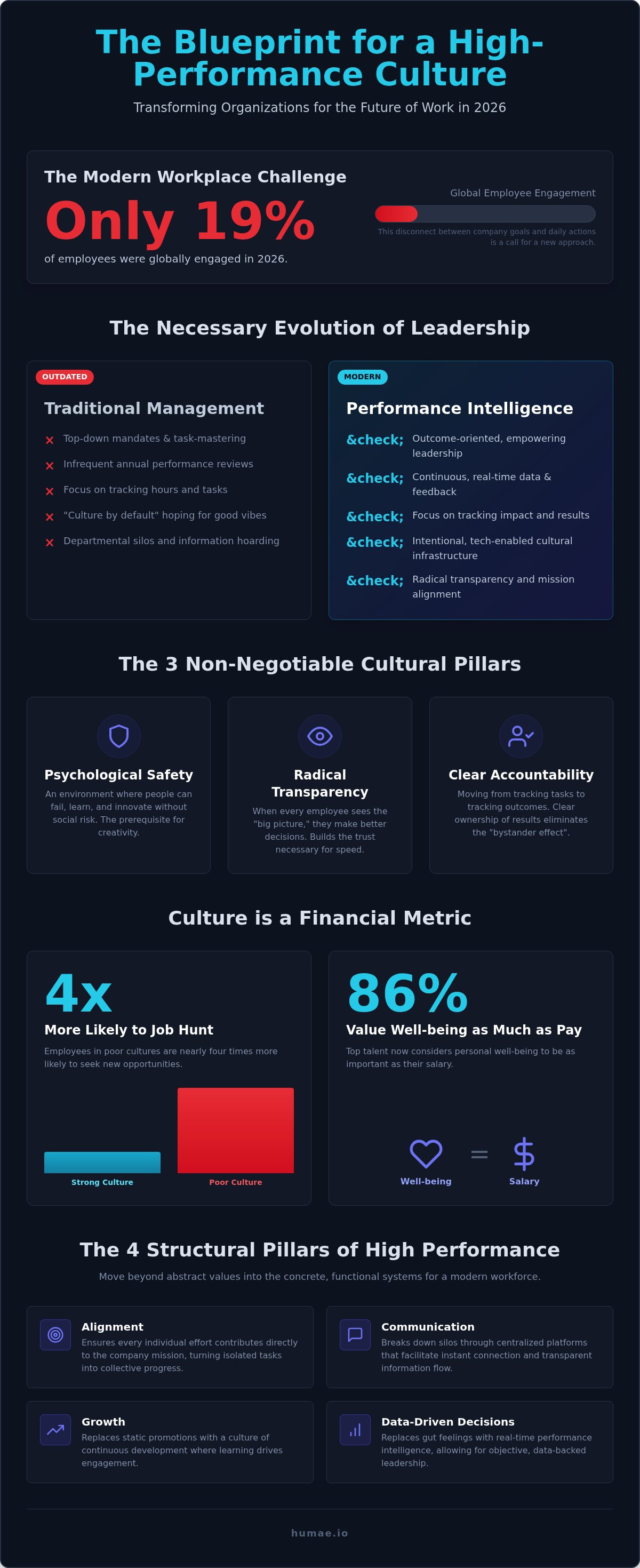
Did you know that despite our hyper-connected world, global employee engagement has dropped to just 19% in 2026? It's a wake-up call for leaders who realize that traditional management styles are no longer enough to keep top talent focused and inspired. You likely feel the weight of this trend when company goals don't translate into daily actions or when tracking cultural health feels like guesswork. Building a high-performance culture isn't about a top-down mandate anymore; it's about creating a technology-enabled infrastructure that supports every individual.
In this blueprint, you'll discover how to transform your organization into a powerhouse using modern alignment frameworks and AI-driven intelligence. We'll show you how to move from outdated annual reviews to continuous performance intelligence that drives retention and productivity. From real-time OKR tracking to sentiment analysis, we're providing the roadmap you need to lead with empathy and data-backed confidence.
Built with Humae. Return to home page or follow us on Facebook.
Key Takeaways
- Transition to outcome-oriented leadership that empowers employees to take full ownership of their results and professional growth.
- Discover the structural pillars of building a high-performance culture, focusing on mission alignment and the removal of departmental silos.
- Learn why modern performance intelligence is replacing traditional annual reviews by providing real-time data for proactive management.
- Master a step-by-step framework to cascade company objectives into measurable key results that keep every team member focused.
- See how AI-powered infrastructure can automate the monitoring of cultural health and performance through centralized workforce data.
Built with Humae. Return to the home page or follow our latest updates on Facebook.
Defining High-Performance Culture: Why Intentionality Wins in 2026
In 2026, culture isn't what happens at the water cooler. It's the silent engine driving every business decision. A high-performance culture is an environment where employees feel empowered to take full ownership of their results. It represents a fundamental move away from "clocking in" toward delivering genuine value. While a foundational understanding of organizational culture often focuses on shared values, the modern reality requires a shift toward outcome-oriented leadership. Managers are no longer taskmasters. They've become facilitators of excellence who provide the vision and then step back to let their teams execute.
Many leaders still rely on "culture by default," hoping that good vibes will somehow translate into productivity. In our hybrid and remote world, this approach fails. Without physical proximity, cultural erosion happens fast. Building a high-performance culture requires radical intentionality. You need a dedicated cultural infrastructure. This isn't just a set of rules; it's the digital and social framework that makes performance possible without constant supervision. It's the operating system that keeps everyone aligned when they aren't in the same room.
The Core Elements of a High-Performance Organization
To scale excellence, you must build on three non-negotiable pillars:
- Psychological safety: Innovation dies where fear lives. High-performing teams create spaces where people can fail, learn, and speak up without social risk. This safety is the prerequisite for any creative breakthrough.
- Radical transparency: When every employee sees the "big picture," they make better decisions. Alignment isn't possible if the mission is hidden in a boardroom. Transparency builds the trust necessary for speed.
- Accountability: We're moving from tracking tasks to tracking outcomes. It's not about how many hours you worked, but the impact those hours created. Clear ownership eliminates the "bystander effect" in large projects.
Why Culture is Your Ultimate Competitive Advantage
Culture is no longer a "soft" metric; it's a financial one. Organizations with poor culture see employees looking for new jobs nearly four times more often than those with strong ones. In 2026, top-tier talent prioritizes well-being as much as salary. In fact, 86% of employees now view their well-being as equal to their paychecks. A high-performance culture accelerates decision-making because everyone knows the "why" behind the "what." This speed allows you to outpace competitors who are still bogged down in bureaucratic approval chains. By investing in your cultural infrastructure, you're not just making people happier. You're building a more resilient, faster, and more profitable business that attracts the best in the industry.
Built with Humae. Return to the home page or follow us on Facebook for more leadership insights.
The Structural Pillars of a High-Performing Organizational Architecture
Building a high-performance culture requires moving beyond abstract values into concrete systems. If your organizational architecture is fragmented, your team's energy will dissipate into administrative friction. In 2026, the most successful leaders focus on four structural pillars: alignment, communication, growth, and data. These aren't just concepts; they're the functional requirements for a modern workforce. Alignment ensures every individual effort contributes directly to the company mission, turning isolated tasks into collective progress. When everyone understands how their work moves the needle, engagement naturally follows.
Communication is the glue that holds these pillars together. We must break down silos through centralized platforms that facilitate instant connection. A growth mindset replaces the old ladder of static promotions with a culture of continuous development, where learning is the primary driver of engagement. Finally, performance intelligence replaces gut feelings with real-time data. This shift allows leaders to make objective decisions based on actual impact rather than subjective perceptions.
Fostering Transparency and Alignment
Centralized platforms are the backbone of this architecture. A modern employee directory is no longer just a contact list; it's a map for cross-functional collaboration. It allows a developer in one region to instantly find the right product expert in another, removing the gatekeepers that usually kill speed. Visibility into leadership goals is equally critical. When employees have a clear view of what the C-suite is tracking, anxiety drops and trust skyrockets. Using a robust workforce management infrastructure ensures that these standards remain consistent across global teams, regardless of time zones or local office customs.
Building a Continuous Feedback Loop
Waiting for an annual review is a culture-killer in 2026. By the time the meeting happens, the data is stale and the opportunity for growth has long passed. High-performance teams rely on a continuous loop where feedback is immediate and actionable. This approach is essential for connecting culture to business outcomes, as it allows for micro-adjustments before small issues become systemic failures. Peer-to-peer feedback also plays a vital role here by reinforcing positive behaviors in real-time. When you master the art of giving constructive criticism that fuels performance rather than draining it, you create an environment where excellence becomes the default. You can see how these frameworks come to life by exploring Humae’s alignment features.
Built with Humae. Return to the home page or follow us on Facebook.
Moving Beyond Annual Reviews: The Rise of Performance Intelligence
The annual performance review has become a relic of a slower era. In 2026, waiting twelve months to tell an employee they missed the mark is a failure of leadership. Performance intelligence replaces these post-mortem judgments with real-time insights. It allows for proactive cultural adjustments that keep teams on track before small misalignments turn into major departures. Building a high-performance culture isn't about watching over shoulders; it's about providing the clarity that makes micromanagement unnecessary. It transforms management from a series of autopsies into a continuous pulse check.
We must also confront the trap of performance theater. This happens when employees optimize for metrics that look good on paper but don't drive actual value. Performance intelligence cuts through the noise by focusing on meaningful outcomes and behavioral patterns. While some fear that data-driven management feels like micromanagement, the reality is quite different. It actually fosters autonomy. When expectations and progress are transparently tracked, managers don't need to ask for status updates every hour. This trust is the bedrock of building a high-performance culture.
The End of the Traditional Review Cycle
Today's modern performance management systems leverage real-time analytics to create a continuous dialogue. Transitioning to monthly or quarterly check-ins removes the "judgment day" anxiety associated with yearly reviews. This steady rhythm supports employee mental health by providing constant reassurance and clear paths for improvement. It turns performance into a shared journey rather than a high-stakes test. When feedback is frequent, it becomes a supportive tool rather than a source of stress.
Leveraging AI and Sentiment Analysis
AI is the secret weapon for scaling empathy. By identifying patterns in feedback and engagement, leaders can spot a decline in morale before it leads to turnover. Sentiment analysis can even predict and prevent burnout by flagging subtle shifts in communication or productivity levels. The ethical use of AI ensures that these tools support the human element rather than replacing it. It's about using technology to be more human, not less. You can see these tools in action by exploring Humae’s infrastructure.
Built with Humae. Return to the home page or follow us on Facebook.
A Step-by-Step Framework for Cultural Alignment through OKRs
Building a high-performance culture requires a bridge between high-level strategy and daily execution. OKRs (Objectives and Key Results) serve as that bridge. Research from July 2026 shows that companies using structured frameworks like OKRs are 39% more likely to achieve their goals. This isn't just about hitting targets; it's about creating a shared language of success. When every team member understands how their specific output moves the needle, engagement becomes a natural byproduct of clarity rather than a forced initiative.
To turn this framework into a cultural engine, follow these five steps:
- Step 1: Define high-level company Objectives that inspire. These shouldn't be dry financial metrics but aspirational statements that give the team a reason to care.
- Step 2: Cascade Objectives into measurable Key Results. Break these down at the department and individual levels so everyone has a clear "definition of done."
- Step 3: Implement a real-time OKR tracking system. Total visibility is the enemy of silos and the best friend of accountability.
- Step 4: Conduct weekly calibration meetings. Teams that review their goals weekly have 43% higher completion rates than those who check in quarterly. Use these to address roadblocks immediately.
- Step 5: Celebrate Key Result achievements. Recognition reinforces the high-performance loop and signals to the team what excellence looks like in practice.
Setting Goals That Inspire Ownership
A deep understanding of OKR meaning reveals that it's a collaborative process, not a top-down mandate. When employees help set their own Key Results, they take psychological ownership of the outcome. You must ensure these results are ambitious enough to spark innovation but achievable enough to maintain motivation. By linking individual OKRs to the company's broader mission, you provide a sense of purpose that fuels performance even during challenging quarters. It's about moving from "having to do work" to "wanting to reach a goal."
Tracking Progress with Real-Time Data
Static spreadsheets are where goals go to die. In a dynamic business environment, you need live data to stay agile. Using analytics dashboards allows you to visualize progress toward goals instantly. This visibility makes course-correction possible before a minor delay becomes a systemic failure. If an Objective is no longer relevant due to market shifts, a high-performance culture allows you to pivot without shame. Ready to see how this looks in practice? You can start tracking your OKRs with Humae today to ensure your team stays aligned.
Built with Humae. Return to the home page or follow us on Facebook.
Scaling Excellence: How Humae Automates High-Performance Infrastructure
Leaders often struggle because they try to manage cultural growth through fragmented tools and manual check-ins. This approach doesn't scale in a fast-moving business environment. Humae provides the AI-powered infrastructure needed to sustain excellence by centralizing hiring, onboarding, and performance into a single, intuitive platform. By removing the administrative friction of managing time-off requests and employee directories, we empower leaders to stop chasing paperwork and start focusing on their people. Building a high-performance culture becomes a streamlined process when the underlying systems are designed for clarity and speed.
Humae's AI-powered analytics act as a real-time monitor for your organization's cultural health. Instead of waiting for an exit interview to find out why a top performer left, our sentiment analysis tools flag potential issues before they escalate. This proactive approach ensures that the "human" element of your business remains the priority. When the operating system of your company handles the data, you are free to lead with empathy and vision. It transforms the role of HR from a cost center into a strategic partner in growth.
Centralizing Performance Intelligence
Performance shouldn't be a separate event that happens once a year. It must be part of the daily rhythm of work. The Humae platform provides a unified view of team growth and productivity, allowing leaders to see exactly how individual progress fuels the broader company mission. By integrating OKR tracking directly into your daily workforce management workflow, you ensure that goals remain visible and actionable for every team member. You can easily access these actionable insights through Humae's features, which turn raw workforce data into a clear roadmap for organizational excellence.
Automating Feedback Loops for Sustained Growth
Consistency is the greatest challenge in maintaining a high-performance environment. Automated feedback triggers ensure that no employee is left behind, regardless of how fast your team expands. Whether it's a prompt for a monthly check-in or an automated reminder for a milestone celebration, these triggers maintain the momentum of your culture without requiring manual intervention. Humae's workforce management infrastructure is built to scale alongside you, providing a stable foundation from your first ten employees to your first thousand. It's time to move from cultural theory to automated execution. See how Humae works and start building your powerhouse organization today.
Built with Humae. Return to the home page or follow us on Facebook.
The Future of Leadership Starts Today
The transition from traditional management to outcome-oriented leadership is no longer a choice; it is a necessity for survival in 2026. You now have the blueprint for building a high-performance culture that prioritizes transparency, psychological safety, and real-time intelligence. By moving beyond the limitations of annual reviews and embracing structured OKR frameworks, you empower your team to own their results while staying aligned with the company mission. This shift doesn't just improve productivity. It creates a workplace where talented people actually want to stay and grow.
Success requires the right infrastructure to support your vision. Humae provides the AI-driven performance intelligence and global workforce management infrastructure you need to scale with confidence. Our real-time OKR tracking ensures that every individual effort moves the needle toward your collective goals. It's time to stop managing through guesswork and start leading with data-backed empathy. Build your high-performance culture with Humae today and transform your organization into a powerhouse of excellence. Your team is ready for a partner that values their growth as much as you do.
Built with Humae. Return to the home page or follow us on Facebook.
Frequently Asked Questions
What is the difference between company culture and high-performance culture?
Company culture is the general collection of shared values and behaviors within an organization, while a high-performance culture is an intentional environment focused on achieving measurable results. In a standard culture, the emphasis might be on social cohesion or tradition. In a high-performance setting, the focus shifts to empowerment, accountability, and the continuous pursuit of excellence through clear alignment and outcome-oriented leadership.
Can you build a high-performance culture in a remote-first team?
You can absolutely build a high-performance culture in a remote-first setting, provided you have the right digital infrastructure. Without physical proximity, intentionality becomes your most important tool. You must replace traditional management styles with transparent tracking systems and centralized communication platforms. These tools keep everyone connected to the mission regardless of their physical location or time zone.
How do OKRs specifically help in building a better culture?
OKRs improve culture by providing total transparency and fostering a sense of psychological ownership over results. When employees see how their daily tasks contribute to high-level company objectives, their work gains deeper meaning. This framework eliminates the ambiguity that often leads to frustration, replacing it with a clear roadmap for success that everyone can see and follow in real-time.
Is high-performance culture just another word for working long hours?
High-performance culture is about maximizing impact rather than increasing the number of hours worked. In fact, research from 2026 shows that 86% of employees value well-being as much as salary, making burnout the enemy of performance. A true high-performance environment focuses on efficiency, clear priorities, and outcome-tracking, allowing teams to achieve more while maintaining a healthy work-life balance.
How long does it typically take to see results from a cultural shift?
You will likely see immediate micro-shifts in engagement, but systemic cultural change typically takes three to six months to fully take root. The speed of this transition depends on your leadership's commitment to transparency and the tools you use to track progress. Consistent weekly calibration meetings are essential to ensure that new behaviors become permanent habits across the organization.
What role does AI play in modern HR and culture management?
AI serves as a powerful tool for scaling empathy and monitoring cultural health through performance intelligence. By using sentiment analysis, leaders can identify patterns in feedback that might suggest burnout or misalignment before they become major issues. This technology allows for a more human-centric approach by providing the data needed to support employees exactly when they need it most.
How can I measure the ROI of a high-performance culture?
You can measure the ROI of building a high-performance culture through key metrics like employee retention rates, productivity growth, and OKR completion percentages. Companies with strong cultures see significantly lower turnover costs and higher goal achievement. By tracking these data points over time, you can see the direct link between a healthy, aligned workforce and your organization's bottom-line profitability.
Built with Humae. Return to the home page or follow us on Facebook.