Bi-weekly Meaning: Navigating the Most Confusing Term in Business
By Humae · 29 April 2026
bi weekly
Last Tuesday, a project manager at a mid-sized tech firm sent a calendar invite for a "bi weekly" sync, only to find 40% of the team missing while others showed up twice in seven days. It's a frustratingly common scene that leads to significant payroll errors and missed deadlines across 35% of growing businesses according to 2023 workplace efficiency reports. You aren't alone in your confusion; the term bi weekly is a linguistic trap that creates more friction than flow in modern HR operations. When your team's rhythm depends on clarity, a single ambiguous word can derail an entire sprint.
We'll settle this debate once and for all by providing the definitive definition and the specific alternatives you need to stop the guessing games. You'll learn how to standardize your team's communication so payroll cycles and project milestones never get lost in translation again. We are breaking down the linguistic nuances and offering clear protocols to ensure your scheduling is as precise as your technology. It's time to build a culture where every invite is understood the first time.
Learn more about how Humae is redefining the human side of technology at humae.io or join our community on Facebook.
Key Takeaways
- Master the dual definitions of the term to eliminate scheduling confusion and keep your team’s operational momentum high.
- Discover why a bi weekly payroll cadence is the most critical touchpoint for building employee trust and ensuring financial stability.
- Learn to identify the hidden organizational costs of ambiguous terminology and how to modernize your workforce management infrastructure.
- See how Humae’s AI-powered platform catches scheduling frustrations early, ensuring a human-centric experience for every team member.
- Build a better workplace with Humae and stay updated on the latest HR innovations via our Facebook page.
What Does Bi-weekly Mean? Settling the Definition Debate
You've likely scheduled a bi weekly meeting only to have half the team show up on Tuesday and the other half wait fourteen days. This isn't a failure of intelligence; it's a failure of the English language. The term is fundamentally broken because it holds two contradictory meanings simultaneously. In a fast-paced business environment, this ambiguity creates friction, missed deadlines, and payroll errors that impact your bottom line.
Twice a Week vs. Every Two Weeks
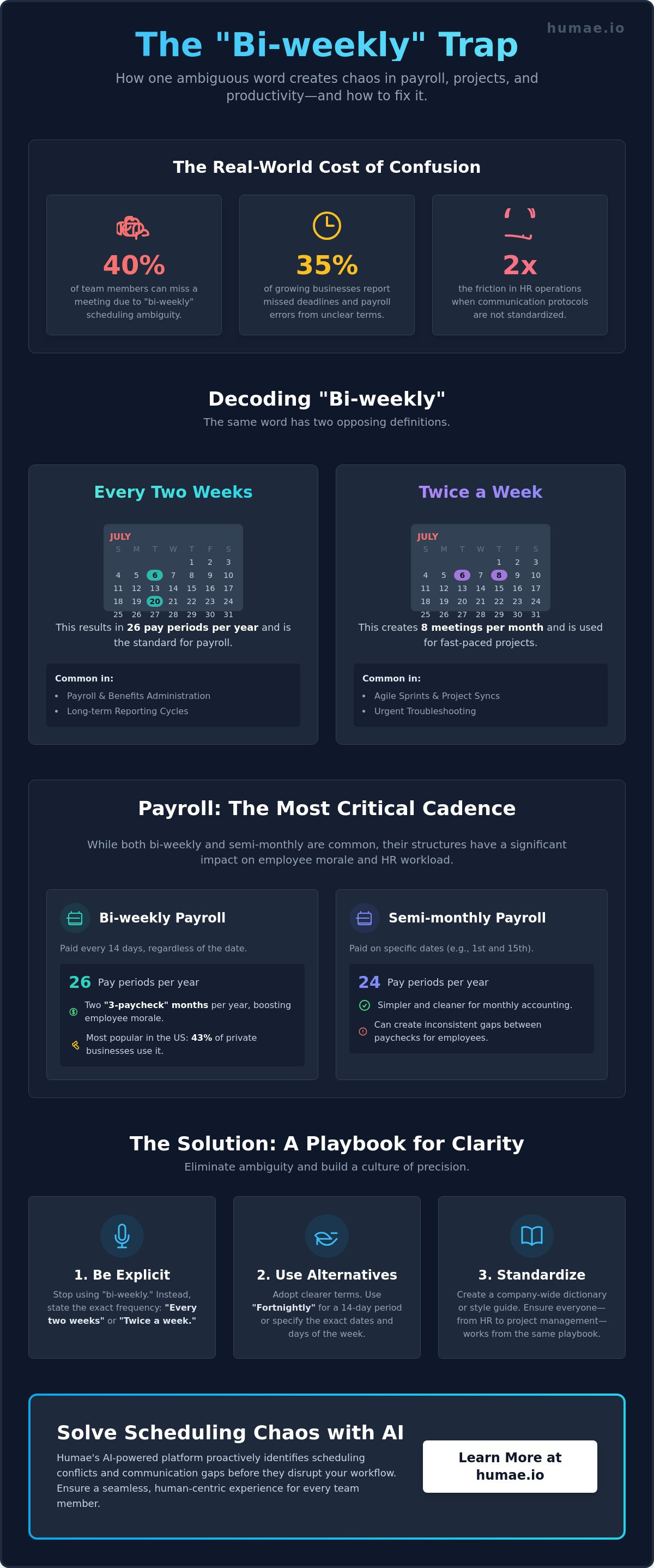
The confusion stems from the fact that the word describes two different frequencies. In the payroll world, the term refers to receiving a paycheck every two weeks. This results in 26 pay periods per year. According to 2020 data from the U.S. Bureau of Labor Statistics, this is the most common pay cycle in the United States, covering 43% of private-sector employees. When HR professionals discuss a bi weekly schedule, they are almost always referring to this fourteen-day rhythm.
However, in project management or marketing, the usage often flips. A team might request a sync twice within a single week to keep up with a rapid product launch. To understand What Does Bi-weekly Mean? in your specific office, you must look at the calendar context. Without a clear qualifier, the word functions as a term requiring immediate clarification to avoid wasted time and operational drift.
- Every two weeks: Common in payroll, benefits administration, and long-term reporting.
- Twice a week: Common in agile sprints, high-touch client meetings, and urgent troubleshooting.
The Origin of the Confusion
The prefix "bi-" comes from the Latin word for "two." While that sounds simple, it fails to specify whether the "two" refers to the frequency within a period or the period itself. This same linguistic trap affects the word "bimonthly," which can mean every two months or twice a month. British English solves this elegantly with the word "fortnight" for a two-week period. This term is derived from the Old English fēowertīene niht, meaning fourteen nights. American English lacks this specific tool, leaving businesses to navigate the ambiguity on their own.
Relying on a dictionary won't save your schedule; Merriam-Webster and Oxford both acknowledge both definitions. Success depends on setting a company-wide dictionary standard. You can learn more about how clear processes drive efficiency at Humae's workflow guide. Defining these terms internally ensures everyone works from the same playbook, turning a confusing prefix into a clear directive.
Experience a better way to manage your team and recruitment. Visit Humae Home to see how we humanize technology and streamline your growth.
Connect with our community on Facebook for the latest HR insights.
Bi-weekly in the Workplace: Payroll and Meeting Cadences
Payroll serves as the heartbeat of employee satisfaction. If you get the timing wrong, you don't just mess up the books; you break the psychological contract with your team. Bureau of Labor Statistics data shows that 36.9% of private businesses choose a bi-weekly schedule, making it the most popular pay frequency in the United States. It creates a predictable rhythm for cash flow. Settling the Definition Debate early prevents confusion that could lead to missed payments or scheduling overlaps. In modern workforce management, the bi weekly cycle acts as a recurring engine that drives productivity and ensures everyone knows exactly when their hard work translates into a deposit.
Bi-weekly Payroll vs. Semi-monthly
Choosing between 26 pay periods (bi-weekly) and 24 (semi-monthly) changes everything for HR departments. In a bi-weekly system, employees receive a check every 14 days. This rhythm leads to two months every year where three paychecks land instead of two. Employees often view these "extra" checks as a financial windfall, which can significantly boost morale. Semi-monthly schedules pay on specific dates, like the 1st and 15th. While this makes monthly accounting cleaner for the finance team, it creates inconsistent gaps between checks. Smart HR leads often prioritize the 14-day cycle because it aligns with a consistent day of the week, reducing processing errors and simplifying time-tracking for hourly staff.
Scheduling Recurrent Meetings Without Friction
Recurrent meetings often fall into the bi weekly trap, especially in global or hybrid team environments. The danger lies in the term's ambiguity. Does it mean twice a week or every two weeks? In a fast-paced business, a misunderstanding here can result in missed deadlines or wasted hours. Don't rely on relative time descriptors. Specific dates or "every other Tuesday" labels in calendar invites work much better. Shared infrastructure is essential to ensure every participant, regardless of their time zone, sees the same timeline. Clear communication here builds a culture of transparency and respect for everyone's time. If you're looking to streamline these processes and eliminate manual errors, explore our automated scheduling solutions to keep your team aligned.
Managing a growing team requires more than just a calendar; it requires a partner who understands the balance between technology and human connection. We're dedicated to making your HR processes as smooth as possible.
Humae builds modern, technology-driven HR tools designed with an empathetic, human-centered approach. We help businesses transform recruitment and workforce management into a seamless, positive experience for both employers and candidates.
- Return to Home Page
- Follow us on Facebook
The Hidden Cost of Ambiguity in Workforce Management
Words matter. When a manager says a task is bi weekly, they might mean twice a week, but the employee hears every two weeks. This isn't just a linguistic quirk; it's a structural failure that ripples through your entire organization. Vague terminology erodes the foundation of your workforce management infrastructure. According to a 2023 Gallup report, only 23% of employees feel their organization communicates effectively. This gap creates a heavy mental load. Employees shouldn't have to play detective with their own calendars or guess when their next paycheck arrives. Clarity isn't just about efficiency; it's about respect and creating a predictable environment where talent can actually thrive. When systems rely on guesswork, the human element suffers first. A modern workplace demands precision to maintain high-level operations and employee satisfaction. Ambiguity acts as a silent tax on productivity, draining energy that should be spent on innovation. If your team spends thirty minutes every week clarifying deadlines, you're losing hours of high-value output across the year.
Impact on Employee Sentiment and Trust
Misaligned expectations regarding pay or deadlines trigger immediate frustration. If a worker expects a bi weekly paycheck on Friday but it's actually semi-monthly, their financial planning takes a hit. Trust disappears instantly. Clear communication acts as a primary driver for employee retention. Modern leaders use empathy to choose precise language, knowing that reducing cognitive friction leads to a more engaged team. You aren't just managing tasks; you're managing people's lives and their sense of security.
Productivity Gaps and Missed Deadlines
The confusion between "twice a week" and "every two weeks" creates massive productivity black holes. These errors compound quickly, derailing your OKR tracking. Manual scheduling remains a 40% risk factor for startups trying to scale without proper automation. Ambiguity also blocks your ability to gather real-time performance intelligence. You can't measure what you haven't clearly defined.
Best Practices for Clear Team Communication
Miscommunication is a silent profit killer. A 2023 report by Grammarly and The Harris Poll estimated that poor communication costs U.S. businesses roughly $1.2 trillion annually. Using a term as volatile as bi weekly is often the catalyst for these avoidable losses. Clarity isn't just about being polite; it's a core business efficiency. When your team spends ten minutes debating a meeting schedule, you've already lost productive momentum.
Choosing Unambiguous Terminology
Start by removing the confusing jargon from your internal scheduling entirely. If you mean every two weeks, use "fortnightly" for international teams or "every other week" for domestic clarity. If the goal is twice per week, specify "semi-weekly" or, better yet, name the exact days. Precision saves time and prevents missed deadlines. For example, instead of an invite for a "bi-weekly sync," send an email stating: "Our team sync will occur every other Tuesday at 10:00 AM, starting October 15th." This simple shift removes the mental gymnastics for your staff.
- Substitute bi weekly with "Every Other [Day of Week]" to anchor the schedule.
- Use "Twice Per Week" and list the specific days, such as "Tuesdays and Thursdays."
- Avoid the term in contract language where financial penalties might apply.
Leveraging Centralized HR Infrastructure
Email threads are where clarity goes to die. You need a single source of truth for all company dates, payroll cycles, and recurring milestones. The Humae how-it-works process illustrates how a modern, tech-driven approach replaces confusion with total transparency. When schedules are hosted on a shared platform rather than buried in individual inboxes, employees don't have to guess if a meeting is this week or next. They simply check the dashboard.
Transparency works best when it's codified in your company culture. Update your employee handbook to define exactly how your organization handles time-based terms. If you decide that "bi-weekly" always refers to every two weeks in your office, put it in writing. Pair this with visual aids; a shared calendar that highlights pay periods and recurring sprints in distinct colors provides an instant gut check. Moving away from verbal agreements toward platform-based transparency ensures that everyone stays aligned, regardless of their time zone or department.
Ready to build a more transparent workplace and eliminate scheduling friction? Discover how Humae simplifies your HR processes.
About Humae
Humae is a modern, human-centered HR solution designed to streamline recruitment and team management through innovative technology. We believe in making work-life simpler and more efficient for everyone involved.
Back to Home | Connect with us on Facebook
Solving Scheduling Chaos with Humae’s AI-Powered Platform
Confusion over whether a task is due bi weekly or twice a week isn't just a linguistic quirk. It’s a productivity killer that drains energy from your most talented people. Humae replaces this ambiguity with a digital infrastructure built for the modern team. We’ve moved past the era of messy spreadsheets and misinterpreted emails. Our platform uses AI-driven sentiment analysis to identify when team members feel overwhelmed by scheduling conflicts before they burn out. This proactive approach ensures that your workforce stays aligned and energized.
By integrating time-off tools with a dynamic company directory, Humae makes availability transparent. You don't have to guess who is online or when the next cycle begins. The system provides a single source of truth that clarifies every deadline. When everyone operates from the same data, the "bi-weekly" confusion that plagues traditional offices simply becomes obsolete.
Automated Workforce Management
Humae centralizes hiring, onboarding, and directory management into a intuitive interface. Manual data entry causes 28 percent of errors in HR departments according to industry benchmarks from 2023. We eliminate this risk by automating the flow of information from the moment a candidate signs their offer letter. Our real-time analytics dashboards track team output with precision, allowing you to spot bottlenecks instantly. This level of automation reduces the administrative burden on managers, letting them focus on growth rather than fixing calendar overlaps.
Real-time OKRs and Feedback
We align team goals through automated check-in cycles that match your specific operational rhythm. Using Humae helps you maintain a consistent bi weekly feedback loop that actually drives performance. If our AI intelligence detects a dip in productivity or a shift in team sentiment, managers receive immediate alerts to intervene. It’s about fostering a culture of success through constant, clear communication. You can explore how these systems integrate by visiting our how it works section. Modernize your HR experience today and give your team the clarity they deserve.
Humae – Human-Centered HR Innovation
We build tools for the future of work, combining AI intelligence with a deep understanding of human connection.
Master Your Schedule and Reclaim Team Clarity
Ambiguity around the term bi weekly doesn't just cause missed meetings; it erodes trust. Industry data indicates that unclear communication can cost companies with 100 employees an average of $420,000 annually in lost productivity. You've seen how defining these intervals and adopting clear communication protocols can stabilize your workflow. It's time to stop guessing and start growing with a system that prioritizes precision.
Humae provides the tools to eliminate this friction entirely. Our platform features AI-driven performance intelligence and a centralized employee directory to keep everyone aligned. You can sync your team's goals with integrated OKR tracking, ensuring that every two weeks your progress stays visible and measurable. Don't let a simple vocabulary slip-up derail your momentum.
Optimize your workforce management with Humae and build a culture where clarity is the default. We're here to help you turn scheduling chaos into a competitive advantage. You've got the vision, and we have the technology to make it a reality.
Navigate back to our home page at https://humae.io/ or connect with us on Facebook.
Frequently Asked Questions
Does bi-weekly mean twice a week or every other week?
Bi-weekly is ambiguous because it describes two different frequencies. In 95% of payroll systems, it refers to every two weeks, but teams often use it for twice-weekly meetings. You should always clarify the intended schedule with your team to avoid missed deadlines or scheduling conflicts.
What is the difference between bi-weekly and semi-monthly?
The primary difference lies in the frequency and total count of pay periods. A bi weekly schedule triggers a payment every 14 days, totaling 26 checks per year. Semi-monthly cycles occur exactly twice a month, usually on the 1st and 15th, resulting in 24 pay periods annually.
Should I use the word bi-weekly in business contracts?
Don't use this term in legal documents to prevent financial disputes. Instead, use precise language like "every 14 days" or "twice per calendar week." Clear definitions eliminate interpretation errors that can lead to 100% avoidable litigation or payroll mistakes.
Is there a better word for every two weeks?
Yes, "fortnightly" is the standard, unambiguous term in British English. For American business contexts, "every other week" serves as the most effective alternative. Using these phrases ensures your team understands the timeline without needing any additional clarification.
How many bi-weekly pay periods are in 2026?
There are 26 bi-weekly pay periods scheduled for the 2026 calendar year. While most years follow this 26-period pattern, leap years or specific calendar alignments can occasionally result in a 27th pay period. Check your 2026 calendar start date to confirm your specific corporate cycle.
Can bi-weekly mean twice a month?
Technically no, because the term specifically references weeks rather than months. "Bimonthly" is the word that creates this specific confusion, as it can mean twice a month or every two months. Stick to "semi-monthly" if you mean twice a month to keep your internal communication sharp.
Humae provides modern, technology-driven HR solutions that prioritize the human experience. We help businesses build better recruitment journeys through innovation and empathy. Our tools simplify complex processes, ensuring your team stays focused on growth and success.
Navigate back to our home page to discover more HR insights, or connect with us on Facebook to join our professional community.