10 Common OKR Mistakes to Avoid in 2026: A Leader’s Guide to Effective Execution
By Humae · 11 June 2026
common okr mistakes to avoid
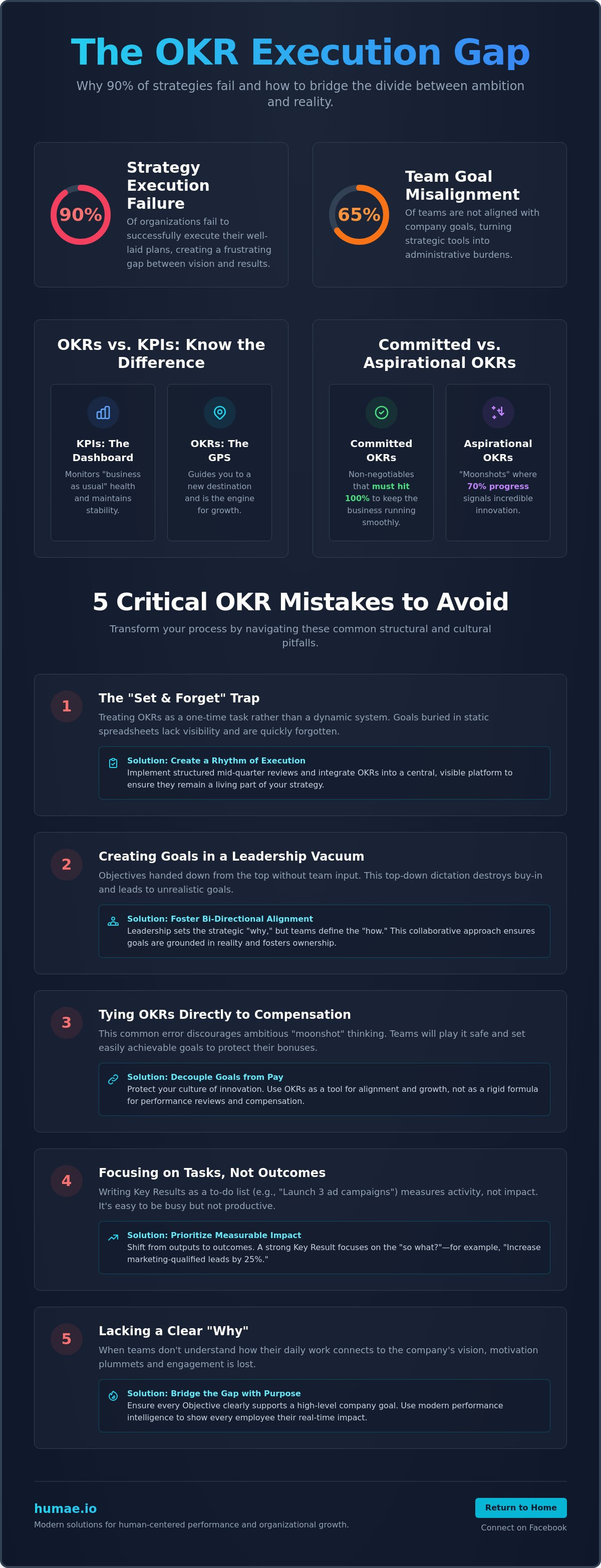
Did you know that 90% of organizations fail to execute their strategies successfully? Despite the global OKR software market reaching a valuation of 1.73 billion dollars in 2026, most leaders still struggle to bridge the gap between ambition and reality. It's frustrating when your team views goal-setting as a chore rather than a catalyst for growth. Often, the culprit isn't a lack of talent, but a handful of common okr mistakes to avoid that quietly derail even the best intentions. From confusing KPIs with true outcomes to losing visibility in the daily grind, these structural gaps turn strategic tools into administrative burdens.
We understand that you want more than just a list of targets; you want a culture where every contributor sees their impact in real-time. This guide will help you navigate the cultural and structural pitfalls that prevent 65% of teams from aligning with company goals. You'll learn how to transform your process using modern performance intelligence and AI-driven insights to ensure your OKRs drive actual growth. We'll explore the ten most critical errors and provide actionable steps to build a streamlined, data-backed execution rhythm that your team will actually embrace.
Key Takeaways
- Bridge the gap between high-level strategy and daily work by understanding why most implementations stall at the individual level.
- Shift your focus from simple to-do lists to measurable impact by identifying common okr mistakes to avoid during the design phase.
- Protect your organizational culture by decoupling goal tracking from compensation to prevent micromanagement and encourage ambitious thinking.
- Implement structured mid-quarter reviews to identify stagnant progress and pivot your team’s focus back to actual business value.
- Scale your success by integrating OKR tracking into your central employee directory for maximum visibility and data-driven decision-making.
Beyond the Buzzwords: Why Most OKR Implementations Stall
In 2026, the Objectives and Key Results (OKR) framework has evolved from a Silicon Valley secret into the backbone of modern workforce management infrastructure. It's no longer just about setting goals; it's about creating a living system of alignment. Yet, many leaders treat it as a standalone exercise. This disconnect creates the "Implementation Gap," where high-level strategy never actually reaches the desks of individual contributors. When goals feel like "extra work" rather than the strategy itself, you've likely hit one of the common okr mistakes to avoid. You need your team to feel the connection between their daily tasks and the company's vision, or the system will simply collapse under its own weight.
Success requires a clear distinction between committed and aspirational goals. Committed OKRs are the non-negotiables. These are the targets your team must hit 100% of the time to keep the business running smoothly. Aspirational OKRs are your "moonshots." Here, a 70% completion rate signals incredible progress and innovation. Without this distinction, teams either play it safe to avoid "failure" or burn out trying to achieve the impossible. Static spreadsheets exacerbate this issue. They are the primary enemy of execution because they lack real-time visibility and human connection. A goal buried in a forgotten folder is a goal that's already failing.
The Difference Between OKRs and KPIs
Think of KPIs as your car's dashboard. They tell you your speed and fuel level, monitoring "business as usual" health. OKRs are your GPS, guiding you toward a new destination. A frequent error is turning every routine KPI into an OKR. If you track everything as a priority, nothing is a priority. Use KPIs to maintain stability and reserve OKRs for the growth engine that drives change. When you blend the two without clear boundaries, you create a cluttered roadmap that confuses your most talented people.
The Cost of OKR Failure in 2026
Failed implementations do more than just stall progress. They actively damage employee engagement and retention. When teams don't see how their work moves the needle, they lose interest. In a market where operational drift can waste millions in capital, you can't afford a "set and forget" mentality. To truly master these concepts, explore our OKR Meaning: The Definitive Guide to ensure your foundation is solid. Fixing these common okr mistakes to avoid early saves your culture from the cynicism that follows poorly executed initiatives.
The "Set and Forget" Trap: Structural Mistakes in OKR Design
Setting goals is easy. Designing them for impact is where the real challenge lies. Many leaders fall into the "set and forget" trap, treating OKRs as a quarterly checkbox rather than a dynamic strategy. This structural failure often stems from common okr mistakes to avoid that prevent teams from seeing the bigger picture. When your framework is built on a shaky foundation, even the most talented team will struggle to deliver meaningful results. You need a structure that lives and breathes with your organization, not a document that gathers digital dust.
One of the most damaging errors is creating OKRs in a leadership vacuum. When objectives are handed down from the top without team input, buy-in evaporates instantly. Modern success requires a bi-directional approach. Leadership sets the strategic direction, but teams must define how they will contribute. This ensures goals are realistic and grounded in the daily reality of your operations. Without this horizontal and vertical alignment, departments often work at cross-purposes, wasting energy on conflicting priorities. Research shows that 65% of teams admit their OKRs aren't linked to the company's primary goals, a gap that usually starts during the design phase.
Outputs vs. Outcomes: The Critical Distinction
A 2026 analysis of over 7,800 Key Results found that 52% were actually tasks or KPIs in disguise. This is a classic pitfall. An output is an activity, like "Launch a new marketing campaign." While necessary, it doesn't guarantee value. An outcome measures the result of that activity, such as "Increase qualified leads by 20%." To fix your design, always ask what happens after the task is done. Correcting these common OKR implementation mistakes shifts your team’s focus from "being busy" to "being effective."
The "Too Many Goals" Syndrome
If everything is a priority, nothing is. Over-committing is a fast track to burnout and mediocre results. The golden rule remains 3 Objectives with 3 Key Results each per person. This constraint forces you to make hard choices about what truly matters. When you exceed this limit, team morale drops as the workload feels like "extra work" rather than a focused mission. You can use an analytics dashboard to monitor goal density across your organization, ensuring no single team is buried under a mountain of competing targets. Refining your design process becomes much simpler when you use modern OKR tracking that bridges the gap between planning and execution.
Cultural Sabotage: When OKRs Meet Rigid Performance Management
Culture isn't just a buzzword; it's the engine that powers your entire OKR system. Even with perfect structural design, your framework will fail if the underlying environment is built on fear or rigid control. One of the most destructive common okr mistakes to avoid is treating these goals as a weapon for micromanagement. When leaders use key results as a "stick" to monitor every minute of a team's day, they crush the very innovation the framework is meant to foster. You're not looking for compliance; you're looking for commitment and creative problem-solving.
Accountability must start at the top. If leadership doesn't own their OKRs publicly, the rest of the organization won't either. Transparency builds the trust necessary for high-stakes execution. When executives share their own progress and obstacles in town halls or through a shared directory, it signals that the process is a collective journey. Ignoring the human element is another critical error that leads to "cultural sabotage." Goals don't exist in a vacuum. If your people feel burnt out or disconnected, even the most logical targets will feel like an impossible weight. You can't manage what you don't empathize with.
The Compensation Conflict
Linking OKRs directly to individual bonuses is a recipe for "sandbagging." When pay is on the line, employees naturally set safe, easily achievable goals rather than ambitious ones. This kills the aspirational spirit that drives breakthrough growth. To maintain a healthy culture, you've got to decouple these two processes. Check out our A Guide to Modern Performance Management to learn how to run separate, meaningful review cycles. This separation allows OKRs to remain a tool for learning and growth while performance reviews focus on long-term career development and competencies.
Psychological Safety and the Fear of Failure
Innovation requires the freedom to fail. In the world of OKRs, hitting 70% of a stretch goal is often the mark of a great quarter. It means you've pushed the boundaries of what's possible. If your culture punishes anything less than 100%, your team will stop taking risks. Celebrate "smart failures" where the team learned something valuable, even if the target was missed. Using sentiment analysis within your performance intelligence tools can help you detect when fear or burnout is creeping into your workflows. By monitoring the human element alongside the data, you can intervene before a cultural rift stalls your progress.
Auditing Your Strategy: How to Pivot Away from Common OKR Errors
Identifying a problem is only half the battle. To truly excel, you need a systematic way to fix the common okr mistakes to avoid that you've uncovered in your organization. Auditing your strategy shouldn't be a post-mortem exercise at the end of the year. It's a proactive, mid-cycle intervention that ensures your team stays on the right path. When you notice progress stalling, it's often a sign that your Key Results have drifted away from actual business value and turned back into a list of tasks. A quick pivot can save an entire quarter of wasted effort.
Start by conducting a formal "Mid-Quarter Review." If a goal hasn't moved in six weeks, it's stagnant. Don't let it sit there. Re-align those Key Results to outcomes that matter. For example, if your team is focused on "finishing a report," pivot them toward "identifying three actionable cost-saving opportunities." This shift refocuses energy on impact rather than just activity. Data from the 2026 OKR Benchmark Report shows that teams in their fifth cycle or beyond reach a 79% completion rate precisely because they've mastered this disciplined habit of auditing and adjusting.
The Real-Time Tracking Advantage
Monthly updates are far too slow for the pace of business in 2026. If you're waiting until the end of the month to see progress, you're already behind. The "Update Day" scramble, where everyone rushes to fill in data five minutes before a meeting, is a symptom of a broken process. You need to integrate OKR tracking into the tools your team uses every day. When goal visibility is part of your broader workforce management infrastructure, updates become a natural part of the workflow. Teams that conduct weekly check-ins see a 43% higher goal completion rate because they catch misalignments early.
AI-Powered OKR Refinement
AI is your secret weapon for maintaining high-quality goals. Modern Performance Intelligence Software can analyze the language of your OKRs to detect "weak" or non-measurable language. Since 52% of Key Results are often tasks in disguise, AI can flag these instantly and suggest outcome-based alternatives. It can also surface cross-functional risks by identifying when two departments have conflicting targets. This predictive approach allows you to solve problems before they impact your bottom line. To see how these insights can transform your execution, explore our modern performance intelligence tools today.
Scaling Success: Leveraging AI-Powered Performance Intelligence
Scaling is hard. It's the moment where the "human element" meets "technical precision," and many organizations stumble. By the time you've expanded to multiple departments, the common okr mistakes to avoid often multiply. Communication breaks down, and goals become siloed. To prevent this, you need to transition from simple goal tracking to true performance intelligence. It's about seeing the patterns before they become problems. Humae bridges this gap by integrating OKR tracking directly into your core employee directory, ensuring that strategy is never more than a click away from the people driving it.
The future of execution lies in automated reporting and sentiment-aware coaching. As of early 2026, 83% of organizations are actively using AI in their OKR process. However, the real winners are the 13% who use AI as a supportive partner rather than a replacement for human judgment. Humae AI doesn't just record data; it analyzes the "health" of your objectives. It detects when a team's sentiment is dropping or when a Key Result lacks the measurability needed for success. This visionary approach turns your workforce management infrastructure into a proactive growth engine.
Centralizing Your Goal Ecosystem
Your OKRs should live where your people live. When you force employees to log into disparate, disconnected apps just to update a goal, you're creating friction. This friction is a leading cause of the "set and forget" mentality. By centralizing everything within a single platform, you ensure maximum visibility and alignment. You can see how the Humae integration flow simplifies this by connecting performance data with real-time workforce analytics. This unified view eliminates the "Implementation Gap" and keeps everyone focused on the same horizon.
Final Checklist for OKR Success
As you prepare for your next cycle, keep this summary of common okr mistakes to avoid and best practices in mind to ensure your team stays agile and inspired:
- Do: Focus on 3 Objectives and 3 Key Results per person to maintain clarity.
- Don't: Link OKR completion directly to individual bonuses or pay.
- Do: Use outcome-based language that measures actual business value.
- Don't: Create goals in a vacuum; ensure bi-directional alignment.
- Do: Conduct weekly check-ins to maintain a 43% higher completion rate.
Building a modern organizational culture requires the right tools and the right mindset. Transparency and continuous feedback are the fuel for your growth engine. If you're ready to move beyond static spreadsheets and embrace a more human, data-driven way of working, it's time to optimize your team’s growth with Humae. Let's build a future where every goal is an opportunity for collective success.
Mastering the Future of Strategic Execution
Transitioning your organization to a high-performance culture isn't about writing the perfect document; it's about building a sustainable rhythm. You've seen how common okr mistakes to avoid, like confusing tasks with outcomes or burying goals in static spreadsheets, can quietly drain your team's momentum. By shifting your focus toward measurable business value and maintaining bi-directional alignment, you turn a rigid framework into a living growth engine.
True success in 2026 requires more than just discipline. It demands the right infrastructure. You need a unified workforce management infrastructure that provides real-time OKR tracking and AI-driven sentiment analysis to catch burnout before it stalls your progress. Don't let your strategy become another forgotten file. It's time to streamline your strategy with Humae’s AI-powered OKR tracking and empower your people to achieve their most ambitious goals.
Your team's potential is limitless when they have a clear path and the right tools to navigate it. Let's build a future where every objective is a milestone for collective success.
Frequently Asked Questions
How many OKRs should a team have at once?
Focus is your most valuable asset in 2026. For most teams, the limit is 2 to 3 Objectives with 3 to 4 Key Results each. Overloading your people with too many targets leads to context switching and significantly diminishes their impact. By keeping the list short, you ensure that every team member understands exactly where their energy should go to move the needle.
Is it a mistake to change OKRs mid-quarter?
Sticking to a goal that is no longer relevant is a sunk cost mistake. While OKRs provide necessary stability, they shouldn't be rigid if market conditions or company strategy shifts. If a priority changes, it's better to pivot the OKR than to waste resources on a target that no longer provides value. Just ensure you document the reason for the change to maintain transparency across the organization.
Should OKRs be tied to performance reviews?
Generally, no. Tying these goals directly to individual pay or bonuses is one of the common okr mistakes to avoid because it discourages people from setting ambitious, aspirational targets. When compensation is at stake, employees will naturally "sandbag" their goals to ensure they hit 100%. Use OKRs to measure strategic progress and reserve performance intelligence tools to evaluate individual growth and behavioral competencies separately.
What is the biggest mistake in OKR writing?
The most frequent error is drafting a "To-Do" list instead of a measurable result. If your Key Result begins with "Do," "Launch," or "Help," you're likely describing an output rather than an outcome. This focus on activity instead of impact is a trap that leads to busy teams who aren't actually driving business growth. Always define what success looks like after the task is finished.
How do you fix low OKR adoption?
Adoption fails when goals are invisible or feel like administrative "extra work." To fix this, move your objectives out of isolated spreadsheets and into a centralized HRMS platform. When employees can see their goals within the same system they use for daily work and directory access, the framework becomes a natural part of their professional life rather than a chore.
Can AI really help with OKRs?
Yes. In 2026, AI has moved beyond simple drafting to become a sophisticated auditing tool. It can instantly check your goals against SMART criteria and flag any that haven't seen an update in weeks. More importantly, modern performance intelligence can analyze team sentiment to detect if a goal is causing burnout, allowing leaders to intervene with empathy before execution stalls.