Single Source of Truth for Employee Data: The 2026 Guide to HR Data Integrity
By Humae · 29 June 2026
single source of truth for employee data
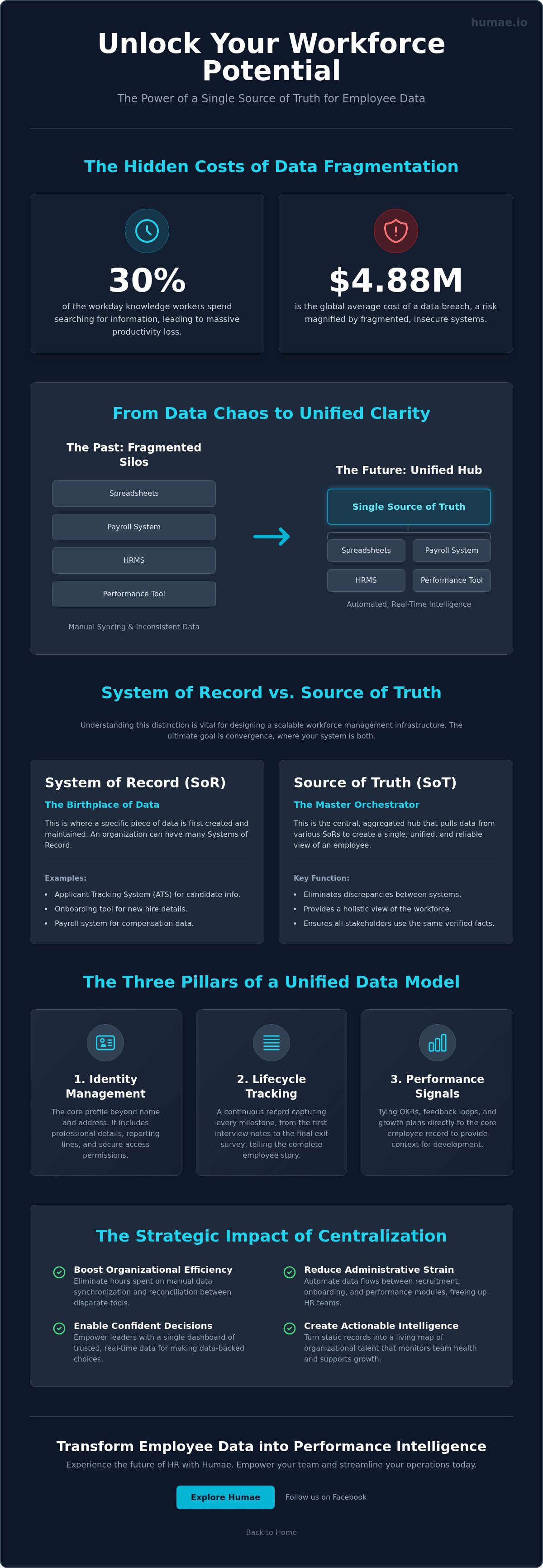
Knowledge workers spend 30% of their workday searching for information, a staggering loss of productivity that usually signals a fragmented system. You've likely felt the frustration of manual data entry errors or the headache of reconciling inconsistent records between payroll and your HRMS. It's exhausting to build stakeholder reports when you can't truly trust the numbers sitting in your spreadsheets.
We understand that HR isn't just about rows of data; it's about the people those numbers represent. Establishing a single source of truth for employee data is no longer a luxury, especially with the global average cost of a data breach reaching $4.88 million in 2026. This guide reveals how a centralized data architecture eliminates daily friction and turns your records into a high-performance engine for AI-driven workforce intelligence.
You'll discover how to transition from manual syncing to automated reliability, creating a single dashboard that empowers your team to make confident, data-backed decisions. We will explore the steps to build a digital foundation that supports both your technology and your people, ensuring your organization stays ahead in a fast-paced market.
Key Takeaways
- Master the transition from fragmented spreadsheets to a unified ecosystem by establishing a single source of truth for employee data.
- Identify the critical differences between a System of Record and a Source of Truth to gain a holistic, harmonized view of your entire workforce.
- Boost organizational efficiency and reduce administrative strain by automating data flows between recruitment, onboarding, and performance modules.
- Follow a practical audit of your current tech stack to identify silos and integrate them into a centralized, real-time intelligence hub.
- Leverage modern infrastructure to turn static records into actionable performance intelligence that monitors team health and supports high-growth goals.
Defining the Single Source of Truth for Employee Data in 2026
Data fragmentation is a quiet productivity killer. When your payroll doesn't talk to your performance management tool, you aren't just losing time; you're losing the trust of your people. By Defining the Single Source of Truth (SSoT), we move away from isolated silos toward a model where every data element is mastered in exactly one place. It's a practice that ensures everyone in the organization, from the CEO to the newest intern, works with the same set of facts. It's simple. It's effective. It's necessary.
In a modern HR ecosystem, this means recruitment, onboarding, and performance data coexist harmoniously. You don't need to spend hours on manual synchronization between disparate tools or messy spreadsheets. A single source of truth for employee data serves as the non-negotiable foundation for all modern people operations. It's the difference between guessing your turnover rate and knowing exactly why it's changing as it happens.
The evolution from static records to live directories
Legacy systems were designed as digital filing cabinets. They were places where data went to rest, often requiring constant manual updates that felt like a second job for HR teams. Modern SSoT architectures are different; they're dynamic and breathing. These systems update in real time as employees interact with the platform, whether they're updating their skills or requesting time off. This shift allows for more accurate employee directory management, turning a basic contact list into a living map of organizational talent and connection.
Key components of a unified employee data model
Building a robust single source of truth for employee data requires three essential pillars:
- Identity management: This is the core profile. It goes beyond names and addresses to include professional details, reporting lines, and access permissions that keep the organization secure.
- Lifecycle tracking: Data shouldn't be a snapshot; it should be a story. You need to capture every milestone, from the first interview notes to the final exit survey, in a single, continuous record.
- Performance signals: True integration means your OKRs and feedback loops aren't sitting in a separate app. They should be tied directly to the core employee record to provide context for growth and development.
When these components work together, HR shifts from being a cost center to a strategic partner. You're no longer just managing records; you're powering the intelligence that drives the company forward.
System of Record vs Source of Truth: Understanding the Difference
Many HR professionals use the terms "System of Record" and "Source of Truth" as if they're interchangeable. They aren't. A System of Record (SOR) is the birthplace of data. It's where a candidate's information first enters your world through an Applicant Tracking System or where a new hire's address is logged during onboarding. A Source of Truth (SOT), however, is the master orchestrator. It pulls data from various capture points to create a unified, reliable view of your people. Understanding this distinction is vital for designing a scalable workforce management infrastructure that grows with your business.
The ultimate goal for modern teams is convergence. When your HRMS serves as both the SOR and the SOT, you eliminate the gap between where data is born and where it lives. This alignment ensures that every decision you make is based on the most current, verified information available. It turns your database into a single source of truth for employee data that empowers rather than restricts your growth.
Why your current HRIS might not be a true SSoT
Data silos are the quiet enemy of organizational clarity. They form naturally when payroll, time off, and performance metrics are managed in separate, unconnected applications. If your Monday morning involves exporting three different CSV files just to build a single headcount report, you don't have an SSoT. You have a collection of digital islands. This fragmentation leads to a trust deficit; when different systems provide conflicting answers to simple questions, leadership loses confidence in the data. Organizations lose an average of $12.9 million annually due to poor data quality. Don't let your infrastructure be part of that statistic.
The role of data harmonization in modern HR
Harmonization is the process of ensuring your systems speak the same language. It's what ensures a "Senior Developer" title in your recruitment tool matches the "Senior Developer" in your payroll system exactly. Without it, your data is just noise. Effective harmonization creates a standardized vocabulary for the entire organization. It's also the first essential step toward building reliable analytics dashboards. When your data is clean and unified, your insights become undeniable. If you're ready to see how a truly integrated system feels, explore our performance intelligence features to start your journey.
The Strategic Impact of Centralized Workforce Information
Stop relying on gut feelings to lead your team. In a high-growth environment, intuition is a poor substitute for verified facts. Centralized data allows leadership to make moves based on reality rather than assumptions. When you establish a single source of truth for employee data, you aren't just cleaning up a database; you're building a foundation for every strategic decision your company makes. This clarity is the prerequisite for any meaningful employee engagement or retention strategy. After all, you can't improve what you haven't accurately measured.
The impact of this infrastructure reaches far beyond the boardroom. Data integrity directly impacts company culture and trust by ensuring that every employee's professional identity is handled with precision and care. When an employee's title, tenure, and achievements are reflected accurately across every platform, they feel seen and valued by the organization. It eliminates the friction that erodes morale and replaces it with a sense of professional stability.
Eliminating manual entry and administrative friction
Manual data entry is a relic that your team can't afford. Automated workflows ensure that information flows seamlessly from your recruitment tools to your core HRMS without human intervention. This connectivity is vital. Knowledge workers currently spend about 30% of their workday just searching for information. By automating these paths, you reclaim that time for high-impact work. It also removes the risk of "fat-finger" errors. A simple typo in a bank detail or a start date can lead to massive payroll headaches or compliance failures that take weeks to untangle. HR professionals should focus on people and strategy, not on cleaning up avoidable mistakes.
Enhancing data security and regulatory compliance
Managing data in one place makes it significantly easier to enforce global privacy standards like GDPR or CCPA. With the global average cost of a data breach reaching $4.88 million in 2026, security is no longer just an IT concern; it's a core business risk. A centralized system allows you to manage access controls from a single point. You can ensure that sensitive personal information only reaches authorized eyes, reducing the internal threat surface. Audit trails also become transparent and easy to generate. Whether it's an internal review or an external audit, having your records in one place makes the process fast and painless. You'll always have a clear map of who accessed what data and when, providing a level of accountability that fragmented systems simply can't match.
Building Your Infrastructure for Data Accuracy and Real-Time Insights
Transitioning from fragmented silos to a unified system requires a clinical look at your current setup. Start by auditing your existing tech stack to identify every location where employee data currently lives. You might find records tucked away in forgotten spreadsheets, local folders, or specialized apps for niche tasks. Mapping these capture points is the only way to ensure nothing is left behind during the migration to a single source of truth for employee data. It's a heavy lift, but it's the only way to stop the data leakage that slows down your growth.
Once the map is clear, select a central hub that offers deep integration capabilities with your existing business tools. This isn't just about finding a storage space; it's about finding a processor that can communicate with your entire ecosystem. Simultaneously, you must establish clear data ownership rules. Define who has the authority to update specific records, such as banking info versus performance reviews, to prevent conflicting updates. Organizations lose an average of $12.9 million annually due to poor data quality. These rules are your first line of defense against that loss.
Integrating disparate tools into one intuitive interface
Look for platforms that offer native integrations for time off, performance, and directories. An API-first architecture is non-negotiable in 2026. It allows for seamless connectivity with external payroll or benefit providers without requiring manual exports. The goal is a "single pane of glass" view for all people operations. This transparency ensures that HR managers spend less time toggling between tabs and more time supporting their teams. When your tools talk to each other, your team can finally stop acting as the middleman for data transfers.
Leveraging AI for continuous data validation
AI can identify anomalies in data patterns that a human might miss, such as mismatched salary bands or overlapping time-off requests. Predictive cleaning tools can suggest updates based on changes in other integrated systems, like flagging an outdated address when a tax form is updated elsewhere. Smart validation ensures your performance management systems are always running on fresh data. This automated hygiene keeps your single source of truth for employee data reliable for years to come. It's about moving from reactive cleanup to proactive integrity.
If you're ready to build a foundation that scales with your ambition, explore our centralized HRMS solutions to unify your workforce data today.
Transforming Employee Data into Performance Intelligence with Humae
Static records belong in the past. To lead a high-growth team, you need a system that breathes with your organization. Humae provides the centralized infrastructure required for modern teams to move fast without losing their human touch. We don't just offer a place to store names and dates; we provide an intelligence layer that turns your single source of truth for employee data into a strategic asset. By unifying your directory with performance metrics, we help you see the vibrant reality of your workforce in real time. It's about clarity, connection, and the common success of every team member.
Our approach is built on the belief that technology should serve people, not the other way around. We combine professional rigor with an empathetic design that makes people operations feel effortless. When your data is clean and centralized, you can stop fighting with your tools and start focusing on your culture. It's time to experience a partner that understands the complexity of your growth and offers the simplicity you deserve.
Beyond records: Real-time OKR and sentiment tracking
A true source of truth should tell you where your company is going, not just where it's been. Humae allows you to integrate OKR tracking directly into individual employee profiles. This alignment ensures that daily work always maps back to your high-level company goals. We also leverage AI-driven sentiment analysis to help you understand team morale long before burnout becomes a risk. Instead of waiting for an exit interview to learn what went wrong, you can use our intuitive analytics dashboards to make proactive adjustments that keep your best talent engaged and inspired.
Scaling your workforce management with a visionary partner
Growth shouldn't feel like a series of breaking points. Whether you're managing your first ten hires or scaling toward an enterprise workforce, Humae is designed to grow alongside you. Our comprehensive features are built to simplify even the most complex people operations, from time-off management to performance intelligence. We invite you to join the security and HR leaders who already trust us to be their definitive single source of truth for employee data. Together, we can build a workplace culture that is data-driven, deeply human, and ready for whatever the future holds.
Build a Future-Ready Workforce Today
Data is the pulse of your organization. Transitioning from fragmented silos to a unified system is more than a technical upgrade; it's a commitment to your team's success. By establishing a single source of truth for employee data, you eliminate the manual errors that drain productivity and create a foundation of trust that scales with your growth. You've seen how centralized information turns static records into dynamic intelligence, allowing you to move from reactive management to visionary leadership.
It's time to stop searching for information and start acting on it. With AI-powered performance intelligence and real-time OKR tracking, you can align every individual's work with your company's highest goals. This isn't just about efficiency. It's about creating a modern culture where every person feels seen and every decision is backed by facts. You deserve a platform that handles the complexity so you can focus on the people.
Discover how Humae can become your single source of truth and experience an intuitive workforce management interface designed for high-growth teams. Let's build something extraordinary together.
Frequently Asked Questions
What is a single source of truth for employee data?
A single source of truth is the organizational practice of aggregating all HR information into one centralized, authoritative location. It ensures that every piece of information, from a new hire's address to their latest performance review, is mastered in exactly one place. This approach eliminates the confusion caused by having different versions of the same record in separate systems.
How does an SSoT differ from a standard HR database?
Standard databases often act as static digital filing cabinets that require constant manual updates. In contrast, a source of truth is a dynamic ecosystem that harmonizes data from various capture points in real time. It ensures that information remains consistent across every integrated application, preventing the data silos that usually lead to administrative errors.
Can I build a source of truth using my existing HR software?
You can build a single source of truth for employee data if your current software supports deep API integrations and a unified data model. If your tools don't talk to each other, you'll likely continue struggling with manual exports and inconsistent records. The goal is to move away from digital islands toward a hub that masterfully orchestrates your entire workforce information.
What are the main benefits of centralizing employee information?
Centralization reduces the administrative burden on your team and eliminates the "fat-finger" errors that lead to compliance risks. It also provides leadership with a single dashboard for reliable intelligence, making it easier to build trust with stakeholders. Since knowledge workers spend about 30% of their day searching for info, centralization reclaims that lost time for higher-value strategic work.
Is it difficult to migrate my current data into a new SSoT platform?
Migration is a structured process that starts with a clear audit of where your data currently lives. While it requires initial effort to map your existing records, modern cloud-native platforms use automated tools to simplify the transition. The long-term gain in data integrity and team productivity far outweighs the temporary challenge of moving away from fragmented spreadsheets.
How does an SSoT improve employee performance tracking?
It links performance signals directly to the core employee profile, ensuring that OKRs and feedback are never isolated from the rest of the person's professional history. This creates a holistic view of team health and individual growth milestones. You can track progress more accurately because the data is always fresh and tied to a verified identity.
What role does AI play in maintaining HR data integrity?
AI acts as a continuous validation layer that identifies anomalies and patterns a human might miss. Predictive tools can suggest updates to your single source of truth for employee data based on changes in integrated systems. This automated hygiene ensures your records stay clean and reliable, allowing your team to focus on people rather than data cleanup.