Reviews of HiBob Platform: A Comprehensive 2026 Analysis for HR Leaders
By Humae · 21 July 2026
hibob alternatives
Is your culture-first HRIS actually creating a culture of frustration for your leadership team? You likely chose HiBob because you wanted a platform that felt human, not like a digital filing cabinet. It’s a common sentiment among HR leaders, yet as the search for hibob alternatives intensifies in 2026, the friction of navigating between disconnected modules and managing complex payroll integrations is becoming harder to ignore.
In this comprehensive analysis, you’ll discover the real-world pros and cons of the platform based on the latest user data. We’ll explore why some teams find the interface fragmented and why many high-growth organizations are now evaluating more intuitive, AI-driven performance intelligence tools. We promise to give you a transparent look at where HiBob excels and where it falls short, ensuring you have the clarity needed to select the right software for your team’s future. We’ll cover everything from core strengths to the specific reasons a shift toward streamlined OKR tracking might be your next best move.
Key Takeaways
- Understand how HiBob's modern aesthetic impacts engagement and where the Bob vs. Talent module split creates unexpected friction for HR teams.
- Discover why many leaders are evaluating hibob alternatives to solve fragmented workflows and gain more advanced AI-driven performance intelligence.
- Learn to identify the technical triggers, like search glitches or complex payroll integrations, that signal it's time for a more streamlined HRMS.
- Gain a clear framework for choosing between culture-first social platforms and data-first AI solutions that offer real-time sentiment analysis.
The 2026 HRMS Landscape: Where HiBob Fits In
HiBob remains a dominant force in the workforce management space. It successfully carved out a niche by ditching the grey, spreadsheet-heavy look of legacy systems for a social media-style interface. Mid-sized and large organizations often flock to it because they want their HR platform to feel like a community hub rather than a compliance tool. However, as business needs evolve in 2026, many leaders are looking at hibob alternatives to find a more unified experience that doesn't split the user journey between separate tabs for core HR and talent management.
Understanding where HiBob fits requires a look at its dual nature. It balances core administrative tasks with high-level talent management. For many, this versatility is a strength. For others, the structural complexity of managing different modules becomes a hurdle that slows down daily productivity. The platform is built for companies that prioritize employee experience above all else, yet the technical friction of navigating its various modules can sometimes undermine that very goal.
Core Features of the HiBob Platform
The platform's foundation rests on its centralized employee directory. It handles global team records with a level of visual flair that few competitors match. Automated onboarding workflows help reduce the administrative burden on HR teams by guiding new hires through documentation and culture intros simultaneously. Integrated time off management and absence tracking also provide a solid baseline for daily operations. It's a capable HRMS that covers the essentials, but the way these features are grouped can sometimes feel like navigating two different apps at once. This fragmentation is a key reason why organizations seek out more integrated performance intelligence solutions.
The Culture-First Approach to HRIS
What truly sets HiBob apart is its commitment to engagement. Features like Shoutouts and Kudos turn the HRIS into a social feed, encouraging peer recognition that feels organic. Remote-first environments benefit from interest groups and "Clubs," helping employees find common ground beyond their job descriptions. This approach is a radical departure from the rigid, process-driven structures of legacy systems like Workday or Oracle.
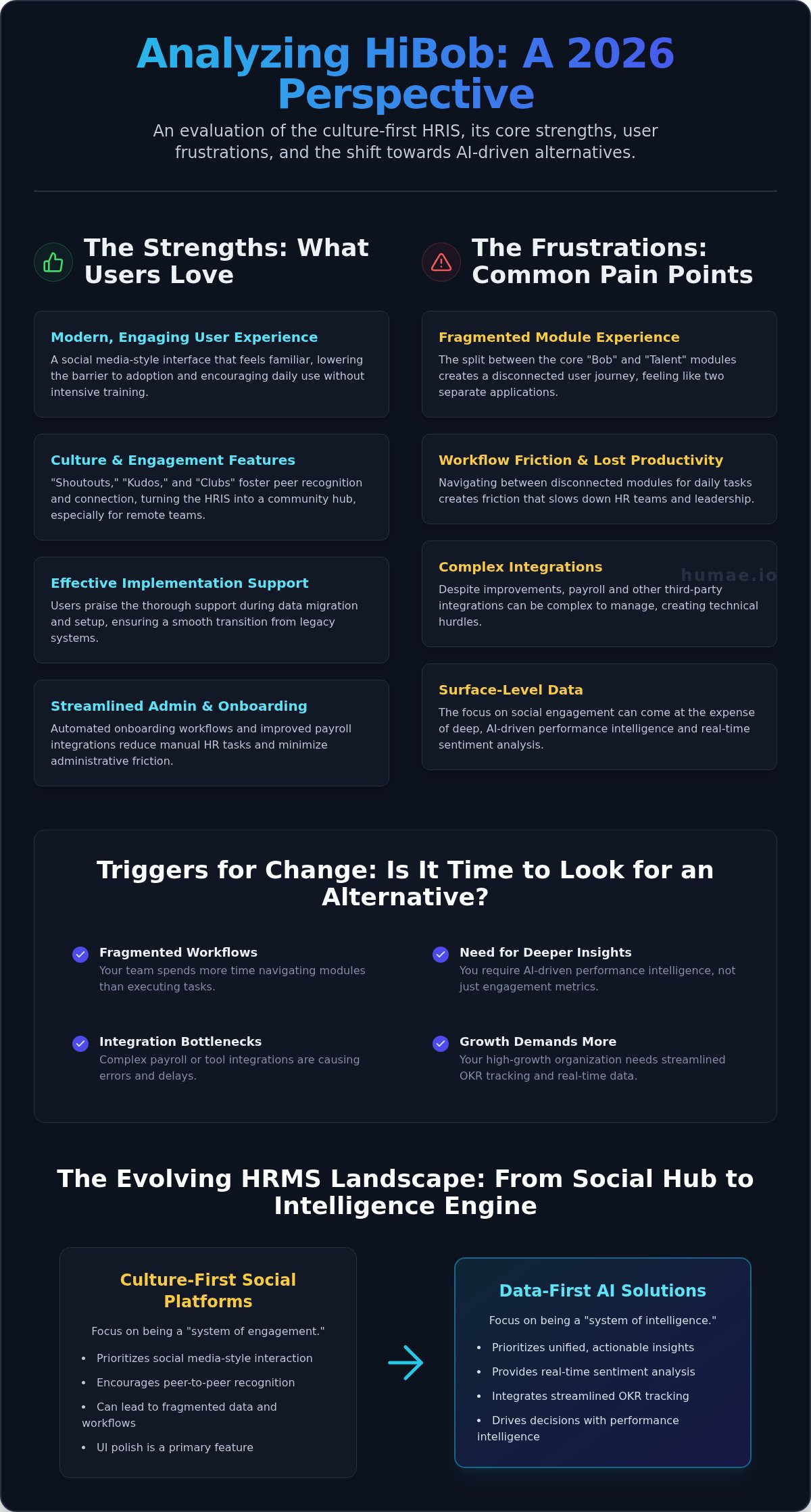
While legacy platforms focus on being a "system of record," HiBob tries to be a "system of engagement." It’s designed for the modern employee who expects their workplace tools to look like the apps they use in their personal lives. For teams that find this social layer distracting or the navigation clunky, exploring hibob alternatives that prioritize AI-driven insights over social feeds is becoming a common strategic priority. Leaders are realizing that while culture is vital, it must be supported by deep, accessible data that doesn't require clicking through multiple disconnected modules.
What Real Users Love: The Strengths of HiBob
HiBob wins on first impressions. Its modern aesthetic isn't just for show; it actively lowers the barrier to entry for employees who usually dread HR tasks. This visual polish is often the first thing leaders compare when scouting for hibob alternatives. It transforms the administrative core into an inviting digital workspace that people actually want to use. Beyond the surface, users frequently praise the implementation support. Moving years of messy data into a new system is a high-stakes overhaul, and the HiBob team is known for being thorough during this transition. They don't just hand over the keys; they guide you through the setup to ensure your data structure makes sense for your specific growth goals.
Admin efficiency has also seen a boost through recent updates to the payroll interface. Historically, HR teams struggled with manual export cycles that led to errors and wasted hours. The platform has significantly reduced this friction, allowing for smoother data transfers to external providers. This focus on the "unsexy" side of HR shows that the platform is maturing into a serious tool for operational excellence, not just a social hub.
User Experience and Interface Design
The social feel of the platform makes adoption nearly effortless. Employees find the interface familiar because it mirrors the social networks they use daily. This familiarity drives engagement without the need for intensive training sessions. The mobile app is another highlight, offering snappy functionality for on-the-go requests. Whether it’s approving a leave request from a phone or using the directory view to find a colleague in a distributed team, the experience remains consistent. It’s a level of accessibility that helps large, global organizations feel smaller and more connected.
Comprehensive Talent Management Capabilities
The talent tools are designed for continuous process improvement. Performance review cycles are highly customizable, allowing different departments to run evaluations that actually match their specific workflows. Instead of once-a-year check-ins, the surveying tools allow for automated pulses that capture engagement levels in real time. These insights help leaders pivot before turnover becomes an issue. Deep integration with the modern tech stack, particularly Slack, ensures that HR doesn't live in a silo. You can manage approvals and see updates directly where your team already works. For those who need even deeper, AI-driven performance intelligence, these integrations provide a solid foundation for a data-driven culture.
Critical Feedback: Common Cons and User Frustrations
While the visual "wow factor" discussed earlier is undeniable, the day-to-day reality for many power users reveals significant cracks in the user experience. It's during these moments of technical friction that HR leaders start searching for hibob alternatives. The most persistent frustration centers on the platform's architectural logic. It isn't just about learning where buttons are; it's about a fundamental disconnect in how the system handles different types of data across its various modules.
Admins often find that the social-first approach comes at the cost of deep administrative functionality. When you're managing complex global workflows, a pretty interface can't compensate for a lack of structural cohesion. This disconnect often leads to a "platform fatigue" where employees only log in when absolutely necessary, defeating the purpose of a culture-driven HRIS. Understanding these limitations is vital for any leader looking to build a truly efficient, data-driven HR department.
The Navigation and UI Hurdle
The split between the "Bob" and "Talent" tabs remains a primary source of confusion for teams of all sizes. Users often find themselves jumping between two distinct environments that don't always communicate intuitively. This two-tab structure slows down daily HR tasks significantly. If you need to update an employee record and then immediately check their performance review history, you're forced to toggle between modules. This fragmentation directly impacts employee self-service rates. When workers can't find 1-on-1 spaces or performance review logs quickly, they stop using the tool and start filing support tickets. It's a productivity drain that turns a modern tool into an administrative burden. Admins report that managing complex workflows across these silos requires a steep learning curve that many teams simply don't have time for.
Feature Depth and Consistency
In its quest to be an all-in-one solution, HiBob sometimes feels like a jack of all trades but a master of none. Specialized niche platforms often offer deeper functionality for specific needs like advanced performance intelligence or real-time OKR tracking. For example, users report that the search bar occasionally glitches. This isn't just a minor annoyance; it hinders record retrieval during critical moments like payroll audits or performance cycles. These technical hiccups disrupt user flow and erode trust in the platform's reliability.
Compared to AI-native platforms entering the market in 2026, the frequency of meaningful updates can feel sluggish. While the core HRIS features are solid, the lack of deep, automated insights means admins still do a lot of manual heavy lifting. For organizations that have outgrown basic workflows, the technical friction becomes a barrier to scaling. It's not just about having the features; it's about how those features work together to save you time. When a platform fails to master its core navigation, the strategic impact is felt through lower engagement and higher administrative overhead across the entire department.
Is HiBob Right for Your Team? A Comparison Framework
Selecting software isn't just about comparing features; it's about business alignment. HiBob shines for companies with 50 to 1,000 employees who want to put social connection at the center of their HR strategy. If your primary goal is driving engagement through social feeds and community groups, it's a strong contender. However, if your roadmap requires deep AI-driven performance insights or complex, real-time OKR tracking, you might outgrow the platform sooner than expected. This is where exploring hibob alternatives becomes a strategic necessity for high-growth tech teams that prioritize data over social chatter.
Before committing, decide if you actually need a full-suite HRMS or a specialized point solution. HiBob tries to do everything, which is excellent for consolidation but often leads to the structural friction discussed in previous sections. If your performance management needs are sophisticated, a specialized AI-driven platform might offer better long-term value than a generalist suite. You need a system that grows with your complexity, not one that adds to it with disconnected modules.
HiBob for Startups vs. Enterprises
Startups often find the implementation process too heavy for their current needs. When you're scaling fast, you don't have months to spend on data overhauls or complex configurations. You need speed and agility. Conversely, enterprises benefit from the global multi-site capabilities and compliance tools that HiBob provides. It handles the complexities of different regional laws quite well. For a deeper look at how these systems differ and what your organization truly needs, check out our modern hris guide to see how the right infrastructure supports your specific scale.
The Cost vs. Value Equation
Don't just look at the recurring SaaS fees. The true cost includes the "hidden" hours spent training employees on a fragmented interface. If your team is constantly confused by the Bob vs. Talent split, the culture value might not justify the premium price point. You need to weigh the social benefits against the administrative hours lost to manual workflows and search glitches. When the cost of managing the software starts to rival the time saved on HR tasks, it's time to reconsider your stack. If you're ready for a system that unifies these processes without the administrative clutter, discover how our AI-powered HRMS simplifies performance management.
Beyond Traditional HRIS: Why Humae is the Modern Alternative
Traditional platforms often provide a place to store data, but modern leadership requires a place to drive growth. Humae enters the market as a primary choice among hibob alternatives by eliminating the structural friction that slows teams down. Instead of a fragmented experience split between disconnected modules, we provide a single, intuitive interface for all HR functions. This unity ensures that your data isn't just sitting in a silo; it's actively working to improve your organizational health. It's a shift from being a system of record to becoming a system of intelligence.
Agile teams need more than just a social feed to stay connected. They need a platform that understands the pulse of the organization without requiring manual intervention. By unifying performance intelligence with core HRMS tasks, we remove the "platform fatigue" that occurs when employees have to toggle between different environments to complete a single task. This streamlined approach directly solves the navigation hurdles found in older, multi-tab architectures.
AI-Driven Performance Intelligence
The difference between basic reporting and true intelligence lies in the depth of analysis. Humae uses AI-powered sentiment analysis to move beyond the limitations of standard pulse surveys. While traditional tools might tell you that engagement is low after the fact, our platform identifies burnout and engagement trends early on. This proactive approach allows leaders to intervene before high performers leave. By tracking real-time OKRs alongside continuous feedback, performance remains perfectly aligned with company goals. You can explore how these innovative features redefine workforce management by turning passive data into actionable leadership strategies.
Streamlined Workforce Management
Efficiency is born from simplicity. A centralized infrastructure beats a multi-tab system every time because it removes the cognitive load from your HR admins. Humae simplifies the entire employee journey, from the first touchpoint in our hiring tools to the final step of onboarding. Agile teams don't have time to navigate search glitches or module toggles. They need a system that reflects their own speed. You can see how it works to visualize a streamlined journey where hiring, performance, and analytics live in one cohesive space. This isn't just about software; it's about building a modern organizational culture that values time and human connection equally.
Building a High-Performance Culture for 2026
Managing a modern workforce requires a platform that does more than just store records; it must actively drive your strategy. While HiBob offers a vibrant social experience for mid-sized teams, the fragmented navigation and technical hurdles we’ve discussed often lead leaders to explore hibob alternatives. The shift toward a unified, AI-native infrastructure is no longer just an option for high-growth teams; it's a necessity for maintaining operational speed and clarity.
By choosing a system that prioritizes intuitive single-interface design, you eliminate the administrative friction of toggling between disconnected modules. Real-time OKR tracking and AI-driven sentiment analysis allow you to move from reactive reporting to proactive leadership. You deserve a partner that understands the technical challenges of modern HR while keeping the human element at the center of every interaction. It's time to stop fighting your software and start empowering your people. Experience the future of AI-powered HR with Humae and see how a streamlined approach can transform your organizational culture today.
Frequently Asked Questions
What are the most common complaints in reviews of the HiBob platform?
Navigation friction and occasional search glitches are the most frequent issues reported by power users. Many HR admins find that the split between the "Bob" and "Talent" modules creates a fragmented workflow that slows down daily data entry and record retrieval. While the interface is visually appealing, the technical logic behind moving between different platform areas can feel clunky during high-usage periods.
Is HiBob suitable for small businesses with fewer than 50 employees?
HiBob is generally optimized for mid-sized companies between 50 and 1,000 employees. Very small businesses might find the implementation process too heavy and the feature set more complex than they actually need. For these agile teams, looking into hibob alternatives that offer a more streamlined, single-interface approach often provides better value and faster deployment.
How does HiBob handle performance management and OKR tracking?
The platform manages these functions through its Talent module, which allows for customizable review cycles and visual goal setting. It's effective for driving social engagement and kudos, but some leaders find the OKR tracking lacks the deep, AI-driven insights found in newer performance intelligence tools. The separation of these tools from core HR data can also make it difficult to get a truly unified view of employee growth.
Does the HiBob platform integrate well with payroll systems?
Yes, it integrates with several major payroll providers, and recent updates have significantly improved the data transfer process. However, admins still report that setting up these integrations can be complex, especially for global teams with multiple regional providers. It's often necessary to monitor these syncs closely to ensure that manual export cycles don't lead to data discrepancies.
What is the difference between the Bob and Talent sections in the UI?
The "Bob" section serves as the core HRIS where you manage employee directories, time off, and basic records. The "Talent" section is a separate environment dedicated to performance reviews, surveys, and engagement pulses. This architectural split is a common point of confusion for users who expect a more unified experience without having to toggle between different tabs for related tasks.
Is HiBob implementation process difficult for HR teams?
Implementation is known for being thorough but can be quite time-consuming for lean HR departments. The process often involves a major data overhaul to ensure the system’s global multi-site capabilities work correctly. While the support team provides guidance, the sheer number of modules and customization options means your team must dedicate significant hours to the initial setup phase.
How does HiBob AI capabilities compare to newer platforms like Humae?
HiBob focuses primarily on social engagement and traditional reporting, whereas Humae is built as an AI-first performance intelligence platform. While HiBob uses basic automation, Humae offers advanced features like continuous sentiment analysis and real-time OKR tracking. This allows leaders to proactively identify burnout and engagement trends rather than waiting for the results of a scheduled survey.
Can HiBob manage global teams with different compliance needs?
Managing global teams is one of the platform's core strengths, as it includes tools for multi-site management and regional compliance. It handles different documentation requirements and local laws effectively for companies with international offices. This makes it a strong contender for established enterprises, even if the user interface remains a hurdle for some daily administrative tasks.