OKR Progress Tracking and Reporting: The 2026 Guide to Performance Intelligence
By Humae · 13 June 2026
okr progress tracking and reporting
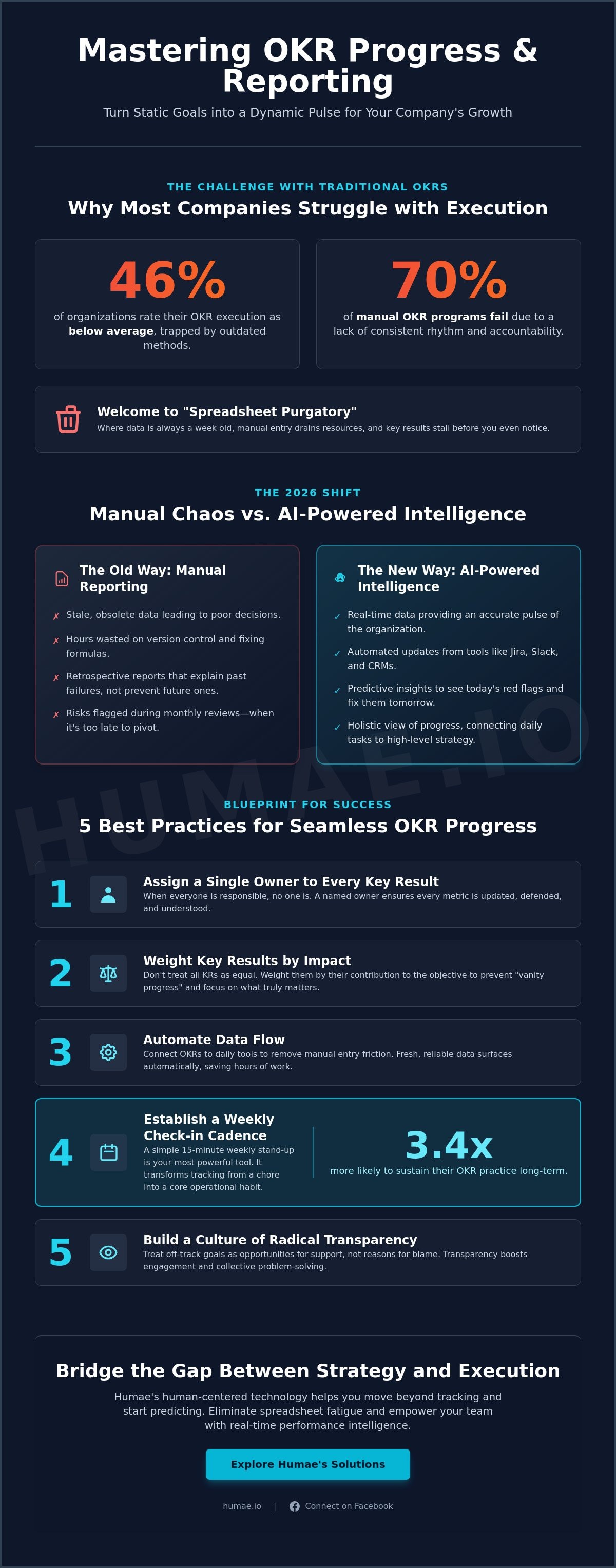
Did you know that 46% of organizations still rate their OKR execution as below average? Most leaders aren't failing because they lack vision. They're failing because they're trapped in "spreadsheet purgatory" where data is always a week old and manual entry feels like a second job. You've likely felt that frustration when a key result stalls and you only find out during the monthly review when it's too late to pivot.
It's time to move beyond recording history and start predicting it. This guide will show you how to master okr progress tracking and reporting to turn static goals into a dynamic pulse for your company. You'll learn how automated updates and real-time performance intelligence can flag risks before they become failures. We're diving into the 2026 strategies that connect every daily task to your highest strategy, ensuring your team stays engaged and your growth stays on track.
Humae helps organizations bridge the gap between strategy and execution with human-centered technology. Return to our home page to explore our solutions or connect with us on Facebook.
Key Takeaways
- Stop the "set and forget" cycle by shifting from static spreadsheets to continuous, real-time measurement of your Key Results.
- Drive high team engagement by establishing non-negotiable weekly check-in cadences and assigning clear owners to every metric.
- Master okr progress tracking and reporting using automated systems that flag risks early and connect daily tasks to high-level strategy.
- Leverage AI-powered performance intelligence to monitor team morale alongside goal completion for a holistic view of organizational health.
- Build a culture of radical transparency where off-track goals are treated as opportunities for support rather than reasons for blame.
Why OKR Progress Tracking is the Pulse of Modern Teams
Think of your strategy as a high-performance engine. If you only check the oil once every three months, you shouldn't be surprised when things seize up. Effective okr progress tracking and reporting acts as your organization's real-time dashboard. It's the continuous process of measuring Key Results against Objectives to ensure every team member stays aligned with the mission. Without this constant feedback loop, even the best-laid plans fall apart.
Many leaders fall into the "Set and Forget" trap. They spend weeks crafting perfect Objectives and Key Results (OKR) only to let them gather digital dust in a forgotten folder. Statistics suggest that roughly 70% of manual OKR programs fail because they lack a consistent rhythm. When tracking stops, accountability vanishes. People revert to "business as usual," and the strategic needle doesn't move. In 2026, the competitive edge belongs to those who treat tracking as a daily habit rather than a quarterly chore.
We've moved beyond retrospective reporting. Modern performance intelligence isn't about explaining why you missed a target last month. It's about seeing the "red" status today so you can fix it tomorrow. This transparency doesn't just improve numbers; it boosts engagement. When employees see their progress reflected in real-time, they feel a direct connection to the company's success. It turns abstract strategy into a visible, winning game.
The Difference Between Tracking and Reporting
It's easy to confuse these two concepts, but they serve different masters. Tracking is the tactical, high-frequency input of data. It’s the weekly check-in where a team lead updates a metric or leaves a comment on a blocker. Reporting is the strategic synthesis of that data. It takes those individual inputs and turns them into a narrative for decision-makers. You can't build a reliable report on a foundation of shaky data. Disciplined tracking habits are the only way to get reports that actually drive growth.
The Cost of Manual Goal Tracking in 2026
Relying on manual spreadsheets is a recipe for "stale data" and executive headaches. Every hour your team spends on version control or fixing broken formulas is an hour stolen from high-value work. By the time a manual report reaches a director's desk, the information is often already obsolete. This lag leads to poor decisions based on what was true two weeks ago, not what's happening now. Transitioning to a modern HR infrastructure eliminates these bottlenecks, ensuring your data is as fresh as your vision.
5 Best Practices for Seamless OKR Progress Tracking
Success in execution isn't about luck. It's about building a system that makes failure impossible to ignore. To achieve this, your okr progress tracking and reporting needs to move from a "nice-to-have" to a core operational habit. Start by assigning a single owner to every Key Result. When everyone is responsible, no one is. A named owner ensures that data isn't just recorded but defended and understood. This person isn't necessarily doing all the work, but they are the one who ensures the metric stays updated and accurate.
Don't treat all Key Results as equal. Weight them based on their actual contribution to the Objective. Some KRs are foundational, while others are aspirational. By weighting them, your progress percentage reflects reality, not just a mathematical average. This level of OKR tracking and measurement prevents "vanity progress" where teams hit easy targets while the main goal remains stalled. It forces a conversation about what truly matters for organizational growth.
Automating the flow of data is the final hurdle. Connecting your OKRs to daily tools like Jira, Slack, or your CRM removes the friction of manual entry. When data surfaces automatically, it stays fresh and reliable. If you're looking for a way to simplify this, automated OKR tracking can bridge the gap between daily work and strategic outcomes, saving your team hours of spreadsheet fatigue every month.
Setting Up Your Review Cadence
A 15-minute weekly stand-up is your most powerful tool. Research shows that teams with weekly check-ins are 3.4 times more likely to sustain their OKR practice long-term. Keep these meetings tight. Focus on blockers, not just status updates. Move the conversation from "What did we do?" to "What is stopping us from hitting the target?" Monthly Business Reviews then provide the space for larger strategic pivots without cluttering the weekly tactical rhythm.
The Role of Confidence Scores
Quantitative data only tells half the story. A project might be 50% complete, but the lead developer knows a major technical bug just appeared. Confidence scores (0-10) capture this human insight. They allow owners to signal that a goal is at risk even if the current numbers look fine. Confidence scores are the early warning system of OKRs. They turn okr progress tracking and reporting into a proactive strategy session rather than a disappointing post-mortem.
Manual vs. AI-Powered OKR Reporting: The 2026 Shift
The era of chasing people for spreadsheet updates is finally over. In 2026, the gap between manual and AI-powered systems has widened into a chasm. Traditional okr progress tracking and reporting relies heavily on human memory and subjective "gut feelings." This often leads to skewed data where every project looks green until the final week of the quarter. AI-powered reporting changes the game by pulling data directly from the tools your team uses every day. It provides an objective truth that doesn't suffer from optimism bias or manual entry errors.
Automation doesn't just record data; it acts on it. AI agents now serve as digital coaches that nudge owners when an update is missed or when progress decelerates unexpectedly. This shift transforms your reports from descriptive autopsies of the past into predictive forecasts of the future. Instead of asking what went wrong, you're looking at what will go wrong if current trends continue. It’s the difference between looking at a map of where you've been and using a GPS to navigate where you're going.
Automated Dashboards and Visualizations
Static slide decks are where strategy goes to die. Real-time analytics dashboards provide a living, breathing view of organizational health. Stakeholders don't need to wait for a monthly meeting to see alignment. Visualizations like heatmaps quickly show which departments are thriving and which are underwater. Alignment trees allow every individual to see how their specific key results ladder up to the company's vision, making the abstract feel concrete and achievable.
AI-Driven Sentiment and Performance Intelligence
This is where the human element meets high-tech precision. Performance intelligence in 2026 includes AI-driven sentiment analysis. By analyzing the tone of check-ins and the frequency of updates, AI can detect early patterns of burnout or misalignment. If a team is hitting targets but sentiment is plummeting, the system flags a retention risk. It suggests "Next Best Actions," such as a 1:1 coaching session or resource reallocation, before a high performer decides to walk out the door. It makes your reporting as much about people as it is about percentages.
Building a Culture of Accountability and Transparency
Transparency is the bedrock of any successful framework. When you implement okr progress tracking and reporting, you aren't just measuring numbers; you're building trust. Radical transparency means every team, from marketing to engineering, can see each other's goals and progress. This visibility eliminates the "black box" effect where departments work in isolation. It fosters a sense of collective ownership. If one team is struggling, others can see the bottleneck and offer support before it impacts the entire organization. It’s about creating a "one team" mentality where everyone knows where the ship is headed.
Creating this culture requires psychological safety. If a "Red" status on a report leads to a reprimand, people will stop being honest. They'll "sandbag" their goals or manipulate data to look better. Instead, treat off-track OKRs as a signal for help. Ask, "What resources do you need?" rather than "Why did you fail?" Conversely, don't forget to celebrate "Green" milestones. Recognition isn't just a morale booster; it's a way to reinforce the behaviors that lead to success. Honest reporting only happens when people feel safe enough to be vulnerable about their challenges.
Democratizing Goal Data
Visibility shouldn't be reserved for the C-suite. Every employee needs to understand how their daily output moves the needle on the top-line Objective. When people see their impact, engagement skyrockets. Visible data also exposes cross-functional dependencies. If the sales team's goal depends on a product release, both teams should see that connection clearly. This alignment is a core part of modern management principles that prioritize agility over hierarchy. It breaks down silos and ensures everyone is rowing in the same direction.
Turning Reports into Action
Data is useless if it doesn't lead to a decision. Use your OKR reports to reallocate resources in real-time. If a high-priority Key Result is lagging, move budget or talent to support it immediately. This is where the retrospective process becomes vital. At the end of a cycle, analyze missed goals to learn why they failed. Was the target too aggressive? Did the market change? Training managers to coach based on this objective data, rather than gut feelings, ensures a more consistent and fair performance culture. It turns okr progress tracking and reporting into a continuous learning loop for the whole company.
Ready to transform your organizational culture with data-driven insights? Explore how Humae’s performance intelligence can help you build a more transparent workplace today.
Optimizing Growth with Humae’s OKR Intelligence
Most companies treat their goal-setting as an isolated island. They have one tool for hiring, another for time-off, and a messy spreadsheet for their OKRs. This fragmentation is the enemy of organizational growth. Humae changes the narrative by embedding OKR tracking directly into a centralized workforce management platform. It’s a shift from managing tools to empowering people. By integrating your goals with your employee directory and performance data, you get a 360-degree view of your organization's health without switching tabs.
We believe that okr progress tracking and reporting shouldn't feel like a part-time job for your managers. Manual reporting is essentially an "admin tax" on your team's creativity. Humae reduces this burden through automated check-ins and smart notifications that surface progress in real-time. Instead of spending hours compiling slide decks, your leaders can focus on high-impact coaching. Our AI-driven sentiment analysis even monitors team morale alongside goal completion, ensuring that your pursuit of growth doesn't come at the cost of burnout.
The Power of Performance Intelligence
True performance intelligence goes beyond simple bar charts. With Humae’s advanced analytics, you can see how your OKRs interact with other vital business metrics. Does a spike in time-off requests correlate with a lag in a specific Key Result? Are your hiring efforts in the ATS aligned with your strategic growth targets? This holistic approach allows you to spot patterns that siloed tools miss. If you're ready to see this in action, request a demo to see how it works for your specific team structure.
Scalable Goal Management for 2026
Whether you're a fast-growing startup or an established enterprise, your goal management system must scale with you. Humae is designed to consolidate your HR stack, bringing OKRs, ATS, and Performance into a single, intuitive interface. This consolidation doesn't just save money; it creates a "single source of truth" for your entire culture. When performance data is linked to employee growth and directory management, every team member sees a clear path forward. Start your journey toward data-driven leadership today and turn your static goals into a dynamic engine for success.
Future-Proof Your Growth with Performance Intelligence
The transition from static goal-setting to dynamic execution starts with a shift in mindset. Manual systems create "stale data" that slows you down and disconnects your team from the mission. By adopting a rhythm of weekly check-ins and assigning clear ownership, you turn your strategy into a living habit. Mastering okr progress tracking and reporting is no longer a luxury; it's a survival skill for organizations that want to stay agile in 2026.
Success isn't just about hitting a number. It's about building a culture where transparency allows for honest pivots and collective support. When you integrate your goals into a unified infrastructure, you gain the clarity needed to lead with confidence. Stop looking in the rearview mirror. Start using real-time insights to predict your next win and secure your future. We're here to help you bridge that gap between vision and reality.
Optimize your team’s growth with Humae’s AI-powered OKR tracking. Our platform delivers real-time performance intelligence and AI-driven sentiment analysis within a fully integrated workforce management infrastructure. Let’s build a more transparent and successful organization together.
Frequently Asked Questions
How often should we update our OKR progress?
Weekly updates are the gold standard for high-performing teams. This frequency ensures that roadblocks are identified early enough to pivot. While some metrics might update daily via automation, the human check-in should happen every seven days to maintain focus. It prevents the "set and forget" trap that leads to stale data and lost momentum.
What is the difference between OKR tracking and KPI monitoring?
OKRs focus on strategic growth and change, while KPIs measure the ongoing health of existing processes. Think of KPIs as your car's speedometer and OKRs as the GPS destination. You need both to succeed. Effective okr progress tracking and reporting helps you see if your strategic leaps are actually moving the needle on your baseline metrics.
Can OKR tracking be fully automated?
You can automate the quantitative data flow, but the qualitative context still requires a human element. Modern tools pull numbers from Jira or Salesforce automatically. However, the confidence score and the "why" behind a lag still need an owner's input. This balance ensures your data is both accurate and meaningful for real-time decision-making.
How do I handle OKRs that are consistently "off-track" in reports?
Treat "off-track" status as a request for support rather than a reason for a reprimand. Use the report to trigger a resource reallocation or a coaching session immediately. If a goal is consistently red, it might be a sign of unrealistic targets or shifting market conditions. Adjusting the key result mid-cycle is better than pursuing an impossible target.
What are the best tools for OKR reporting in 2026?
The best tools in 2026 are integrated workforce management platforms that combine performance intelligence with daily operations. Look for software that offers real-time dashboards and AI-driven sentiment analysis. These features help you see the human story behind the numbers. Avoiding siloed tools prevents data fragmentation and reduces the "admin tax" on your managers.
How does OKR tracking impact employee engagement?
Transparent tracking boosts engagement by giving every employee a clear sense of purpose. When people see their individual contributions reflected in the company's top-line objectives, they feel more valued. It eliminates the feeling of working in a vacuum. Visibility creates a culture of shared success where everyone understands how their daily work matters.
Is it better to use spreadsheets or dedicated OKR software?
Dedicated software is significantly more effective than spreadsheets for modern organizations. Spreadsheets suffer from version control issues and quickly become data graveyards. Dedicated okr progress tracking and reporting tools automate the process and provide predictive alerts. This saves hours of manual entry and ensures your executive decisions are based on the latest facts.
How do I present OKR reports to the board of directors?
Focus on high-level strategic outcomes and predictive intelligence rather than tactical tasks when presenting to the board. Show them the trend lines and highlight how current progress aligns with the long-term vision. Use visualizations like alignment trees to demonstrate cross-functional health. The board wants to know if the strategy is working and where future risks lie.