Key Metrics for HR Dashboards in 2026: A Guide to People Intelligence
By Humae · 23 June 2026
key metrics for hr dashboards
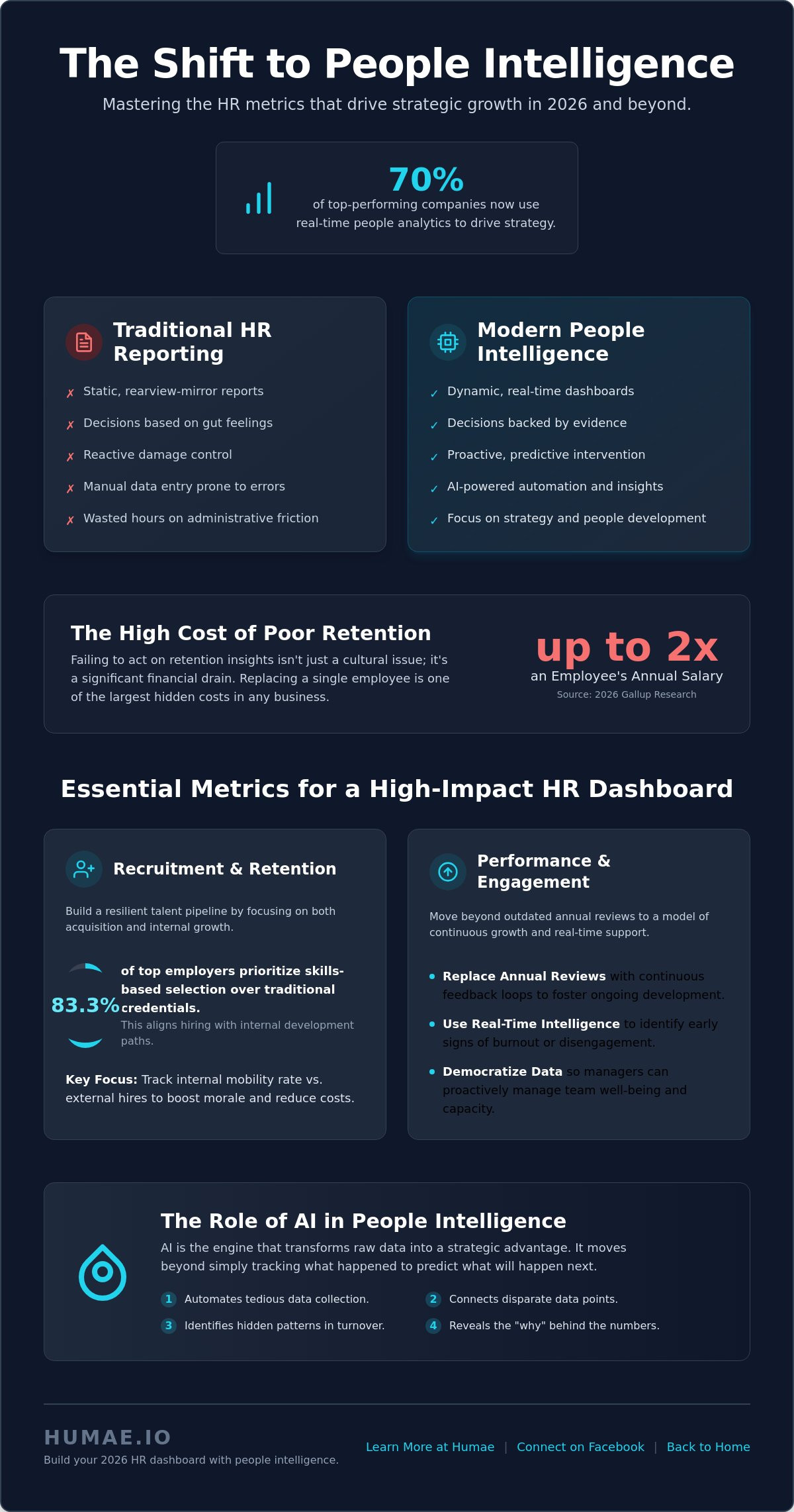
Did you know that 70% of the world's top-performing companies now rely on real-time people analytics to drive their strategy? Mastering the key metrics for hr dashboards is no longer just a technical task; it's a requirement for any leader who wants to turn human capital into a competitive advantage. If you feel overwhelmed by a mountain of data that fails to provide clear insights, you aren't alone. Many HR leaders struggle to connect daily activities to business outcomes, often wasting hours on manual reporting that remains prone to error.
In this guide, we'll help you master the data points and AI-driven insights needed to transform your reporting into a strategic growth engine. You'll gain a prioritized list of metrics and a framework for building dashboards that executives actually care about. We'll also explore how AI can simplify people analytics, allowing you to focus on what matters most: your people and their potential.
Learn more about our vision for people intelligence at Humae. Stay updated on the latest HR trends via our Facebook page. Back to Home.
Key Takeaways
- Move beyond static reports by embracing predictive people intelligence that anticipates future workforce needs.
- Master the key metrics for hr dashboards to gain a clear, data-driven view of your recruitment health and turnover trends.
- Modernize your performance strategy by replacing annual reviews with real-time intelligence and continuous feedback loops.
- Boost operational efficiency by tracking the hidden relationship between absence management and actual team capacity.
- Build a high-adoption workforce management infrastructure by selecting intuitive tools designed for the modern business landscape.
The Shift from HR Reporting to People Intelligence in 2026
The traditional HR office of the past relied on static spreadsheets and gut feelings. In 2026, that's no longer enough to stay competitive. The modern HR dashboard has transformed into a dynamic workforce management infrastructure that does more than just store names; it breathes with the organization. Static monthly reports fail because they're looking in the rearview mirror while the business is trying to accelerate. If you're only seeing turnover numbers thirty days after a star performer leaves, you've already lost the battle. Building a system around the key metrics for hr dashboards ensures that every decision you make is backed by real-time evidence.
When your systems don't talk to each other, you spend more time fixing manual errors than helping your employees grow. Centralizing your data is the first step toward reducing administrative friction. When information flows from a single source of truth, HR teams stop being data entry clerks and start being strategic partners. This shift relies on a solid understanding of Human resource metrics, but it takes them a step further. We're moving from historical tracking to forward-looking predictive analytics. By identifying the key metrics for hr dashboards today, you can anticipate where your talent gaps will be tomorrow. Centralization isn't just about convenience; it's about survival in a market where replacing a single employee can cost up to two times their annual salary, according to 2026 Gallup research.
Dashboard vs. Report: Understanding the Difference
Think of a report as a photograph; it captures a single moment that has already passed. A dashboard is a window into the present. Real-time visibility allows you to see a spike in burnout or a drop in engagement before it turns into a cultural crisis. It's about proactive intervention rather than reactive damage control. High-performing teams now use these tools to democratize data. Department managers no longer wait for HR to send a monthly PDF. They use self-service analytics to see their team's capacity in real-time, allowing them to reallocate tasks before anyone hits a breaking point.
The Role of AI in Modern HR Infrastructure
AI is the engine behind this new level of people intelligence. It automates the tedious collection of data from various touchpoints like time-off requests, employee directories, and performance reviews. Humans might miss the subtle pattern of a specific department losing engagement every Tuesday, but AI won't. It connects the dots between disparate data points to reveal the "why" behind the numbers. This is why Humae serves as the core infrastructure for this intelligence. It doesn't just show you data; it provides the clarity needed to lead with empathy and precision while identifying patterns in turnover that humans often overlook.
Essential Recruitment and Retention Metrics for Growth
Growth doesn't happen by accident. It's the result of a healthy talent pipeline that consistently brings in the right people at the right time. When selecting the key metrics for hr dashboards, many leaders fixate on speed. They track how fast they can fill a seat, but they often ignore the long-term value of that seat. In 2026, recruitment efficiency is directly linked to organizational productivity. If your hiring process is slow, your existing teams face burnout. If it's too fast but lacks quality, you'll see a revolving door that drains your budget. According to Gallup, replacing a single employee can cost between one-half and two times their annual salary. This makes retention just as critical as acquisition.
To lead effectively, you need a balanced view of your workforce. This involves tracking internal mobility alongside external hiring. In 2026, 83.3% of top employers are prioritizing skills-based selection to help align hiring with internal development. By promoting from within, you reduce recruitment costs and boost morale. A well-structured HR KPIs guide can help you distinguish between simple data points and true performance indicators. Using these insights allows you to build a resilient team that scales with your business goals. If you're looking to streamline this process, exploring a modern Applicant Tracking System can provide the real-time data needed to make these strategic shifts.
The Recruitment Pipeline: Beyond Time-to-Hire
Your offer acceptance rate is a direct reflection of your employer brand. If candidates are walking away at the final stage, your compensation or culture might not be meeting 2026 market expectations. Beyond that, you must measure the quality of hire. This looks at the long-term success and performance of new team members six to twelve months after they join. High-growth companies also track the cost of a vacant position. A vacancy isn't just a missing salary; it's lost revenue and decreased team momentum that shows up in your key metrics for hr dashboards.
Retention and Turnover: Identifying the 'Why'
Distinguishing between voluntary and involuntary turnover is vital. While involuntary exits might signal a performance management success, high voluntary turnover is a red flag for culture or leadership issues. Data from 2025 shows an average voluntary turnover rate of 13%, but the real insight lies in the "new hire turnover" rate. With 22% of new hires leaving within the first 90 days, your onboarding process is often the culprit. You can use a centralized employee directory to track team stability and see which departments are thriving and which need support.
Strategic Performance and Engagement Intelligence
The annual performance review is officially a relic of the past. In a business environment where 75% of knowledge workers already utilize AI to accelerate their output, waiting twelve months to provide feedback isn't just slow; it's a strategic liability. We've entered the era of performance intelligence. This approach replaces the dreaded yearly sit-down with continuous, data-backed insights that keep teams moving. By integrating these real-time feedback loops into your key metrics for hr dashboards, you transform performance from a retrospective autopsy into a live growth strategy. Momentum is everything in 2026. When people know exactly where they stand, they don't just work harder; they work with more purpose.
A common objection from traditionalists is that performance is too subjective to measure on a digital interface. We believe the opposite is true. Modern dashboards remove bias by grounding "feelings" in concrete behavioral data and peer recognition. You aren't just looking at a single manager's opinion; you're looking at a holistic view of an employee's impact. Visualizing this data helps leaders identify high-potential talent long before a promotion cycle begins. It also allows for early intervention when a top performer's engagement starts to dip, saving the organization from the high cost of preventable turnover.
Real-Time OKR Tracking and Goal Alignment
Transparency is the fuel of modern organizational culture. Implementing OKR tracking ensures that every team member sees how their daily tasks fuel the company's mission. Your dashboard should clearly visualize the percentage of goals on track versus those at risk. This level of clarity prevents "strategic drift," where teams work hard on the wrong things. When individual goals are visually connected to company-wide objectives, engagement naturally rises because employees see the direct value of their contribution.
AI-Driven Sentiment Analysis for Engagement
Engagement metrics have evolved far beyond the static annual survey. Today, we use continuous pulse checks and AI-driven sentiment analysis to understand the "mood" of the office in real-time. These tools analyze open-ended feedback to detect early signs of burnout or surges in excitement that traditional scores might miss. By tracking eNPS (Employee Net Promoter Score) as one of the key metrics for hr dashboards, you gain a live pulse of your internal brand health. It's about leading with empathy, powered by the precision of modern technology.
Operational Efficiency and Workforce Management
Efficiency isn't just about speed. Operational efficiency often hides in the details that managers overlook until they become expensive problems. In 2026, the key metrics for hr dashboards must spotlight these "unseen" factors to protect the bottom line. It's not just about how many people are at their desks; it's about understanding how capacity fluctuates. When you track operational data, you aren't just counting hours. You're ensuring that your workforce management infrastructure supports your broader business goals. By looking at these figures, you can optimize labor costs without stripping away the human elements that define your culture.
Measuring the ROI of your HR technology is a crucial part of this process. If your team saves twenty hours a week on manual reporting because of a centralized system, that's a direct win for efficiency. In 2026, 70% of Top Employers use these metrics to justify their tech spend. They don't just buy tools; they invest in intelligence. This involves looking at the reduction in administrative errors and the speed of decision-making. If you're ready to see how your operations stack up, it's time to experience our analytics dashboards for yourself.
Absence and Time-Off Management
Unplanned absences do more than just slow down a project; they create a ripple effect of stress across the entire team. By tracking the Bradford Factor or similar weighted metrics, you can identify patterns of short-term absence that might signal deeper engagement issues. This data allows for better resource planning and prevents your top performers from being overloaded. Integrating time off management into your dashboard ensures that you always have a realistic view of your team's current capacity. It turns a reactive headache into a proactive planning tool that keeps your projects on schedule.
Diversity, Equity, and Inclusion (DEI) Metrics
DEI is no longer just a checkbox; it's a core component of people intelligence. In 2026, pay transparency laws in states like Virginia, California, and New York have made pay equity analysis a legal and ethical necessity. Your dashboard should visualize representation across every level of the hierarchy, not just the entry-level roles. By tracking the diversity of your candidate pool against your final hires, you can identify where bias might be creeping into your recruitment funnel. These are essential key metrics for hr dashboards because they ensure your growth is both sustainable and inclusive. Transparency in these areas builds trust with your employees and your future candidates.
Building Your 2026 HR Dashboard with Humae
Selecting the right tools for your workforce management infrastructure is one of the most significant decisions an HR leader can make in 2026. It's not just about checking off a list of features; it's about creating an environment where data flows naturally. High user adoption is the secret to accurate reporting. If a platform is clunky or difficult to navigate, managers will avoid it, and your data will remain incomplete. Humae focuses on an intuitive interface that feels like a natural extension of your daily workflow. By integrating different modules like the Applicant Tracking System, OKR tracking, and Performance Intelligence, we create a single source of truth that eliminates the need for fragmented spreadsheets. This unified approach ensures that the key metrics for hr dashboards are always live, accurate, and ready for strategic analysis.
Our vision is a workplace where technology serves the human element, creating a data-empowered culture that values every individual's contribution. When you move away from disconnected tools and embrace a connected platform, you aren't just managing a workforce. You're nurturing a community that is backed by the precision of modern technology. This shift allows you to lead with both empathy and evidence, ensuring that your people strategy is always aligned with your organization's growth.
Centralizing Your People Data
Data silos are the primary enemy of people intelligence. When your recruitment data lives in one place and your performance intelligence lives in another, you lose the ability to see the full employee lifecycle. Humae provides a unified view that connects these dots, allowing you to see how a specific onboarding process impacts long-term retention. Centralization also simplifies the growing burden of global compliance. As of January 1, 2026, new comprehensive privacy laws in states like Indiana, Kentucky, and Rhode Island have increased the requirements for employee data protection. A centralized infrastructure ensures that your data is not only accessible but also secure and compliant with the latest regulations.
From Insights to Actionable Strategy
The ultimate goal of any dashboard is to turn raw data into an actionable strategy. When you present your findings to the C-suite, focus on the business outcomes rather than the technical details. Executives care about how the key metrics for hr dashboards relate to ROI, productivity, and strategic growth. Use your dashboard to highlight "warning lights" before they become full-blown crises. For instance, an automated alert for high turnover in a specific department allows you to intervene with support before the culture suffers. We invite you to explore Humae features to see how our platform can transform your people data into a strategic engine.
Transform Your Data into Strategic Impact
Leading a modern organization requires more than just intuition. It demands a sophisticated approach to people intelligence that bridges the gap between human empathy and data-backed precision. By mastering the key metrics for hr dashboards, you're no longer just tracking the past; you're actively shaping the future of your workforce. The shift toward real-time insights allows you to protect your culture and optimize your operations simultaneously.
The path to a more human, data-empowered workplace starts with centralizing your infrastructure. When you integrate real-time OKR tracking with AI-driven sentiment analysis, you gain the clarity needed to make decisions that truly matter. It's time to stop reacting to turnover and start predicting growth. Your team deserves a platform that understands the human element as much as the business bottom line. Let's build a future where every employee has the data they need to thrive.
Optimize your team's growth with Humae's AI-powered HR platform
Frequently Asked Questions
What are the top 5 HR metrics every company should track?
The most critical metrics include voluntary turnover rate, quality of hire, Employee Net Promoter Score (eNPS), OKR attainment, and the Bradford Factor for absence management. These five points provide a balanced view of your organization's retention, recruitment success, cultural health, strategic alignment, and operational capacity. Focusing on these ensures you cover both the human and financial aspects of people intelligence.
How do I choose the right HR dashboard software for a startup?
Startups should prioritize scalability, ease of use, and seamless integration capabilities. It's vital to choose a platform that can grow with your headcount without requiring a dedicated data analyst to manage. Look for a solution that centralizes your employee directory and time-off management into a single, intuitive interface to reduce administrative friction from the beginning.
Can AI really measure employee sentiment accurately?
Yes, modern AI utilizes Natural Language Processing (NLP) to analyze the context and emotion behind open-ended feedback with high precision. By identifying patterns in tone and keyword frequency, AI can detect early signs of burnout or surges in engagement. This allows leaders to address cultural issues long before they show up in turnover statistics or exit interviews.
What is the difference between a KPI and an HR metric?
An HR metric is a raw data point that tracks a specific process, while a KPI is a metric directly tied to a strategic business objective. For example, "total headcount" is a metric used for basic tracking. In contrast, "revenue per employee" is a KPI because it measures the direct impact of your workforce on the company's financial success.
How often should HR dashboards be updated and reviewed?
Dashboards should ideally update automatically in real-time to provide a live pulse of the organization's health. While managers should glance at daily shifts in capacity or engagement, leadership teams should conduct a deep-dive review at least once a month. This frequency allows for timely course corrections while providing enough data to identify long-term trends.
How do I connect HR metrics to company ROI?
You can connect HR data to ROI by calculating the specific costs associated with turnover, vacancy, and productivity gaps. For instance, if a new training program increases the quality of hire and reduces early-career turnover, the saved recruitment and onboarding costs represent a direct return on investment. Always frame your people data in terms of cost savings or revenue generation.
Is it better to use Excel or a dedicated HRMS for dashboards?
A dedicated HRMS is significantly better for maintaining key metrics for hr dashboards because it automates data collection and eliminates manual entry errors. Excel spreadsheets are static, difficult to share securely, and quickly become outdated. A centralized system ensures that your data is always live, compliant, and accessible to the decision-makers who need it.
What are the most common pitfalls in HR reporting?
The most common pitfalls include tracking too many irrelevant "vanity" metrics and failing to act on the insights gathered. Many organizations fall into the trap of overcomplicating their key metrics for hr dashboards, which leads to analysis paralysis. Success comes from selecting a few high-impact data points and using them to drive concrete cultural or operational changes.