How to Measure Employee Engagement with Data: The 2026 Leader’s Guide
By Humae · 24 June 2026
how to measure employee engagement with data
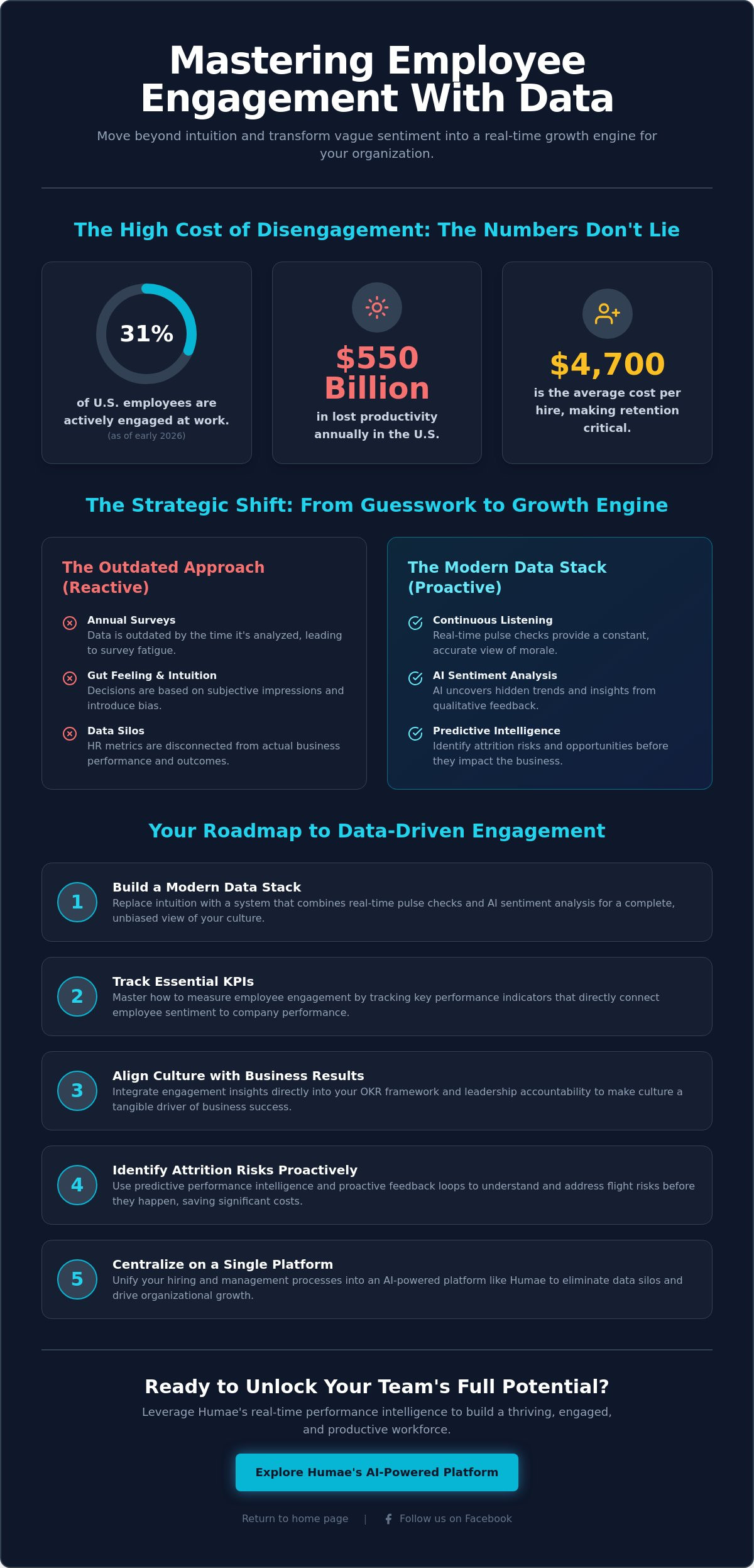
Did you know that as of early 2026, only 31% of U.S. employees are actively engaged at work? This widespread disconnect costs U.S. organizations an estimated $550 billion in lost productivity annually. You’ve likely felt the frustration of low survey response rates or subjective feedback that’s difficult to act on. If you're tired of the gap between HR metrics and actual performance, it's time to master how to measure employee engagement with data.
We're here to help you transform vague sentiment into a real-time growth engine. With the average cost per hire reaching $4,700, retaining your best talent through performance intelligence is no longer optional. This guide provides a roadmap to building a clear dashboard of engagement KPIs and predicting turnover before it happens. We’ll show you how to leverage continuous listening to align employee happiness with productivity, ensuring your organization thrives in a competitive market. It’s about moving from static snapshots to a dynamic, human-centric understanding of your team’s heartbeat.
Key Takeaways
- Replace intuition with a modern data stack that combines real-time pulse checks and AI sentiment analysis for a complete view of your culture.
- Master how to measure employee engagement with data by tracking ten essential KPIs that connect employee sentiment to company performance.
- Align culture with business results by integrating engagement insights directly into your OKR framework and leadership accountability.
- Identify attrition risks before they happen using predictive performance intelligence and proactive feedback loops.
- Centralize your hiring and management processes into a single AI-powered platform to eliminate data silos and drive organizational growth.
Beyond the Hunch: Why Data-Driven Engagement Measurement is Essential
Intuition is a liability in the high-stakes talent market of 2026. Relying on a gut feeling to gauge team morale is like trying to fly a plane without a dashboard. Data-driven engagement is the strategic intersection of sentiment, daily behavior, and business outcomes. It's a shift from asking "how are you?" once a year to understanding the real-time heartbeat of your organization. When leaders prioritize learning how to measure employee engagement with data, they stop reacting to crises and start building resilience.
The stakes are higher than ever. With only 31% of U.S. employees actively engaged, the cost of silence is staggering. Disengagement drains roughly $550 billion from the economy annually through lost productivity. Modern Employee engagement strategies recognize that satisfaction and engagement aren't the same thing. A satisfied employee shows up for the paycheck; an engaged employee drives innovation. Data allows you to distinguish between the two by connecting emotional commitment to tangible performance metrics.
The Limitations of Traditional Feedback
Annual surveys are organizational fossils. By the time HR teams analyze the results, the data is six months old and the context has vanished. These "once-a-year" events often trigger survey fatigue, leading to biased or rushed self-reporting that masks real issues. Worse, when managers rely on personal impressions rather than hard facts, they unintentionally introduce bias into their decisions. This lack of objectivity creates an inequitable environment where the loudest voices get the most attention, while quiet high-performers slip toward burnout unnoticed.
The ROI of Engagement Intelligence
Precision matters because turnover is expensive. With the average cost per hire now reaching $4,700, every resignation is a significant financial hit. Engagement intelligence is the key to sustainable scaling because it allows you to link sentiment directly to retention rates and recruitment savings. When you can prove that a 5% increase in engagement scores correlates with a 10% drop in churn, HR initiatives move from "nice-to-have" perks to essential business investments. This level of clarity is what secures executive buy-in for budget requests and ensures Performance Intelligence is at the center of your growth strategy.
By moving from a reactive to a proactive stance, you can predict turnover before it happens. Data identifies the subtle patterns of disengagement, such as declining participation in collaborative tools or shifting OKR progress, long before an employee hands in their notice. Understanding how to measure employee engagement with data transforms your HR department from a cost center into a strategic partner that fuels the company’s competitive edge.
The Modern Engagement Data Stack: Surveys, Pulse Checks, and AI
Measuring sentiment used to be a guessing game. Today, it's a technical architecture. To truly understand how to measure employee engagement with data, you need a multi-layered stack that captures both what people say and how they actually work. A holistic view doesn't come from a single source. It emerges when you combine active feedback with passive digital signals. This approach moves you away from static reports and into a world of real-time organizational intelligence.
A central piece of this infrastructure is your Employee Directory. It isn't just a list of names; it's a map of your company's health. By seeing how teams are structured and how information flows between them, you can identify silos that might be dampening morale. When this structural data meets sentiment data, you get a clear picture of where engagement is thriving and where it's stalling. If you want to see this in action, you can explore how AI transforms performance intelligence on our platform.
Pulse Surveys and eNPS
Pulse surveys are the foundation of continuous feedback loops. Unlike the heavy annual survey, these are short, frequent checks that take less than two minutes to complete. Currently, 53% of organizations utilize these short surveys to stay current with employee sentiment. Gallup's research indicates that organizations with continuous listening programs experience a 24% lower turnover rate compared to those that only conduct annual surveys. We recommend a weekly or bi-weekly cadence to track your Employee Net Promoter Score (eNPS) as a North Star metric. This simple, powerful number tells you if your team would recommend your company as a great place to work.
AI and Natural Language Processing (NLP)
The most valuable insights often hide in open-ended comments. AI-driven sentiment analysis uses Natural Language Processing to decode the mood of your organization without forcing employees to fill out endless forms. It identifies recurring themes like "work-life balance" or "lack of clarity" across hundreds of responses in seconds. This technology is a game-changer for anyone figuring out how to measure employee engagement with data, as it uncovers hidden signals that traditional metrics miss. It's particularly effective at spotting "quiet quitting" signals before they become resignations. Modern platforms ensure anonymity and ethics, focusing on aggregate trends to protect privacy while giving leaders the clarity they need to lead with empathy.
Key Performance Indicators: Tracking the 10 Essential Engagement Metrics
Data collection is only the first step; choosing the right metrics defines your success. Many leaders feel overwhelmed by the sheer volume of available information. To truly understand how to measure employee engagement with data, you must select KPIs that align with your specific organizational goals. It isn't just about achieving high scores. It's about finding the correlation between how people feel and how the business performs. You need a balanced view that weighs quantitative figures against qualitative sentiment.
Adopting a research-based approach to measuring engagement helps you move beyond vanity metrics. Benchmarking these numbers against your own historical growth is often more valuable than chasing broad industry standards. Every company culture has its own baseline; your goal is continuous internal improvement. To make this data actionable, visualizing it through analytics dashboards is essential. This allows for real-time monitoring and ensures that managers can spot shifting trends before they become systemic problems.
Behavioral Metrics: What Employees Do
Behavioral data provides an objective look at the "what" behind your workforce. While sentiment tells you what people say, these metrics show you what they actually do. Tracking these patterns helps you stay ahead of burnout and disengagement.
- Voluntary turnover rate: This is the ultimate lagging indicator. If your top talent is leaving, your engagement strategy needs an immediate audit.
- Absenteeism and "presenteeism": Patterns in time-off management often signal deeper issues. Frequent unscheduled absences or low productivity while "on the clock" are red flags for disengagement.
- Internal mobility: A high rate of employees seeking new roles within the company shows they see a long-term future with you. It’s a sign of a healthy, growth-oriented culture.
Sentiment and Participation Metrics
These metrics gauge the level of trust and active involvement within the organization. They are critical for anyone learning how to measure employee engagement with data because they reflect the "human" side of the equation.
- Survey response rates: Low participation is a metric in itself. It often indicates "feedback fatigue" or a lack of trust that leadership will take meaningful action.
- Recognition program participation: Peer-to-peer appreciation is a vital sign of a supportive culture. Measuring how often teams celebrate each other’s wins reveals the strength of your community.
- Goal completion rates: Motivation and output are linked. Tracking how engagement levels influence OKR progress helps you prove the business value of your culture initiatives.
From Insights to Action: Integrating Engagement Data with OKRs
Engagement isn't a side project for HR; it's the engine of your business execution. If your engagement data lives in a vacuum, you're missing the chance to drive real results. To truly master how to measure employee engagement with data, you must weave these insights into your Objectives and Key Results (OKR) framework. When sentiment data aligns with business targets, you create a culture where people don't just work; they thrive. This integration transforms passive metrics into active drivers of success.
Setting "Engagement OKRs" holds leadership accountable for the organization's heartbeat. It's not enough to hit revenue targets if your team is burning out in the process. By making culture a measurable objective, you ensure that employee well-being is prioritized alongside financial growth. Understanding the OKR meaning in a modern context allows you to bridge the gap between individual aspirations and company-wide success. It's about creating a shared vision where everyone understands how their happiness fuels the collective mission.
Using Engagement Data to Refine OKRs
Data acts as an early warning system for unrealistic expectations. If your pulse surveys show a sharp decline in morale following the rollout of new targets, your goals might be driving disengagement rather than motivation. Real-time feedback from the front lines allows you to adjust key results before they cause permanent damage to your culture. Fostering transparency by sharing this data during OKR reviews builds trust and psychological safety. It shows your team that their voice actually shapes the company's direction. Start aligning your team's happiness with your company's growth by using Humae’s Performance Intelligence tools.
Predictive Analytics for Performance
Engagement trends are powerful predictors of future performance. A dip in sentiment often precedes a miss in quarterly objectives by several weeks. Highly engaged teams are 21% more productive according to Gallup, making engagement a lead indicator for revenue and efficiency. AI-powered analytics can now identify high-performers who are showing subtle signs of disengaging, even if their current output remains high. This allows you to intervene with support or recognition before they reach a breaking point. Learning how to measure employee engagement with data gives you the foresight to protect your most valuable assets and maintain a steady trajectory toward your goals.
Leveraging Humae for Real-Time Performance Intelligence
Building a robust data infrastructure shouldn't be a hurdle for leadership. While previous sections explored the "what" and "why" of metrics, the "how" requires a platform that bridges the gap between raw numbers and human empathy. Humae provides this bridge by streamlining data collection through an AI-powered HRMS. When you centralize hiring, onboarding, and daily management, you eliminate the data silos that typically hide the truth about your culture. This unified approach is the most efficient way to master how to measure employee engagement with data without getting lost in spreadsheets.
The transition from fragmented tools to a single source of truth allows for instant organizational insights. Our built-in analytics dashboards turn complex sentiment patterns into clear, visual stories. Instead of waiting for monthly reports, you see the real-time impact of management decisions on team morale. This level of visibility ensures that workforce management remains deeply human; it allows you to act on facts rather than assumptions.
The Humae Advantage: AI-Driven Insights
Automation is the secret to scaling empathy. Humae’s AI-driven sentiment analysis saves HR teams hours of manual work by automatically categorizing feedback and identifying emerging moods. This intelligence feeds directly into our real-time OKR tracking. When a team’s engagement dips, the system reflects how that change might jeopardize their current objectives. We empower managers with an intuitive interface that provides actionable feedback; it’s about giving every leader the tools to be a visionary partner for their team.
Getting Started with Data-Driven Engagement
Transformation begins with a solid foundation. Implementing a centralized infrastructure starts with your Employee Directory, which serves as the anchor for all performance intelligence. From there, you can establish a feedback cadence that feels supportive and collaborative, rather than intrusive. By choosing a platform that values the user experience for both employees and leaders, you foster a culture of trust. It's time to move beyond old-school HR and optimize your team growth with modern, technology-centered tools that keep the human element at the core of every decision. Learning how to measure employee engagement with data is the first step toward a more resilient, high-performing organization.
Lead the Change: From Data Points to Human Growth
The shift from guessing to knowing is the hallmark of the 2026 leader. We've explored how a multi-layered data stack and the right KPIs turn vague feelings into actionable intelligence. By aligning your team's pulse with your business objectives, you don't just improve morale; you secure the long-term health of your organization. Mastering how to measure employee engagement with data is about more than just retention. It's about building a workplace where every individual feels seen and every goal is achievable.
You can experience the future of HR with Humae’s AI-powered platform to start making this vision a reality. Our centralized workforce management infrastructure provides the clarity you need to scale with empathy. With features like AI-driven sentiment analysis and real-time OKR tracking, you can stay connected to your team’s heartbeat every day. The tools for a thriving organizational culture are ready. Let's build a future where data and humanity work in perfect harmony.
Frequently Asked Questions
How do you measure employee engagement without using surveys?
You can track behavioral digital signals and organizational patterns. Monitor metrics like internal mobility rates, participation in peer recognition programs, and the speed of OKR completion. These passive data points provide an objective look at how teams are collaborating and growing without requiring active input from staff.
What is the most important metric for employee engagement in 2026?
The voluntary turnover rate of high-performers is the ultimate indicator of organizational health. While sentiment scores are helpful, the choice of your most productive talent to stay or leave tells the real story. It directly reflects whether your culture is successfully supporting and retaining the people who drive your innovation.
How often should a company collect employee engagement data?
A bi-weekly or monthly cadence for pulse checks is the modern standard. Continuous listening ensures you catch shifts in morale before they escalate into turnover. Mastering how to measure employee engagement with data requires moving away from static annual events toward a dynamic, real-time feedback loop that matches the pace of business.
Can AI really understand how employees are feeling?
AI uses Natural Language Processing (NLP) to detect linguistic patterns and recurring themes in open-ended feedback. It doesn't experience emotions, but it can accurately categorize the tone of comments to identify hidden burnout or excitement. This technology allows leaders to understand the aggregate "vibe" of large teams instantly and objectively.
What is a good eNPS score for a growing tech startup?
A score between 30 and 50 is generally considered very good for a scaling organization. Scores above 50 are excellent and indicate a highly loyal workforce. For a growing startup, the most important factor is the direction of the trend rather than the static number itself as the team expands.
How do you ensure data privacy when measuring engagement?
Prioritize anonymization and aggregate reporting to protect individual identities. Use an HRMS that follows global data protection standards and be transparent with your team about how their feedback is used. When employees see that their data leads to positive cultural changes without personal risk, trust in the system grows.
Why is it important to link engagement data to OKRs?
Linking these metrics proves that culture is a driver of business success rather than just a "nice-to-have" perk. When you learn how to measure employee engagement with data alongside your strategic goals, you can identify if low morale is the root cause of missed targets. It turns HR insights into actionable business intelligence.
What is the difference between engagement and job satisfaction?
Satisfaction is about an employee’s contentment with their pay, benefits, and working conditions. Engagement is a deeper emotional commitment to the company’s mission and success. A satisfied employee shows up to do their job, but an engaged employee is motivated to innovate and go the extra mile for the collective goal.