How to Improve Workforce Productivity with AI in 2026
By Humae · 17 August 2026
how to improve workforce productivity with AI
What if the biggest barrier to your team's success isn't a lack of talent, but a surplus of invisible work? In 2026, the gap between being busy and being productive has never been wider. You likely see your best people bogged down by administrative bloat and repetitive tasks that drain their creative energy. Understanding how to improve workforce productivity with AI is no longer optional if you want to scale effectively. It's frustrating to watch strategic initiatives stall because your management team is stuck manually tracking OKRs or chasing status updates. We understand that you want a workplace where technology empowers people rather than complicates their day.
This shift isn't about replacing your staff; it's about using intelligent tools to remove the friction that prevents human brilliance. In this article, you'll discover actionable strategies to leverage performance intelligence and automated workflows without losing the empathetic touch that defines your culture. We'll show you how to turn real-time data into better feedback loops and sustainable engagement. Get ready for a clear roadmap that transforms your HR operations into a streamlined, insight-driven engine for growth.
Powered by Humae. Connect with us on Facebook. Back to Home
Key Takeaways
- Focus on augmenting human talent to transform your organizational culture into one of innovation and high performance.
- Discover exactly how to improve workforce productivity with AI by identifying and eliminating the administrative bottlenecks that cause employee burnout.
- Transition from reactive management to proactive leadership by leveraging real-time sentiment analysis and predictive performance intelligence.
- Adopt a centralized, all-in-one HR infrastructure to eliminate tool fatigue and create a seamless experience for your entire team.
- Build a sustainable roadmap for AI integration that prioritizes human empathy and long-term professional growth.
Powered by Humae. Connect with us on Facebook. Back to Home
The New Era of AI-Driven Workforce Productivity
In 2026, the definition of output has shifted. We've moved past the idea of AI as a simple replacement for human talent. Instead, we see it as a powerful augmentation that acts like an exoskeleton for the mind. True productivity today means freeing your team from the "low-value" grind. Think of data entry, manual scheduling, and chasing status updates. When you understand how to improve workforce productivity with AI, you stop measuring hours and start measuring impact. This evolution allows your best people to focus on creativity and strategy, the areas where human intuition remains irreplaceable.
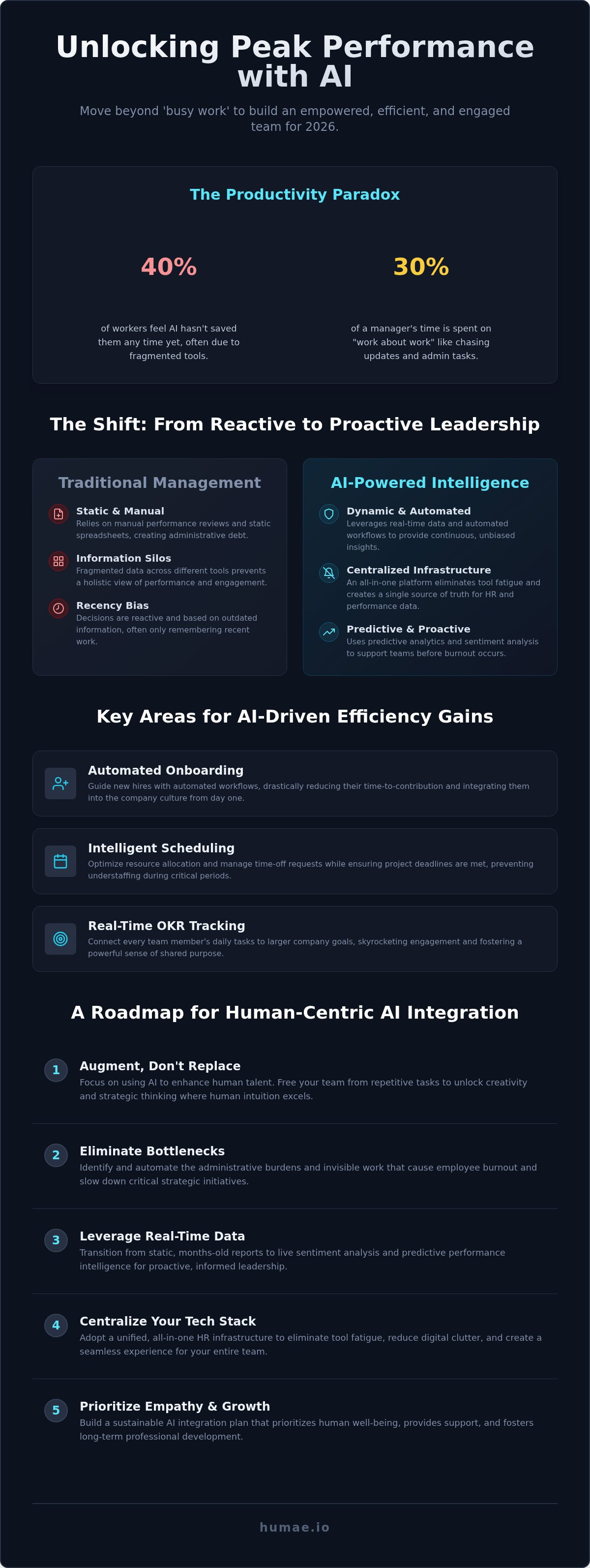
Many organizations fall into the 'Productivity Paradox.' They add more tools, but those tools create more noise. Research shows that 40% of workers feel AI hasn't saved them any time yet. This happens when AI is treated as just another tab to check rather than a centralized workforce management infrastructure. The goal is to move your people toward high-value strategic work. By consolidating your tech stack, you ensure that AI actually removes friction instead of adding to the digital clutter that leads to burnout.
Why Traditional Management Methods are Failing
Manual performance reviews and static spreadsheets are relics of a slower age. They create administrative debt that suffocates employee engagement. When leadership relies on fragmented data, decisions become reactive rather than proactive. You can't lead a modern team using data that's already three months old. This lack of real-time visibility is why many traditional systems fail to keep up with the 2026 economy. Consider these limitations:
- Information Silos: HR data that doesn't talk to project management tools.
- Recency Bias: Reviews that only remember the last two weeks of work.
- Admin Bloat: Managers spending 30% of their time on "work about work."
The Role of AI in Human-Centric Workplaces
AI should serve your people, not the other way around. The workplace impact of artificial intelligence shows that when implemented correctly, technology shifts the focus from oversight to empowerment. It provides the insights needed to support a team's well-being before burnout sets in. Modern platforms like Humae bridge this gap by turning complex data into actionable empathy. This is how to improve workforce productivity with AI while keeping the human element at the center of your strategy. By using intelligent data, you can build a culture where everyone feels seen, supported, and ready to excel.
Key Areas Where AI Boosts Team Efficiency
Efficiency in 2026 isn't just about working faster; it's about working smarter. Executives are increasingly looking for ways on how to improve workforce productivity with AI to gain a competitive edge. According to recent research on AI, Productivity, and the Workforce, the integration of intelligent agents is already showing measurable gains in labor output. For HR teams, this starts with automated onboarding. Instead of manual paperwork, AI-driven workflows guide new hires through their first weeks, drastically reducing the time it takes for them to become fully contributing members of the team. This immediate connection to the culture and tools sets a positive tone from day one.
Intelligent scheduling takes the headache out of resource allocation. AI can manage time-off requests while simultaneously ensuring project deadlines are met, preventing understaffing during critical periods. This alignment extends to real-time OKR tracking. When every team member can see how their daily tasks contribute to larger company goals, engagement skyrockets. You're no longer just finishing a checklist; you're driving the vision forward. By connecting individual output to the bigger picture, you create a sense of purpose that traditional methods simply can't match.
Streamlining Administrative and HR Infrastructure
Administrative debt is a silent killer of momentum. A centralized employee directory does more than store phone numbers; it acts as a dynamic map of your organization's talent. By automating repetitive requests for document access or time-off management, you eliminate the constant context switching that drains focus. Centralized dashboards allow managers to see everything in one place, which is how to improve workforce productivity with AI without adding to the team's cognitive load. This consolidation reduces the "tool fatigue" that often plagues high-growth startups.
Enhancing Strategic Performance Intelligence
The annual review is too slow for today's pace. AI enables continuous feedback loops that provide growth opportunities in the moment. By analyzing work patterns, sentiment analysis can detect shifts in engagement before they lead to burnout. This predictive power helps leaders identify skill gaps and suggest personalized development paths. It's a shift from policing performance to nurturing it. If you want to see how this works in practice, explore the performance intelligence features that make these insights possible.
AI Performance Intelligence vs. Traditional Tracking
Traditional tracking methods are like looking in a rearview mirror. They focus on lagging indicators, such as sales figures from three months ago or completion rates for projects that ended last week. While this data is useful for accounting, it does little to help you understand how to improve workforce productivity with AI in real time. AI performance intelligence shifts the focus to leading indicators. It uses predictive models to identify which teams are on track and which ones might struggle before the deadline arrives. This proactive stance allows leaders to intervene with support rather than criticism, fostering a culture of trust and high performance.
Transparency is the cornerstone of this new approach. When employees understand that data is being used to empower them rather than just monitor them, resistance fades. Effective OKR tracking creates a shared language of accountability. It ensures everyone knows where the ship is headed and how their specific efforts keep it on course. By making progress visible to all, you eliminate the guesswork that often leads to misalignment and wasted effort.
The Power of Sentiment Analysis in 2026
Output metrics only tell half the story. A team might be hitting their numbers while being on the verge of total burnout. In 2026, AI processes natural language in feedback and internal communications to gauge morale. This isn't about reading private messages; it's about identifying aggregated trends. Managers can see if a specific department's sentiment is dipping. This insight allows for more empathetic, human-centered conversations. Instead of asking why a deadline was missed, a leader can ask how they can help reduce the team's stress. It's a supportive attitude that transforms the manager from a supervisor into a coach.
Real-Time OKRs for Dynamic Team Alignment
Static goals often become irrelevant within weeks of being set. Dynamic, AI-updated key results reflect the reality of a fast-moving business. Immediate visibility into project roadblocks means you can pivot before a small delay becomes a major crisis. This level of alignment directly correlates to increased workforce output. When people don't have to wait for a weekly meeting to discover a dependency is blocked, they stay in the flow. It's a faster, more agile way to work that keeps every team member focused on what truly matters for the company's success.
5 Steps to Implement AI for Maximum Productivity
Transitioning from theory to practice requires a structured approach. If you're wondering how to improve workforce productivity with AI, the secret lies in a phased implementation that prioritizes people over purely technical shifts. Don't try to automate everything at once. Instead, follow these five steps to build a resilient, AI-empowered organization that thrives on efficiency.
- Audit Your Current Workflow: Pinpoint the repetitive, low-value manual tasks that drain your team's energy.
- Choose a Centralized AI-Powered HR Platform: Avoid tool fragmentation by using an all-in-one solution like Humae to keep your data in one place.
- Train Your Team on AI Ethics and Usage: Build trust through transparency so employees see AI as a partner rather than a threat.
- Start with High-Impact Areas: Implement AI in onboarding or OKR tracking first to secure quick wins and visible ROI.
- Iterate Based on AI-Driven Analytics: Use real-time data to refine your processes and adapt to changing team needs.
Auditing for Administrative Friction
Start by categorizing tasks into those requiring human empathy and those that follow algorithmic logic. Complex conflict resolution needs a person; updating a project status does not. Research indicates that 31% of workers who used AI in the last week saved one to two hours. An audit helps you identify exactly where those hours can be recovered in your specific organization. Preparing your data for this transition means cleaning up your existing employee records and ensuring your OKR history is documented. This foundation allows the AI to provide accurate, actionable insights from the very first day.
Building a Culture of AI Empowerment
Communication is the bridge between fear and adoption. Clearly explain the 'why' behind these new tools to every team member. Position AI as a career-growth assistant that handles the "boring" parts of the job so your people can focus on the creative work they love. Encourage experimentation and ask for regular feedback on new AI features. When your team feels like they're part of the innovation process, how to improve workforce productivity with AI becomes a shared mission rather than a management directive. This supportive attitude fosters a culture where technology and human talent work in perfect harmony.
Start your organizational transformation with Humae today.
Optimizing Team Growth with Humae Infrastructure
Scaling a business in 2026 requires more than just hiring more people; it requires a foundation that can support rapid growth without losing the human touch. Humae provides this foundation by centralizing the entire employee lifecycle into a single, intuitive interface. When you look at how to improve workforce productivity with AI, the most effective approach is to eliminate the friction caused by fragmented systems. Instead of juggling five different apps, your team has one home for everything from recruitment to long-term performance management. This consolidation drives measurable ROI by ensuring that data flows seamlessly between departments, providing a clear picture of organizational health.
A Centralized Hub for Modern Teams
The value of an all-in-one HR platform lies in its ability to reduce administrative overhead. By integrating hiring, onboarding, and daily management, Humae ensures that no information is lost in transition. Intuitive design is at the heart of the platform, which increases adoption across all levels of the company. When a tool is easy to use, data accuracy improves because employees actually want to engage with it. You'll spend less time managing multiple SaaS subscriptions and more time focusing on your people. This streamlined approach is a key component of how to improve workforce productivity with AI while keeping your operations lean and agile.
Scaling Your Vision with Performance Intelligence
Humae is built to grow alongside you, whether you're a team of 10 or an enterprise of 1,000 plus. As you scale, the platform's performance intelligence features provide the actionable analytics needed for strategic planning. These dashboards offer a bird's-eye view of team performance and sentiment trends, allowing you to make data-driven decisions that prevent burnout before it starts. The integration of real-time OKR tracking ensures that even as you add hundreds of new employees, everyone remains aligned with your core mission. To see the platform in action, we invite you to explore our how it works section for a deep dive into the technology. Experience the difference that a visionary partner can make in your team's success.
Step Into the Future of High-Performance Leadership
The journey toward a more efficient workplace doesn't require sacrificing the human element. By now, it's clear that how to improve workforce productivity with AI is about more than just speed; it's about clarity and connection. You've seen how centralizing your infrastructure reduces tool fatigue and how real-time data transforms managers into supportive coaches. This shift allows your team to leave the low-value administrative grind behind and focus on the creative work that actually drives growth. It's a transition from simply managing tasks to truly empowering people.
Humae offers the visionary partnership you need to navigate this transition. With real-time OKR tracking and sentiment analysis, you gain deep insights into team alignment and morale before issues arise. Our centralized workforce management infrastructure provides an intuitive interface designed for growth, ensuring that your organization remains agile in a fast-moving market. It's time to empower your people with the tools they deserve. Your most productive era is just one step away.
Start optimizing your team's productivity with Humae today.
Frequently Asked Questions
How does AI actually improve employee productivity?
AI improves productivity by automating high-volume administrative tasks like scheduling and data entry. This allows employees to focus on high-value creative and strategic work. By using performance intelligence, managers can identify bottlenecks in real time. This ensures that resources are allocated where they are needed most. It's about empowering people to work on what matters rather than getting lost in repetitive manual processes that cause burnout.
Will AI replace human HR managers in the next few years?
No, AI is designed to augment human HR managers rather than replace them. While technology handles data processing and tracking, the human element of empathy and complex conflict resolution remains essential. AI provides the insights that help HR professionals make better, more informed decisions. It frees them from administrative bloat so they can spend more time on culture building and professional development for their teams.
What are the best AI tools for workforce management in 2026?
The best tools in 2026 are centralized platforms that combine multiple HR functions into one interface. Effective solutions include features for real-time OKR tracking and AI-driven sentiment analysis. These tools help leaders understand how to improve workforce productivity with AI by providing a clear view of both output and morale. Avoid fragmented toolsets that cause context switching. Look for all-in-one infrastructures that scale with your team's growth.
Is it expensive to implement an AI-powered HR platform?
Implementation costs vary, but the return on investment often outweighs the initial setup. By consolidating multiple SaaS subscriptions into one centralized hub, you reduce overall software overhead. AI also saves significant costs by automating tasks that previously required hundreds of manual hours. Many organizations find that the efficiency gains and reduced turnover from better engagement provide a clear financial benefit within the first year of deployment.
How can I ensure employee privacy while using AI sentiment analysis?
Privacy is maintained by focusing on aggregated team trends rather than monitoring individual private communications. You should clearly communicate how data is collected and used to support team well-being. Transparency builds the trust necessary for successful adoption. Ensure your platform complies with the latest security standards and use the insights to have more empathetic conversations with your staff. It's about supporting the team, not policing them.
Can AI help with remote team engagement and productivity?
Yes, AI is particularly effective for remote teams where physical presence is lacking. It provides visibility into project roadblocks through dynamic OKR tracking and continuous feedback loops. This keeps remote workers aligned with company goals and feeling connected to the culture. By using sentiment analysis, managers can detect shifts in engagement from afar. This allows for proactive support that prevents the isolation often associated with remote work.
What is the difference between an HRIS and an AI-powered HR platform?
A traditional HRIS is a static database for storing records and lagging indicators. In contrast, an AI-powered platform uses performance intelligence to provide leading indicators and predictive insights. It doesn't just store data; it analyzes work patterns to suggest improvements. This modern infrastructure helps you understand how to improve workforce productivity with AI by turning raw information into actionable strategies for team growth, alignment, and organizational success.