Compliance Management in HR Software: The 2026 Strategy for Risk-Free Growth
By Humae · 10 July 2026
compliance management in hr software
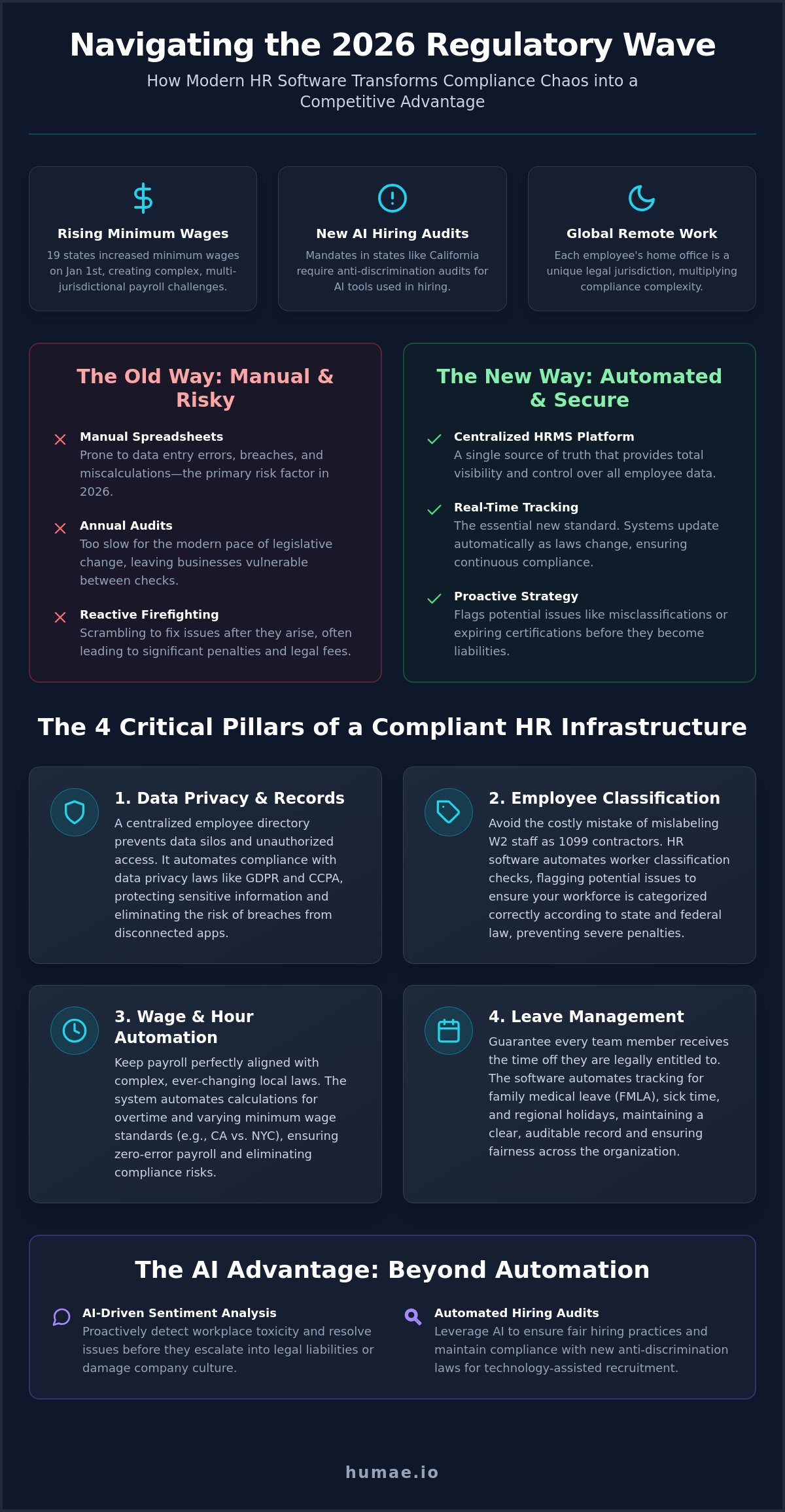
What if the 2026 regulatory wave wasn't a threat to your growth, but the secret engine behind it? With 19 states increasing minimum wages on January 1st and new AI hiring audits becoming mandatory in California, the stakes for your business have never been higher. Most HR leaders feel buried under manual spreadsheets, yet the right compliance management in hr software can turn this chaos into a streamlined asset. It's exhausting to keep up when the rules change every time you cross a state line, especially when a single data entry error could lead to significant penalties.
We believe that staying legal shouldn't feel like a full-time job. This guide shows you how modern tools move you beyond reactive firefighting into a world of zero-error payroll and real-time risk intelligence. You'll learn how to leverage AI to automate documentation and maintain peace of mind, no matter how complex global labor laws become. Let's transform your compliance strategy from a legal burden into a proactive competitive advantage that fuels your organization's future.
Key Takeaways
- Learn why real-time tracking has replaced annual audits as the essential standard for navigating 2026 regulatory shifts.
- Discover how compliance management in hr software protects your employee directory and automates complex worker classifications.
- Leverage AI-driven sentiment analysis to detect workplace toxicity and resolve issues before they become legal liabilities.
- Identify the critical integrations between performance intelligence and compliance tools that ensure a risk-free growth strategy.
- See how OKR tracking connects your company culture directly to regulatory standards for total organizational peace of mind.
Understanding Compliance Management in HR Software for 2026
Compliance management isn't just a static checklist you review once a year. It's a living, breathing part of your organization's growth. In 2026, viewing Regulatory compliance as a proactive strategy is the only way to scale without fear. It involves meeting legal and policy obligations through a continuous, automated process. Old-school annual audits have become a liability because the pace of legislative change is simply too fast for manual checks. If you're still relying on a "paper-trail" approach, you're leaving your business vulnerable. Effective compliance management in hr software shifts the focus toward a digital-first infrastructure where every data point is captured and verified in real-time. This centralized HRMS serves as your single source of truth, providing total visibility into your workforce's legal status.
The Evolving Landscape of HR Regulations
The rise of global remote work has turned every employee's home office into a unique legal jurisdiction. If your talent is spread across California, New York, and Washington, you're currently managing three different minimum wage standards and varying paid leave requirements. For example, California's $16.90 minimum wage and New York City's $17.00 rate are just the beginning of the complexity. You also have to consider new mandates like California's anti-discrimination audits for AI in hiring. Data privacy laws like GDPR and updated CCPA mandates now require ironclad security for every piece of employee data. Manual spreadsheets can't keep up with these shifts. They've become the primary risk factor for data breaches and miscalculation errors in 2026. To stay safe, businesses need a system that updates automatically as laws change.
Why HR Software is the Foundation of Modern GRC
GRC stands for Governance, Risk, and Compliance. This framework is the backbone of any stable business. Modern software automates the "Governance" portion of the equation by hard-coding rules directly into your features and workflows. By moving these processes into a unified platform, you're moving away from reactive firefighting and toward a system where compliance is built-in. A modern HRMS handles the heavy lifting of risk mitigation by:
- Automating Governance: Standardizing how data is collected and stored across the whole company.
- Reducing Risk: flagging potential issues like misclassified employees or expiring certifications before they become legal problems.
- Ensuring Compliance: Providing real-time dashboards that show exactly where you stand during an audit.
This digital foundation allows your team to focus on meaningful work while the platform ensures that your organization remains protected and professional. It's about turning a legal burden into a seamless experience for both the HR team and the employees.
The 4 Critical Pillars of a Compliant HR Infrastructure
Building a resilient organization requires more than just following the rules; it requires a structure that makes following them effortless. To stay legally compliant in a shifting market, your infrastructure must rest on four specific pillars. First, data privacy ensures that sensitive employee information stays protected from breaches. Second, proper employee classification prevents the costly mistake of mislabeling W2 staff as 1099 contractors. Third, wage and hour automation keeps your payroll aligned with local overtime and minimum wage standards. Finally, leave management guarantees that every team member receives the time off they're legally entitled to, whether it's for family medical leave or regional holidays. Strong compliance management in hr software integrates these pillars into your daily workflow, turning potential risks into a foundation for stable growth.
Automating the Employee Directory and Records
Data silos are a primary source of regulatory friction. When employee records live in separate spreadsheets or disconnected apps, the risk of unauthorized access or outdated information skyrockets. A centralized employee directory creates a single, secure environment for all personnel data. By utilizing self-service portals, you empower employees to maintain their own records, which significantly improves data integrity. This approach ensures that your HR team isn't bogged down by manual entries while maintaining a perfect audit trail for every change made to the system. It's a simple way to protect privacy while fostering a culture of transparency and trust.
Managing Time Off and Regulatory Leave
Tracking leave has become incredibly complex with the rise of regional mandates. In 2026, you aren't just managing vacation days; you're navigating a patchwork of FMLA, state-specific sick leave, and unique local holidays. Inconsistent policy application across different teams is a major liability that can lead to discrimination claims or labor board investigations. Modern software provides a standardized framework that applies leave rules fairly and automatically. We suggest setting up automated alerts to notify managers of leave expirations or upcoming policy changes. This proactive approach ensures you never miss a critical deadline and keeps your operations running smoothly across every jurisdiction. Using a dedicated Time Off Management tool helps you maintain this consistency without the headache of manual tracking.
Integrating these pillars into your business model does more than just satisfy regulators. It creates a professional, high-trust environment where your team feels valued and protected. When your infrastructure handles the complexity of the law, you're free to focus on the human side of your business.
Overcoming Modern Compliance Hurdles with AI and Automation
Legal uncertainty remains the biggest hurdle for growing companies. In 2026, staying current with fast-paced labor laws feels like trying to hit a moving target. If you're waiting for a quarterly report to check your status, you're already behind. Modern compliance management in hr software leverages AI to close this gap by monitoring changes in real-time. It's a shift from looking in the rearview mirror to having a high-definition GPS for your legal obligations. This technology doesn't just store data; it interprets it to keep you safe.
Some worry that adding automation removes the human element from HR. We believe the opposite is true. By automating the repetitive, data-heavy tasks, you give your team the space to practice true empathy. Technology handles the "what" and the "when" so your people can focus on the "why" and the "how." It's about using intelligence to support human connections, not replace them. When your system manages the technicalities, your HR professionals can return to being truly human-centric.
Proactive Risk Detection with AI Intelligence
Workplace toxicity often brews in silence before it erupts into a legal grievance. AI-driven sentiment analysis changes this dynamic by identifying patterns in internal communication and feedback that suggest rising tension. Understanding the foundations of HR compliance management means recognizing that a healthy culture is your best defense against litigation. Continuous feedback loops allow you to address micro-aggressions or burnout before they lead to discrimination claims. AI performance intelligence acts as a digital safeguard against wrongful termination suits by providing objective, data-backed evidence of employee conduct.
Eliminating Audit Anxiety through Real-Time Dashboards
Audits used to mean weeks of frantic document gathering and spreadsheet reconciliations. This manual approach is no longer sustainable in a high-speed business environment. Real-time dashboards turn these month-long marathons into a simple, one-click task. Stakeholders can view compliance health at a glance, seeing exactly where the company stands across every jurisdiction. This level of transparency builds trust and ensures that compliance goals, tracked through integrated OKRs, are actually met. Utilizing Humae Analytics Dashboards provides the clarity you need to stay ahead of regulators and keep your growth on track without the stress of audit season.
How to Evaluate Compliance Features in HRMS Platforms
Selecting the right tool for your organization is a strategic decision that goes far beyond a simple feature list. When you evaluate compliance management in hr software, you aren't just buying code; you're investing in your company's protection. Scalability is the first hurdle. If your team expands into states like Washington or New York, your platform must automatically adjust to local minimum wages. In 2026, these rates reached $17.13 and $17.00 respectively. Integration is equally vital. Your compliance tools should sync perfectly with your time-off management and performance intelligence to ensure no data point is missed. Audit trails provide the accountability you need, recording every single change made to employee records with a name and timestamp. Finally, prioritize user experience. If the interface is clunky, managers will skip steps, creating the very risks you're trying to avoid.
The Checklist for Global Compliance Readiness
A robust system must include a specific set of tools to handle the complexities of 2026. Automated tax updates are a baseline requirement, as is the ability to collect electronic signatures for legally binding documents. Secure document storage ensures that your records are audit-ready at a moment's notice. A built-in Applicant Tracking System (ATS) is no longer optional. It's a critical tool for hiring compliance, especially with new mandates like California's anti-discrimination audits for AI in recruitment. For a deeper look at how these systems function together, check out our guide on What Is an HRIS to find the perfect fit for your team.
Security Standards to Demand from Your Vendor
Security is the silent partner of compliance. You should demand SOC 2 compliance from any vendor you consider. This proves they meet the highest industry standards for data protection. Role-based access control (RBAC) is another essential feature. It ensures that sensitive information is only visible to those who truly need it. In 2026, data encryption is a non-negotiable requirement to protect against the rising threat of cyberattacks. These standards aren't just technical boxes to check. They're the promises you make to your employees that their information is safe with you. Ensuring your vendor prioritizes these areas is the only way to build a truly resilient organization.
Ready to see these features in action? Explore how Humae simplifies your infrastructure and keeps your growth risk-free.
Building a Culture of Compliance with Humae
Compliance is often viewed as a restrictive wall. We see it differently. It's the framework that allows your team to move fast without breaking things. When you implement compliance management in hr software, you aren't just checking boxes. You're building a centralized infrastructure that supports every employee from their very first day. Automated workflows make onboarding new hires a breeze. Every document is signed and every policy is understood without manual follow-ups. This consistency builds deep trust. Employees feel safe knowing their rights are protected by a system that never forgets a local labor law update or a mandatory filing deadline. In a world where 19 states implemented minimum wage increases on January 1, 2026, having this level of automation isn't just a luxury. It's a survival requirement for growth.
Integrating Compliance into Performance Intelligence
In 2026, compliance and performance are no longer separate departments. With Humae, you can track mandatory regulatory training as a core OKR. This ensures that legal safety becomes a shared organizational goal rather than an administrative chore. For instance, if your organization needs to comply with new AI hiring audit requirements in California, you can set specific milestones within the platform to track progress in real-time. Our sentiment analysis tools further empower leaders to maintain an ethical workplace. By flagging shifts in team morale, you can intervene before cultural friction turns into a compliance risk. We invite you to see How It Works to understand how these features create a unified experience for your entire organization.
The Future of Risk Management is Human-Centric
The most successful companies recognize that technology is a tool for human connection. By letting our platform handle the complex data of shifting paid leave mandates and evolving privacy laws, you free your HR team to focus on what matters most: your people. Compliance should be invisible and effortless. When the legal burden is automated, your culture thrives on transparency and fairness. This is how you transform a risk-management strategy into a retention engine. High-performing teams stay where they feel protected and valued. Humae provides the digital foundation to make that a reality for every member of your staff.
Join our community on the Humae Facebook Page to stay updated on the latest HR trends and regulatory shifts. We're here to be your partner in growth, providing the tools you need to build a modern, compliant, and thriving workforce. Ready to protect your business and empower your team? Start your trial with Humae today and experience the future of HR infrastructure.
Step into the Future of Risk-Free Growth
The landscape of 2026 demands a shift from reactive auditing to a proactive, digital-first strategy. Real-time tracking across multiple jurisdictions isn't just a technical upgrade. It's the only way to protect your organization from the complexities of modern labor laws. Effective compliance management in hr software ensures that your workforce infrastructure remains resilient against errors and legal shifts. You've seen how AI-driven tools can detect cultural friction and how centralized records eliminate the anxiety of audit season. It's time to lead with confidence. By automating the data, you empower your people to focus on genuine connection and strategic impact.
Don't let legal uncertainty hold your organization back. Build a culture where safety and performance go hand in hand. Streamline your workforce infrastructure and stay compliant with Humae. Our platform provides AI-driven performance intelligence, a centralized workforce management infrastructure, and real-time OKR and sentiment tracking. You deserve the peace of mind that comes with a truly modern HR system. Let's build a thriving, compliant future together.
Frequently Asked Questions
What are the most common HR compliance issues for startups?
Startups often struggle with employee misclassification, specifically the distinction between 1099 contractors and W2 employees. They also face challenges with maintaining accurate personnel records and keeping up with shifting minimum wage laws. Without a centralized system, these small errors can quickly lead to expensive legal disputes or labor board investigations.
How does AI improve compliance management in HR software?
AI enhances compliance management in hr software by identifying risks before they become legal liabilities. It uses sentiment analysis to flag workplace toxicity and automates the tracking of complex legislative updates in real-time. This technology turns a reactive, manual process into a proactive defense strategy that protects your organization's growth.
Is HR compliance software mandatory for small businesses?
While not legally mandatory, the regulatory environment of 2026 makes manual compliance nearly impossible for small teams. Smaller businesses are often at higher risk because they lack dedicated legal departments to monitor daily changes in labor law. Software provides an affordable way to access the same level of protection as a large corporation.
Can HR software handle global labor law compliance?
Modern platforms are built to navigate the complexities of multiple jurisdictions simultaneously. Whether your team is in New York, Washington, or California, the system automatically adjusts for local minimum wages and leave requirements. This is a critical feature for any company embracing a remote-first or hybrid workforce model.
How much does non-compliance cost an organization on average?
The costs of non-compliance are steep and go beyond simple fines. In California, pay data reporting violations start at $100 per employee for initial offenses and double for repeat violations. When you add in legal fees and the damage to your brand's reputation, the total cost can threaten the stability of your entire business.
What is the difference between an HRIS and compliance management software?
An HRIS is the broad platform used to manage all employee data and HR processes. Compliance management is the specific function or module within that system that ensures all data follows legal standards. A modern HRIS integrates these functions so that every action you take is automatically checked against current regulations.
How often should we conduct an HR compliance audit?
The traditional annual audit is no longer sufficient in the fast-paced regulatory world of 2026. You should move toward a model of continuous, real-time monitoring. Using a digital dashboard allows you to see your compliance status every day, ensuring you're always ready for an unexpected inspection without the last-minute panic.
Does Humae integrate with existing payroll providers for compliance?
Humae is designed to integrate seamlessly with your existing payroll providers to maintain data integrity across your infrastructure. While we don't process payroll ourselves, our system ensures that the employee data and hours tracked are accurate and legally sound before they reach your payroll engine. This creates a secure, end-to-end workflow.