Workforce Management Software Checklist: Choosing the Right Platform in 2026
By Humae · 31 March 2026
workforce management software
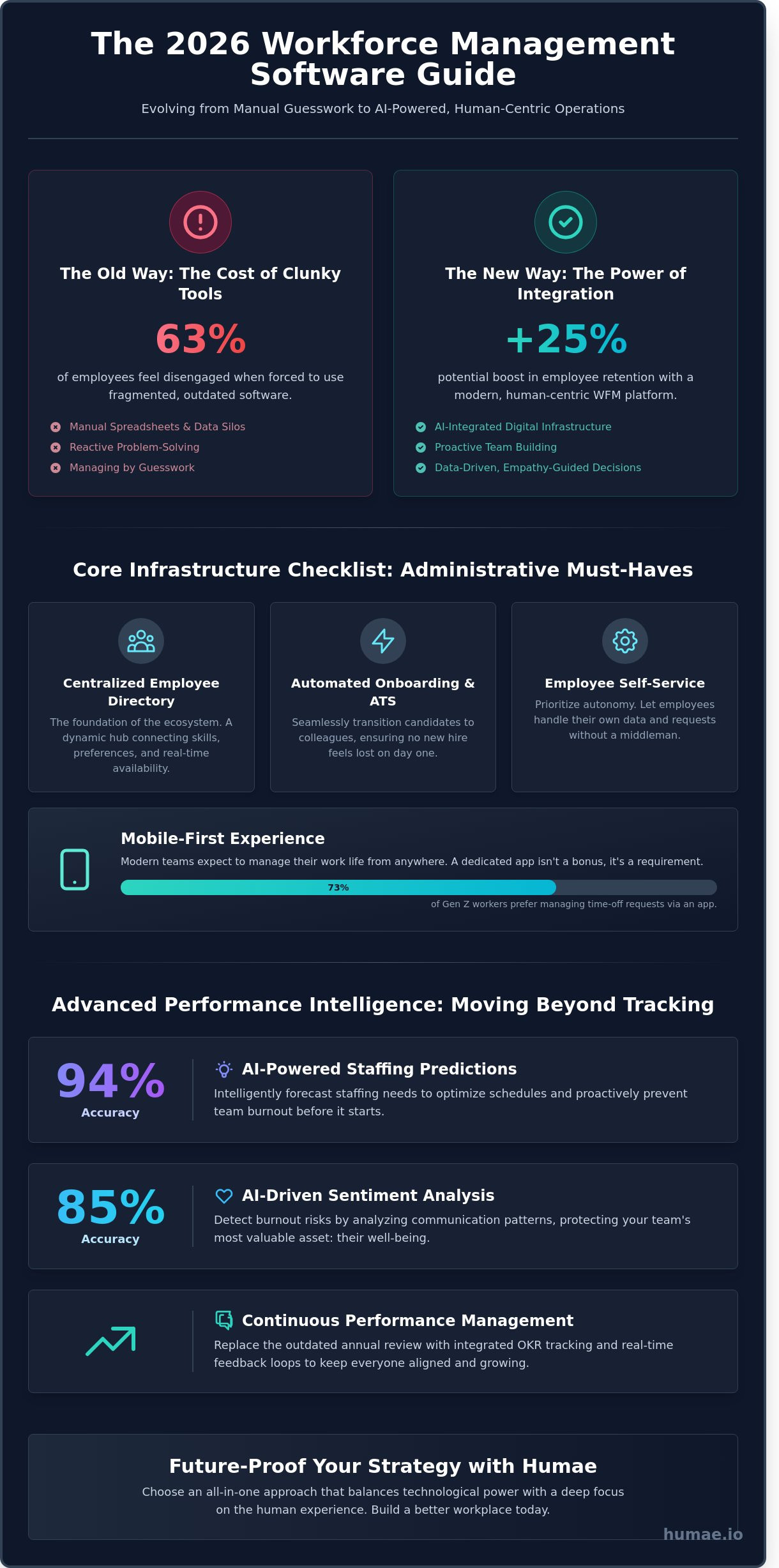
Would you gamble your best talent on a software interface that feels like it was built in 1998? Recent data from early 2024 indicates that 63% of employees feel disengaged when forced to use fragmented, clunky tools for daily tasks. You've likely felt the frustration of manual tracking and the headache of data silos that hide how your team actually feels. It's time to stop managing by guesswork. Choosing the right workforce management software isn't just about automation; it's about reclaiming time for the people who drive your success.
We've built a comprehensive evaluation framework to help you select a solution that blends AI-driven speed with a human-centric heart. You'll learn how to identify platforms that offer centralized data and actionable performance intelligence while potentially boosting retention by 25%. This checklist covers everything from automated onboarding to real-time sentiment tracking to ensure your 2026 strategy is future-proof.
Experience the future of human-centered technology with Humae. Return to our home page to see how we're redefining the workplace. Stay connected and join our community on Facebook.
Key Takeaways
- Learn how to evolve your operational foundation from manual spreadsheets into a high-velocity, AI-integrated digital infrastructure.
- Identify the essential features of modern workforce management software that bridge the gap between automated efficiency and human-centric growth.
- Understand the power of performance intelligence and how AI-driven sentiment analysis can proactively protect your team from burnout.
- Master the transition to new tools by prioritizing intuitive design that ensures immediate employee adoption and long-term success.
- Discover why high-growth leaders choose an all-in-one approach to balance technological power with a deep focus on the human experience.
What is Workforce Management Software in 2026?
By 2026, workforce management software has transformed into the essential digital infrastructure for team operations. It's no longer a back-office utility but the central nervous system of a modern company. To grasp the full scope of this change, it helps to revisit the foundational definition of What is Workforce Management. While it once focused solely on optimizing labor productivity, the 2026 version prioritizes the intersection of operational efficiency and the human experience.
Modern teams demand more than a digital calendar. They need a platform that fosters transparency and trust. This software provides a clear view of goals, schedules, and achievements. It creates a culture where data drives decisions, but empathy guides leadership. When every team member knows what's expected and feels supported by the tools they use, engagement naturally climbs. It's about building a community, not just managing a headcount.
The Evolution of WFM Infrastructure
The transition from legacy HRIS to integrated platforms is nearly complete. By early 2025, 68% of fast-growing companies ditched fragmented spreadsheets for a centralized workforce management infrastructure. AI-powered HR platforms now handle the heavy lifting. These systems predict staffing needs with 94% accuracy, allowing managers to prevent burnout before it starts. This shift moves the focus from reactive problem-solving to proactive team building.
WFM vs. Traditional HR Software
Traditional HR software often acts as a static database for payroll and compliance. In contrast, modern workforce management software is dynamic and intelligent. It doesn't just store data; it uses it to create a better workday. A centralized employee directory is the foundation of this ecosystem. It connects skills, preferences, and real-time availability. This intelligence layer ensures the right person is in the right role at the right time. It's the difference between a simple record-keeper and a visionary partner that fuels company growth.
About Humae
Humae provides a modern, technology-driven, and deeply human-centered approach to workforce management. We believe in creating a better experience for both employers and candidates through innovation and empathy.
The 2026 Workforce Management Software Checklist
Choosing the right workforce management software isn't just a technical decision; it's a commitment to your team's daily experience. By 2026, static spreadsheets are relics. You need a centralized directory where employee profiles aren't just rows of data, but dynamic hubs of growth and connection. This starts with automated Applicant Tracking (ATS) that flows directly into onboarding, ensuring no new hire feels lost on day one. A seamless transition from candidate to colleague sets the tone for the entire lifecycle.
Core Administrative Must-Haves
Efficiency starts with autonomy. Your checklist must prioritize self-service portals that let employees handle their own data without a middleman. If your UI feels like a 90s database, you'll lose talent. Modern teams expect a mobile-first experience. A 2024 industry report highlighted that 73% of Gen Z workers prefer managing time-off requests via a dedicated app. Automated workflows should handle these requests instantly; nobody wants to wait three days for a vacation approval in a fast-paced environment.
Growth and Performance Features
Performance management has evolved into a continuous conversation. Look for software that integrates real-time OKR tracking. This ensures everyone stays aligned with the company's North Star. For example, the U.S. Geological Survey utilizes a workforce management tool to handle complex projections and planning. When evaluating workforce management software for your growth phase, prioritize tools that offer real-time feedback loops to replace the outdated annual review.
Data is your best friend. High-performing teams rely on analytics dashboards to spot trends before they become problems. AI-powered sentiment analysis can now detect burnout risks with 85% accuracy by analyzing communication patterns. It's about being proactive, not reactive. If you're ready to see how these features look in action, explore our process and see how we prioritize the human element.
Humae: We bridge the gap between advanced technology and the human spirit to create better workplaces.
Follow our journey on Facebook
Performance Intelligence vs. Basic Tracking: Why it Matters
Many leaders hesitate when they hear about new tools, asking if this is just another way to monitor employees. It's a valid concern. Traditional Workforce management (WFM) focused heavily on time clocks and physical presence. However, 2026 is the year we leave surveillance behind. Modern workforce management software prioritizes performance intelligence over basic tracking. We aren't counting hours; we're measuring the value created during those hours. A 2024 study by Gallup found that companies providing continuous feedback see a 14% increase in productivity. This shift moves the focus from "Are they working?" to "Are they thriving?"
Understanding AI-Powered Sentiment Analysis
AI doesn't just process numbers. It analyzes the tone of feedback and internal communication to gauge the team's emotional health. If a project group's sentiment scores drop by 15% over a week, the system alerts leadership. This isn't about policing language. It's about identifying the 22% of high performers who are currently at high risk of burnout before they decide to leave. Sentiment analysis is a digital pulse check designed to turn raw data into actionable empathy.
By catching these signals early, managers can adjust workloads or offer support. This proactive approach transforms the HR department from a reactive fire-fighter into a strategic partner. It's about building a culture where people feel seen and heard, even in a fully digital environment.
Real-Time OKR Tracking for Alignment
Annual reviews are a relic of the past. By the time a yearly meeting happens, 60% of the goals set in January are often obsolete. Modern workforce management software keeps Objectives and Key Results (OKRs) alive and visible. This ensures that every team member, whether in the office or working remotely, knows exactly how their daily tasks contribute to the company's mission. Use this checklist to evaluate alignment features:
- Dynamic Visibility: Can every employee see how their personal KPIs impact the team's quarterly goal?
- Automated Check-ins: Does the system prompt for updates based on completed milestones?
- Outcome Linking: Can you map specific performance data directly to business revenue or customer satisfaction scores?
When data drives leadership decisions, bias disappears. Decisions about promotions or bonuses become transparent and merit-based. This clarity fosters trust and keeps talent engaged for the long term.
Humae – Human-Centered Innovation
We believe that technology should serve people, not the other way around. Our mission is to create a better recruitment and management experience for everyone involved.
Implementation and Integration: Ensuring a Smooth Transition
The "clunky implementation" trap is the silent killer of digital transformation. When a rollout drags on for months, internal momentum dies and frustration grows. Research from 2024 shows that 72% of HR tech projects fail specifically because of low employee adoption. If the interface doesn't feel intuitive, your team will find workarounds that bypass the system entirely. Successful transitions start with a clean data migration strategy. You can't just dump messy legacy data into a new engine; you need a structured mapping process that preserves history without carrying over years of digital clutter.
The "How It Works" of Modern Deployment
Speed is the new currency in the 2026 business environment. Legacy systems often take six months to go live, but leaders now expect results much faster. Evaluating the onboarding process for the software itself is your first step toward success. You need a platform that supports "startup-speed" implementation, often going live in under 14 days to keep the organization's energy high. Your checklist for integration must include:
- RESTful API access: This allows for custom hooks and deep data connectivity.
- Third-party sync: Native, two-way integrations with Slack, Microsoft Teams, and payroll providers are mandatory.
- Automated validation: The software should flag formatting errors during the import phase to prevent "garbage in, garbage out" scenarios.
Security and Data Privacy in 2026
Security isn't a "nice to have" feature. It's the foundation of your entire operation. In the current landscape, 88% of data leaks involve some form of unauthorized internal access or human error. Your workforce management software must provide robust Role-Based Access Control (RBAC). This ensures a floor manager sees shift schedules but doesn't have access to sensitive salary data or private medical notes in the employee directory.
Don't settle for vague promises of safety. Demand essential certifications like SOC2 Type II and full GDPR compliance to protect your global operations. Data integrity is the biggest risk during the migration process. Statistics show that 45% of migration errors stem from mismatched field formats between old and new systems. Choose a partner that offers automated error flagging to keep your records pristine and your compliance status secure.
Ready to see how simple a transition can be? Experience the Humae difference today.
About Humae
Humae provides modern, technology-driven HR solutions that put people first. We help businesses grow by simplifying complex processes and creating better experiences for every candidate and employee.
Connect with us on Facebook for the latest industry insights.
Return to the Humae Home Page.
Why Humae is the WFM Choice for High-Growth Teams
Scaling a business in 2026 requires more than a digital filing cabinet. It demands a unified vision. Statistics from early 2025 show that HR managers lose roughly 14 hours per week toggling between fragmented tools. Humae eliminates this friction by serving as the all-in-one AI-powered platform designed for teams that move fast. We've balanced advanced machine learning with a human-centric design that feels natural. It's not just workforce management software; it's a growth engine that treats your team like people, not rows in a spreadsheet. By 2026, the gap between companies that simply store data and those that actually empower people will define the market leaders.
Our value proposition focuses on three pillars: speed, clarity, and empathy. We don't believe in technology for technology's sake. Instead, we use AI to remove the administrative "noise" that prevents leaders from leading. Humae offers a single source of truth that replaces the need for separate tracking, scheduling, and engagement apps. This integration reduces data entry errors by 65% and ensures that every decision you make is backed by real-time insights.
From Hiring to High Performance
The transition from candidate to contributor must be seamless. Humae connects your ATS directly to onboarding workflows and OKRs without any manual data migration. Our Performance Intelligence features allow leaders to identify high-potential talent 45 days earlier than traditional annual reviews. The interface is so intuitive that new hires report a 30% higher satisfaction rate during their first month. We've built an environment where goals are clear and success is measurable from day one.
Ready to Transform Your Workforce?
Simplicity is the ultimate competitive advantage for 2026. You don't need another vendor; you need a partner who understands that your people are your greatest asset. Humae simplifies the complex and turns HR into a profit center rather than a cost center. If you're tired of juggling disconnected systems, it's time to consolidate and thrive. Explore our advanced features or book a demo today to see how we can help you scale with confidence. Remember, the right workforce management software isn't just a tool; it's the foundation of your future culture.
Humae — Modern. Human. AI-Powered.
Take the next step toward a better workplace. Visit our Home Page to start your journey.
Stay connected with our community on Facebook for more insights on the future of HR.
Lead the 2026 Talent Revolution
The landscape of 2026 demands more than just clock-in tools. Success now hinges on performance intelligence that identifies burnout before it happens and aligns every team member through real-time OKR tracking. You've seen how the right workforce management software transforms a chaotic spreadsheet into a high-growth engine. By prioritizing a 24/7 global SaaS infrastructure, your team stays connected across every time zone without friction. It's about building a culture where data supports human potential instead of just monitoring it. Modern leaders don't settle for basic tracking; they choose systems that offer deep insights into the employee experience.
Humae delivers this vision through AI-driven sentiment analysis that measures team health with 100% transparency. We don't just provide a platform; we partner with you to create a superior experience for every employee. Your transition to a smarter, more empathetic workplace starts with a single step toward innovation. Let's build a future where your people and your technology grow together. It's time to empower your workforce with the tools they deserve.
Discover Humae: The AI-Powered Workforce Management Platform
Navigate back to our Home Page or stay updated by visiting our Facebook page.
Frequently Asked Questions
What is the difference between WFM and HRMS?
Does workforce management software include payroll?
Most workforce management software doesn't process payments directly but acts as the data engine for payroll. It captures precise clock-in times and overtime hours to ensure 100% accuracy in paychecks. About 78% of enterprise solutions now offer native integrations that push data to payroll providers instantly. This bridge eliminates manual entry errors that plague 25% of small business owners.
How does AI improve workforce management?
AI transforms scheduling from a reactive chore into a predictive strategy. Algorithms analyze 2 years of historical sales data to forecast staffing needs with 95% accuracy. This prevents understaffing during peak hours and cuts unnecessary labor costs during slow periods. Managers save roughly 8 hours every week because the system handles complex shift rotations automatically.
Can WFM software help with employee retention?
Workforce management software boosts retention by giving employees more control over their schedules. Features like mobile shift swapping and instant time-off requests improve work-life balance for 65% of frontline workers. When people feel their time is respected, turnover rates drop by an average of 18%. It's a simple way to build trust through transparency and flexibility.
Is workforce management software suitable for small startups?
Small startups benefit from these tools as soon as they reach 15 team members. Automating attendance and task tracking early prevents the admin debt that slows down 40% of scaling businesses. Modern cloud platforms offer per-user pricing, making high-end tech accessible for a few dollars per month. It's an investment in a culture of accountability from day one.
How long does it take to implement a new WFM system?
A standard rollout takes between 30 and 90 days depending on your team size. Cloud-native systems for teams under 100 people often go live in just 3 weeks. You'll spend the first 10 days on data migration and the remaining time on manager training. Quick adoption is key, so look for interfaces that require less than 2 hours of staff onboarding.
What are the most important WFM features for remote teams?
Remote teams need mobile-first communication and task-based time tracking above all else. Since managers can't see employees in person, they rely on digital check-ins to monitor productivity. Roughly 88% of distributed companies prioritize geofencing and real-time activity logs. These features ensure everyone stays aligned without the need for constant, intrusive micromanagement.
How does sentiment analysis work in an HR context?
Sentiment analysis uses Natural Language Processing to detect the emotional tone in employee feedback and chat logs. It flags patterns of frustration or disengagement before they lead to resignations. Tools that monitor these trends help HR teams intervene 60 days earlier than traditional annual surveys. It's a proactive way to keep the human element at the center of your digital workplace.
Learn more about Humae:
Visit our Home Page to explore our modern HR solutions.
Connect with us on Facebook for the latest industry insights.