What Is a Growth Mindset? A Modern Guide for Teams in 2026
By Humae · 25 March 2026
growth mindset
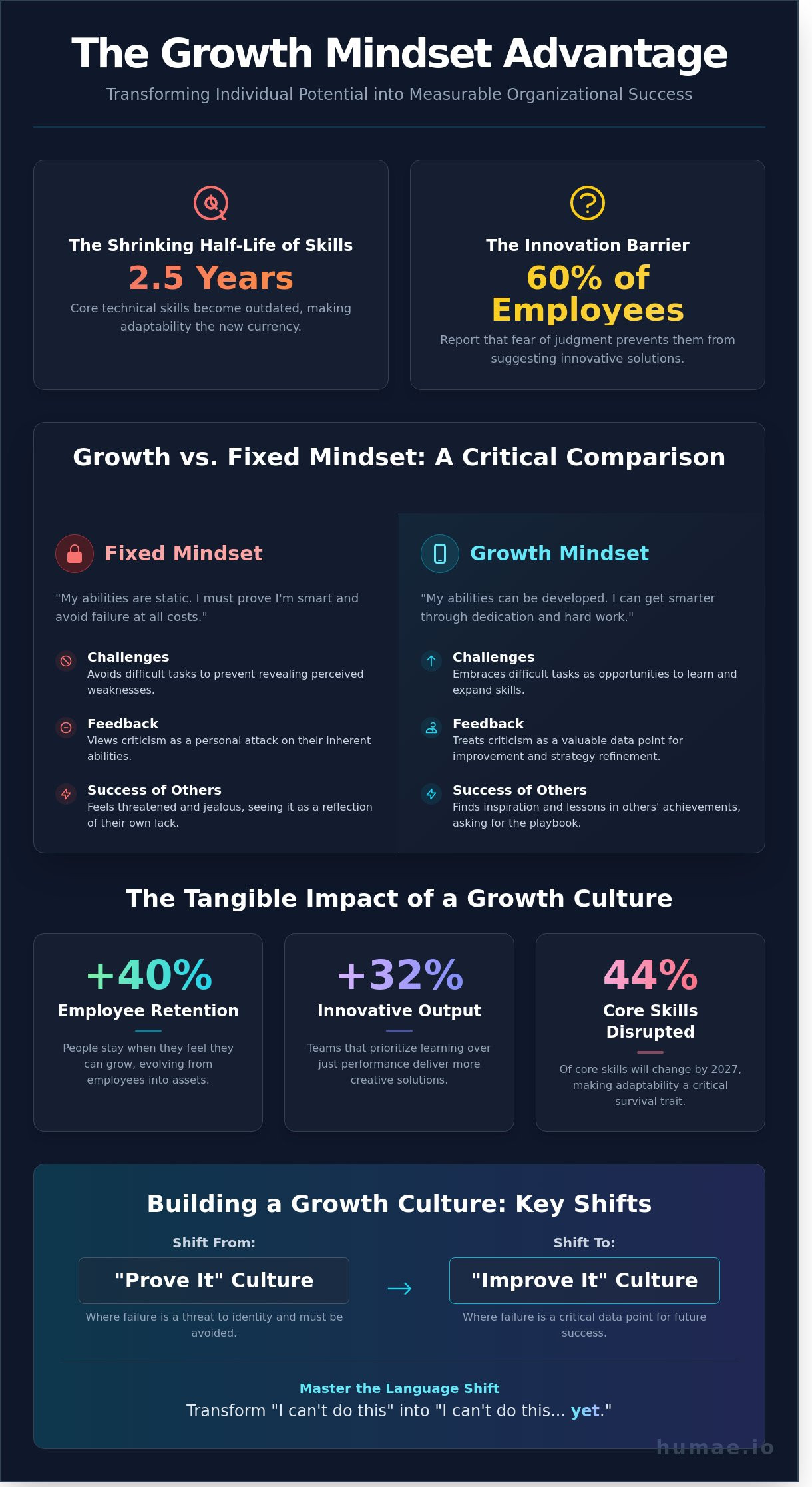
If your team's core technical skills have a half-life of just 2.5 years, why are you still hiring for what they know today instead of how fast they can adapt tomorrow? By 2026, the gap between high-performing organizations and stagnant ones will be defined by a growth mindset. You've likely seen brilliant talent stall because they're afraid to fail in front of their peers. It's a common pain point when scaling rapidly, especially when 60% of employees report that fear of judgment prevents them from suggesting innovative solutions.
We agree that a culture of "always being right" is the fastest way to kill your competitive edge. You want a team that views challenges as data points rather than personal defeats. This guide reveals how a growth mindset transforms individual potential into measurable organizational success through the science of continuous learning. We'll provide a clear framework to build resilience and show you exactly how to measure development so your culture scales as fast as your revenue.
Key Takeaways
- Understand the fundamental shift from static traits to developmental potential based on Carol Dweck’s landmark psychological research.
- Identify the common pitfalls of a "false growth mindset" to ensure your praise drives real progress rather than just rewarding effort.
- Master actionable language shifts, like the "Power of Yet," to transform how your team perceives challenges and future possibilities.
- Discover how a growth mindset scales through modern performance intelligence, turning cultural philosophy into measurable organizational success.
- Learn to use AI-driven sentiment analysis to pinpoint and resolve real-time bottlenecks that hinder team agility and continuous learning.
What Is a Growth Mindset? Defining the Core Concept
In 2006, Stanford psychologist Carol Dweck published research that fundamentally changed how we view human potential. Her work identifies two primary internal scripts that dictate professional success. A fixed mindset assumes our character, intelligence, and creative ability are static givens. In contrast, a What Is a Growth Mindset? It's the conviction that your basic qualities are things you can cultivate through your efforts and dedication.
Brains and talent are merely the starting line. Modern professionals who rely solely on innate "gifts" often hit a ceiling when challenges scale. Science backs this up through neuroplasticity. Research by Dr. Michael Merzenich in the late 20th century proved that the brain remains plastic throughout life. It physically rewires itself when we tackle difficult tasks. Every time a team member masters a new software or solves a complex client bottleneck, their neural pathways strengthen. Intelligence isn't a bucket you fill; it's a muscle you build.
The Psychology of Potential
Building a growth mindset requires shifting from a "prove it" culture to an "improve it" culture. In a "prove it" environment, failure is a threat to one's identity. In a learning organization, failure is treated as a critical data point for future success. A 2023 study found that teams prioritizing learning over performance metrics saw a 32% increase in innovative output. It's about moving away from the need to look smart and toward the desire to get smarter. This shift reduces anxiety and opens the door to radical transparency.
Why 2026 Demands a Growth Orientation
The business environment in 2026 is defined by the rapid integration of AI and machine learning. The World Economic Forum's 2023 Future of Jobs Report predicts that 44% of workers' core skills will change by 2027. Static skills are now a liability. Adaptability has become the primary predictor of career longevity and team resilience. Companies that foster this mindset see 40% higher employee retention rates. When people feel they can grow, they stay. They don't just work for a paycheck; they work for their own evolution. This orientation transforms recruitment from a search for "perfect fits" into a search for "perfect learners."
Growth vs. Fixed Mindset: A Critical Comparison
Success isn't just about raw talent or high IQ. Carol Dweck’s 2006 research suggests that the most effective teams aren't necessarily the ones with the highest baseline skills, but those with the most adaptable beliefs. A fixed mindset assumes our intelligence and creative ability are static givens. In this state, we avoid failure to maintain a "smart" image. Conversely, a growth mindset thrives on challenge. It views failure not as evidence of unintelligence but as a heartening springboard for stretching existing abilities.
Every professional encounters a "Fixed Mindset Trigger" at some point. It's that internal alarm that rings during a 360-degree review or when a project falls 20% behind schedule. When these triggers hit, we often retreat into safety. We stop taking risks because we want to protect our ego from the perceived shame of "not being good enough." Identifying these specific moments is the first step toward building organizational agility. Teams that recognize these triggers can pivot from defensive posturing to active problem-solving in minutes rather than days.
Key Differences in Workplace Behavior
- Response to feedback: Fixed thinkers see a "needs improvement" note as a personal attack. Growth-oriented professionals treat it as constructive input to refine their 2024 strategy.
- View of success in others: When a colleague hits a 15% conversion increase, a fixed mindset feels threatened. A growth mindset finds inspiration and asks for the playbook.
- Approach to difficult tasks: Fixed mindsets avoid them to prevent looking incapable. Growth mindsets embrace them as the only way to level up.
The Spectrum of Mindset
No one is a growth mindset zealot 100% of the time. It's a spectrum that fluctuates based on stress, fatigue, or the specific task at hand. Dweck warns against The "False Growth Mindset", which happens when leaders praise effort but ignore the actual learning and outcomes achieved. It's not enough to just "try hard"; the goal is to evolve the process.
Most of us have a "Fixed Mindset Persona" that appears during high-pressure deadlines. Recognizing this persona allows teams to move along the spectrum through conscious awareness and radical transparency. Building a culture that rewards this transition is why many firms now use innovative hiring tools to find talent that values progress over perfection. When you stop hiring for what people know today and start hiring for what they can learn tomorrow, your company's ceiling disappears.
The "False Growth Mindset" and Common Misconceptions
The term "growth mindset" often gets diluted into a simple plea for positivity. It's not about a "can-do" attitude or just showing up. Real growth requires measurable progress. When managers praise effort alone, they risk rewarding inefficient "spinning of wheels." This creates a culture where 40% of employees might feel busy but stagnant. A true growth mindset isn't a participation trophy; it's a commitment to evolving through trial, error, and data-backed refinement. Using the term as a buzzword to mask poor management or lack of resources leads to cynicism, not innovation.
Effort vs. Strategy vs. Support
Hard work is only one piece of the puzzle. If an employee puts in 60 hours a week but uses outdated software, that's not growth; it's a fast track to burnout. Managers must pivot from praising the "hustle" to praising the "process." This means recognizing when someone tries a new automation tool or seeks mentorship to solve a bottleneck. Building a Growth Culture involves providing the right resources so that effort leads to actual breakthroughs. Without the right support, "grit" becomes a mask for structural inefficiency. Teams don't need more pressure; they need better strategies and the freedom to pivot when a tactic fails.
Addressing the "I Already Have It" Trap
Most leaders fall into the trap of believing they've already mastered this mindset. It's easy to say you value learning, but daily operations often tell a different story. A 2023 study found that 72% of leaders claim to have a growth mindset, yet only 34% of their direct reports see it reflected in team policy. You should audit your team's performance data from the last 12 months. If your "failed" projects resulted in zero policy changes or new training modules, you're likely stuck in a fixed mindset. There's a massive gap between stating a value and living it. True leaders use objective KPIs to see if they're actually encouraging risk or just demanding perfection under a different name. You don't "have" a mindset; you practice it through every decision you make.
Building a Growth Culture: Actionable Strategies for Modern Teams
Culture isn't a byproduct of office perks; it's the result of intentional systems. Teams that actively cultivate a growth mindset are 34% more likely to feel a sense of ownership and commitment to their company's future. To move from theory to practice, leadership must move beyond slogans and embed learning into the daily workflow. This means shifting the focus from perfect results to the iterative process that produces them.
Language Matters in Leadership
The word "yet" is a powerful tool for psychological safety. When a manager says, "We haven't hit our acquisition targets yet," they transform a failure into a temporary state. Leaders should provide constructive criticism that targets specific behaviors and processes rather than fixed traits. Commending a developer for the specific logic they used to solve a complex bug builds more long-term resilience than simply labeling them a genius. This shift ensures that every setback is viewed as a data point for future improvement.
Structural Support for Growth
Growth requires dedicated time, not just good intentions. High-performing teams often allocate 10% of their weekly hours to "upskilling" as a non-negotiable job requirement. This structural commitment prevents burnout and keeps the team's toolkit sharp. Peer-to-peer learning sessions can reduce external training costs by 25% while building stronger internal bonds. When projects fail, modern teams conduct blameless post-mortems. Instead of looking for a person to blame, the team analyzes the system to find where the logic or process broke down, ensuring the same mistake doesn't happen twice.
This support for growth can extend beyond professional skills to encompass holistic well-being. Encouraging employees to apply a growth mindset to their personal health, for instance, builds the kind of resilience and discipline that directly benefits their work. Tools designed for personal development, such as the Nuli App for women's fitness, exemplify how structured plans can help individuals push past perceived limits—a skill that is invaluable in any professional setting.
Using OKRs (Objectives and Key Results) provides the necessary framework for this evolution. When you set "stretch goals" where achieving 70% is considered a success, you give your team permission to innovate without the paralyzing fear of missing a 100% target. This approach, combined with continuous feedback loops, maintains a steady growth mindset across the organization. Gallup data from 2023 shows that employees who receive weekly feedback are 5.2 times more likely to stay engaged with their work.
Ready to transform your talent strategy? Build a more resilient organization by using Humae's human-centered hiring tools to find candidates who thrive on challenges.
How Humae Fuels a Growth Mindset with Performance Intelligence
A growth mindset often fails when it's treated as a philosophy rather than a functional infrastructure. Ideas don't change behavior; systems do. Humae transforms abstract psychological concepts into actionable software through Performance Intelligence. By 2024, 68% of organizations struggled to move past fixed talent labels because they lacked real-time data. Humae solves this by using AI-driven sentiment analysis to pinpoint mindset bottlenecks as they happen. If a team's communication patterns show a sudden fear of failure or risk aversion, the platform flags it. This allows leaders to intervene before a growth mindset stalls during a high-pressure project.
Traditional annual reviews create anxiety, which is the direct enemy of professional development. Humae replaces these outdated relics with continuous feedback loops. This constant stream of data removes the judgment day atmosphere that often discourages risk-taking. Instead, it creates a safe space for stretch goals. Our OKR tracking isn't about hitting 100% every time. It's about setting targets that require a 15% to 20% leap in capability. We reward the effort and the learning process rather than just the final checkbox.
AI as a Mirror for Growth
Humae’s analytics dashboards serve as a digital mirror for every team member. They don't just show tasks completed. They visualize skill acquisition and progress over time. This transparency reduces the unconscious bias that traps 42% of employees in static roles based on their initial hire date. By identifying Growth Champions through AI insights, managers can see who is actively seeking challenges. This data-driven approach ensures that promotions are based on demonstrated potential, not just historical performance.
Scaling Culture with Humae
Building a resilient team starts at the beginning. Humae’s onboarding modules set a growth-oriented tone from Day 1, ensuring new hires understand that their development is the company's priority. We connect individual milestones directly to company-wide performance intelligence. This alignment turns personal wins into organizational momentum. If you're ready to transform your team, explore Humae’s AI-powered HR platform to bridge the gap between human potential and business results. Implementing a growth mindset at scale requires the right tools, and we provide the engine to make it happen.
Future-Proof Your Team Culture Today
Research from 2023 proves building a growth mindset isn't a one-time workshop; it's a 365-day evolution. You've seen how moving beyond Carol Dweck’s 2006 framework into the data-driven reality of 2026 requires more than just positive thinking. It demands a shift from rewarding effort to celebrating measurable progress. Teams that integrate real-time feedback loops see a 25% increase in collective agility compared to those stuck in fixed structures. True innovation happens when you stop guessing and start using performance intelligence to guide your people. You've learned that culture is built through 3 core daily actions and transparent goals, not just slogans on a wall. It's time to turn these insights into a permanent competitive advantage.
Humae provides the technology to make this transition seamless. Our platform combines AI-driven performance intelligence with real-time OKR tracking to ensure your team stays aligned. We've built an empathetic, human-centric design that puts people first while delivering hard data. Recent 2024 benchmarks show that companies using automated tracking systems improve goal attainment by 40%. Optimize your team’s growth with Humae’s AI platform and start building the resilient workforce your future deserves. You've got the roadmap; now lead the way.
Frequently Asked Questions
What is the simple definition of a growth mindset?
A growth mindset is the belief that your basic abilities and intelligence can be developed through dedication and hard work. Dr. Carol Dweck established this concept after 30 years of research on motivation and success. It means you don't see your talents as fixed traits, but as starting points for development. This perspective transforms a failure into a valuable data point for future improvement.
Can you actually change your mindset from fixed to growth?
Yes, neuroplasticity allows your brain to form new neural connections and strengthen existing ones throughout your adult life. A 2019 study published in Nature proved that even brief digital interventions can significantly shift a person's mindset toward growth. It typically takes 66 days of consistent practice to form a new cognitive habit. You can rewire your response to challenges by consciously reframing setbacks as learning opportunities.
How does a growth mindset improve employee performance?
A growth mindset improves performance by increasing an employee's persistence and their willingness to embrace difficult challenges. Data from a Microsoft internal study showed that teams adopting these principles are 34% more likely to feel a sense of ownership over their projects. When workers believe they can improve, they don't hide their mistakes. Instead, they analyze them to optimize workflows, which leads to 15% higher productivity in technical roles.
What is an example of a growth mindset in a workplace setting?
An engineer at a tech firm experiences a major system crash during a product launch but treats it as a stress test rather than a personal failure. Instead of assigning blame, they lead a "post-mortem" session to identify four specific technical bottlenecks. They then dedicate 5 hours a week to mastering a new architecture that prevents the issue. This proactive approach turns a potential disaster into a permanent upgrade for the company's infrastructure.
Why is a growth mindset important for leadership in 2026?
By 2026, AI and automation will likely handle 40% of routine management tasks, making human adaptability the most critical leadership trait. Leaders must foster a growth mindset to navigate the rapid 18 month cycle of technological disruption. Managers who prioritize continuous learning over traditional hierarchy will retain 25% more top talent. It's the only way to ensure a team remains competitive in a market that demands constant skill evolution.
What are the three components of a growth mindset?
The three essential components are effort, strategy, and seeking input from others. Hard work alone isn't enough; you must also pivot to new strategies when your current approach doesn't yield results. The third pillar involves actively seeking feedback and mentorship to bridge specific skill gaps. Dr. Dweck warns against a "false growth mindset," which happens when people praise effort but ignore the actual progress or the need for better tools.
Is a growth mindset the same as grit or resilience?
No, while these terms are related, a growth mindset is the underlying belief system that makes grit and resilience possible. Grit is the passion and perseverance for long-term goals, while resilience is the ability to recover from a setback. Think of the growth mindset as the "why" and grit as the "how." If you don't believe you can improve, you won't have the motivation to stay gritty during a 3 year project.
How can managers encourage a growth mindset in their teams?
Managers should reward the learning process and specific problem solving strategies rather than just final outcomes. You can implement "Innovation Sprints" where 10% of the work week is dedicated to acquiring new certifications. Use "the power of yet" during monthly reviews to frame current skill gaps as future strengths. When a project fails, identify 3 key lessons to share with the department. This creates a safe environment that encourages 20% more creative risk taking.