Ultimate Guide: Employee Directory Software 2026
By Humae · 11 August 2026
employee directory software
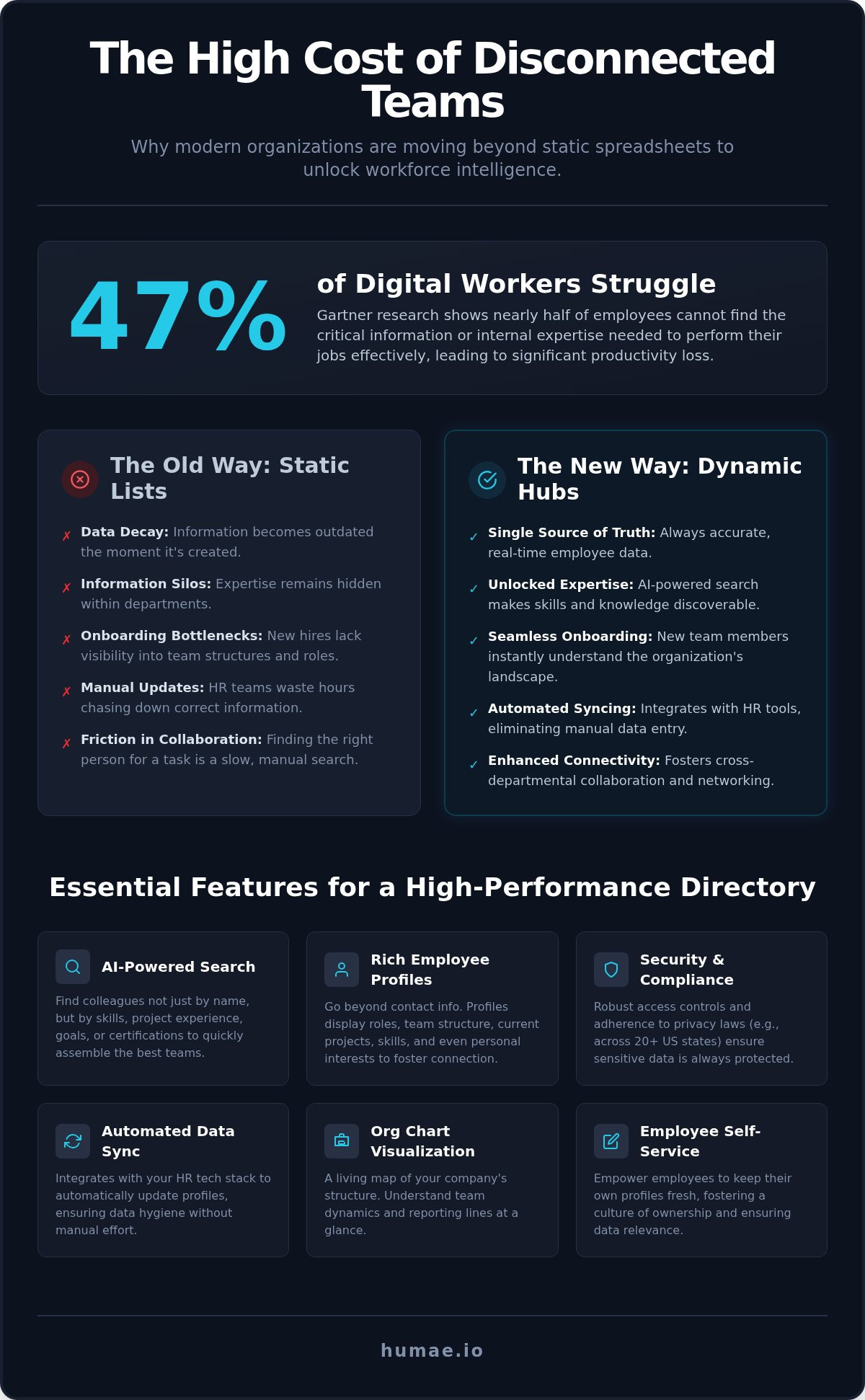
According to Gartner research, 47% of digital workers struggle to find the critical information or expertise they need to do their jobs effectively. It's a staggering statistic that highlights a common organizational failure: the reliance on outdated spreadsheets instead of modern employee directory software. You likely recognize the pain of fragmented data scattered across different platforms and the onboarding bottlenecks that occur when new hires lack visibility into the team structure. It's frustrating when the "who's who" is a mystery rather than a resource.
In this guide, we'll show you how to transform your basic list into a dynamic workforce intelligence hub that drives connectivity and performance. You'll discover how the right employee directory software serves as a single source of truth, automating data syncing with your HR tools while improving internal networking. We'll preview the top platforms of 2026, examine critical privacy compliance across 20 US states, and explore how AI-powered search can unlock hidden expertise within your company. Let's build a more connected workplace together.
Discover more with Humae, your partner in modern HR. Follow our latest updates on Facebook or return to our homepage.
Key Takeaways
- Transition from static spreadsheets to real-time, automated databases that serve as a single source of truth for your organization.
- Discover why AI-powered search is the new standard for finding internal expertise and talent across your workforce.
- Learn how modern employee directory software acts as a central hub for sentiment analysis and workforce intelligence.
- Get a step-by-step implementation roadmap and a vendor checklist to ensure a seamless software rollout.
- See how Humae integrates directories with performance intelligence to drive better connectivity and higher performance.
Discover more with Humae, your partner in modern HR. Follow our latest updates on Facebook or return to our homepage.
Beyond the Digital Phonebook: Why Modern Teams Need Employee Directory Software
The traditional office phonebook is dead. In its place, modern organizations are building a dynamic workforce management infrastructure. This isn't just a list of names and extensions; it's a living map of your company's talent. Effective employee directory software serves as the central nervous system for your business, connecting people to the information they need to perform at their peak. It transforms a passive contact list into an active tool for organizational intelligence.
For remote and hybrid teams, this connectivity is a vital lifeline. Without physical "water cooler" moments, finding a colleague's specific expertise becomes a digital obstacle course. A centralized directory removes this friction. It acts as the foundational layer for all modern HR operations, ensuring that data flows seamlessly from onboarding into performance tracking and daily collaboration. When everyone knows who does what, the entire organization moves faster.
The Role of Connectivity in High-Growth Companies
Scaling a business requires speed. When a team member needs a specific expert to solve a client issue, every minute spent searching through Slack or outdated email threads is wasted capital. Information silos are a silent tax on high-growth companies. By making skills, roles, and project histories transparent, you reduce the friction of internal networking. This transparency allows employees to collaborate across departments without needing a formal introduction from a manager. It turns your workforce into a fluid, responsive network rather than a collection of isolated islands.
Moving from Static Lists to Dynamic Data
Relying on manual spreadsheets or PDF directories is a recipe for data decay. The moment you export a contact list, it's already out of date. Modern employee directory software solves this through real-time automated databases. Instead of an HR administrator chasing people for phone number updates, these systems integrate with your existing tech stack to ensure total data hygiene. This isn't a clunky plugin; it's an intuitive platform that lives where your work happens.
Employee self-service is the engine behind this shift. When individuals can update their own profiles with new skills, certifications, or even personal interests, the directory stays fresh and relevant. This transition from a static document to a dynamic platform ensures that your "source of truth" remains accurate. It empowers the workforce to take ownership of their professional identity within the company, fostering a culture of trust and visibility.
Essential Features of a High-Performance Employee Directory in 2026
Selection criteria for employee directory software have shifted. In 2026, a high-performance system isn't just a place to look up an email address. It's a strategic asset. You need a platform that balances deep technical integration with an intuitive, human-centric interface. If the software doesn't simplify the lives of both HR and the end-user, it won't be adopted. The focus has moved from simple data storage to active talent discovery.
Intelligent Search and Rich Employee Profiles
AI-powered search has become the industry standard for finding internal talent. It allows users to search by skills, projects, or even specific OKRs rather than just names. This level of granularity is essential for cross-departmental collaboration. When a rich profile includes a person's current goals and past successes, it builds immediate trust. It helps teams identify the right expert for a task in seconds, cutting through the noise of traditional communication channels. This integrated approach to workforce management ensures that every profile contributes to the bigger picture of organizational success.
Security, Compliance, and Access Management
Data protection is more complex than ever. With 20 US states now enforcing comprehensive privacy laws, your directory must be a fortress. Enterprise-grade encryption is the baseline, but the real value lies in granular role-based access control. You need to ensure that sensitive personal information remains private while professional details stay accessible. Modern systems must facilitate automated data subject rights requests to remain compliant with GDPR and CCPA standards without manual overhead. Protecting your people's data is just as important as connecting them.
Finally, accessibility must be universal. Deskless workers and frequent travelers need a mobile-first experience that feels as snappy as a consumer app. A truly high-performance directory lives in the pocket of every employee. It ensures that connectivity isn't limited to those sitting at a desk. By prioritizing mobile-native features, you ensure that your entire workforce stays aligned, regardless of their physical location or time zone.
Static Lists vs. AI-Powered Workforce Infrastructure: Making the Shift
Most companies treat their directory as a graveyard for data. It's where profiles go to be forgotten. In 2026, the best employee directory software functions as an active infrastructure. It doesn't just store data; it interprets it. By integrating AI-driven sentiment analysis directly into the directory experience, leadership can gauge the pulse of the organization in real-time. This isn't about surveillance. It's about empathy and support. When a directory update triggers an automated workflow, such as a promotion announcement or a customized onboarding path, it removes the administrative friction that slows down high-growth teams.
The shift from a static list to an AI-powered hub changes how teams interact. Traditional tools are passive. They wait for you to search. Modern infrastructure is proactive. It suggests connections based on project history or shared goals. This transition ensures that your directory data isn't just accurate; it's actionable. It turns a simple contact list into a strategic engine that drives daily performance and long-term organizational health.
The Power of Integrated Performance Intelligence
Linking directory profiles to OKR tracking is the ultimate transparency move. When you look up a colleague, you don't just see their title; you see their goals and how they align with the company's vision. This real-time visibility allows managers to identify high-potential talent based on actual output rather than just tenure. Workforce management infrastructure is the backbone of talent optimization. It turns a simple lookup into a strategic talent review, making sure the right people are in the right roles at the right time.
Automation: Reducing the HR Administrative Burden
Manual entry is a relic of the past. Modern employee directory software automates the onboarding flow the moment a new hire is added to the system. It handles time-off management visibility, so teams know who's available without checking three different apps. A robust API ensures that this data flows into your existing tools, creating a seamless ecosystem. This isn't just about efficiency. It's about giving HR professionals their time back to focus on people, not paperwork. When your systems talk to each other, your people can talk to each other more effectively.
How to Evaluate and Implement Your Directory Software
Implementing employee directory software is a strategic move that requires more than just a technical installation. It's an organizational upgrade. To succeed, you must approach the rollout as a bridge between your legacy data and your future culture. Start by auditing your current employee information. Clean data is the foundation. If you migrate messy records, you'll simply have a digital version of your old problems. Focus on data integrity by verifying titles, reporting lines, and contact details before the transition begins.
A successful rollout depends on a clear migration strategy. Don't try to move everything at once if your data is scattered across multiple spreadsheets. Identify the "source of truth" and use it as the primary feed for your new system. This ensures that the migration doesn't lose the integrity of your reporting structures. Once the data is live, the focus shifts from the technical setup to the people who will use it every day.
A Checklist for HR Decision Makers
Choosing the right partner is critical. You aren't just buying a tool; you're selecting a workforce intelligence hub. Use this checklist to evaluate potential vendors:
- Total Cost of Ownership: Does the price include implementation support, data migration, and future updates?
- Scalability: Can the platform handle your team's growth over the next five years without performance lag?
- Integration Depth: Does it sync natively with your current HRMS and communication tools?
- User Interface: Is the UI intuitive enough for employees to use without a 50-page manual?
You can learn more about how it works to see how a modern platform handles these complexities. A visionary partner will prioritize both technical robustness and ease of use.
Ensuring High Adoption Rates Across the Team
A directory only provides value if people actually use it. To drive adoption, make the platform a daily destination. It shouldn't just be a place to find a phone number. Integrate OKR visibility and performance intelligence so that employees see the directory as a tool for their own professional growth. When people see how their work connects to the larger mission, they're more likely to keep their own profiles updated. Train your team on self-service features early. This empowers them to own their professional identity while reducing the administrative load on HR.
Gathering feedback is the final piece of the puzzle. Ask your team what's missing. Is the search fast enough? Can they find experts in seconds? Use these insights to continuously refine the experience. A successful implementation is never truly finished; it evolves with your company. If you're ready to transform your workforce intelligence, explore our employee directory solutions today.
Building a Connected Culture with Humae
Humae represents the next evolution of organizational connectivity. We've built a platform for teams that refuse to settle for clunky SharePoint plugins or fragmented legacy tools. Our employee directory software isn't just a database; it's a vibrant ecosystem where technical precision meets human empathy. By centralizing your workforce data, we help you move past the administrative hurdles of the past and focus on what truly matters: your people. It's about creating a space where every employee feels seen and every manager feels empowered to lead effectively.
The Humae Advantage: AI Meets Empathy
Technology should serve people, not the other way around. Our AI-driven sentiment analysis provides a real-time pulse-check of your organization, allowing leaders to identify where support is needed most before burnout becomes a bottleneck. This isn't about tracking; it's about understanding the emotional health of your teams through subtle data patterns. We believe that a modern HR platform should be as beautiful as it is functional. That's why Humae features a clean, Red-Dot-style interface that makes managing complex data feel intuitive and fresh. You can explore our full feature set to see how we've reimagined every touchpoint of the employee experience.
Ready to Transform Your Workforce Management?
The synergy between our directory and performance intelligence tools creates a seamless flow of information that drives results. Managers can track real-time OKRs, approve time-off requests, and monitor team performance within a single, unified interface. This centralized infrastructure simplifies everything from the initial hiring phase to the final steps of onboarding, ensuring that every new team member feels connected from day one. It's about building a culture where transparency and performance go hand in hand without the friction of jumping between multiple apps.
As we look toward the future of HR tech in 2026, the organizations that thrive will be those that prioritize both data integrity and human relationships. Humae is designed to be the backbone of that success. We invite you to see our employee directory software in action and discover how a truly integrated platform can elevate your entire organization. Your team deserves a hub that inspires connectivity, fosters growth, and drives measurable results. Don't wait for your culture to catch up; lead the way with a system built for the modern age.
The Future of Organizational Intelligence
The workplace of 2026 demands more than just a digital phonebook. It requires a central nervous system that fuels growth and connection. By upgrading to modern employee directory software, you move from managing static lists to orchestrating a dynamic workforce. You've learned that the right platform doesn't just store names; it aligns goals, protects sensitive data, and surfaces hidden expertise across your entire organization. It's the difference between working in silos and thriving as a unified team.
Ready to lead your organization into the next era of productivity? Streamline your workforce with Humae today and leverage AI-powered performance intelligence. With centralized hiring and onboarding plus real-time OKR tracking, we provide the infrastructure your culture needs to excel. Let's transform your workforce management into a competitive advantage. Your team's potential is waiting to be unlocked.
Discover more with Humae, your partner in modern HR. Follow our latest updates on Facebook or return to our homepage.
Frequently Asked Questions
What is employee directory software and why is it better than a spreadsheet?
Employee directory software is a dynamic, automated database that centralizes workforce information and provides real-time visibility. It's superior to a spreadsheet because it eliminates manual data entry errors and ensures that contact details are always current. While a spreadsheet is static and decays the moment it's saved, a dedicated platform syncs with your existing tech stack to maintain total data hygiene across the organization.
Can employee directory software integrate with my existing HR tools?
Yes, modern employee directory software is designed to integrate seamlessly with your current HRMS, communication apps, and identity providers. Most systems use robust APIs to connect with tools like Slack, Microsoft Teams, or Google Workspace. This connectivity ensures that when a change occurs in one system, it reflects everywhere, creating a single source of truth for your team's information.
How does AI improve the functionality of a digital employee directory?
AI transforms a directory from a simple lookup tool into an intelligent workforce hub by enabling natural language search and skill discovery. It allows users to find colleagues based on project history or specific expertise rather than just job titles. Additionally, AI can power sentiment analysis to help leaders understand team morale and connectivity patterns without the need for manual surveys.
Is employee directory software secure for sensitive personal information?
Modern employee directory software is built with enterprise-grade security, including role-based access control and advanced encryption. Unlike shared documents, these platforms allow you to restrict who can see sensitive data like home addresses or private phone numbers. This structure ensures compliance with global privacy regulations such as GDPR and the various US state laws in effect as of 2026.
How much does it cost to implement a modern directory for a mid-sized team?
The cost typically follows a per-user, per-month subscription model, though the exact price depends on the complexity of the feature set. While basic tools focus on contact info, enterprise-grade infrastructure that includes AI and performance intelligence requires a more strategic investment. It's best to evaluate the total cost of ownership, including data migration and support, against the significant efficiency gains you'll achieve.
What is the difference between an HRMS and a simple employee directory?
An HRMS is a comprehensive suite managing the entire employee lifecycle, while a simple directory focuses primarily on contact information and organizational charts. Modern platforms often bridge this gap by offering directory features within a larger workforce management infrastructure. This includes tools for OKR tracking and performance analytics, providing a more holistic view of the team than a standalone contact list.
Can employees update their own information in the directory?
Employees can and should update their own information through intuitive self-service portals to maintain data accuracy. This feature empowers individuals to manage their professional profiles, including skills, certifications, and personal interests. By shifting this responsibility away from HR departments, you reduce administrative bottlenecks and ensure that the directory always reflects the most current information available.
How does a directory help with remote team onboarding?
A directory accelerates remote onboarding by providing new hires with immediate visibility into the company structure and key stakeholders. It helps them identify exactly who to contact for specific questions, which reduces the isolation often felt in hybrid environments. When integrated with your hiring tools, the directory entry is created automatically, ensuring a smooth transition from candidate to a fully connected team member.