Top Workforce Management Solutions for 2026: Building Modern HR Infrastructure
By Humae · 8 April 2026
workforce management solutions
What if your HR tech stack felt less like a digital junk drawer and more like a high-performance engine? A 2024 report by Sapient Insights Group notes that companies choosing integrated workforce management solutions see a 32% boost in talent retention over those using fragmented tools. You likely feel the drain of toggling between five different windows just to approve a single time-off request. It's hard to lead with empathy when manual tracking and disconnected data get in the way of real human connection.
We're here to help you evaluate and implement systems that bridge the gap between operational efficiency and employee growth. We'll explore how to build a centralized source of truth for your data and automate onboarding workflows. You'll learn to replace guesswork with actionable insights that improve team sentiment and productivity by 2026. This is about more than software; it's about building an infrastructure that respects your time and your people.
Return to Home.
Follow us on Facebook.
Key Takeaways
- Understand the shift from legacy time-clocks to AI-powered infrastructure that treats your workforce as a strategic asset rather than an operational cost.
- Identify essential mobile-first features that maximize operational efficiency while significantly improving the daily employee experience.
- Discover why AI-native workforce management solutions are replacing clunky legacy ERPs with intuitive, SaaS-driven designs tailored for 2026.
- Master a frictionless implementation roadmap that uses "employee-first" communication to unify fragmented tools into a single, cohesive platform.
- Explore how Humae balances intelligent automation with human-centric design to centralize performance tools and drive team growth.
What Are Workforce Management Solutions in 2026?
The shift from basic "time-clocks" to AI-powered HR platforms has changed how leaders view their teams. Modern workforce management solutions utilize machine learning to predict staffing needs and automate repetitive workflows. This evolution introduces the concept of People Intelligence. It's the next stage of HRMS where data isn't just stored; it's used to understand employee sentiment, productivity patterns, and long term potential. It's about making decisions based on real-time insights rather than gut feelings or outdated reports from last quarter.
The Core Components of Modern WFM
A robust system starts with a single source of truth. Employee directories in 2026 are dynamic hubs that manage centralized data, ensuring that every department stays aligned. Automated time-off and absence management systems have replaced the "email tag" game, allowing teams to request and approve leave in seconds. Perhaps most importantly, integrated performance tracking creates real-time feedback loops. Research shows that 73% of employees feel more engaged when they receive immediate feedback rather than waiting for an annual review. These components work together to create a seamless experience for both managers and staff.
Why Your Business Needs Digital HR Infrastructure Now
The hidden costs of manual data entry are staggering. Industry data suggests that manual payroll processing leads to an error rate between 1% and 8%, which can cost a mid-sized company thousands every year. Moving away from "spreadsheet fatigue" isn't just about saving time; it's about survival. Centralized workforce management solutions significantly reduce compliance risks and legal exposure by automatically updating to match current labor laws and tax regulations. Beyond the numbers, these systems foster a transparent company culture. When everyone can see their goals, schedules, and progress in one place, trust becomes the default setting of the organization.
Humae | Modern HR Infrastructure for Visionary Teams
We build technology that puts people first, helping you transform recruitment and management into a competitive advantage.
Return to our Home Page to explore our solutions.
Connect with us on Facebook for the latest HR innovation updates.
Key Features to Look for in a Workforce Management Platform
Modern workforce management solutions no longer just track hours. They act as the digital nervous system of your organization. By 2026, the gap between high-performing teams and struggling ones will be defined by how they balance operational efficiency with the employee experience. You need a system that removes friction, not one that adds administrative layers.
Mobile accessibility is the new baseline. With 80% of the global workforce being deskless, your team needs to manage their professional lives from their pockets. If a platform doesn't offer a seamless mobile experience for swapping shifts or requesting leave, it's already obsolete. Efficiency comes from empowering employees to handle their own data without waiting for HR approval on every minor detail.
This is especially true for field service businesses, where technicians need to manage jobs, inventory, and customer communication on the go. Digitizing these operations with a dedicated platform like Repair-CRM can streamline everything from scheduling to invoicing, directly impacting both efficiency and customer satisfaction.
The shift toward an AI-powered HR platform is where the real competitive advantage lies. Automation should handle the repetitive tasks, but AI should provide the insights that humans often miss. Scalability is equally vital. A startup with 15 people needs simplicity, but that same company with 500 employees needs complex permission structures and deep integration capabilities. Your software must grow as fast as your headcount does.
Performance Intelligence & AI Sentiment Analysis
Annual reviews are dead. Data from Gallup shows only 14% of employees feel inspired by traditional performance assessments. Modern platforms use AI to monitor team morale in real-time. By analyzing patterns in communication and output, these tools can flag signs of burnout before a resignation letter hits your desk. You get actionable dashboards that highlight cultural health, allowing for continuous feedback loops that keep your best talent engaged and supported.
Strategic Goal Alignment: Integrating OKRs
Transparency drives retention. When employees don't see how their work impacts the company, they check out. Research indicates that 95% of workers don't fully understand their company's strategy. Modern workforce management solutions bridge this gap by integrating Objective and Key Results (OKR) tracking directly into the daily workflow. It connects a developer's daily task to the CEO's five-year vision. This alignment turns a job into a mission, significantly boosting engagement across every department.
Ready to transform your team's potential? Explore how to modernize your HR infrastructure today.
We build technology that puts people first, simplifying recruitment and management for the next generation of businesses.
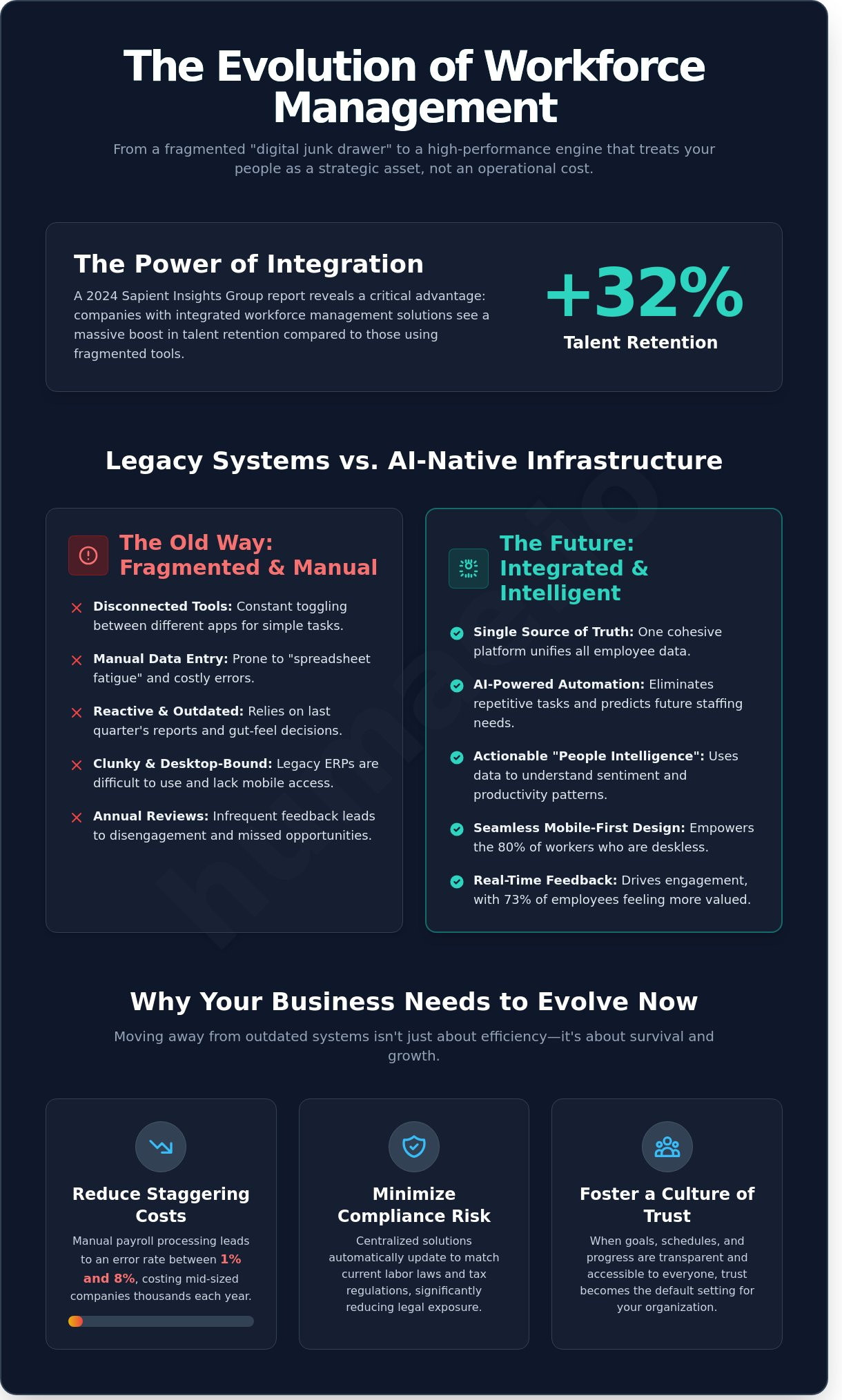
Comparing WFM Solutions: Legacy Systems vs. AI-Native Infrastructure
The myth that enterprise software must be difficult to use is finally fading. For decades, HR departments operated under the assumption that powerful workforce management solutions required a steep learning curve and a cluttered interface. By 2026, the industry has shifted. We've moved from the gray, menu-heavy ERPs of the 2010s to intuitive, SaaS-driven designs that prioritize the user experience as much as the data itself.
Legacy ERPs: The High Cost of Complexity
Old-school systems were built for record-keeping, not for people. These legacy platforms often require implementation timelines stretching from 6 to 18 months. During this period, companies frequently encounter hidden consulting fees that can inflate the total cost of ownership by 40 percent. The architecture is usually fragmented. Different modules for payroll, scheduling, and recruitment often don't talk to each other without manual "bridge" work from IT teams.
The real cost isn't just financial. It's the "user resistance" factor. When software feels like a burden, adoption rates plummet. A 2024 industry survey revealed that 55 percent of employees avoid using their company's HR portal because the navigation is too confusing. These systems collect data, but they don't understand it. They leave HR managers drowning in spreadsheets instead of providing actionable insights.
AI-Native Platforms: Agility and Insight
Modern, AI-native platforms represent a clean break from the past. They're built on the principle of data intelligence rather than simple data collection. Instead of just storing a clock-in time, these workforce management solutions analyze patterns to predict burnout or suggest optimal staffing levels before a shortage occurs. This "intelligence-first" approach is why 80 percent of fast-growing scale-ups are abandoning traditional ERPs for agile alternatives.
Deployment speed is a major differentiator. Modern platforms offer instant-on functionality. You can see how it works by looking at the automated workflows that replace hundreds of manual clicks. Native integrations eliminate the need for expensive third-party connectors, ensuring that data flows freely between recruitment and operations. It's about creating a better experience for everyone involved, from the recruiter to the new hire.
Humae: Building the Future of HR
Humae combines cutting-edge technology with a deeply human-centered approach to transform your recruitment and workforce strategy. We're here to help you grow with confidence and clarity.
Ready to see the difference? Return to our Home Page to explore our vision.
Stay connected with our community on Facebook.
How to Implement a Workforce Management Solution Without the Friction
Step 1: Audit Your Current HR Tech Stack
Look at your subscriptions. A 2024 industry report found businesses waste $18,000 annually per employee on unused or redundant SaaS features. Identify where data silos live. If your payroll doesn't talk to your scheduling, you've got a silo that creates manual work. Define the specific "jobs to be done" for your new platform. Are you solving for shift compliance or talent retention? Secure buy-in by showing management the cost of inaction. For the team, emphasize that better workforce management solutions mean more predictable schedules and faster leave approvals. It's about making their lives easier, not just tracking their hours.
Step 2: Data Migration and Onboarding
Spreadsheets are where data goes to die. When migrating to a central database, verify every entry. Inaccurate start dates or tax IDs will tank your system's credibility on day one. Use automation to handle the heavy lifting of onboarding. A smooth digital welcome increases new hire retention by 82% according to Brandon Hall Group data. Set up your initial employee directory with clear roles and permissions. This transparency builds trust. Establish immediate OKRs to track success. Aim for a 50% reduction in manual data entry within the first 30 days. This creates instant proof of value for every stakeholder involved.
Ready to modernize your team's experience? See how Humae features can transform your daily operations.
Humae: Modern HR infrastructure for human-centered growth.
Navigate back to our Home Page.
Follow us for more insights on Facebook.
Humae: The Intelligent Infrastructure for Modern Teams
Humae isn't just another software entry in the crowded HR market. It represents a shift toward intelligent infrastructure where AI doesn't replace people, it empowers them. By 2026, the demand for workforce management solutions that prioritize the employee experience will reach an all-time high. Humae meets this demand by combining a centralized directory with automated time-off management and robust performance tools. It's about moving away from fragmented spreadsheets into a single source of truth. Stop chasing paper trails; start leading teams with clarity.
Real-time sentiment analysis changes how leaders communicate. Instead of waiting for annual reviews, managers receive signals that allow for immediate support. This data-driven empathy is why 92% of users report better team alignment within the first quarter of implementation. You get a clear view of organizational health without the guesswork. The platform's design focuses on the human element, ensuring that every automated process serves to strengthen the bond between the company and its talent.
From Hiring to Performance Intelligence
- Unified Data: Eliminate data silos by keeping ATS and performance history in one place.
- Empathy-at-Scale: Use AI to identify burnout risks before they lead to turnover.
- Automated Workflows: Reduce administrative load by 30% through intelligent task delegation.
Ready to Build Your Modern Workforce Infrastructure?
Competitive advantage in 2026 belongs to those who embrace an AI-powered workforce. Transparency isn't just a buzzword; it's a requirement for retaining top talent. Humae facilitates this through clear OKR tracking, allowing every team member to see how their daily tasks contribute to the company's vision. When people understand their impact, engagement rises by 14% on average. This visibility fosters a culture of growth and accountability that traditional workforce management solutions simply can't match.
It's time to visualize your team's growth through a lens of innovation. Explore the core features and see how the platform adapts to your specific needs. Don't let your HR infrastructure remain in the past while your goals are in the future.
Building the future of work, one human connection at a time.
Return to Home Page | Connect with us on Facebook
Master Your Team's Growth with Intelligent Infrastructure
The move toward 2026 requires a total departure from rigid legacy tools that create silos. Research suggests 80% of high-growth firms will transition to AI-native systems by 2026 to stay competitive. Modern workforce management solutions must act as a living nervous system for your company, not just a static database. By integrating AI-powered performance intelligence and real-time OKR tracking, leaders can monitor team progress the moment it happens. Centralizing your employee infrastructure ensures that your data remains actionable and accessible across every department. It's about turning HR from a back-office cost center into a strategic growth engine. You don't need to struggle with friction-heavy rollouts when the right technology prioritizes the human experience. Start building a culture where every team member feels seen and every goal is within reach. The future of work is already here, and it's built on intelligence and empathy.
Experience the future of HR with Humae; start your journey here.
Frequently Asked Questions
What is the difference between HRIS and workforce management solutions?
HRIS platforms manage core employee data like contracts and payroll, while workforce management solutions focus on daily operational efficiency. An HRIS handles the administrative "who" of the company. In contrast, WFM tools tackle the "how" and "when" through scheduling and real-time task tracking. Gartner reports that 60% of large enterprises now integrate both to bridge the gap between static records and active labor productivity.
Can small startups benefit from advanced workforce management software?
Startups with as few as 10 employees see immediate ROI by automating scheduling and compliance. Small teams often lose 20% of their productive time on manual admin tasks that don't scale. Implementing these tools early builds a professional foundation. It prevents the process debt that typically hits companies once they cross the 50-employee threshold and need more structure.
How does AI-driven sentiment analysis actually work in an HR context?
AI sentiment analysis processes natural language from internal surveys and chats to identify patterns in employee mood. Algorithms categorize keywords into emotional clusters like frustration or engagement. A 2025 Deloitte study indicates that predictive sentiment tools flag burnout risks 3 months before an employee actually resigns. This allows leaders to intervene with empathy rather than reacting to a sudden, costly exit.
Is it possible to track OKRs directly within a workforce management platform?
Most modern workforce management solutions now feature dedicated modules for tracking Objectives and Key Results (OKRs). Integrating goals with daily workflows ensures that 100% of tasks align with company strategy. You can see real-time progress bars and link individual shift performance to quarterly targets. This transparency turns abstract goals into actionable daily habits for every team member.
How long does it typically take to implement a new WFM solution?
Standard implementation for mid-sized companies takes between 6 and 12 weeks from the initial kickoff to the go-live date. The first 3 weeks focus on data migration and system configuration. Training usually occupies the final 14 days of the cycle. Cloud-native platforms have reduced this total timeline by 40% compared to legacy on-premise systems used a decade ago.
Will a workforce management solution help with employee retention?
Effective workforce management solutions increase retention by providing predictable schedules and fair workload distribution. Research from the Work Institute shows that 33% of turnover stems directly from poor work-life balance. These platforms allow for self-service shift swaps and easy time-off requests. Giving employees control over their time builds trust and reduces the likelihood of them seeking other opportunities.
Does workforce management software include applicant tracking for hiring?
While some suites include Applicant Tracking Systems (ATS), many specialized tools focus strictly on post-hire operations. Comprehensive platforms like Humae bridge this gap by connecting the recruitment experience directly to onboarding. This ensures that the promises made during the interview process translate into a consistent daily work experience. It's about maintaining the human element from the first click to the first promotion.
What are the security considerations for cloud-based HR infrastructure?
Security relies on SOC 2 Type II compliance, end-to-end encryption, and multi-factor authentication (MFA). Data breaches in HR cost an average of $4.45 million according to IBM's recent reports. Modern providers use 256-bit encryption to protect sensitive employee data. Regular third-party audits ensure that the infrastructure remains resilient against evolving cyber threats while keeping private records strictly confidential.
Build a better workplace with Humae.
We combine cutting-edge technology with a deeply human approach to transform your HR infrastructure. Experience a recruitment and management journey that values people as much as performance.
Return to Home Page |
Follow us on Facebook