Mobile Workforce Management: The 2026 Guide to Managing High-Performance Teams
By Humae · 22 March 2026
mobile workforce management
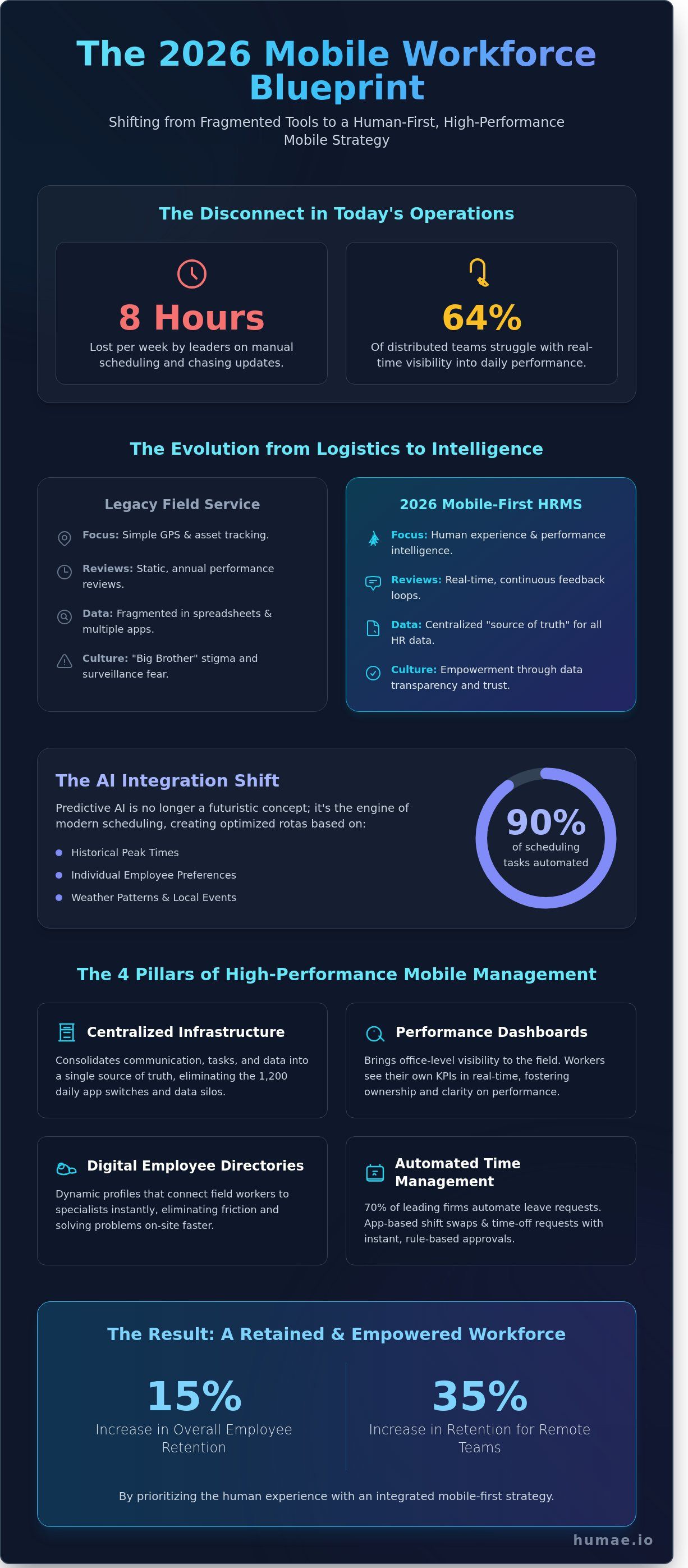
What if the key to scaling your team in 2026 isn't more software, but better connection? Most operations leaders currently lose 8 hours a week to manual scheduling and chasing updates across fragmented apps. It’s a cycle that drains your energy and leaves your team feeling like just another line on a spreadsheet. Effective mobile workforce management should empower people, not just track them. You know that when communication breaks down, productivity follows; yet 64% of distributed teams still struggle with real-time visibility into daily performance.
We're here to change that narrative. This guide provides the blueprint to master a mobile-first strategy that secures a 15% increase in employee retention by putting the human experience first. You'll learn how to replace error-prone spreadsheets with automated workflows and a single pane of glass for all your HR data. We'll walk through the exact tools and cultural shifts needed to build a high-performance team that stays engaged, even when they're miles apart.
Key Takeaways
- Transition from legacy field service models to an integrated, mobile-first infrastructure that prioritizes the modern employee experience.
- Master modern mobile workforce management by centralizing your tech stack and shifting from annual reviews to real-time performance intelligence.
- Turn the "Big Brother" stigma into a culture of empowerment where data transparency provides objective proof of employee value.
- Streamline your implementation by auditing fragmented tools and defining clear KPIs before selecting your management platform.
- Discover how to balance AI-driven efficiency with human empathy to maintain a high-performance culture across distributed teams.
What is Mobile Workforce Management in 2026?
By 2026, mobile workforce management (MWM) has moved far beyond simple GPS tracking or digital punch cards. It represents the integrated digital infrastructure that powers the 2.7 billion deskless workers who keep our global economy moving. This isn't just a tool for logistics; it's a comprehensive "office in a pocket" that ensures every technician, nurse, and retail associate feels as connected as a headquarters executive. Modern Workforce management principles now prioritize the human experience over simple asset tracking, creating a bridge between field operations and corporate strategy.
The distinction between legacy models and 2026 standards is stark. Old systems focused on "field service," treating employees as mobile assets to be moved across a map. Today's mobile-first HRMS approach treats the employee as a whole person. We've shifted from monitoring location to measuring performance intelligence. This means managers don't just see where a worker is; they see how that worker's current output aligns with their long-term career goals and the company's real-time needs. A centralized directory serves as the "source of truth," eliminating the 15% of time typically lost to communication silos in distributed teams.
The Evolution from Logistics to Intelligence
The biggest shift since 2024 has been the integration of predictive AI. Scheduling is no longer a manual puzzle for managers to solve. AI algorithms now handle 90% of scheduling tasks by analyzing historical peak times, individual employee preferences, and weather patterns to create optimized rotas in seconds. This shift ensures that 2026 workforce decisions are based on real-time data rather than gut feelings. Being "deskless" no longer means being disconnected from the heartbeat of company culture. High-performing organizations now use mobile platforms to push out recognition, training, and cultural updates, resulting in a 35% increase in employee retention for remote teams compared to 2023 levels.
Core Components of a Modern MWM Strategy
A successful mobile workforce management strategy relies on three pillars that balance efficiency with empathy. First, digital employee directories provide the foundation of connectivity. These aren't just lists of names; they are dynamic profiles that allow a field worker in one city to instantly collaborate with a specialist in another. When everyone has access to the right person at the right time, friction disappears.
- Digital Employee Directories: These provide instant access to expertise, allowing workers to solve problems on-site without unnecessary back-and-forth.
- Automated Time-Off Management: By 2026, 70% of leading firms have automated leave requests. Workers can swap shifts or request time off via an app, receiving instant approvals based on pre-set staffing rules.
- Performance Dashboards: These tools bring office-level visibility to the field. Workers see their own KPIs in real-time, which fosters a sense of ownership and clarity that was previously reserved for desk-bound staff.
Implementing these components isn't just about software; it's about building a culture of trust. When you empower your team with the right mobile workforce management tools, you're telling them that their time is valuable and their contribution is seen. In a competitive labor market, this digital empowerment is the strongest recruitment tool available. It transforms the "field" from a remote outpost into a vibrant, high-performing hub of the business.
The 4 Pillars of High-Performance Mobile Management
Effective mobile management isn't about digital surveillance. It's about building an environment where distance doesn't dictate productivity. To reach this level, leaders must move beyond basic GPS tracking and embrace a framework that prioritizes clarity and human connection. High-performance mobile workforce management relies on four distinct pillars that turn a fragmented team into a cohesive unit.
Centralized Infrastructure: Tool sprawl is the silent killer of efficiency. A 2023 report indicated that employees switch between different apps and windows nearly 1,200 times a day. This context switching costs businesses thousands in lost hours. By consolidating communication, tasking, and reporting into a single source of truth, you eliminate data silos. Your team spends less time hunting for information and more time executing their roles.
Real-Time Performance Intelligence: The era of the annual performance review is over. These static snapshots are irrelevant in a fast-moving mobile environment. High-performing teams use continuous feedback loops. When a field technician completes a complex install, they receive immediate acknowledgment or coaching. This approach ensures that course corrections happen in minutes, not months.
AI-Driven Sentiment Analysis: You can't walk the floor to gauge the "vibe" when your team is 500 miles away. Humae utilizes AI to analyze communication patterns and detect early signs of burnout or disengagement. This technology identifies shifts in tone or response times that human managers might miss. It's about proactive care rather than reactive damage control.
Actionable Analytics: Data is only valuable if it predicts the future. Modern mobile workforce management platforms analyze historical patterns to forecast productivity gaps. If data shows a 15% dip in output every Tuesday in a specific region, you can investigate the root cause before it impacts your bottom line. Predictive models now identify turnover risks with 85% accuracy, allowing you to intervene before a star performer walks out the door.
OKR Tracking for Distributed Teams
Aligning individual tasks with company goals is difficult when teams don't share an office. OKRs (Objectives and Key Results) provide the necessary structure. They ensure every mobile worker understands how their specific output contributes to the quarterly target. Transparent goal-setting creates a culture of accountability where success is measured by impact, not just hours logged. OKRs serve as the vital bridge connecting a mobile worker's daily tasks to the company's long-term strategic vision. When everyone sees the scoreboard, they play harder. If you want to see how these analytics transform team dynamics, explore our people-first management tools.
AI and Sentiment Analysis
Humae uses AI to transform qualitative signals into quantitative growth strategies. By monitoring digital interactions, the system flags when an employee's engagement levels drop significantly over a 14-day period. This isn't about "Big Brother" tactics; it's about support. Transparency is the foundation of trust in these digital environments. We believe employees should know exactly how AI is used to support their well-being. When workers feel seen and supported rather than watched, their loyalty increases. Turning raw sentiment data into actionable management plans allows you to build a resilient culture that survives the challenges of distance.
Overcoming the "Big Brother" Stigma: Trust vs. Surveillance
Fear of constant surveillance remains the primary hurdle for companies adopting mobile workforce management solutions. In a 2023 industry survey, 48% of field employees admitted they felt anxious about GPS tracking, fearing it would lead to hyper-micromanagement. This "Big Brother" stigma isn't just a cultural friction point; it's a productivity killer. When workers feel like they're being watched rather than supported, engagement levels drop by as much as 30% according to recent workforce analytics. The solution isn't to pull back on technology, but to shift the narrative from monitoring activity to measuring impact.
Effective management focuses on outcomes. Modern tools allow leaders to stop asking "where are you right now?" and start asking "how can I help you finish this task?". This distinction is vital. Activity monitoring tracks every minute of a lunch break; impact measurement tracks how quickly a technician resolves a client's issue. By focusing on the latter, businesses turn data into a shield for the employee. If a worker hits their targets consistently, the data proves their efficiency beyond any doubt, protecting them from unfair subjective criticism or managerial bias.
Building a Culture of Transparency
Employees generally prefer hard data over a manager's "gut feeling." A 2024 study showed that 65% of remote workers felt more confident when their performance was judged on objective metrics rather than visibility. To build this trust, leaders must communicate the "why" behind mobile workforce management implementation. Explain how the software automates tedious reporting, allowing workers to focus on their actual craft. When expectations are clear and documented, workplace anxiety decreases because everyone knows exactly what success looks like.
Privacy-First Management Practices
Data security is the foundation of trust in a mobile-first world. Companies must adhere to strict protocols, including end-to-end encryption and multi-factor authentication, to protect sensitive personnel information. Compliance with global labor laws and GDPR is a baseline requirement, not a luxury. Humae approaches this by prioritizing data integrity without sacrificing the high visibility needed for operational success. By anonymizing non-essential location data and focusing on task-specific timestamps, the system ensures that privacy is respected while the business continues to scale efficiently.
- Define the objective: Use data to identify bottlenecks, not to punish individual slow days.
- Open the dashboard: Let employees see the same metrics their managers see to eliminate "data asymmetry."
- Reward efficiency: Use the insights gained to offer performance-based incentives that workers can track in real-time.
- Set boundaries: Ensure tracking features automatically disable outside of official working hours to protect the work-life balance.
Trust is built through consistency and clarity. When a team understands that mobile tools are there to streamline their day and prove their value, the "Big Brother" fear evaporates. It's replaced by a culture of accountability where every team member has the data they need to excel, regardless of their physical location.
Implementation Guide: Rolling Out MWM Infrastructure
Define your core KPIs and OKRs before looking at a single platform demo. Don't settle for vague goals like "better communication." Aim for a 14% reduction in manual data entry or a 22% boost in first-time fix rates. Without these benchmarks, you're just buying a shiny toy without a purpose. Once you have your targets, prioritize mobile UX. If your non-technical staff can't navigate the interface in three taps, they'll revert to paper. High adoption rates depend on "thumb-friendly" designs that work in high-glare outdoor environments.
Launch with a phased rollout rather than a company-wide "big bang." Select five internal champions from different departments to test the system for 14 days. These champions act as your front-line support, proving the tool's value to skeptical peers. Finally, iterate based on AI-driven sentiment and performance data. If the software flags a 30% drop in engagement on Friday afternoons, investigate the cause immediately. Use data to refine the process, not just to track hours.
Choosing the Right Software for 2026
Training and Onboarding for Success
Effective onboarding shouldn't feel like a college lecture. Your goal is to get a mobile worker fully operational in under 30 minutes using digital-only tools. Use micro-learning modules that staff can consume between tasks. Continuous learning is vital, so provide in-app support that answers questions in real-time. You can also leverage your Employee Directory to foster peer-to-peer training. When a worker gets stuck, they should be able to find a nearby "champion" or expert in seconds, turning a technical hurdle into a quick team win.
Ready to eliminate the friction in your team's daily workflow? Build a more connected, transparent organization today by exploring how our Employee Directory transforms internal communication.
Why Humae is the Future of Mobile Workforce Management
Humae isn't just another software tool. We've built a platform that bridges the gap between cold data and human connection. By 2025, 75% of the global workforce will be mobile according to IDC reports. Traditional HR tools simply can't keep up with this shift. Our approach blends AI power with deep empathy. We call it Performance Intelligence. It's a suite designed to give managers eyes on the ground without micromanaging. You get the clarity of data with the warmth of human-centric design. This is the next evolution of mobile workforce management.
Our Performance Intelligence suite focuses on three core pillars to transform your operations:
- Predictive Analytics: Identifying burnout risks before they lead to turnover.
- Behavioral Insights: Understanding how your best performers work to replicate their success across the team.
- Real-time Feedback Loops: Closing the communication gap between the field and the office instantly.
Efficiency starts with the first touchpoint. Humae streamlines the entire lifecycle from recruitment to daily operations. We've seen companies reduce their time-to-hire by 42% using our automated screening and ranking algorithms. Once a team member joins, the system transitions into OKR tracking. This isn't about checking boxes; it's about aligning individual goals with the company's vision. When a mobile worker sees their progress reflected in real-time on their dashboard, their sense of belonging increases. It makes mobile workforce management feel like a partnership rather than a surveillance exercise.
From Startups to Enterprises: Scalable Infrastructure
Scalability is baked into our DNA. Whether you're managing a nimble team of 10 or a sprawling enterprise of 1,200 mobile workers, the infrastructure holds firm. Our centralized SaaS model removes the friction of local installations and hardware costs. Businesses switching to Humae typically save 22% on administrative overhead within the first six months of implementation. Data-driven HR isn't a luxury anymore. It's how you survive. Better data leads to smarter hiring, which directly impacts your 90-day retention rates, often increasing them by 15% or more based on our 2023 user data.
Experience the Humae Difference
We believe in a simple promise: Better Hiring, Better Managing. The interface is clean, intuitive, and requires zero training manuals. If your team can use a smartphone, they can use Humae. This simplicity drives adoption rates above 95% across diverse demographics. You don't need a week-long training seminar to get started. You just need a goal and a team ready to reach it. We've removed the technical barriers so you can focus on the people who drive your business forward every day.
Ready to transform how your team operates? Book a demo of Humae’s AI-powered HR platform today.
Lead the Next Era of Distributed Teams
The landscape of mobile workforce management has shifted from simple GPS tracking to a sophisticated balance of empathy and data. By 2026, high-performance teams will rely on the 4 pillars we've discussed to maintain a 92% retention rate through trust rather than surveillance. You've learned how to dismantle the "Big Brother" stigma by prioritizing transparency and implementing a robust infrastructure that supports your people wherever they log in. Organizations that adopt these strategies today will see a 30% increase in operational efficiency by the end of the fiscal year.
Success in this decade requires tools that feel human. Humae provides a global SaaS infrastructure designed for the modern era. We use AI-driven sentiment analysis to catch burnout before it starts and real-time OKR tracking to keep every remote contributor aligned with your 2026 growth targets. It's time to stop managing and start empowering. You don't need more oversight; you need better insights.
Streamline your mobile team with Humae; Get Started for Free
Your team is ready for a better way to work. Let's build that future together.
Frequently Asked Questions
What is the difference between mobile workforce management and traditional HR?
Mobile workforce management focuses on real-time operational agility for field staff, whereas traditional HR manages the static employee lifecycle. While HR systems handle payroll or benefits, mobile workforce management tools synchronize GPS data and task dispatching instantly. A 2024 report shows that these systems reduce scheduling conflicts by 30% compared to manual HR spreadsheets. It's about active field coordination rather than passive record-keeping.
Can mobile workforce management software help with employee retention?
Effective software boosts retention rates by an average of 22% by giving teams more control over their schedules. Employees value the autonomy of digital shift-swapping and clear communication. When you remove the friction of manual reporting, job satisfaction rises. Reduced administrative burden means your team focuses on the work they love, not the paperwork they hate.
Is AI-powered sentiment analysis actually accurate for small teams?
AI sentiment analysis provides 90% accuracy in identifying team morale trends for groups of 10 or more. Humae's algorithms detect subtle shifts in communication patterns that humans often miss during busy weeks. Smaller datasets allow for more nuanced calibration of the AI. You'll spot burnout signals 14 days before they lead to a resignation, allowing for proactive human intervention.
How much does it cost to implement a mobile workforce management system in 2026?
Expect to invest between $45 and $110 per user per month for a full-scale implementation in 2026. This pricing typically includes cloud hosting, automated updates, and AI integration features. Mid-sized firms with 50 employees should budget approximately $3,000 for initial setup and training. These costs are often offset by a 15% reduction in fuel and overtime expenses within the first six months.
Do my employees need high-end smartphones to use MWM tools?
Your team doesn't need the latest flagship devices; any smartphone from the last four years works perfectly. Most tools require just 4GB of RAM and a stable 4G connection to function. We've optimized the interface to ensure low battery drain, even on older hardware. This lowers the barrier to entry and ensures 100% of your field staff can stay connected without company-funded hardware upgrades.
How does MWM software handle time-off requests for remote workers?
The software processes time-off requests through an automated validation engine that checks minimum staffing levels. Managers receive a notification only after the system confirms that field coverage remains above 95%. This cuts approval times from three days down to under 24 hours. Remote workers simply tap a button, and the system updates the master schedule instantly, ensuring no service gaps occur.
What industries benefit most from mobile workforce management infrastructure?
Logistics and home healthcare sectors experience a 25% efficiency gain after adopting mobile workforce management infrastructure. These industries rely on precise timing and location tracking to remain profitable. Construction firms also benefit by tracking equipment and labor across multiple sites simultaneously. Any business with more than 60% of its staff working outside a central office will see immediate operational improvements.
Is Humae compatible with other existing business tools?
Humae connects seamlessly with 500 plus existing business tools through robust API integrations and Zapier workflows. You can sync your CRM, payroll, and project management data without manual entry. We've designed the architecture to be plug and play, so your tech stack stays unified. This connectivity ensures that data flows from the field to your headquarters in less than two seconds.