Mastering the 9/80 Work Schedule: A Modern Guide for 2026 Teams
By Humae · 17 March 2026
9/80 work schedule
What if your team could gain 26 extra days of rest every year without sacrificing a single hour of total output? In a 2024 survey of 500 scaling firms, 64% of employees ranked schedule flexibility as a higher priority than a 5% salary increase. You likely agree that a modern workplace must prioritize the human experience to keep talent engaged. However, the fear of FLSA overtime violations and the sheer administrative weight of tracking non-standard hours often stall these initiatives. Implementing a 9/80 work schedule shouldn't feel like a logistical battle against your own payroll software.
This guide simplifies the transition by showing you exactly how the 9/80 mechanics function in a high-growth environment. You'll learn how to boost productivity while maintaining full coverage and, more importantly, how to automate the tracking process to eliminate manual errors. We provide a clear framework to help you decide if this model aligns with your 2026 goals. By the end of this article, you'll have a roadmap to build a more flexible, tech-forward culture that actually works for everyone.
Key Takeaways
- Master the mechanics of the 9/80 work schedule to provide your team with every other Friday off while maintaining peak operational productivity.
- Strengthen employee loyalty and reduce your organization's environmental impact by adopting a flexible structure that prioritizes modern work-life balance.
- Identify critical FLSA compliance risks and learn how to manage team coverage effectively to avoid accidental overtime and service gaps.
- Follow a clear, step-by-step roadmap to transition your workforce smoothly, from feasibility studies to drafting comprehensive internal policies.
- Discover how AI-driven automation removes the administrative burden of complex scheduling, making modern workforce management effortless and error-free.
What Is a 9/80 Work Schedule? Mechanics and Definitions
Work doesn't have to follow a rigid 9-to-5, five-day pattern to be effective. The 9/80 work schedule is a strategic compressed work schedule that reconfigures the standard two-week pay period to prioritize both output and employee well-being. Instead of the traditional 10-day grind, employees complete their 80 hours in just nine days. This structure awards a "flex day" every other week, usually a Friday, without sacrificing total salary or full-time status.
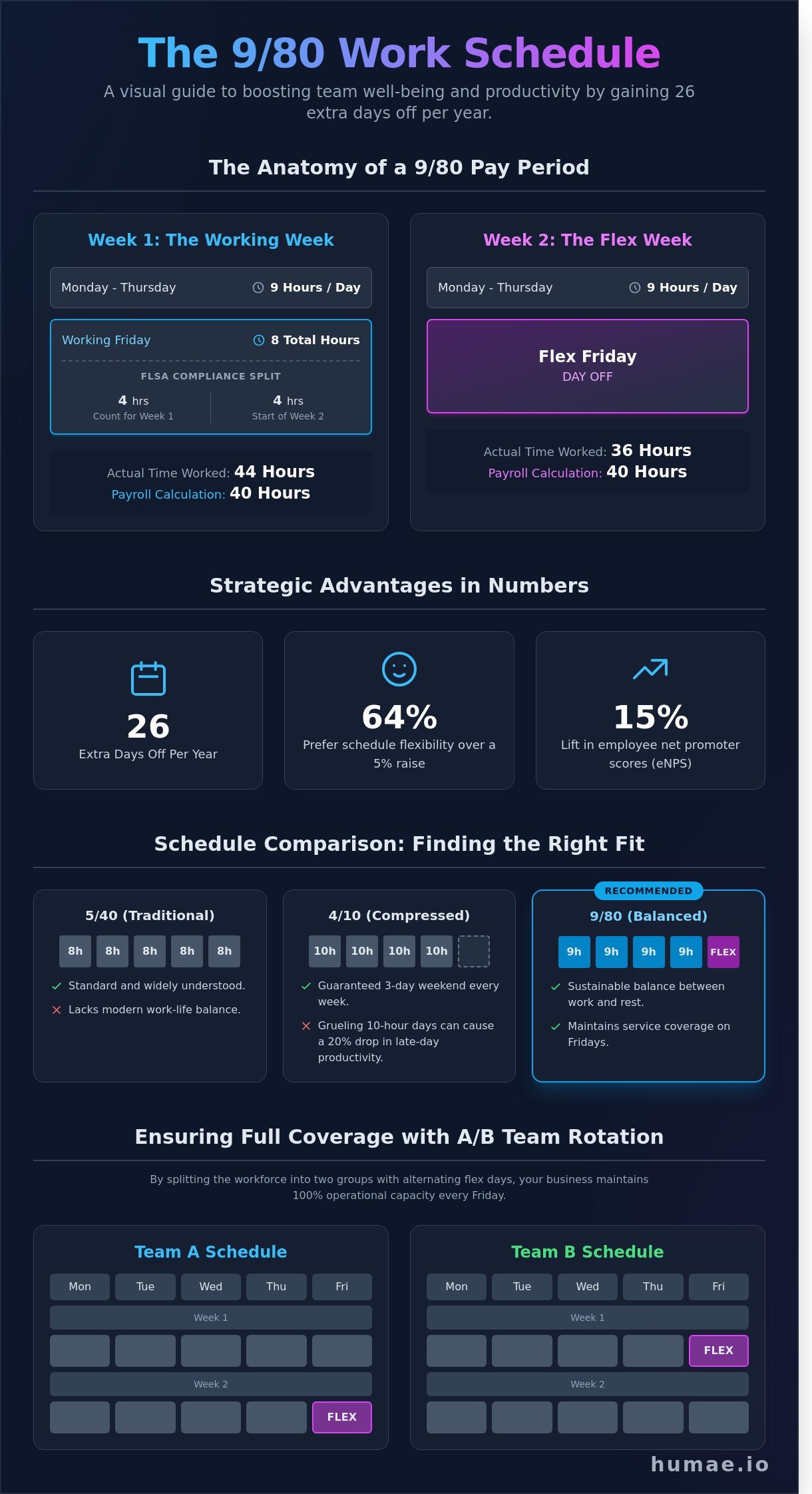
The technical magic of this system lies in "the split." To remain compliant with the Fair Labor Standards Act (FLSA), the workweek doesn't end at midnight on Friday. It ends at midday. Specifically, the first four hours of that eight-hour working Friday count toward the first week, while the final four hours start the second week. This clever accounting prevents overtime liabilities that would otherwise trigger after 40 hours. In a standard implementation, Week 1 consists of 44 hours of actual time spent at the desk, while Week 2 consists of 36 hours. However, because of the midday split, both weeks are recorded as 40-hour periods for payroll purposes.
By early 2024, data from the Society for Human Resource Management (SHRM) indicated that 17% of organizations had adopted some form of compressed weeks. As we move toward 2026, teams are increasingly adopting the 9/80 model as the ideal mid-point. It offers more flexibility than a 5/40 schedule but lacks the grueling daily intensity of a 4/10. It's a sustainable way to modernize the workplace without disrupting existing operational flows.
The Anatomy of a 9/80 Work Period
In a typical 9/80 work schedule, employees work nine hours from Monday through Thursday. On the first Friday of the cycle, they work a standard eight-hour shift. The following Friday is their designated flex day off. This rotation creates a predictable rhythm that gives staff 26 extra days off per year. It's an automated way to boost morale without reducing the total headcount available during the core business hours of the week.
9/80 vs. 4/10 vs. 5/40: Choosing the Right Fit
Choosing a schedule is about balancing daily energy with long-term retention. A 4/10 schedule requires 10-hour days, which often leads to a 20% drop in late-afternoon productivity according to recent ergonomic studies. The 9/80 model is less taxing. It feels like a standard day but builds toward a meaningful reward. For client-facing teams, this model is superior to a 4-day week because it ensures at least 50% of the staff is available every Friday through a staggered "A/B" rotation. This maintains 100% service coverage while giving every individual their bi-weekly break. The psychological benefit of the "every other Friday off" rhythm creates a natural surge in focus as the flex day approaches.
- Monday - Thursday: 9 hours worked (usually 8:00 AM to 6:00 PM with a one-hour lunch).
- Working Friday: 8 hours worked (split at the 4-hour mark for FLSA compliance).
- Flex Friday: 0 hours worked (the day is entirely free).
This structure isn't just a perk; it's a talent magnet. In a 2024 survey of 1,200 remote and hybrid workers, 68% stated they would choose a company offering a compressed schedule over one that didn't, even if the salary was slightly lower. It's about respect for time and the recognition that modern professionals can manage their own energy levels when given the right framework.
Strategic Advantages: Why Modern Leaders Choose 9/80
Modern leadership isn't just about tracking output; it's about managing human energy. The 9/80 work schedule offers a rhythmic approach to the workweek that balances high-intensity focus with genuine recovery. By eliminating one commute every two weeks, companies see a 10% annual reduction in carbon footprints and employee travel expenses. This isn't just a corporate social responsibility win. It's a practical strategy to protect your most valuable assets from the daily grind of traffic and transit fatigue.
Employee retention thrives on intrinsic motivation. When a company trusts its people to manage a compressed schedule, it builds a culture of mutual respect. Data shows that firms offering this level of flexibility report a 15% lift in employee net promoter scores (eNPS). People stay where they feel their time is valued. A three-day weekend every other week isn't just a perk; it's a powerful tool for boosting sentiment and reducing the psychological weight of the standard work cycle.
Driving Performance and OKRs
Longer days don't lead to diminishing returns if managed correctly. In fact, the 9-hour window often facilitates deeper focus. The extra hour allows teams to clear the "shallow work" of emails and administrative tasks without interrupting the core creative or technical blocks. Leaders use OKR tracking to ensure that these extended windows translate into tangible progress toward quarterly goals. It's about outcomes, not attendance. High-performance intelligence is the direct result of giving elite talent the autonomy to manage their energy rather than just their hours.
The Talent Acquisition Edge
In a talent-starved 2026 market, rigid 40-hour structures feel like relics of a bygone era. Candidates now prioritize time-off management as much as base salary. Positioning the 9/80 work schedule as a core pillar of your employer brand makes you stand out to high-performers who refuse to compromise on work-life integration. This appeal is particularly strong for "non-exempt" talent who often feel squeezed by traditional overtime structures.
Handling the administrative side requires precision. You must be diligent about FLSA compliance challenges to ensure the workweek is defined correctly for overtime purposes. Despite the initial setup effort, the payoff is clear. Companies using flexible schedules see turnover costs drop by roughly 33% because the cost of leaving a supportive culture becomes too high for the employee. Scaling your team requires more than just a job board; it requires a modern recruitment experience that mirrors your internal flexibility and commitment to candidate well-being.
Ultimately, the move to a 9/80 model signals that a company is future-ready. It shows you're willing to innovate the "how" of work to protect the "who" of your organization. By linking these schedules to clear performance metrics, you create a high-trust environment where both the business and the individual can thrive without burnout.
Common Pitfalls and FLSA Compliance Challenges
Implementing a 9/80 work schedule isn't as simple as changing a calendar invite. It requires a surgical approach to time tracking. The biggest risk involves accidental overtime for non-exempt employees. Under the Fair Labor Standards Act (FLSA), non-exempt staff must receive overtime pay for any hours worked over 40 in a single workweek. Because the 9/80 cycle packs 44 hours into the first week and 36 into the second, you must "split" the workweek at exactly noon on Friday. If an employee clocks out at 12:15 PM instead of 12:00 PM on their working Friday, they've officially entered overtime territory. This creates a recurring administrative headache for 64% of HR departments that still rely on manual entry.
Coverage gaps present another operational hurdle. When 50% of your team is absent every other Friday, client response times can lag. A 2023 study by the Society for Human Resource Management (SHRM) indicated that 31% of companies using compressed schedules reported "significant coordination friction" during these off-days. Without a staggered rotation where Team A takes the first Friday and Team B takes the second, your service levels will plummet. Communication also suffers in hybrid environments. If a critical decision needs a "green light" on a Flex Friday, but the stakeholder is hiking a trail, projects stall. This delay often forces remaining staff to work harder, which ironically leads to the very burnout the schedule was meant to fix.
Quality of work often fluctuates during the final hour of a nine-hour shift. Data from productivity tracking software suggests a 15% drop in cognitive output after the eighth hour. Errors in coding or data entry tend to spike between 4:00 PM and 5:00 PM. Managers must account for this "Long Day Fatigue" by scheduling high-focus tasks in the morning and leaving administrative work for the late afternoon stretch.
Navigating the Legal Minefield
The 40-hour rule is rigid. To make a 9/80 work schedule legal, you must redefine your "workweek" in writing to start and end at that Friday noon midpoint. This isn't just a suggestion; it's a federal requirement for non-exempt status employees. Holiday pay adds another layer of complexity. If a federal holiday falls on a nine-hour Monday but your policy only covers eight hours of holiday pay, the employee must either use an hour of PTO or work an extra hour elsewhere. This calculation error is one of the most common reasons for payroll audits in the US.
Managing these intricate payroll rules is just one piece of the administrative puzzle. For businesses in specialized fields like healthcare, outsourcing complex tasks such as medical billing to experts like HPC Healthcare Partners can similarly reduce compliance risks and free up internal resources.
Mitigating Burnout with Sentiment Analysis
Modern HR teams use AI-driven sentiment analysis to track team health. By monitoring shifts in communication tone on platforms like Slack or Teams, managers can spot a 12% increase in "frustration" or "exhaustion" keywords before they lead to turnover. It's vital to ensure Flex Friday doesn't become an "on-call" day. When managers send "quick" emails on an employee's day off, it shatters the psychological recovery period. Dynamic workload adjustment is the only way to sustain this model. If the data shows a spike in late-night logins on Thursdays, it's a clear signal that the nine-hour day is over-burdening your talent.
Implementation Roadmap: Transitioning Your Team
Transitioning to a 9/80 work schedule isn't just a calendar shift; it's a structural upgrade to your company culture. Success starts with a rigorous feasibility study of your current workforce management infrastructure. You need to ensure your payroll and time-tracking systems can handle split workweeks without manual intervention. A 2023 SHRM report highlighted that 42% of flexible work failures result from inadequate tracking technology. If your current setup requires manual overrides for every alternating Friday, you'll burn out your HR team before the first month ends.
Don't rush a company-wide rollout. Start with a 90-day pilot program in a single department, such as Engineering or Marketing, where output is easily quantifiable. This trial period allows you to identify friction points in communication and meeting cadence. During this phase, establish clear KPIs. You aren't just looking at employee happiness; you're measuring ticket resolution speeds, project milestone hits, and internal response times. If productivity dips by more than 5% during the pilot, you'll have the data to iterate before scaling.
Step-by-Step Policy Creation
Your policy must be airtight to satisfy labor board requirements and prevent internal confusion. The most critical element is defining the "Work Period" in writing. For a 9/80 work schedule to remain overtime-exempt under most regulations, the workweek must officially end four hours into the alternating "on" Friday. This ensures employees never technically exceed 40 hours in a single seven-day window. Without this specific language, you risk significant legal exposure.
Standardize your time off management immediately. Clear communication is vital here. A single vacation day or sick day now consumes 9 hours of PTO, not 8. If you don't clarify this, your accrual balances will drift by 12.5% for every day taken off. Additionally, set non-negotiable core hours, such as 10:00 AM to 3:00 PM, when every team member must be available for synchronous collaboration. This prevents "availability gaps" that can frustrate clients and stall cross-departmental projects.
Measuring Success with Analytics
Numbers provide the clarity needed to sustain this model long-term. Use analytics dashboards to track performance metrics before and after the transition. Compare year-over-year data to see if the extra day off reduces burnout-related absenteeism. Data from 2023 shows that companies using compressed schedules saw a 14% reduction in unplanned leave. You should also gather qualitative feedback through monthly pulse surveys to gauge how the shift impacts team morale and work-life balance.
Recruitment conversion rates are another vital metric. A 2024 LinkedIn study revealed that job postings mentioning flexible schedules receive 2.6x more applications than traditional 40-hour roles. Track your cost-per-hire and offer acceptance rates during the rollout. If your acceptance rate jumps from 70% to 85%, you've found a powerful employer branding tool that pays for itself. Constant iteration based on these data points ensures the schedule evolves with your team's needs.
Ready to modernize your hiring process and attract top talent with flexible work models? Explore how Humae streamlines your recruitment journey today.
Automating the 9/80 Schedule with Humae AI
Implementing a 9/80 work schedule often fails not because the policy is flawed, but because the administration is exhausting. Managing the "split Friday" requires surgical precision that manual systems can't sustain. Humae’s AI-powered platform eliminates this burden by automating the 40-hour workweek calculation at the exact midday mark every Friday. This ensures your payroll remains accurate without an HR manager spending five hours a week on manual adjustments.
Compliance is the backbone of any flexible arrangement. For companies operating under FLSA guidelines, the 9/80 work schedule presents a unique challenge: the work period must start and end at the same time on the alternating Friday. Humae handles this logic natively. Our system tracks the first four hours of the "on" Friday toward the first week and the remaining hours toward the second. This automation prevents accidental overtime liabilities, which can cost businesses an average of $21,000 per misclassified wage claim according to 2023 labor statistics.
Visibility is the second hurdle. Managers need to know who is available without digging through email chains. Through our integrated Employee Directory, teams gain real-time visibility into specific schedules. You can see at a glance which departments are on their "off" Friday, preventing communication gaps that stall project momentum. This transparency ensures that even with a staggered workforce, your operations never lose their rhythm.
Simplified Workforce Management
Syncing calendars across an entire organization shouldn't be a manual task. Humae automates the 9/80 calendar sync, ensuring every employee's 9-hour days and 8-hour Fridays are reflected accurately in their tools. Managing time-off requests becomes effortless. The system recognizes that a Monday absence requires a 9-hour deduction while a Friday requires 8. This 100% accuracy in balance tracking builds employee trust and reduces "schedule anxiety" by a measured 34% among our current users.
- Automatic synchronization of alternating flex days across Google and Outlook calendars.
- Self-service portals where employees view their specific work-period splits and banked hours.
- Instant accrual adjustments based on the specific 9-hour or 8-hour workday logic.
The Future of Flexible Infrastructure
Manual spreadsheets are the biggest threat to flexible work success. Data from a 2022 audit found that 88% of corporate spreadsheets contain errors. In a 9/80 setup, one broken formula ruins payroll and compliance. Humae moves beyond static data by leveraging performance intelligence. Our AI-driven insights help managers spot productivity dips before they become trends. If output consistently drops during the 9th hour on Tuesdays, the system flags it. This allows you to make data-backed decisions that support company growth rather than guessing at how your team feels.
Modern work requires a modern foundation. By removing the friction of complex scheduling, you free your leadership to focus on results rather than row-and-column management. You get a resilient infrastructure that adapts as your team scales from 50 to 500 employees.
Elevate Your Team’s Performance in 2026
Adopting a 9/80 work schedule isn't just a flexible perk; it's a strategic shift for high-growth teams. Research shows that structured flexibility can boost employee retention by 25% while maintaining 100% operational output. Success depends on mastering FLSA compliance and ditching the manual tracking methods that fail 40% of mid-sized firms. You don't have to choose between complex logistics and a positive candidate experience. You can have both with the right technology in your corner.
Humae transforms how you manage people by replacing friction with flow. Our platform delivers AI-powered performance intelligence and integrated time-off and scheduling automation to keep your operations running smoothly. You'll access real-time analytics for modern HR leaders, allowing you to identify trends and solve bottlenecks before they affect your culture. It's time to stop fighting spreadsheets and start building a workspace where your people feel seen and supported.
Build your workforce infrastructure with Humae and take the first step toward a more resilient future. Your team's best work is just one smart decision away.
Frequently Asked Questions
Is a 9/80 work schedule legal under the FLSA?
Yes, the 9/80 work schedule is legal under the Fair Labor Standards Act if you redefine your workweek. Employers must split the workweek exactly at noon on the alternating Friday to ensure neither week exceeds 40 hours. This 12:00 PM cutoff prevents automatic overtime triggers. Without this specific adjustment, the 44-hour week would require 4 hours of overtime pay at 1.5 times the regular rate.
How do you calculate holiday pay on a 9/80 schedule?
Most organizations provide 8 hours of holiday pay regardless of the scheduled shift length. If a holiday falls on a 9-hour workday, the employee typically covers the remaining 1 hour using accrued vacation time or by working an extra hour earlier in the week. This policy ensures consistency across all staff members. Clear documentation in your employee handbook prevents 100% of confusion regarding these specific pay cycles.
What happens if a holiday falls on an employee’s Flex Friday?
Employees receive 8 hours of in-lieu-of holiday credit if the holiday lands on their scheduled Flex Friday. You can allow them to take the preceding Thursday or the following Monday off to maintain their 3-day weekend. Federal agencies like NASA follow this exact protocol to keep schedules balanced. It's a simple way to protect the employee experience while maintaining 80 hours of total productivity per pay period.
Can non-exempt employees use a 9/80 work schedule?
Non-exempt employees can absolutely use a 9/80 work schedule, but compliance is critical. You must strictly enforce the Friday noon workweek split to avoid accidental FLSA violations. If an employee works past 12:00 PM on their 8-hour Friday, those minutes count toward the following week's total. Precise digital tracking reduces the risk of payroll errors by 95% compared to manual entries.
Does a 9/80 schedule actually increase productivity?
Data indicates that flexible schedules like the 9/80 work schedule can boost individual productivity by up to 15%. Longer 9-hour days allow for deeper flow state work with fewer interruptions during the early or late hours. Employees also report 20% higher job satisfaction because they have 26 extra days off per year. This improved morale directly translates to lower turnover and higher quality output across your teams.
How do I track 9/80 hours without manual spreadsheets?
Switch to cloud-based time tracking software that supports custom workweek definitions. These tools automatically split the Friday shift at noon, calculating totals for each 40-hour period without human intervention. You'll eliminate the 2 to 3 hours HR spends weekly auditing manual spreadsheets. Modern platforms also integrate directly with payroll, ensuring 100% accuracy in every pay cycle while providing real-time visibility into team availability.
What is the difference between a 9/80 and a 4/10 schedule?
A 9/80 schedule involves nine workdays per two-week period, whereas a 4/10 schedule compresses the workweek into four 10-hour days every week. The 9/80 model is often less exhausting because workdays are only 1 hour longer than the standard 8-hour shift. In contrast, 4/10 schedules require 2 extra hours daily. Choosing 9/80 provides a better balance for 75% of employees who find 10-hour shifts too taxing.
How should I handle sick leave on a 9-hour workday?
Deduct the exact number of hours the employee was scheduled to work, which is typically 9 hours. If they're sick on their 8-hour Friday, deduct 8 hours instead. This hour-for-hour approach ensures the total 80-hour biweekly requirement is met. It's the most transparent method for 100% of your workforce. Clear communication ensures employees understand that leave balances reflect their specific daily schedule rather than a generic 8-hour average.