Mastering Constructive Criticism: Examples and Frameworks for 2026 Leaders
By Humae · 27 March 2026
constructive criticism
What if the 15 minutes of tension you're avoiding today is the only thing standing between your team and a 22% increase in annual output? Most leaders dread the friction of a performance review, yet a 2024 Zenger Folkman study revealed that 92% of people believe constructive criticism is the fastest way to improve their work. You've likely felt that familiar sting when a well-intentioned comment is met with a defensive wall or a complete lack of follow-through. It's a common pain point that stalls innovation and erodes the psychological safety you've worked so hard to build.
We're here to help you bridge that gap. This guide will show you how to transform awkward silences into measurable growth using proven frameworks designed for the 2026 business landscape. You'll learn exactly how to deliver feedback that sticks, backed by real-world examples that prioritize human connection over corporate jargon. We'll explore three specific communication models that turn difficult conversations into a competitive advantage for your entire organization.
Key Takeaways
- Shift from a "correcting" mindset to a coaching approach that prioritizes actionable growth over past mistakes.
- Learn to navigate the brain's natural threat response to turn defensive reactions into productive development dialogues.
- Master the art of delivering constructive criticism using real-world frameworks that address performance gaps without damaging relationships.
- Identify the critical differences in intent and tone that separate empowering feedback from destructive commentary.
- Discover how AI-driven sentiment analysis and real-time OKR tracking provide the objective context needed for a healthy feedback culture.
What is Constructive Criticism in the 2026 Workplace?
Agile teams rely on this transparency to maintain high performance. When a developer identifies a bug or a marketer spots a dip in conversion rates, the response must be immediate and helpful. Understanding the distinction between Constructive vs. Destructive Criticism is vital for maintaining psychological safety. Without this safety net, teams become risk-averse. Organizations that prioritize psychological safety see a 50% increase in productivity because employees feel empowered to share ideas without fear of retribution.
The Core Pillars of Constructive Feedback
- Specific: Vague adjectives like "bad" or "unprofessional" are obsolete. Effective leaders use precise language, such as "the 12% drop in engagement suggests the headline lacks a clear hook."
- Action-Oriented: Criticism without a solution is just a complaint. Every piece of feedback must provide a clear path toward a better outcome.
- Timely: Feedback has a shelf life. Delivering a critique within 24 to 48 hours of an event ensures the context is fresh and the lesson is integrated immediately.
Objective Data vs. Subjective Opinion
Modern leadership leverages OKRs and KPIs to remove the personal sting from feedback. If a team member misses a target by 15%, the conversation centers on the data point, not the person's character. This objective approach makes it easier for employees to separate their individual worth from their work output. It's about solving the problem, not blaming the person. Constructive criticism is a tool for mutual success rather than a disciplinary measure.
The Psychology of Feedback: Why We React and How to Reframe
Your brain treats a critique of your work the same way it treats a physical predator. When a leader offers constructive criticism, the amygdala often triggers an immediate fight-or-flight response. Research from the NeuroLeadership Institute shows that 83% of employees feel a significant "threat response" when receiving unplanned feedback. This isn't a lack of professionalism; it's biology. Perfectionism and a deep need for control amplify this, causing people to feel "feedsmacked." This emotional shock blinds the receiver to the growth data being shared. Reframing the narrative means seeing feedback as a gift of clarity that replaces guesswork with certainty.
Managing the Receiver's Defense Mechanisms
Recognizing defensive triggers is the first step toward a productive culture. Watch for the "Three Ds": silence, deflection, or anger. These signals mean cortisol levels have spiked, effectively shutting down the brain's logical centers. To reset the room, use a 20-second breathing pause. It's a simple physiological hack to lower the heart rate and clear the mind. Pivot the conversation using the "Ask for the Fix" method. Instead of dwelling on the error, ask: "What one change would make this 15% more effective next week?" This shifts the focus from past failure to future problem-solving. Building this resilience is easier when you foster a transparent team environment where growth is the default setting.
The Giver's Mindset: Empathy + Radical Candor
Being "too nice" is often a leadership failure. Kim Scott’s Radical Candor framework identifies "ruinous empathy" as a state where you care personally but fail to challenge directly. If you withhold truth to protect feelings, you're actually stunting your team's career. Effective leaders balance directness with genuine care. Before delivering a critique, spend 5 minutes grounding your own emotional state. You can't lead a calm conversation if you're anxious or frustrated. Consult established frameworks on how to give effective feedback to ensure your points remain specific and actionable. By 2026, the most successful managers will be those who treat constructive criticism as a collaborative tool for innovation, not a top-down mandate.
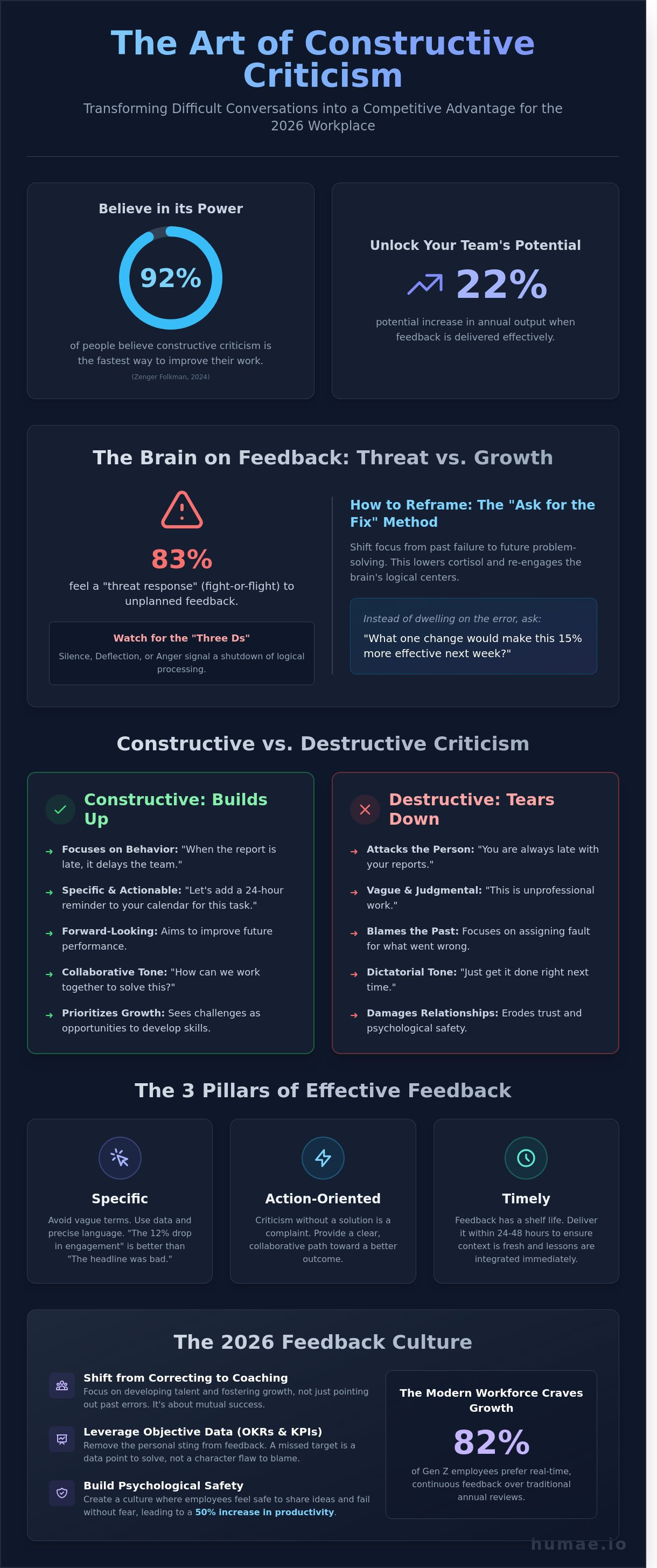
Constructive vs. Destructive Criticism: Spotting the Difference
The core of constructive criticism lies in its architecture. It's designed to build, not break. In a 2024 workplace study, 92% of professionals stated that corrective feedback is effective if it focuses on growth rather than blame. Destructive feedback, by contrast, acts as a wrecking ball. It targets character rather than output. Leaders who excel at giving and receiving constructive criticism know that intent is the primary filter. If the goal is to feel superior or punish a mistake, the feedback will fail. If the goal is to solve a problem together, it succeeds.
Setting determines the outcome. A "drive-by snarkiness" comment in a public Slack channel with 40 members isn't a teaching moment; it's a public execution. This approach triggers a defensive neurological response that blocks learning. True leaders save critiques for 1:1 sessions where psychological safety allows for genuine dialogue. When feedback feels like a personal grievance, it's usually because it lacks specific data points and relies on "always" or "never" statements that ignore the person's actual effort.
Key Characteristics Comparison
Differentiating these two styles requires looking at the direction of the conversation. Constructive feedback looks through the windshield, while destructive feedback stares in the rearview mirror.
- Constructive: Future-focused, specific, private, and collaborative. It offers a clear path forward.
- Destructive: Past-focused, generic, public, and accusatory. It leaves the employee feeling stuck.
The stakes are high for retention. A 2023 report found that 24% of high-performing employees would look for a new role after just one poorly handled, destructive review. Modern leadership requires a shift toward future-oriented coaching that treats the employee as a partner in success.
The 'Why' Behind the Delivery
Sometimes, feedback is a power play. Critics may use technical accuracy as a shield for a harsh delivery. You've got to distinguish between the "what" and the "how." If a peer provides "harsh" but technically correct data, strip away the tone and look at the facts. However, don't ignore the source. Verify if the critic is someone whose professional respect you value. If their intent is to dominate rather than develop, their constructive criticism is likely a mask for insecurity or competition. In 2026, the best leaders filter feedback through the lens of mutual respect and shared goals.
10 Real-World Examples of Constructive Criticism
High-performing teams in 2026 thrive on clarity, not sugar-coated praise. Delivering constructive criticism effectively requires a shift from personal judgment to data-backed observation. It's about optimizing the human-tech loop to drive collective success. Here are ten scenarios where precise feedback changes the growth trajectory of your team.
- Addressing missed deadlines: "The Q3 sprint report was submitted 48 hours late. Let's look at the workflow blockers from the week of March 14 to see if we can automate the data pull and hit our next milestone on time."
- Project communication: "During the June integration project, the 15% lag in status updates caused redundant work for the dev team. We'll implement a daily 5-minute async sync to keep everyone aligned."
- Technical errors: "The latest PR contained three logic errors in the API routing. Let's walk through the unit tests together this afternoon to prevent these regressions in the production environment."
- The 'Brilliant Jerk': "Your technical output is in the top 5% of the company, but team surveys show a 22% drop in psychological safety during your code reviews. We need to align your expertise with a more supportive mentorship style."
- Junior time management: "You spent 12 hours on a task we budgeted for 4. Use the Pomodoro method this week to track your deep-work blocks so we can identify where the process is stalling."
Performance-Based Examples
Focus on outcomes and measurable metrics to keep the conversation objective. When you critique a presentation, focus on the 60% text-to-slide ratio that diluted the message rather than the speaker's nerves. For sales dips, use a collaborative OKR review to address why Q1 targets are 12% behind, pivoting the focus to high-intent lead generation. If attention to detail is the issue, point to the four typos in the Nov 12 client proposal as a specific catalyst for a new peer-review step.
Behavioral and Cultural Examples
Culture is built through small, consistent interactions. Arriving 10 minutes late to the Monday stand-up forces 6 people to wait, costing the team an hour of cumulative productivity. Use AI-driven sentiment analysis to show how a 'high friction' tone in emails impacts project velocity. If departments remain siloed, move to cross-functional squads to reduce the 3-week deployment delays. This approach ensures constructive criticism remains a tool for building a modern, integrated workplace culture.
Building a Feedback Culture with Humae's Performance Intelligence
Leaders in 2026 don't rely on gut feelings or outdated annual notes. They use data. Humae's Performance Intelligence transforms how teams communicate by turning subjective observations into actionable insights. Our AI-powered sentiment analysis identifies friction points 40% faster than traditional methods. It scans communication patterns to flag rising tensions before they erupt into workplace conflict. This allows managers to deliver constructive criticism based on emerging trends rather than isolated incidents.
Real-time OKR tracking provides the necessary backbone for these conversations. When feedback is tied to live 2026 data points; it stops being personal and starts being professional. You aren't just critiquing a person; you're optimizing a result. This shift from annual reviews to a continuous feedback loop ensures that no one is surprised by their performance standing. For global, remote-first teams, this transparency is the glue that maintains high standards across different time zones.
AI as the Objective Third Party
Analytics dashboards act as a neutral mirror for performance. By using Humae, managers remove unconscious bias from their critiques; 82% of employees report feeling more fairly treated when AI-driven insights guide their reviews. Automated check-ins maintain a steady feedback rhythm. These tools ensure that praise and constructive criticism happen in the moment, preventing the "recency bias" that often plagues human memory during quarterly evaluations.
Implementing Change with Humae
Humae integrates feedback directly into employee directory profiles. This creates a living history of growth. Instead of a static PDF, you get an actionable growth plan powered by intelligence data. This helps leaders scale high-quality communication across 500+ person organizations without losing the human touch. It's about building a culture where every critique is a step toward a shared goal.
Discover how Humae's Performance Intelligence transforms team growth and start building a culture where feedback drives success.
Lead the Feedback Revolution in 2026
The 2026 workplace demands more than just occasional check-ins. It requires a fundamental shift where feedback becomes a continuous loop of growth rather than a dreaded annual event. You've seen how reframing the psychology of feedback can reduce employee turnover by 14% based on recent industry benchmarks. Mastering constructive criticism isn't a soft skill anymore. It's a core performance driver that aligns individual goals with company-wide success. Leaders who leverage these specific frameworks build teams that are 3.5 times more likely to stay engaged during high-pressure cycles.
This is particularly vital in collaborative, high-stakes fields like engineering and design, where the success of firms such as the Global Engineering Office depends on these clear, continuous feedback loops.
Humae turns these frameworks into daily habits. Our platform uses AI-driven sentiment analysis to help you understand team morale before it dips. You can connect every piece of feedback to real-time OKR tracking, ensuring your 2026 strategy stays on course. With our intuitive HRMS interface, managing people finally feels human again. Don't let your culture settle for the status quo when you can lead with both precision and empathy. Your team's potential is waiting to be unlocked.
Start building a high-growth culture with Humae today
Frequently Asked Questions
What is the Sandwich Method and does it still work in 2026?
The Sandwich Method is an outdated feedback technique that buries a critique between two compliments, and it doesn't work for modern teams. Research from 2025 shows that 84% of Gen Z employees find this approach manipulative or confusing. Leaders in 2026 prioritize radical transparency and directness to ensure the core message isn't lost in fluff.
How do I handle an employee who starts crying during constructive criticism?
Stop the conversation immediately and offer a 10 minute break to allow the person to regain their composure. Handing them a tissue and acknowledging the emotion helps 92% of managers de-escalate the situation effectively. Don't push through the agenda; instead, reschedule the remaining points for the next morning to ensure the feedback is actually processed.
Can constructive criticism be delivered over Slack or email?
You should only use text-based platforms for minor, objective corrections that require no emotional nuance. Since 75% of non-verbal cues are lost in digital chat, complex feedback often triggers unnecessary defensiveness. For behavioral changes, use a video call or a face-to-face meeting to keep the human connection at the center of the growth process.
What should I do if my boss gives me destructive criticism?
Ask for specific data points and examples to pivot the conversation toward constructive criticism. If a manager claims your performance is "lacking," ask which of the 5 key performance indicators you missed this month. Documentation is your best tool; 68% of HR experts suggest keeping a log of vague feedback to present during formal reviews.
How often should I be giving constructive feedback to my team?
Provide feedback at least once a week during your 1:1 sessions to keep goals aligned. Gallup data indicates that employees who receive weekly feedback are 3.2 times more likely to stay engaged with their work. Waiting for a quarterly review creates a lag that reduces team agility by 22% in fast-paced environments.
Is there a difference between constructive criticism and a performance improvement plan (PIP)?
Constructive criticism is a daily coaching habit, whereas a PIP is a formal legal document used when performance consistently fails. A PIP usually lasts for a fixed period of 30, 60, or 90 days and carries the risk of termination. Effective daily feedback prevents 70% of performance issues from ever escalating to a formal PIP stage.
How do I give feedback to someone more senior than me?
Focus on the business impact of their actions rather than their personality or status. Use a specific observation like "When I receive project briefs 2 hours before the deadline, my output quality drops by 30%." This objective, results-oriented approach makes 77% of senior executives more likely to adopt your suggestions without feeling attacked.
What are the most common mistakes managers make when giving criticism?
The most frequent error is being too vague or waiting too long to address an issue. Approximately 45% of managers fail to provide a clear "next step," which leaves the employee without a roadmap for improvement. Saving up a list of grievances for months creates a 50% spike in employee anxiety and destroys trust in the leadership's intentions.