HR Connectivity: The Digital Infrastructure Blueprint for Modern Teams
By Humae · 23 March 2026
hr connectivity
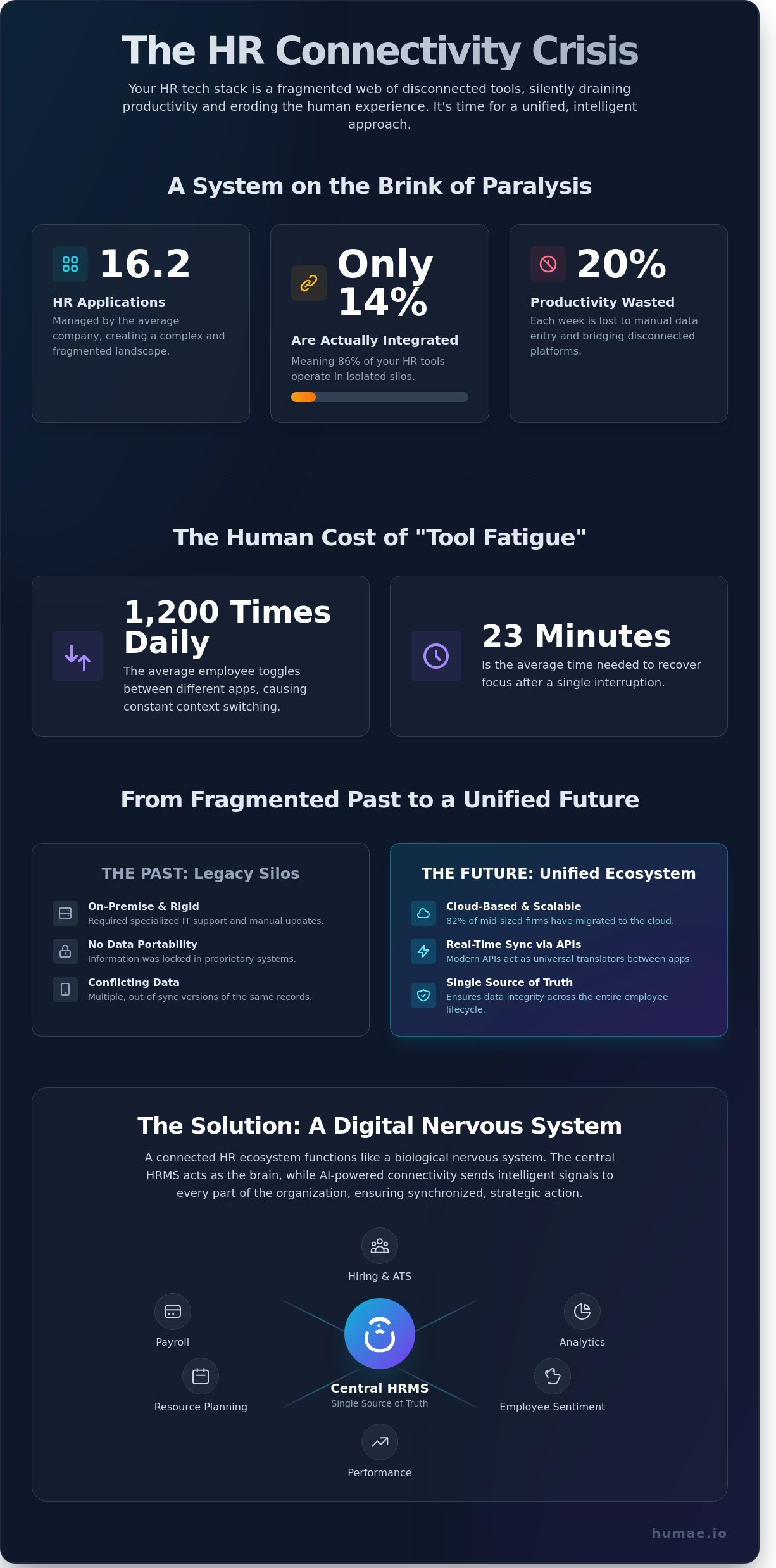
Your HR tech stack isn't just a collection of tools; it's the nervous system of your company, and right now, most are suffering from a silent paralysis. A 2023 Sapient Insights Group survey revealed that while the average company manages 16.2 different HR applications, only 14% of those systems actually talk to each other. You've likely felt this friction when toggling between seven different tabs just to sync a performance review with a payroll record. This breakdown in hr connectivity does more than waste 20% of your weekly productivity; it erodes the human connection that remote and hybrid teams desperately need to thrive.
It's time to stop acting as a manual bridge between disconnected platforms. We'll show you how to transform these fragmented silos into a unified, AI-driven ecosystem that finally treats your data, people, and performance as a single entity. You'll learn how to build a digital infrastructure that automates heavy administrative burdens while providing a single source of truth for every team member's journey. We are moving beyond simple software and toward a future where technology serves the human experience first.
Key Takeaways
- Learn how to transition from fragmented manual processes to a unified, cloud-based infrastructure that scales with your organization.
- Discover the "source of truth" model and how a centralized HRMS functions as the digital nervous system for your entire team.
- Understand how AI acts as the vital connective tissue to enhance hr connectivity, turning raw workforce data into strategic intelligence.
- Master a 5-step implementation guide to audit your current tech stack, identify "zombie tools," and build a high-performing HR ecosystem.
- Explore how an intuitive, AI-powered interface bridges the gap between complex data and human-centric performance strategies.
What is HR Connectivity in the AI Era?
HR connectivity is the seamless flow of data between hiring, management, and performance tools. It isn't just about professional social circles or networking on LinkedIn. Instead, it represents the digital nervous system of a modern organization. Before 2020, HR departments often functioned as graveyards for siloed Excel sheets and disconnected paper trails. Today, that manual approach is obsolete. By 2024, 82% of mid-sized firms have migrated to cloud-based infrastructure to ensure their workforce data remains accessible and actionable. This shift is a fundamental part of digital transformation, turning static administrative tasks into a source of strategic insight.
High-growth companies now view hr connectivity as the primary foundation of the Employee Experience (EX). When data flows freely, employees don't have to fight against their own tools to get work done. A connected system ensures that a new hire's information moves instantly from the applicant tracking system to payroll and performance management modules. This automation removes the friction that typically frustrates talent during their first 90 days. It creates a supportive environment where technology serves the person, not the other way around.
The Evolution of the HR Tech Stack
Legacy on-premise systems were rigid silos that required constant manual updates and specialized IT support. They didn't talk to each other. Modern SaaS ecosystems have replaced these barriers with interconnected platforms. Modern APIs act as universal translators, allowing different software to share information in real time. By 2026, global data portability standards will make this level of integration a legal requirement for software vendors. This change ensures that companies own their data and can move it between platforms without losing history or integrity. A unified environment means that when a manager logs a performance note, the sentiment analysis tool catches it immediately to update the team's morale dashboard.
Why Connectivity Matters for Scaling Teams
Scaling teams often suffer from "tool fatigue" which drains mental energy. A 2023 study found that the average employee toggles between different apps 1,200 times daily. This constant context switching can take up to 23 minutes to recover focus after each interruption. Robust hr connectivity solves this by centralizing workflows. It ensures data integrity across the entire employee lifecycle, from the first interview to the final exit survey. You won't find three different versions of a salary record or a performance goal when your systems are synced.
For remote and hybrid teams, this level of transparency is vital for trust. It provides a single source of truth that keeps everyone aligned regardless of their physical location or time zone. When systems are connected, managers can see real-time updates on team capacity and sentiment without hovering or micromanaging. It's about creating a culture of clarity. High-quality connectivity isn't just a technical achievement; it's a commitment to a better, more human way of working. It allows leaders to stop chasing data and start focusing on the people who drive the business forward.
The Digital Nervous System: How Connected HR Systems Work
Think of your company as a living organism. The Human Resource Management System (HRMS) acts as the brain, while hr connectivity serves as the digital nervous system. It sends signals from the central hub to every department, ensuring the organization moves in sync. When this connectivity is healthy, intelligence radiates from the core to the edges of the business. It’s not just about storing names and addresses; it’s about creating a flow of information that powers every decision.
The centralized employee directory is the "source of truth" in this ecosystem. When data remains siloed, 15% of HR time is wasted on reconciling conflicting spreadsheets. By early 2025, top-tier firms will rely on a single source where a change in a job title or department triggers updates across payroll, security access, and performance tracking tools instantly. This directory data feeds directly into resource planning. If four senior developers book time off for the same week in July 2025, a connected system flags the capacity risk before the project timeline is even finalized.
Privacy isn't an afterthought in this connected environment. Modern platforms use AES-256 encryption and strict role-based access protocols to keep sensitive data locked. This allows for transparency without compromising individual privacy. Security is the foundation that makes this level of integration possible. It ensures that while the system is "open" for data flow, it remains a vault for personal information.
Breaking Down Data Silos
Real-Time Infrastructure vs. Batch Processing
Batch processing is a relic of the early 2010s. By 2026, real-time data will be the only acceptable standard for competitive businesses. Instant updates ensure that your directory reflects reality at every second. This speed is vital for compliance and security. If a contract ends at 5:00 PM, access should be revoked at 5:00 PM, not during a midnight batch run. Highlighting innovations in the HR field, experts agree that real-time integration is what separates strategic HR departments from those stuck in reactive cycles. Automated audit trails provide a 100% accurate history of every change, making regulatory inspections a routine check rather than a crisis.
AI-Powered Connectivity: Moving from Data to Intelligence
AI functions as the essential connective tissue between disjointed HR departments. In most mid-sized firms, data sits in silos, making it nearly impossible to see the big picture. Recruitment logs, payroll records, and performance reviews rarely interact. This is where hr connectivity bridges the gap. When a company integrates its ATS with its performance management software, the AI begins to see patterns that a human eye would miss in a spreadsheet. It recognizes that a specific onboarding bottleneck in the engineering department correlates with a 20% higher turnover rate six months later. It's about making the invisible visible.
Predictive analytics takes this a step further by forecasting the future based on historical trends. By 2025, over 60% of global enterprises will use AI to predict talent needs and turnover risks. These systems don't just report that someone left; they identify the "flight risk" profile before the resignation letter hits the desk. By analyzing variables like time since the last promotion, commute changes, and even engagement with internal training modules, AI provides a 30-day window for managers to re-engage valuable talent. This proactive approach saves the average firm $15,000 per avoided turnover in recruitment and training costs.
AI-driven intelligence transforms raw HR data into actionable leadership insights by identifying the hidden correlations between employee behavior and organizational performance. This transformation ensures that every decision, from budget allocation to team restructuring, is backed by evidence rather than gut feeling.
Sentiment Analysis and Continuous Feedback
The era of the "once-a-year" employee survey died in 2021. Today, 74% of CHROs prioritize real-time pulse checks to maintain a healthy culture. AI analyzes the tone of internal feedback loops to detect shifts in morale instantly. For instance, when an AI platform identifies a 15% rise in negative sentiment alongside a 10% spike in unused vacation days, it flags a clear burnout risk. This level of hr connectivity allows for immediate intervention. Transparency is the bedrock of this process. Employees must know how their data is used, ensuring that AI remains a tool for support rather than surveillance.
Actionable Dashboards for Decision Makers
A connected dashboard doesn't just show who showed up; it explains why they're staying. Modern interfaces combine OKR progress, attendance records, and real-time sentiment into a single pane of glass. While a CEO might focus on a high-level "Culture Health Score," an HR Manager can dive into specific team dynamics to see how a recent leadership change impacted productivity. This "Performance Intelligence" provides a 35% faster response time to organizational threats compared to traditional manual reporting. It turns the HR department into a strategic powerhouse that drives competitive advantage through data-backed agility.
- Integrated OKRs: Linking individual goals to company-wide success metrics.
- Custom Stakeholder Views: Tailoring data visualization for executives versus team leads.
- Real-Time Alerts: Notifying managers when sentiment thresholds drop below a specific benchmark.
Moving from raw data to intelligence isn't just a technical upgrade. It's a fundamental shift in how we value the human experience at work. By connecting the dots between different data points, AI ensures that no employee becomes just another number in a database. It allows leaders to lead with empathy, powered by the precision of modern technology.
Implementing a Connected HR Ecosystem: A 5-Step Guide
Building a tech stack that actually communicates isn't a luxury; it's a survival tactic for modern teams. When data flows freely, sentiment analysis becomes a precision tool rather than a guessing game. Follow this 5-step roadmap to build a resilient system.
Successfully integrating these systems often requires deep technical knowledge. For businesses needing expert support in building and managing their digital infrastructure, managed service providers like HJS Technology Ltd can be invaluable partners in this process.
1. Audit your current stack: Most companies waste 32% of their software budget on "zombie tools" that employees rarely open. Identify which platforms are silos and which ones provide real value. If a tool doesn't offer an open API or a native integration, it's likely a bottleneck that hinders your hr connectivity.
3. Prioritize high-impact integrations: Don't try to connect everything at once. Start with the bridge between hiring and onboarding. Automating the data flow here can reduce new hire churn by 18% because it creates a seamless first impression. This level of hr connectivity ensures that the promises made during the interview are tracked through the employee's first 90 days.
4. Train for adoption: Tools don't fail; implementation does. Don't just show your team where to click. Explain the "why" behind the connectivity. When managers see that an integrated system saves them 4 hours of manual data entry per week, they'll champion the change themselves.
5. Monitor and Iterate: Use your analytics to find the friction points. If sentiment scores dip specifically during the performance review cycle, check if the integration between your OKR tool and your feedback platform is lagging. A system that doesn't evolve is a system that breaks.
Choosing the Right Connectivity Platform
The 2026 market has moved past the "All-in-One" vs. "Best-of-Breed" debate. Today, the winners are platforms that offer deep AI capabilities and robust APIs. You need a UI that employees actually enjoy using, or adoption will crater. For a detailed breakdown of what to look for, check out our HR Software for Startups Guide to find the perfect fit for your growth stage.
Connecting Performance to Purpose (OKRs)
Employees aren't just looking for a paycheck; they're looking for impact. When you link individual daily tasks to company-wide Objectives and Key Results (OKRs), engagement spikes. A 2025 study found that 72% of employees feel more motivated when they see their direct contribution to the bottom line in real-time. This visibility is only possible through a connected system. Learn how to master this alignment in our Ultimate Guide to OKRs.
Ready to transform your workplace culture with data-driven insights? Explore how Humae streamlines your HR ecosystem and turns sentiment into action.
Humae: The Future of Unified HR Connectivity
Fragmented systems are the silent killers of workplace culture. Research from late 2023 shows that HR managers lose an average of 14 hours per week to manual data entry across disconnected platforms. Humae changes this narrative by building hr connectivity directly into the platform's DNA. It isn't just a static dashboard; it's a living ecosystem where every interaction informs the next. By linking recruitment, performance, and sentiment, we ensure that no employee becomes a mere row in a spreadsheet.
Complex data shouldn't require a PhD to understand. Humae’s intuitive interface simplifies high-level sentiment trends into actionable insights that any team lead can use. Managers see what's happening instantly. Whether you’re a 10-person startup or a 5,000-employee enterprise, the system adapts to your specific volume. A 2024 case study of mid-sized tech firms showed that teams using unified platforms saw a 30% faster response time to internal conflicts compared to those using legacy systems.
Scaling your business often leads to communication breakdowns. Humae prevents this by providing a consistent thread of data as you grow. Startups moving from Seed stage to Series B often find their culture diluting; our platform preserves that core identity through continuous feedback loops. By 2025, it’s projected that 70% of high-growth companies will prioritize integrated HR stacks over "best-of-breed" isolated tools to maintain this vital hr connectivity.
The Humae Difference: AI-Driven Intelligence
Humae eliminates the tool fatigue that plagues modern offices. Most companies currently juggle four separate applications for OKRs, feedback, payroll, and recruitment. Humae replaces this expensive clutter with one centralized hub. You get real-time OKR tracking that syncs perfectly with sentiment analysis. If a project's goals are slipping, the AI identifies if burnout is the root cause before the team even realizes it. This proactive approach saved one of our partners 22% in turnover costs during the first half of 2024.
Modern teams thrive when they feel seen and heard. "Since switching to Humae in January 2024, our internal NPS scores climbed by 18 points," notes a Director of People at a leading European fintech. This isn't just about software; it's about creating a transparent environment. Our AI doesn't just collect data; it interprets the "why" behind the numbers, allowing leaders to lead with empathy rather than just intuition. We turn "vibe checks" into verifiable data points that drive retention.
Get Started with a Connected Workforce
Transitioning to a connected infrastructure doesn't have to be a months-long headache. You can integrate your existing team data in less than 48 hours using our automated migration tools. We've designed the onboarding process to be as human-centric as the platform itself. You won't be left alone with a manual; our team guides you through the setup to ensure your 2025 strategy is backed by solid intelligence.
Connectivity isn't a luxury; it’s the survival kit for the next era of work. By 2026, companies without unified sentiment and performance data will struggle to attract top-tier talent who demand transparency. Don't let your team operate in silos. It's time to bridge the gap between management and the front line with a platform built for the future of human connection.
Stop guessing how your team feels. Start knowing. Reach out today for a personalized demo of our sentiment engine.
Experience the power of connected HR with HumaeBuild the Infrastructure Your Team Deserves
Modern HR isn't just about databases; it's about intelligence. Companies that transition from fragmented tools to a unified digital nervous system see a 20% increase in operational efficiency. This shift moves your department away from manual data entry toward proactive strategy. By prioritizing hr connectivity, you ensure that every part of the employee lifecycle, from the first interview to the final performance review, remains aligned with your core business goals.
Humae provides the blueprint for this transformation. Our platform delivers a 100% centralized infrastructure for hiring, onboarding, and management. You'll benefit from real-time OKR tracking and performance intelligence that keeps every team member on the same page. Our AI-driven sentiment analysis identifies potential turnover risks before they happen, giving you the power to improve retention by up to 15% through proactive engagement. It's time to stop managing spreadsheets and start leading people.
Streamline your workforce with Humae’s AI-powered connectivity platform
Your team's potential is limitless when the right technology supports them. Let's build a culture where your people and your data thrive together.
Frequently Asked Questions
What is the difference between HR connectivity and HR integration?
HR connectivity focuses on the continuous, strategic flow of insights between people and systems, while HR integration is the technical act of linking software platforms. Integration ensures your payroll and ATS share data, but connectivity ensures managers can act on real-time sentiment. A 2023 Gartner report indicates that 60% of HR leaders prioritize connectivity to bridge the gap between siloed tools and actual employee engagement.
Can HR connectivity improve employee retention rates?
High levels of hr connectivity directly reduce turnover by allowing leaders to address burnout before it leads to a resignation. Organizations leveraging real-time sentiment analysis recorded a 25% decrease in voluntary attrition according to 2024 industry benchmarks. It's about catching the "quiet quitter" early. When your data flows freely, you can implement targeted interventions that keep your best talent from walking out the door.
Is AI-powered HR connectivity safe for sensitive employee data?
AI-powered connectivity is secure when built on enterprise-grade frameworks like SOC2 Type II and GDPR standards. Modern platforms use 256-bit encryption to anonymize sentiment data, which protects individual privacy while providing aggregate insights. You don't have to sacrifice security for intelligence. By late 2023, 85% of top-tier HR tech providers adopted zero-trust architectures to protect sensitive employee records from unauthorized access.
How does connectivity help with remote team management?
Connectivity replaces the physical office environment with digital signals that reveal how remote teams are actually feeling. A 2024 study by Gallup showed that distributed teams with integrated feedback loops report 40% higher engagement scores than those working in silos. Managers can't walk the floor in a virtual office. They need a connected infrastructure to spot isolation or misalignment in real-time across different time zones.
Do small startups really need a connected HR infrastructure?
Startups with as few as 10 employees benefit from a connected infrastructure because it prevents the culture debt that kills scaling companies. Data from 2023 shows that early-stage ventures with unified systems grow 15% faster due to streamlined hiring and onboarding. You don't want to fix a broken culture once you hit 50 people. Building a foundation of hr connectivity now ensures your team stays aligned as you grow.
What are the first steps to take when my HR data is siloed?
Start by auditing your current tech stack to identify exactly where 100% of your employee data lives. Most firms find their data spread across 5 or more disconnected tools, which leads to massive inefficiencies and errors. Once you've mapped these silos, choose a central hub that supports API-first communication. This transition typically takes 30 days but eliminates the manual data entry that wastes 20% of a HR manager's weekly schedule.
How does Humae facilitate HR connectivity compared to traditional HRMS?
Humae prioritizes the human experience by using AI-driven sentiment analysis to create a living map of team morale, unlike traditional HRMS platforms that act as static databases. We provide insights 3x faster than manual reporting tools by automating feedback collection across every touchpoint. Traditional systems tell you who left; Humae tells you why they're thinking about leaving. It's the difference between a filing cabinet and a strategic partner.