How to Master OKR Tracking: A Guide to Performance Intelligence in 2026
By Humae · 30 March 2026
okr tracking
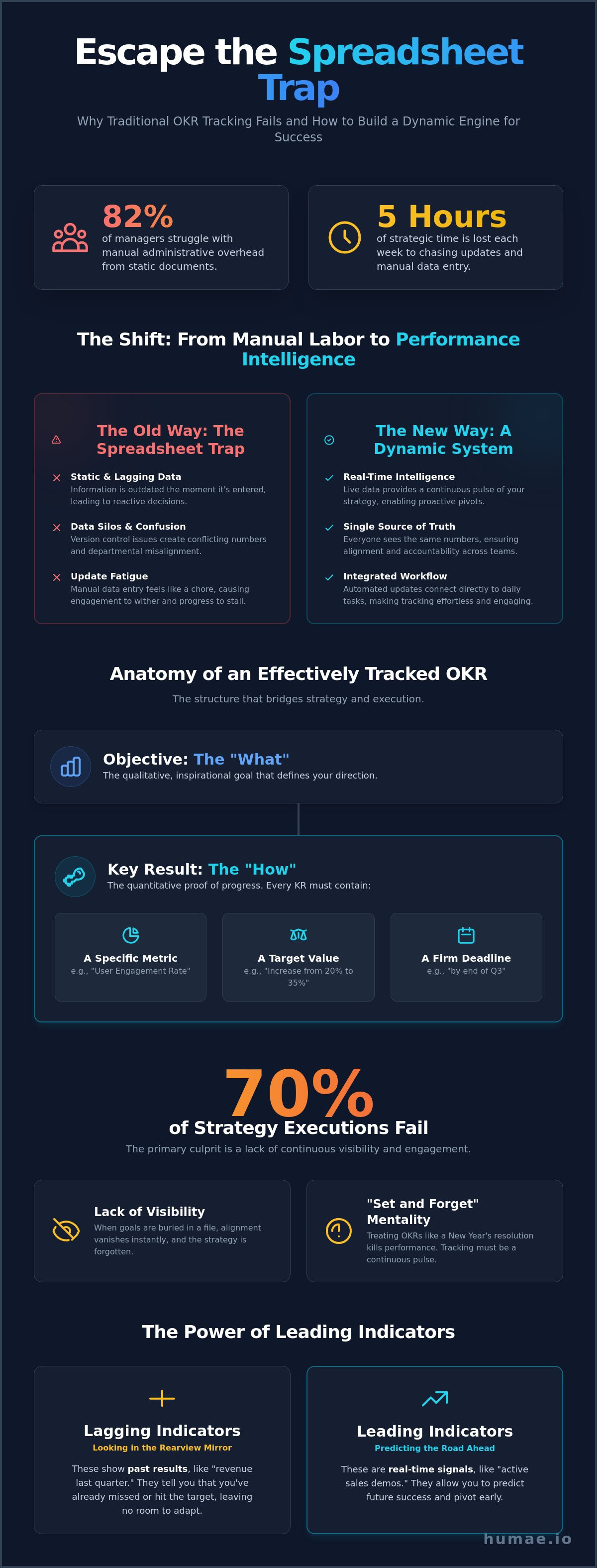
What if your current spreadsheet is actually the biggest obstacle to your company’s growth in 2026? You likely know the frustration of chasing team leads for manual updates or realizing a key objective fell behind 14 days ago because your okr tracking was stuck in a static document. It’s exhausting to manage high-growth teams with tools that feel like navigating a modern city with a paper map from 2012. Statistics from 2024 suggest that 82% of managers still struggle with manual administrative overhead that eats into five hours of their weekly strategic time.
We agree that your team’s energy is too valuable for repetitive data entry. This guide promises to show you how to move beyond messy manual updates into a high-impact system that delivers real-time performance intelligence. You’ll learn to automate your progress updates, visualize goal alignment across every department, and build a culture of transparency that keeps employees genuinely engaged. We’ll explore the exact technical shifts required to turn your goals into a dynamic engine for measurable success.
Key Takeaways
- Shift from static spreadsheets to a dynamic system that provides real-time performance intelligence and eliminates the "set and forget" trap.
- Master a sustainable okr tracking cadence using weekly check-ins to monitor confidence levels and proactively remove blockers.
- Boost team engagement by integrating automated goal tracking directly into your daily digital workflows to maximize focus and ROI.
- Implement a clear 5-step roadmap to establish a single source of truth and ensure accountability for every Key Result.
- Leverage AI-powered sentiment analysis to understand the human element and team feelings behind your performance metrics.
Experience the future of performance at Humae or follow us on Facebook.
What is OKR Tracking and Why Does It Fail in Spreadsheets?
OKR tracking isn't a quarterly administrative chore. It's the continuous pulse of your organization's strategy. Most teams treat OKRs like a New Year's resolution; they set ambitious goals in January and ignore them until the end of the cycle. This "set it and forget it" mentality is the fastest way to kill performance. Real okr tracking requires a rhythmic process of monitoring, discussing, and adjusting Key Results to stay aligned with the mission.
Many companies fall into the Spreadsheet Trap. They use Excel or Google Sheets because it feels familiar, but static documents can't handle the speed of 2026 business environments. Version control issues lead to "data silos" where different departments look at conflicting numbers. Engagement withers because spreadsheets lack the visual feedback and social connectivity that modern teams crave. Performance Intelligence is the successor to this manual labor. It shifts the focus from just recording numbers to understanding the "why" behind the data.
The Anatomy of an Effectively Tracked OKR
Success starts with structure. The Objective is your "What," representing the qualitative, inspirational goal. The Key Result is your "How," providing the quantitative proof of progress. Every trackable KR must contain three non-negotiable elements: a specific Metric, a target Value, and a firm Deadline. Without these, you aren't tracking; you're just guessing. OKR tracking is the bridge between strategy and execution.
Why 70% of OKR Initiatives Lose Momentum
Industry data suggests that 70% of strategy executions fail, and the primary culprit is a lack of visibility. When goals are buried in a file that's hard to find, alignment vanishes instantly. This leads to "update fatigue." Employees get tired of manual data entry that feels disconnected from their daily tasks. They stop updating their progress, and the system collapses.
- Lagging Indicators: These show past results, like "revenue last month." They tell you that you've already missed the target.
- Leading Indicators: These are real-time signals, like "active sales demos." They allow you to predict future success and pivot early.
Modern okr tracking prioritizes these leading indicators. It removes the friction of manual reporting, allowing teams to focus on the work that actually moves the needle. By moving toward a Performance Intelligence model, you turn data into a supportive partner rather than a reporting burden.
Powered by Humae
We build technology that prioritizes the human experience in every professional journey. Whether you're scaling a startup or leading an enterprise, our tools bring clarity to your most complex challenges.
Setting Up a High-Performance OKR Tracking Cadence
Execution fails when tracking becomes a monthly afterthought. High-performance teams treat okr tracking as a living ritual, not a static report. This starts with appointing an OKR Shepherd. This person isn't a micromanager; they're the guardian of the process. They ensure data stays fresh and facilitate the flow of information between departments. By using real-time analytics dashboards, the Shepherd moves meetings away from "what happened" toward "how do we fix it." Visualizing progress through live data heatmaps allows teams to spot 12% deviations before they turn into 40% failures. This proactive stance ensures that performance intelligence remains at the core of every decision.
The Weekly OKR Check-In Ritual
Speed is your greatest asset. Keep check-ins under 15 minutes per team to maintain momentum. Instead of long status updates, focus on Confidence Scores. Every owner assigns a 1 to 10 rating to their Key Result. A 4/10 is a signal for help, not a reason for punishment. This transparency flags at-risk goals early. Teams that document "lessons learned" in their tracking log every Friday see a 24% increase in goal attainment by the next quarter. It's about building a collective memory of what works. If you want to see how technology simplifies this, check out our performance features to streamline your workflow.
Quarterly Reviews and Scoring
The end of a 90-day cycle requires honest reflection. In the world of Performance Intelligence, a score of 0.7 is often the mark of success. It means the goal was ambitious enough to drive growth. A perfect 1.0 frequently suggests "sandbagging," where teams set targets too low to ensure a win. Analyzing cycle-over-cycle trends reveals the true health of your organization. By comparing Q1 2025 data against Q1 2026, you identify whether your velocity is increasing or if systemic blockers are slowing you down. This data-driven approach turns okr tracking into a strategic advantage rather than a chore.
Humae | Modern, tech-driven, and human-centered performance solutions.
Explore our platform: humae.io
Connect with us on Facebook
Manual vs. Integrated OKR Tracking: The ROI of Automation
Choosing between a spreadsheet and a dedicated platform isn't just a technical decision. It's a financial one. Manual okr tracking feels free because the software license cost is zero, but the labor cost is staggering. When data lives in a vacuum, teams lose sight of why their work matters. Automation turns goals from a quarterly chore into a live pulse of the company. It's the difference between looking at a map and using a real-time GPS.
Human error is the silent killer of strategy. A study by the University of Hawaii found that 88% of spreadsheets contain significant errors. In a performance context, one broken formula can misrepresent an entire department's progress. Software creates a single source of truth, pulling data directly from the tools your team uses every day. This eliminates the "reporting tax" that exhausts your best talent. It ensures that everyone is working from the same set of facts.
The Hidden Costs of "Free" Spreadsheets
For a 50-person team, manual reporting is a productivity drain. If each employee spends 15 minutes a week updating a sheet, you lose 650 hours annually. At an average cost of $45 per hour, that's $29,250 wasted on data entry alone. These "data silos" disconnect daily tasks from high-level goals. When a manager leaves, their logic often leaves with them. This makes succession planning nearly impossible because the historical context of goals is buried in a private file.
The Value of an Integrated HRMS Infrastructure
Connecting goals to your employee directory creates instant accountability. It's about the person, not just the number. An integrated system allows leaders to see okr tracking metrics alongside time-off management. This is vital for preventing burnout. If a key result is lagging while an employee has zero vacation days booked, you have an intervention point before they quit. You can learn more about these connections in our guide: What Is an HRMS? The Ultimate Guide for 2026.
Humae – Modern technology for an empowered workforce.
Navigate back to our home page: https://humae.io/
Connect with us on social media: Humae Facebook
5 Steps to Implement Effective OKR Tracking
Success isn't accidental; it's engineered through disciplined execution. To move beyond static goals, follow these five steps to master okr tracking in a way that fuels growth without burning out your team. By 2026, the gap between companies that use real-time data and those that rely on quarterly post-mortems will only widen.
For businesses that rely on sales data, integrating a modern Point of Sale system is a crucial part of this automation; if you're exploring options, you can check out Merchant Solutions Corp.
Automating the Feedback Loop
Don't let tracking become a chore. Set up automated Slack or Teams reminders that feel like helpful nudges rather than micro-management. Pair these with public recognition features; celebrating a 70% completion rate in a shared channel boosts morale instantly. For scaling teams, it's vital to integrate these goals with your Applicant Tracking Systems. This ensures your hiring pipeline directly supports your strategic milestones, making every new hire a tactical win. Discover how automated workflows can simplify your team's growth.
Visualizing Success with Analytics Dashboards
Your executive dashboard needs to prioritize high-level KPIs like goal confidence scores and resource allocation. Use heatmaps to visualize performance across the entire company. These visual cues instantly highlight which departments are lagging, allowing leaders to provide support where it's needed most. The ideal OKR dashboard is a real-time map of company strategy. It transforms raw data into a narrative of progress that everyone can understand and follow.
Humae – Modern Recruitment and Performance Intelligence
We combine technology with a human-centered approach to help your business thrive. Visit our Home Page to learn more.
Stay updated and join our community on Facebook.
Elevating Performance with Humae’s AI-Powered OKR Infrastructure
Legacy tools often feel like digital graveyards for goals. They're clunky, disconnected, and usually ignored until the end of the quarter. Humae flips this script by turning okr tracking into a live, breathing part of your company culture. It's not just a dashboard; it's a centralized infrastructure where hiring, onboarding, and performance metrics live in a single, intuitive interface. This unified approach ensures that every new hire understands their impact from day one, bridging the gap between talent acquisition and strategic execution.
Real-Time Tracking Meets AI Intelligence
Humae's AI doesn't just record data. It analyzes patterns to predict which OKRs are at-risk up to 21 days before a deadline. By linking workforce management directly to goal execution, leaders see how team capacity impacts results in real-time. If a key project stalls because of resource gaps, the system flags it immediately. This proactive intelligence allows managers to pivot resources before a "yellow" status turns "red." Modern okr tracking shouldn't be a post-mortem exercise; it should be a GPS for your business growth.
Discover Humae: The All-in-One HR Platform
Why Modern Teams Choose Humae
Startups and scaling enterprises choose Humae because we prioritize the "human" in HR technology. Data shows that 45% of failed goals stem from team burnout or lack of clarity. Humae addresses this with AI-driven sentiment analysis. Our platform tracks how your team actually feels about their targets. If confidence scores drop by 15% in a single week, you'll know exactly where to step in and offer support. We believe tracking is about empowering people, not just hitting cold numbers. It's about building a culture where everyone knows they're supported.
- Predictive Analytics: Identify bottlenecks before they impact your bottom line.
- Sentiment Insights: Understand the "why" behind the data.
- Centralized Interface: Stop jumping between five different tools to manage one team.
Start your AI-powered OKR journey with Humae today.
About Humae
Humae is the modern performance intelligence partner for growth-focused companies. We blend cutting-edge AI with a deeply human approach to HR and goal management.
Turn Your 2026 Strategy Into Measurable Reality
Static spreadsheets cost modern teams 20% of their productive hours every week. By 2026, the competitive edge belongs to leaders who ditch manual entry for automated performance intelligence. Research shows that teams using integrated systems see a 30% higher goal attainment rate compared to those stuck in legacy workflows. Mastering okr tracking is the fastest way to align your workforce and ensure every individual contribution drives the bottom line.
Humae offers a seamless path to this high-performance future. Our AI-powered performance intelligence combines integrated HRMS and workforce management into one intuitive platform. You'll gain access to real-time actionable analytics dashboards that transform raw data into clear growth paths. It's time to stop managing spreadsheets and start leading people.
Streamline your strategy with Humae’s OKR tracking
You've got the vision; we've got the tools to make it happen. Let's build something incredible together.
Navigate back to the Humae Home Page or connect with our community on Facebook.
Frequently Asked Questions
How often should we update our OKR tracking software?
Update your software every 7 days to maintain real-time data integrity. Teams that review progress weekly see a 31% increase in goal attainment compared to those using monthly cycles. Regular updates prevent surprises and keep the human element of performance at the center of your strategy.
Can OKR tracking be linked to employee compensation?
You shouldn't link OKRs directly to compensation because it kills the ambition required for moonshot goals. Google's internal data suggests that separating rewards from OKRs encourages employees to set 10x targets without fear of financial penalty. Focus on development and growth instead of using a 70% achievement score to calculate bonuses.
What is the difference between tracking KPIs and tracking OKRs?
KPI tracking monitors business-as-usual health metrics while OKR tracking focuses on aggressive growth and change. Think of KPIs as your car's dashboard showing fuel levels and OKRs as the GPS guiding you to a new destination. In 2026, 85% of high-performing firms use both to balance stability with innovation.
What happens if a team fails to reach their tracked key results?
Failing to reach a tracked key result is a learning opportunity, not a reason for punishment. If a team hits 60% of a moonshot goal, they've often achieved more than they would have with a safe, 100% reachable target. Analyze the data from your okr tracking process to pivot strategy for the next 90 day cycle.
Is AI really necessary for effective OKR tracking in 2026?
AI is essential for effective okr tracking in 2026 because it automates data collection and predicts performance bottlenecks. Predictive analytics now flag a 15% probability of goal failure three weeks before it happens. This allows leaders to provide support exactly when the human team needs it most.
How do we track qualitative goals (moonshots) versus quantitative ones?
Track qualitative moonshots by breaking them into 3 to 5 measurable milestones that indicate progress. A subjective goal like "Improve Brand Sentiment" becomes quantitative when you track a 20% rise in positive social mentions or a 4.5 star average rating. Use specific metrics to ground your biggest visions in reality.
How much does OKR tracking software typically cost for small teams?
Small teams of 10 to 25 people typically pay between $7 and $15 per user per month for professional software. 80% of platforms offer a free tier for under 5 users to help startups build a performance culture early. Budgeting $150 monthly ensures your team has the tech they need to scale.
What is the best way to visualize OKR progress for an entire company?
The best way to visualize company-wide progress is through a real-time heat map or a nested tree diagram. These dashboards allow every employee to see how their daily tasks contribute to the 3 main annual pillars. Transparency builds trust and ensures 100% alignment across every department.