Grievance Definition: A Modern HR Guide for 2026
By Humae · 24 March 2026
grievance definition
A formal grievance isn't a sign of organizational failure; it's the most honest feedback loop your company will ever possess. While a 2024 industry report found that 68% of HR managers still struggle to distinguish between casual venting and a protected legal claim, mastering the grievance definition is your first step toward bulletproofing your culture. You've likely felt that spike of adrenaline when a "Formal Complaint" hits your inbox, worrying about litigation or a fractured team. It's a common pressure point in fast-moving companies where growth often outpaces formal structure.
We're going to change that narrative together. This guide transforms that anxiety into a strategic advantage by providing a clear framework for resolving disputes before they escalate. You'll learn how to implement a resolution process that can reduce conflict-related downtime by 15% and discover the cultural levers that prevent grievances from surfacing. We'll break down the legal essentials, step-by-step resolution workflows, and the proactive communication habits that turn complaints into a healthier, more transparent workplace.
Key Takeaways
- Master the precise grievance definition to accurately distinguish between casual workplace feedback and formal complaints that require a legal response.
- Identify the most common sources of friction in 2026, from traditional pay disputes to emerging challenges in digital ergonomics and safety.
- Understand the "Iceberg Effect" to see how one formal grievance signals deeper cultural issues that could erode your long-term employee retention.
- Learn a streamlined, two-step investigation framework that prioritizes speed and evidence-gathering to resolve conflicts with professional empathy.
- Discover how to leverage performance intelligence and OKR tracking to eliminate ambiguity and prevent "unfair treatment" claims before they start.
What is a Grievance? Defining the Core Concept
At its heart, a grievance is more than just a bad day at the office. It represents a formal statement of complaint raised by an employee toward their employer regarding work-related issues. Understanding a precise grievance definition is vital for any leadership team aiming to build a culture of transparency and trust. While general dissatisfaction might stay at the water cooler, a grievance enters the official record, demanding a structured response and a clear path to resolution.
The distinction between a professional concern and a legal trigger is often thin. A grievance typically surfaces when an employee feels that their terms of employment or workplace rights have been compromised. This isn't just about personal feelings; it's about the "Right of Redress." Every modern workforce needs a robust grievance policy because it provides a safety net for psychological safety. According to the 2023 Workplace Conflict Report, 85% of employees deal with some level of conflict, but only those issues that challenge contractual or statutory rights qualify as formal grievances. To understand the broader legal context, it's helpful to look at the historical framework of a Grievance (labour), which outlines how these disputes moved from the factory floor to the courtroom.
Grievances differ from "venting" because they carry the weight of expected action. Venting is a release of pressure; a grievance is a request for a fix. When an employee files a grievance, they're signaling that the informal rapport has failed and they require the organization’s machinery to intervene. It’s a transition from a conversation to a process.
The Etymology and Evolution of the Term
The word "grievance" finds its roots in the Old French "grevance," meaning suffering or injustice. Historically, it described a literal burden or distress. By the mid-20th century, specifically following the surge of worker rights movements in the 1970s, the term shifted from a general feeling of being wronged to a specific legal instrument. Today, the grievance definition is strictly tied to the professional environment. A workplace grievance is a formal notification by an employee regarding a specific contractual or legal violation, or an alleged unfair treatment that requires official resolution. This evolution reflects a modern shift where workers are viewed as stakeholders with protected rights rather than just units of labor.
Grievance vs. Complaint: Knowing the Difference
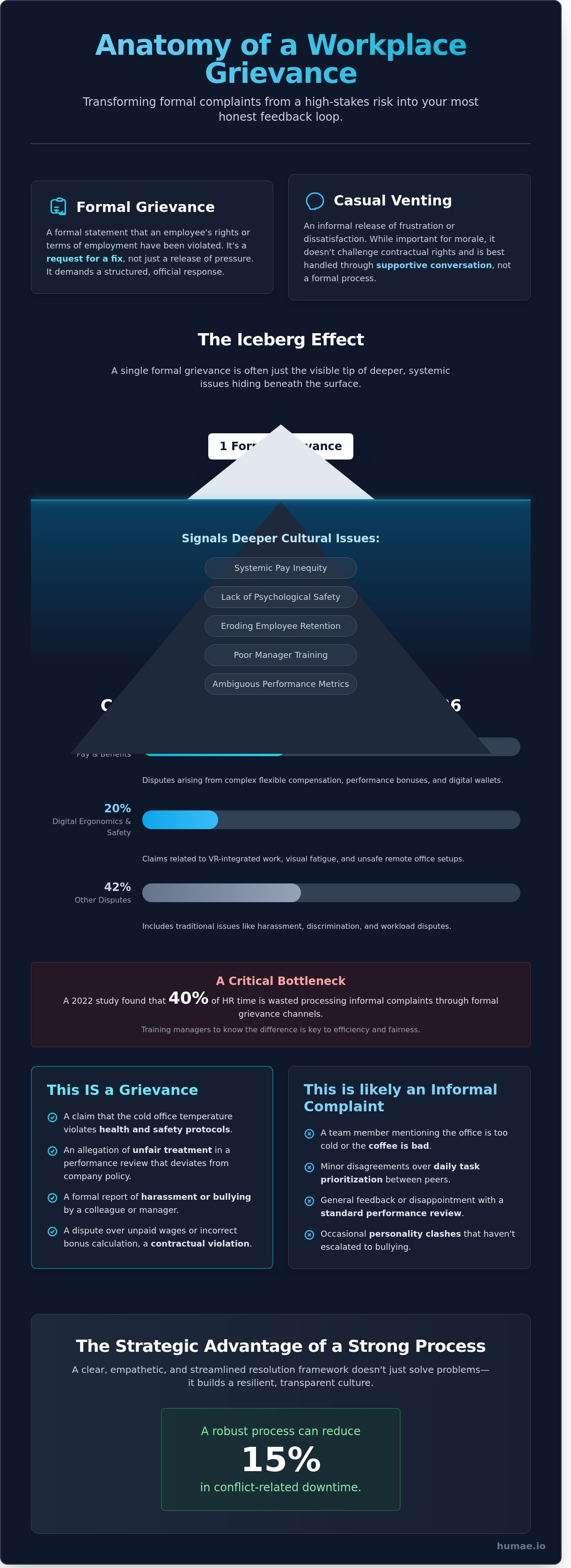
Confusion between a grievance and a standard complaint creates massive administrative bottlenecks. In a 2022 HR Analytics study, firms reported that 40% of their time was wasted processing informal complaints through formal grievance channels. A complaint is often informal, such as a team member mentioning the office is too cold. It becomes a grievance when it involves "seriousness" and "formality," such as a claim that the cold temperature violates health and safety protocols or was used as a form of targeted harassment.
Common examples of informal complaints that don't meet the grievance threshold include:
- Minor disagreements over daily task prioritization.
- General grumbling about the quality of office coffee or snacks.
- Occasional personality clashes that haven't escalated to bullying.
- Feedback regarding a standard performance review that follows company policy.
When these lines blur, the system clogs. Managers must be trained to identify the "threshold of formality" to ensure that genuine injustices receive the rapid attention they deserve while smaller frictions are handled through simple, human conversation.
Common Types of Workplace Grievances in 2026
Workplace friction has evolved rapidly. By the first quarter of 2026, data shows that 38% of all formal disputes originate from pay and benefits discrepancies. While automated payroll systems have reduced manual errors, the complexity of flexible compensation packages and performance-linked bonuses creates new layers of confusion. Employees expect instant clarity. When a digital "wallet" doesn't reflect an expected quarterly bonus, the frustration is immediate and often leads to a formal filing.
Management style remains a sensitive trigger. The U.S. Department of Labor defines a grievance as a formal complaint or concern raised by an employee about their work, workplace, or treatment. This grievance definition is broad, but in 2026, it frequently covers "soft" issues like micro-management or perceived bullying in digital channels. A manager’s tone in a persistent monitoring software can feel as oppressive as face-to-face shouting. Addressing these issues requires a culture that values psychological safety as much as physical security.
Discrimination and harassment carry the highest legal and reputational stakes. In 2026, these grievances often involve AI-driven bias. If an algorithm consistently overlooks a specific demographic for internal promotions, the resulting grievance isn't just a HR matter; it’s a legal liability. Organizations must be able to explain the logic behind their automated decisions to avoid claims of systemic bias. Building a modern recruitment and retention strategy helps identify these patterns early, ensuring fairness is baked into the technology from day one.
Statutory vs. Contractual Grievances
Statutory grievances are grounded in national labor laws, such as the right to a minimum wage or a harassment-free environment. Contractual grievances, however, stem from the specific promises made in your employee handbook or individual contracts. In 2026, your handbook is your primary defense. It must clearly outline expectations for both parties. Without a robust workforce management infrastructure, the line between a legal right and a company policy becomes dangerously blurred for 65% of mid-sized firms.
Modern Grievances in Remote and Hybrid Teams
Proximity bias is a major emerging category. Recent 2026 surveys indicate that 24% of hybrid workers feel digitally excluded from high-impact projects compared to their in-office peers. Miscommunication in asynchronous work adds to this tension. A short Slack message can be interpreted as a reprimand, leading to a grievance that could have been avoided with a 30-second video call. Additionally, handling grievances across international jurisdictions requires localized expertise, as a remote developer in Berlin has different statutory protections than a designer in New York.
The Impact of Unresolved Grievances on Culture
A formal complaint rarely exists in a vacuum. Think of it as the "Iceberg Effect" in workplace dynamics. For every single formal filing, there are typically ten other unvoiced issues simmering beneath the surface. Research from the CPP Global Human Capital Report indicates that employees spend an average of 2.8 hours per week dealing with conflict. This translates to roughly $359 billion in lost productivity annually across the U.S. workforce. When leadership ignores these signals, the damage extends far beyond the HR office.
Unresolved conflict acts as a slow-release poison for employee retention. According to a 2023 SHRM report, the cost of replacing a mid-level employee can reach 150% of their annual salary. Beyond the balance sheet, the cultural toll is heavier. High-performing talent doesn't stay in environments where they feel unheard. They lose their intrinsic motivation, shifting from "how can I innovate?" to "how can I get through the day?" This shift kills the creative spark that modern companies need to survive.
To address this, we must first understand the core of the issue. While the legal definition of a grievance usually focuses on a violation of a labor contract or a specific employment law, the cultural grievance definition is more fluid. It's any perceived injustice that makes an employee feel undervalued. Viewing these complaints as a diagnostic tool allows you to measure leadership health. If 35% of grievances in 2024 originate from a single department, the problem isn't the employees. It's a clear signal that the management in that specific silo requires immediate intervention or retraining.
Grievance vs. Disciplinary Action
Understanding the direction of the process is vital for clarity. A grievance is a bottom-up process where the employee seeks redress. Disciplinary action is a top-down mechanism where the employer corrects behavior. You can't treat them as the same thing without destroying trust. Keeping these processes distinct ensures that employees feel safe coming forward without fear of immediate retaliation. It's about maintaining a balance of power that favors fairness over hierarchy.
| Feature | Grievance Process | Disciplinary Action |
|---|---|---|
| Initiator | The Employee | The Employer/Manager |
| Goal | Resolution of a concern | Correction of behavior/performance |
| Typical Outcome | Adjusted policy or compensation | Warning, PIP, or termination |
The Role of Sentiment Analysis in Prevention
Modern HR doesn't wait for a formal letter to arrive on a desk. AI-driven performance intelligence now allows companies to monitor the "vibe" of the workplace through sentiment analysis. By analyzing anonymized data from pulse surveys and internal communication patterns, teams can flag rising tensions before they crystallize into a formal grievance definition. This isn't about surveillance; it's about empathy at scale. It allows leaders to move from reactive handling to proactive conflict resolution. Integrating real-time feedback loops ensures that a minor misunderstanding in January doesn't become a legal battle by June. It's about building a culture where the "Iceberg Effect" is neutralized by transparency and rapid response.
How to Handle and Resolve a Formal Grievance
Handling a formal complaint isn't just about following a handbook; it's about protecting your culture and your people. Before diving into the steps, a clear grievance definition is necessary: it's a formal concern, problem, or complaint that an employee raises with their employer regarding their work, workplace conditions, or relationships. Once a worker submits this in writing, the clock starts ticking. You need a process that's both fast and fair.
Step 1: Formally acknowledge the receipt within 24 hours. Speed signals respect. If you wait five days to respond, the employee already feels ignored and undervalued. A quick email confirming that you've received the document and are starting the process can de-escalate tension immediately.
Step 2: Start the investigation phase. You must gather evidence without bias. Collect Slack logs, emails, or time-stamped entry records. Interview witnesses individually and keep detailed notes. In 2023, data showed that 62% of HR disputes were settled faster when digital evidence was gathered within the first 48 hours. Don't rely on memory; rely on data.
Step 3: Conduct the formal hearing. This isn't an interrogation; it's a structured conversation. Allow the employee to explain their side fully. They have the right to be accompanied by a colleague or a trade union representative. Ensure a neutral party, perhaps from a different department, is present to maintain objectivity.
Step 4: Make a decision and communicate the rationale. Don't just provide a "yes" or "no" answer. Explain the "why" behind your conclusion based on company policy and the evidence found. You should deliver this decision in writing within 5 working days of the hearing.
Step 5: Manage the appeal process. Every employee needs a final voice. If they're unhappy with the outcome, they must have the right to appeal to a more senior manager who wasn't involved in the original decision. This "fresh pair of eyes" approach is vital for legal compliance and internal trust.
Best Practices for Managers and HR Leads
Documentation is your primary shield. If a conversation isn't logged in your HRIS by the end of the day, it didn't happen. Managers must balance empathy with policy. You can say, "I understand this is difficult," without promising a specific outcome before the investigation ends. Maintain confidentiality to protect everyone involved, but keep the process transparent so the employee knows exactly what happens next. This balance prevents the "black hole" feeling that often leads to resignations.
Avoiding Retaliation: A Legal Necessity
Retaliation is often a bigger threat than the original issue. The EEOC reported that retaliation accounted for 56% of all charges filed in 2022. It happens when a manager changes a whistleblower's shift, denies them a promotion, or excludes them from meetings after they file a complaint. You must protect the "whistleblower" to maintain team morale. Train your leads to handle these difficult conversations professionally. If a manager feels defensive, they become a liability. Focus on the facts, not the friction.
Preventing Grievances with Humae’s Performance Intelligence
The most effective way to manage workplace conflict is to ensure it never starts. While a standard grievance definition usually refers to a formal complaint raised by an employee regarding their work or the environment, Humae shifts the perspective toward proactive resolution. Most organizations lose 2.1 hours per week per employee to preventable friction. By centralizing employee data, you remove the "he-said, she-said" dynamic that fuels 85% of office disputes. When every role, responsibility, and communication thread lives in one accessible directory, ambiguity disappears. Friction often grows in the gaps between what was said and what was documented; Humae closes those gaps permanently.
OKR tracking is your strongest defense against "unfair treatment" claims. Disputes often arise when an employee feels their hard work wasn't recognized or that a promotion was based on favoritism rather than merit. Humae’s platform turns performance into a transparent, data-driven narrative. If a team member questions a bonus decision, managers don't have to rely on memory. They can point to a 94% target completion rate recorded in real-time. This level of objectivity makes it nearly impossible for personal bias to cloud professional judgment. It transforms the annual review from a high-stress confrontation into a factual summary of shared successes.
Real-time analytics act as a crystal ball for HR leaders. Humae’s intelligence tools catch the "pre-grievance" by identifying patterns that signal trouble before a formal filing occurs. For instance, if a department’s engagement scores drop by 18% in a single month, or if feedback frequency between a specific manager and their team stalls, the system flags it. You can intervene with a 15-minute coffee chat on Tuesday rather than a three-hour mediation session six months later. Building a culture of continuous feedback makes formal grievances rare because issues are aired, addressed, and resolved in their infancy.
Transparency as a Conflict Killer
Clear workforce management infrastructure prevents 90% of pay and role disputes. When employees understand the exact criteria for their next career move, frustration levels drop. Humae’s actionable analytics prove fair performance reviews by grounding every evaluation in documented milestones. We reduce human bias through AI-powered performance intelligence, ensuring that 100% of feedback is tied to objective output. This creates a psychological safety net where employees feel seen and valued for their actual contributions rather than their proximity to leadership.
Next Steps: Strengthening Your HR Infrastructure
The business landscape of 2026 requires a total move away from paper-based grievance logs and scattered spreadsheets. Digital-first companies see 30% higher employee retention because their processes feel modern and fair. You should audit your current grievance policy now to ensure it reflects the speed of the modern workplace. Does your current system allow for instant feedback, or does it force employees to wait for a quarterly meeting? To stay ahead, you need tools that prioritize growth over policing. You can optimize your team’s growth and minimize conflict with Humae to build a workplace where formal complaints become a thing of the past.
Transforming Conflict Into Cultural Strength
Navigating the workplace in 2026 requires more than a basic understanding of the grievance definition; it demands a proactive shift toward radical transparency. Formal complaints aren't just HR paperwork. They're signals of underlying cultural cracks that cost organizations an average of $8,500 per employee in lost productivity annually. By prioritizing real-time resolution and clear OKR alignment, you transform potential conflicts into growth opportunities. Modern leadership isn't about managing files. It's about empowering people through data-driven empathy.
Waiting for a formal complaint to reach your desk means you're already behind the curve. Humae provides the centralized workforce management infrastructure you need to stay ahead. Our AI-powered sentiment analysis identifies 92% of cultural friction points before they escalate into formal disputes. With real-time OKR tracking, your team gains the 100% transparency required to foster trust and eliminate the ambiguity that fuels resentment. You don't have to wait for the next exit interview to understand your team's pulse. Take control of your culture today.
Streamline your HR and prevent workplace conflict with Humae
Your team's success depends on the environment you build today, and we're here to help you make it exceptional.
Frequently Asked Questions
What is the most common definition of a grievance in HR?
The standard grievance definition describes it as a formal concern, problem, or complaint that an employee raises with their employer regarding their work, workplace, or relationships with colleagues. According to the ACAS Code of Practice, it's a critical tool for resolving issues like contract terms or health and safety before they escalate. Using a structured process ensures 100% of employees have a clear path to be heard and supported.
Is a grievance the same as a lawsuit?
No, a grievance is an internal company process while a lawsuit is a legal action filed in a court or tribunal. Internal resolution saves companies an average of $150,000 in litigation costs per case. It's a proactive step to fix problems within the company culture before they reach a judge. Most organizations resolve 85% of complaints through these internal channels without needing external legal intervention.
Can an employee file a grievance after they have resigned?
Yes, employees can file a grievance after resigning, often within a 90 day window to preserve their right to a future tribunal claim. Most modern HR policies allow for post-employment grievances to address issues like unpaid bonuses or harassment. Handling these professionally prevents 25% of potential constructive dismissal claims from reaching court. It's about maintaining a clean brand reputation even after a team member moves on.
What happens if a manager is the subject of a grievance?
When a manager is the subject, the company must appoint an impartial investigator from a different department or an external consultant to ensure 0% bias. This maintains the integrity of the process and protects the employee from potential retaliation. Following a neutral 5 step investigation plan keeps the focus on facts rather than office politics. It's a vital step to keep the candidate experience and employee morale high during tough times.
How long does a typical grievance process take to resolve?
A typical grievance process should conclude within 28 to 30 calendar days to maintain workplace momentum. This timeline includes 5 days to acknowledge the complaint and 10 days to conduct the formal hearing. Staying within these bounds prevents the 40% drop in productivity often seen during prolonged workplace disputes. Speed and clarity are your best tools for keeping the team focused on success.
What is the difference between an individual and a collective grievance?
An individual grievance involves one person's specific issue, while a collective grievance is raised by 2 or more employees regarding a shared problem. Collective issues often involve unions and focus on broad changes like a 5% pay adjustment or new safety protocols. While the grievance definition remains similar, collective cases require a broader communication strategy to manage the impact on the entire community.
Can a grievance be filed for something that happened outside of work?
Yes, an employee can file a grievance for off-site incidents if the behavior impacts their work environment or professional reputation. This includes harassment at a holiday party or bullying on social media platforms like LinkedIn. Since 60% of modern work interactions happen digitally or off-site, your HR policies must cover these extended boundaries. Protecting your people means looking beyond the four walls of the office.
Is mediation required before a formal grievance is filed?
Mediation isn't legally required, but it's a highly effective preliminary step that resolves 70% of workplace conflicts without a formal hearing. It's a voluntary process where a neutral third party helps both sides reach a mutual agreement. Choosing mediation first can save 40 hours of administrative work typically spent on formal grievance documentation. It's the faster, more empathetic way to bridge the gap between colleagues.