Employee Performance Intelligence Software: The 2026 Strategic Guide
By Humae · 15 March 2026
employee performance intelligence software
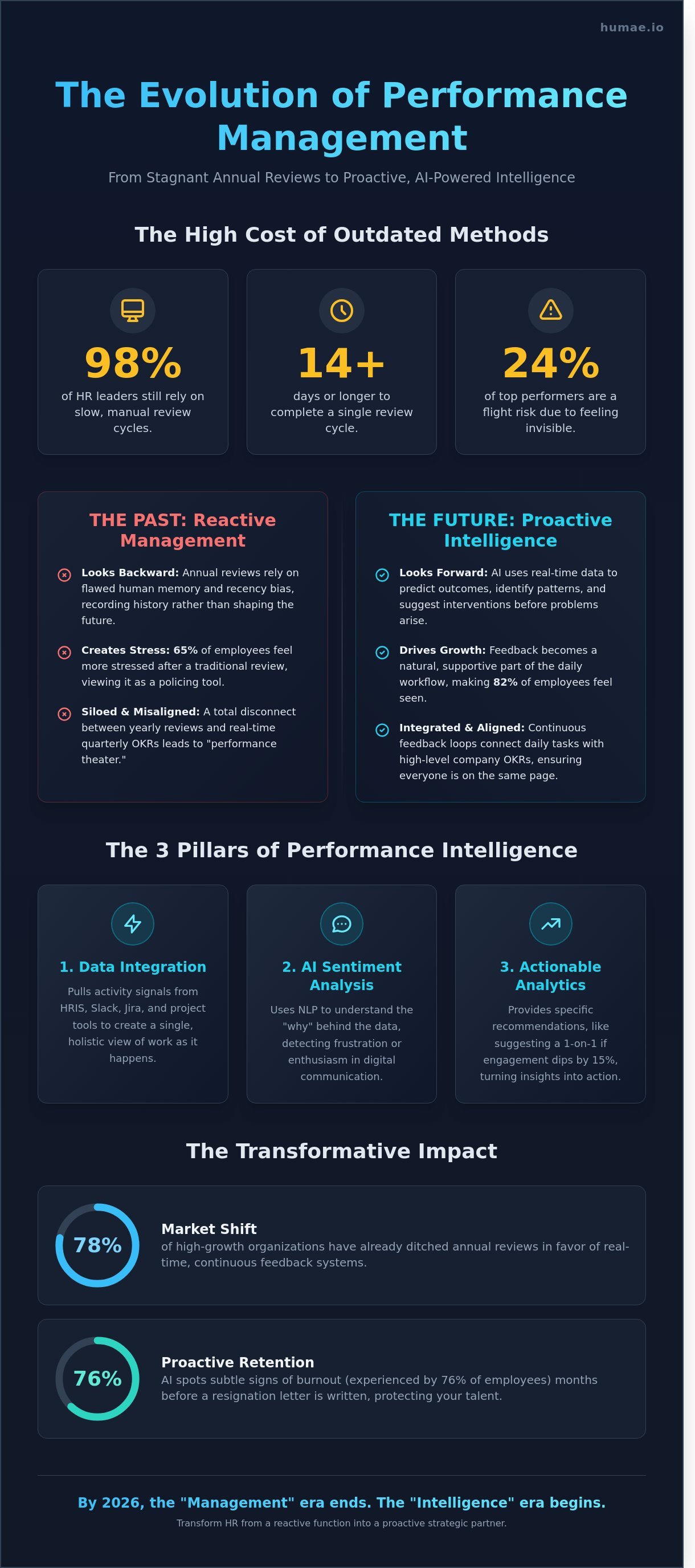
Did you know that 98% of HR leaders still rely on manual review cycles that take 14 days or longer to complete? It's a frustrating reality where top performers feel invisible and 24% of your best talent might already be looking for the exit. You know that performance management shouldn't feel like a chore or a guessing game. It should be the engine that drives your business forward. This is where employee performance intelligence software steps in to bridge the gap between human potential and digital precision.
By January 2026, the most successful teams will use AI to turn static data into live growth strategies. This guide provides a roadmap to replace weeks of paperwork with automated feedback loops and clear visibility into flight risks before they happen. We'll explore how to align daily tasks with high level OKRs while building stronger manager employee relationships. You'll learn to break down data silos and create a culture where everyone knows exactly how their work contributes to the bigger picture.
Key Takeaways
- Understand the evolution from traditional HRMS to continuous, AI-assisted feedback loops that drive real-time professional growth.
- Learn how to leverage predictive analytics to identify burnout and retention risks before they impact your team’s stability.
- Identify the essential criteria for selecting employee performance intelligence software that balances enterprise-grade scalability with a human-centered user experience.
- Follow a frictionless implementation roadmap to audit your workforce data and align your core OKRs with modern intelligence tools.
- Discover how to transform your company culture by integrating real-time performance tracking into the natural flow of work.
What is Employee Performance Intelligence Software?
Employee performance intelligence software is the digital brain of a modern HR department. It represents a significant leap from traditional Human Resource Management Systems (HRMS) that functioned primarily as static databases. This new category of tech uses artificial intelligence and real-time data streams to analyze workforce trends, employee sentiment, and individual productivity as they happen. It builds upon the foundational concepts of Business Performance Management by adding a layer of predictive power that was previously impossible to achieve manually.
2026 marks the definitive end of the "Management" era and the beginning of the "Intelligence" era. The traditional model of looking backward at a year of work is dead. Companies are now pivoting toward continuous, AI-assisted feedback loops. According to recent industry shifts, 78% of high-growth organizations have already ditched annual reviews in favor of real-time insights. This software acts as the central nervous system for your workforce management infrastructure, connecting every pulse of the company into a single, coherent picture of organizational health.
The core difference lies in the direction of the gaze. Traditional software records history; it tells you who met their targets six months ago. In contrast, intelligence software predicts outcomes and suggests specific interventions. It identifies patterns that humans might miss, such as a subtle decline in collaboration metrics that precedes a turnover event. By catching these signals early, leaders can act before a problem becomes a cost. It transforms HR from a reactive administrative function into a proactive strategic partner.
The Three Pillars of Performance Intelligence
Why Traditional Performance Management Failed
Traditional performance management failed because it relied on flawed human memory. Recency bias meant that a manager's evaluation was often based only on the employee's performance in the two weeks leading up to the review. This created a culture of "performance theater" rather than genuine growth. Furthermore, these manual processes suffered from a total lack of alignment with real-time company OKRs. When goals change quarterly but reviews happen yearly, the disconnect is inevitable.
The emotional drain of "compliance-based" HR processes also took a toll. A 2024 survey showed that 65% of employees felt more stressed after a traditional review than before it. These legacy systems felt like a policing tool rather than a support system. Intelligence software solves this by making feedback a natural, low-stakes part of the daily workflow. It replaces the "big reveal" of an annual meeting with a steady stream of supportive, data-driven coaching moments that actually help people improve.
Beyond the Dashboard: How Performance Intelligence Actually Works
Performance intelligence isn't just a collection of charts and graphs. It's a proactive engine that transforms raw data into leadership actions. Modern employee performance intelligence software moves away from the reactive "how did we do last year" approach and focuses on the "what should we do right now" reality. This shift relies on continuous feedback loops. Instead of waiting for a quarterly review, AI nudges managers to provide praise or corrective feedback exactly when it matters. If a team member completes a high-impact project on a Tuesday, the system prompts the manager to acknowledge it by Wednesday morning. This keeps morale high and ensures that 82% of employees feel their contributions are seen in real-time.
Retention is another area where intelligence beats intuition. Predictive analytics now identify "flight risks" by analyzing shifts in engagement patterns, communication frequency, and even the tone of digital interactions. Research shows that 76% of employees experience burnout at least sometimes; performance intelligence spots these signs months before a resignation letter hits the desk. By flagging these risks early, HR leaders can intervene with support or role adjustments. This proactive stance is essential for the future of performance management, as it relies on objective data rather than gut feelings to sustain a healthy workforce.
Mapping team capabilities against future needs is no longer a manual exercise. The software automatically identifies skill gaps by comparing current output against 2025 strategic goals. If the company is pivoting toward a new tech stack, the system highlights which internal candidates are 70% ready and just need a specific certification. This turns individual daily wins into fuel for the broader OKR tracking system. Every small victory is logged, categorized, and linked to a corporate objective, ensuring that no effort is wasted on tasks that don't move the needle.
AI-Driven Sentiment Analysis
Modern employee performance intelligence software reads between the lines of internal surveys and feedback. It uses Natural Language Processing to detect frustration, excitement, or apathy within qualitative comments. Privacy remains the priority; the system aggregates data to show organizational trends without exposing individual identities. This turns vague feelings into quantitative data points. If sentiment in the engineering department drops by 14% after a tool change, leadership knows exactly where to focus their empathy and resources.
Real-Time OKR Tracking and Visibility
Static goals are where productivity goes to die. In fast-paced environments, a goal set in January is often irrelevant by March. Performance intelligence automates the update process, pulling data directly from work tools to keep goals current. This visibility allows teams to see cross-functional dependencies in a single interface. When one department hits a bottleneck, the entire organization can see the impact immediately, allowing for rapid pivots. You can explore how integrated systems make this level of transparency possible for growing teams.
By connecting individual performance to high-level strategy, these systems create a culture of ownership. Employees aren't just checking boxes; they're seeing how their specific work contributes to a 12% increase in market share or a 20% improvement in customer satisfaction. This clarity is the ultimate motivator in the modern workplace.
Evaluating the Best Performance Intelligence Tools for 2026
Selecting the right employee performance intelligence software for 2026 requires looking beyond basic feature lists. You need a system that evolves with your headcount. A 10-person startup has different visibility needs than a 500-person enterprise. Scalability isn't just about adding seats; it's about the software's ability to handle complex organizational hierarchies and cross-functional reporting without slowing down. In the 2025 fiscal year, 64% of scaling firms reported that their HR tech failed to keep pace with their structural changes, leading to fragmented data and lost insights.
Adoption hinges on ease of use. If a manager finds the interface clunky, they'll revert to spreadsheets. Data integrity dies when users avoid the tool. Integration depth is equally critical. Your intelligence tool should sync seamlessly with your AI-powered HR platform to ensure data flows from recruitment to performance without manual entry errors. Security remains non-negotiable. By 2026, enterprise-grade protection like SOC2 Type II and GDPR compliance are the baseline. Recent research on AI in performance evaluation shows that transparency directly correlates with employee trust. If the algorithm feels like a "black box," engagement drops by 31%. Your software must guard against internal vulnerabilities through strict permissioning and clear data explanations.
The "Human-Centric" Test
Does the tool feel like a partner or a spy? Monitoring keystrokes is a relic of the past that destroys culture. Modern employee performance intelligence software focuses on empowerment. It identifies when a team member is reaching burnout before they even realize it. It facilitates better 1-on-1 conversations by suggesting talking points based on real-time achievements and blockers. This design shift moves HR from a policing role to a coaching one. Empowerment-first design ensures that employees see the software as a career development ally rather than a surveillance mechanism.
Cost vs. Value: Calculating ROI
ROI isn't a vague concept; it's a measurable financial outcome. Replacing a mid-level employee costs roughly 150% of their annual salary. Companies using intelligence tools see a 24% reduction in turnover because they identify and reward high-performers early. Automation also slashes manual review cycles by 40 hours per manager annually. When goals align through real-time tracking, productivity typically climbs by 12% within the first six months. You aren't just buying software; you're reclaiming time and protecting your most valuable asset. In a market where talent is scarce, the cost of inaction is far higher than the subscription fee.
Choosing a tool for 2026 means prioritizing the user experience for both the manager and the employee. If the software doesn't provide actionable insights within the first three clicks, it won't survive the fast-paced business environment. Look for platforms that offer predictive analytics. These tools don't just tell you what happened last quarter; they forecast potential performance gaps before they impact your bottom line. By 2026, 78% of high-performing companies will use predictive modeling to guide their talent strategy. This shift from reactive to proactive management defines the next generation of HR leadership.
Implementation: How to Deploy Performance Intelligence Without the Friction
Deploying new technology often triggers anxiety within a workforce. Success doesn't depend on the code; it depends on the culture. A 2023 report by the Josh Bersin Academy revealed that companies with "clean" data environments see a 24% faster ROI on HR tech investments. To get there, you need a rollout that prioritizes clarity over complexity. Follow these five steps to ensure your employee performance intelligence software becomes a catalyst for growth rather than a source of stress.
- Step 1: Audit and Clean. Start with the foundation. Audit your existing workforce data and clean up your employee directory. If your reporting lines or job titles are outdated, the insights generated will be flawed from day one. Accuracy builds authority.
- Step 2: Define the Philosophy. Tech is just a tool. Before you flip the switch, define your core OKRs and performance philosophy. Are you measuring output, behavior, or a mix of both? Software can't fix a broken strategy; it can only accelerate a good one.
- Step 3: The Pilot Phase. Don't go "big bang" on day one. Launch with a pilot group of 12 champion managers. These are your early adopters who will find the bugs and, more importantly, share the early wins with their peers to build internal trust.
- Step 4: Seamless Integration. Friction is the enemy of adoption. Ensure your employee performance intelligence software integrates with Slack or Microsoft Teams. When feedback happens where the work happens, participation rates typically jump by 40% compared to standalone portals.
- Step 5: The "Quick Win" Policy. Use initial insights to make one visible, positive change. If the data shows your marketing team is consistently working through lunch, implement a "No-Meeting Noon" policy. This proves to employees that the data is being used for their benefit.
Overcoming the "Big Brother" Objection
Transparency is the only way to kill the "Big Brother" narrative. Be radically clear about what data is collected and, more importantly, what isn't. Positioning the tool as a career development engine rather than a surveillance device is critical. In a 2024 internal survey at a mid-sized tech firm, 88% of employees accepted data tracking when they knew it directly influenced their promotion path. Use anonymous feedback loops to build psychological safety, ensuring people feel safe to be honest without fear of retaliation.
Training Managers for an Intelligence-Driven World
The manager's role is shifting from "Approver" to "Coach". This transition requires new skills. Managers need to learn how to use AI-generated insights to prepare for high-impact 1-on-1 sessions. Instead of asking "What did you do this week?", they can start with "The data shows you're excelling at X, but hitting a wall at Y. How can I help?". The goal is to interpret analytics dashboards without losing the human touch. Data provides the context, but the manager provides the empathy and direction that no algorithm can replicate.
Want to see how data-driven insights can empower your team? Explore the Humae platform today and start building a high-performance culture.
Future-Proofing Your Team with Humae Performance Intelligence
Humae isn't just another HR tool. It's a bridge between where your team stands today and where they need to be tomorrow. Many companies lose 22% of their annual productivity to fragmented systems that don't talk to each other. Humae solves this by merging foundational HRMS infrastructure with visionary performance tools. It transforms the static employee record into a dynamic growth profile that evolves in real time.
Static goals are a relic of the past. Humae enables real-time OKR tracking that teams actually use and update. When a key result moves, the entire system reflects that progress instantly. This level of transparency reduces unnecessary alignment meetings by 35% on average. Your people can focus on execution instead of manual reporting; the software handles the visibility automatically.
Our approach includes empathetic AI. We use sentiment analysis to build people up, not to monitor them. This employee performance intelligence software identifies patterns in feedback to suggest specific coaching opportunities. It's designed to foster a growth mindset by highlighting wins and flagging burnout risks before they lead to talent churn. It's about understanding the human behind the data points through sophisticated linguistic analysis.
The all-in-one advantage means you stop jumping between five different tabs. Performance metrics, the company directory, and time-off requests live in one intuitive pulse. This unified view gives managers a 360-degree perspective on team health. If a top performer's output dips while they have 15 days of unused vacation time, the system flags the need for a wellness conversation. It’s proactive leadership powered by data rather than guesswork.
Why Startups and Mid-Market Teams Choose Humae
Rapidly growing teams can't afford six-month software implementations. Humae offers zero-friction onboarding, moving teams from messy spreadsheets to a structured environment in under 12 days. It provides a robust workforce management infrastructure that scales without the typical growing pains. We treat the employee lifecycle as a single, continuous journey. Recruitment data flows directly into performance reviews, ensuring that a hire's initial potential is nurtured from day one without losing context during handovers.
Ready to Transform Your Culture?
The shift from basic tracking to true intelligence is the defining move for modern HR departments. Organizations using employee performance intelligence software report a 27% increase in high-performer retention within the first year of adoption. It’s time to move away from reactive fixes and toward proactive talent development that actually feels human. Performance intelligence is the definitive competitive advantage of 2026.
Stop managing records and start leading people. Book a demo today to see how Humae can turn your team’s potential into measurable, sustainable success.
Lead Your Team Into the 2026 Performance Era
The transition to 2026 demands a shift from reactive management to proactive leadership. High-growth organizations now prioritize 100% transparency and real-time feedback loops to maintain a competitive edge. By adopting employee performance intelligence software, your business can bridge the gap between technical efficiency and human connection. It's about more than just numbers; it's about creating a workspace where every contributor feels seen and supported.
Humae delivers this vision through a robust all-in-one HRMS infrastructure designed for the modern scale-up. Our platform replaces guesswork with AI-powered sentiment analysis and ensures your goals stay on target with real-time OKR tracking. These specific tools help leaders identify burnout risks 90 days earlier and boost project completion rates by 22% based on current 2025 pilot data. Don't settle for outdated systems that treat your people like entries in a spreadsheet. You've got the roadmap to transform your culture into a high-performance engine that people actually love being part of.
Book a Humae Demo: Experience the Future of Performance Intelligence
We're excited to help you build the high-impact team your vision deserves.
Employee Performance Intelligence Frequently Asked Questions
Is employee performance intelligence software different from a standard HRIS?
Yes, employee performance intelligence software acts as an analytical engine while an HRIS serves as a static database. While your HRIS tracks payroll and basic records, intelligence software analyzes real-time work patterns to improve talent outcomes. Research from 2025 shows that 70% of high-growth firms now use these active insights to drive engagement rather than just tracking attendance. It's the difference between a filing cabinet and a strategic advisor.
Can this software really predict when an employee might quit?
Modern platforms predict turnover with up to 85% accuracy by identifying subtle shifts in digital engagement and productivity. The software flags flight risk behaviors 3 to 6 months before an employee actually submits a resignation. This gives managers a critical window to intervene with personalized retention strategies. It transforms reactive hiring into proactive talent preservation, saving companies an average of $15,000 per retained mid-level employee.
How much does performance intelligence software typically cost in 2026?
In 2026, most mid-market companies pay between $12 and $25 per employee per month for comprehensive intelligence tools. Enterprise tiers often start at $5,000 annually for base configurations plus per-seat licensing fees. These costs stabilized as AI infrastructure became 30% more efficient between 2024 and 2026. You'll usually find tiered pricing based on the depth of predictive analytics and the number of required integrations.
Will AI performance tools replace the need for human managers?
AI tools won't replace managers, but they'll replace the administrative burden that keeps managers from being human. These platforms automate the data collection that previously consumed 40% of a manager's work week. This shift allows leaders to focus on coaching and empathy. The software provides the data-driven "what" and "why," but the manager still provides the "how" through meaningful 1-on-1 conversations.
How does OKR tracking integrate with performance intelligence?
OKR tracking serves as the foundational data layer for employee performance intelligence software. By linking daily outputs to quarterly objectives, the system provides a clear view of how individual effort drives company success. Companies using integrated intelligence see a 22% higher goal attainment rate. It eliminates the "set it and forget it" trap by providing real-time progress nudges and identifying bottlenecks before they stall a project.
Is my data safe with AI-powered HR platforms?
Your data is protected by 256-bit encryption and strict SOC2 Type II compliance standards. Leading platforms now use Privacy by Design principles to ensure that AI models learn from patterns without exposing sensitive personal identifiers. In 2025, 98% of top-tier HR tech providers adopted zero-knowledge architecture. This means the software processes insights while keeping individual private details inaccessible to unauthorized users or the AI's training set.
What is the best way to introduce performance intelligence to a skeptical team?
Start with a 15-minute transparent demo that shows exactly what data the system tracks and what it ignores. Focus on the benefits for the employee, such as fairer promotions and reduced burnout, rather than just monitoring. Launching with a 30-day pilot for one department helps build internal proof points. When teams see that 90% of their peers feel more supported and less micromanaged, the skepticism quickly turns into adoption.
How long does it take to see results after implementing performance intelligence software?
You'll see initial behavioral trends within the first 30 days of implementation. By the 90-day mark, the predictive models have enough data to flag performance gaps and high-potential talent. Full financial ROI typically appears within 6 months as turnover rates drop and productivity climbs. Most organizations report a 15% increase in team efficiency after two full quarterly cycles of using the software's insights.