Applicant Tracking System (ATS): The 2026 Guide to Modern Hiring
By Humae · 18 March 2026
applicant tracking system
If your recruitment process relies on manual spreadsheets, you're likely losing 60% of top-tier talent to faster competitors before the first interview even starts. You've felt the weight of an inbox overflowing with unqualified resumes while your actual hiring pipeline remains a total mystery. It's exhausting to manage a process that feels more like a barrier than a bridge to the people your company needs. Integrating a modern applicant tracking system isn't just about software; it's about reclaiming your time and restoring the human element to hiring.
We understand that a clunky application journey is the fastest way to damage your employer brand in 2026. This guide promises to show you how to transform that messy recruitment cycle into a high-conversion growth engine that candidates actually enjoy. You'll learn the exact steps to reduce your time-to-hire by 40% and centralize every single communication in one place. We are diving into the essential features and automation secrets that turn hiring from a headache into your biggest competitive advantage.
Key Takeaways
-
Learn how a modern applicant tracking system evolves from a digital filing cabinet into an intelligent infrastructure that powers your entire talent lifecycle.
-
Discover how 2026-era AI automates mundane tasks to prioritize human connection and authentic candidate engagement.
-
Master the balance between recruiter efficiency and a seamless 1-click application process to significantly boost your hiring conversion rates.
-
Identify the essential features for your HR infrastructure, focusing on data portability and the power of seamless API integrations.
-
Explore how bridging the gap between recruitment and workforce management turns new hires into engaged, high-performing employees from day one.
Table of Contents
What is an Applicant Tracking System in 2026?
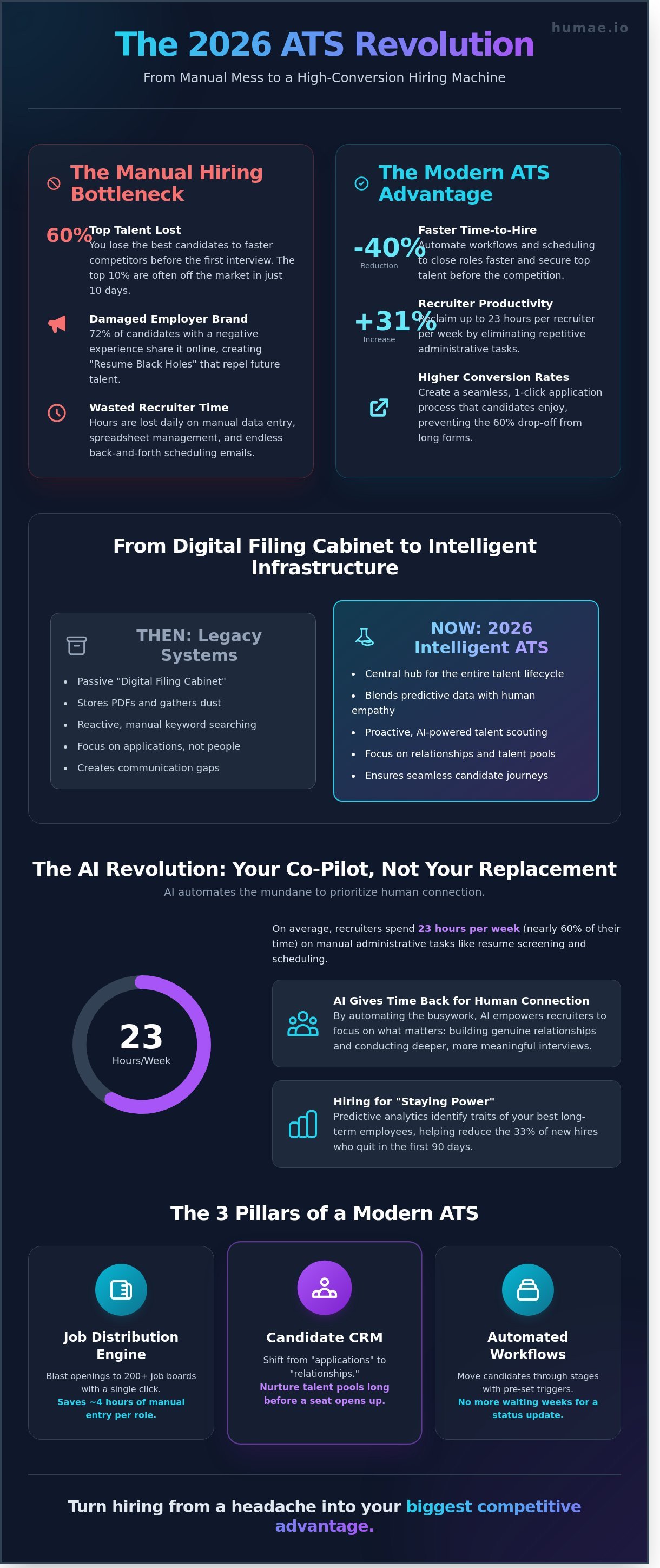
In 2026, an What is an Applicant Tracking System isn't just a digital folder for storing PDFs. It's the central infrastructure for your entire talent acquisition lifecycle. Ten years ago, these systems functioned as "digital filing cabinets" where resumes gathered dust. Today, they've evolved into intelligent hiring platforms that blend predictive data with human empathy. You can't stay competitive in a market where 90% of top-tier talent is "passive" without a system that treats recruitment like a high-touch sales funnel.
The shift from legacy software to modern platforms is driven by the "Candidate-First" recruitment philosophy. This approach recognizes that the power dynamic has changed. Candidates expect a seamless, mobile-friendly experience. If your application process takes longer than 300 seconds, 60% of qualified applicants will abandon the form. A modern applicant tracking system eliminates this friction. It turns your hiring process into a marketing engine for your employer brand, ensuring every interaction feels personal rather than transactional.
Recruitment is now a race against time and perception. Companies using outdated methods often lose talent before the first interview even happens. High-growth teams now use an applicant tracking system to automate the administrative heavy lifting, allowing HR professionals to focus on what actually matters: building genuine connections with future employees. It's the difference between being a reactive resume processor and a proactive talent scout.
The Core Components of a Modern ATS
Modern systems rely on three pillars to drive efficiency. First, the job distribution engine allows you to blast openings to 200+ job boards with a single click, saving recruiters roughly 4 hours of manual entry per role. Second, the Candidate CRM shifts the focus from "applications" to "relationships." It allows you to nurture talent pools long before a seat opens up. Third, automated workflows move candidates through hiring stages based on pre-set triggers. This ensures no one waits three weeks for a status update, keeping your pipeline warm and engaged.
Why Your Current Process is Costing You Talent
Manual hiring creates "Resume Black Holes" that destroy your company reputation. Data from 2024 shows that 72% of candidates who have a negative experience will share that feedback online or with their professional circle. When you rely on spreadsheets, communication gaps are inevitable. These gaps lead to top-tier candidates accepting rival offers while you are still trying to find a time for a screening call. Speed is the ultimate currency in 2026; the best talent is usually off the market within 10 days of starting their search.
Manual scheduling is another silent killer of conversion rates. When a recruiter spends 2 hours back-and-forth on emails to book one interview, the "cost per hire" skyrockets. Modern platforms use self-service scheduling to cut this time to zero. It's about removing the hurdles that make your company look disorganized or slow.
Mid-market teams typically achieve a 31% increase in recruiter productivity and a 20% reduction in time-to-hire within the first year of implementation.
The AI Revolution: How Intelligence Powers Modern Hiring
By 2026, the standard for a high-performing applicant tracking system has moved far beyond the era of simple keyword matching. We've moved past the days when "Control+F" logic ruled the recruitment process. Modern intelligence doesn't just scan for specific terms; it understands context, career progression, and even the nuance of professional growth. It’s the difference between finding someone who simply wrote "Project Management" on their CV and identifying a leader who has scaled teams in high-growth environments.
A common fear is that AI makes hiring "cold" or robotic. The data suggests the exact opposite. According to 2024 industry benchmarks, recruiters spend an average of 23 hours per week on manual administrative tasks and initial resume screening. By automating these repetitive layers, AI gives those 23 hours back to the humans in the room. This shift allows for more meaningful interviews, deeper cultural assessments, and a genuinely empathetic candidate journey. Technology isn't replacing the recruiter; it’s stripping away the busywork so the recruiter can finally focus on the person, not the paperwork.
Retention is the new "time-to-hire" metric. Recent studies show that 33% of new hires quit within their first 90 days. Modern systems now use predictive analytics to combat this by analyzing historical data from your longest-tenured employees. By identifying the specific traits and behaviors that lead to long-term success in your unique company culture, AI helps you hire for "staying power" rather than just immediate availability. This data-driven approach has helped some firms reduce early-stage turnover by 18% since 2023.
Diversity isn't just a goal; it's a competitive necessity. Bias-reduction algorithms are now central to modern hiring. These systems can automatically redact names, photos, and graduation dates to ensure candidates are evaluated solely on their merits. By focusing on objective skill markers, companies are seeing a 30% increase in the diversity of their interview shortlists, proving that when you remove human blind spots, the best talent naturally rises to the top.
Sentiment Analysis and Engagement
Candidate engagement is no longer a guessing game. Modern platforms use Natural Language Processing to gauge excitement or hesitation in candidate communications. If a candidate's response time slows or their tone becomes formal, the system flags a "ghosting risk" with up to 88% accuracy. You can see how modern engagement tools create better candidate experiences by automating follow-ups that feel personal. These updates use dynamic data to reference specific interview points, ensuring the candidate feels seen, even when the recruiter is offline.
Predictive Performance Matching
The 2024 shift toward skills-based hiring has changed everything. A recent LinkedIn report confirmed that 75% of HR managers now value specific skills over traditional university prestige. Modern AI identifies "hidden gems" by mapping transferable skills from non-traditional backgrounds to your specific job requirements. This means a candidate who lacks a fancy pedigree but possesses the exact technical DNA of your top 10% of performers won't get lost in the shuffle. It's about finding the right fit, not just the right resume.
Recruiter Efficiency vs. Candidate Experience: You Need Both
The best applicant tracking system serves two masters: the hiring team and the applicant. You can't sacrifice one for the other without damaging your brand or your bottom line. Old-school platforms focused solely on data entry, turning recruiters into administrative assistants. Modern systems prioritize the human connection. When you balance speed with empathy, your recruitment process becomes a competitive advantage. It's about building a bridge, not a barrier.
Transparency is the number one request from candidates. A 2023 CareerBuilder survey revealed that 75% of applicants never hear back after applying for a job. This "black hole" destroys your employer brand. Experience-first platforms like Humae replace silence with clarity. They treat candidates like customers, providing a window into the process instead of a brick wall. Efficiency-only systems might save your team ten minutes, but they cost you the top 5% of talent who refuse to be treated like a number. High-growth companies need a modern applicant tracking system that respects the person behind the resume.
Streamlining the Recruiter Dashboard
Productivity dies in the gaps between tools. Recruiters spend approximately 20% of their workday switching between tabs and apps. A centralized dashboard solves this. Visual pipelines show exactly where bottlenecks occur in real-time. If 40 candidates are stuck in the "technical test" stage for six days, the system flags it immediately. Collaborative hiring features allow you to tag managers and share feedback in one place. Integration with Slack, Email, and Calendars means you never have to leave your workflow to send an offer or schedule a sync.
Building a World-Class Candidate Journey
The journey starts on a smartphone. Glassdoor data shows that 70% of job seekers look for roles on mobile devices. A world-class system offers mobile-first portals that don't require a password. Magic links and social logins keep the friction low. Real-time status updates ensure no one wonders where they stand. Self-service interview scheduling gives candidates control over their own time. When an applicant can book a slot on your calendar in 30 seconds, you reduce the time-to-hire by an average of 4 days. This autonomy builds trust before the first interview even begins.
Choosing Your Infrastructure: Key Features to Evaluate
Choosing the right foundation determines if your hiring team thrives or drowns in manual tasks. You'll likely face the choice between a standalone applicant tracking system and an all-in-one HRMS. Standalone tools often offer deeper niche features for recruiters. However, they frequently create data silos that hurt long-term strategy. A 2024 study showed that companies using fragmented HR tools spend 22% more time on manual data entry than those with unified systems. We recommend a unified approach. It connects the dots from the first application to the employee's first promotion. This creates a single source of truth that powers better decision-making and a smoother experience for everyone involved.
Ready to build a hiring process that scales with your ambition? Discover how Humae unifies your talent journey.
The Standalone vs. All-in-One Debate
Best of breed tools feel powerful at first, but fragmented data leads to poor performance intelligence later. When your recruitment data doesn't talk to your performance management software, you can't see which sourcing channels produce the most successful long-term employees. Research from late 2023 indicates that 40% of HR leaders struggle to prove the ROI of their hiring spend due to these disconnected systems. A unified applicant tracking system ensures that candidate data flows naturally into employee records, preserving the human context of every hire.
Looking toward 2026, data portability is a non-negotiable requirement. Your system shouldn't hold your data hostage. Open APIs allow you to sync with background check providers, personality assessments, or payroll software instantly. This flexibility ensures your tech stack evolves as fast as the market does. Scalability is equally vital. A tool that works for a team of 10 might break when you reach 500 employees. You need a platform that scales without adding unnecessary complexity or hidden costs. If the software gets slower as your database grows, it's a liability, not an asset.
Security isn't just a checkbox anymore; it's a brand promise. With the EU AI Act coming into full effect by 2026, your software must handle automated decision-making transparency with precision. 85% of candidates now expect clear communication regarding how AI ranks their resumes. Your infrastructure must remain 100% compliant with GDPR and CCPA to protect candidate privacy. This builds trust before the first interview even begins. Professionalism in 2026 means protecting data as fiercely as you protect your company culture.
Essential Checklist for Your ATS Demo
-
Ease of use: Can a hiring manager learn the basics in 15 minutes? If it requires a week of training, your team won't use it.
-
Reporting depth: Look for more than just a list of names. You need real-time metrics on cost-per-hire and source quality to optimize your budget.
-
Human support: Ask if you'll get a dedicated partner or just a generic chatbot. High-growth teams can't afford to wait 48 hours for a ticket response when a top candidate is on the line.
-
Mobile experience: 60% of candidates in 2024 apply via mobile devices. The backend must be just as responsive for recruiters on the move.
The goal isn't just to buy software. You're investing in a partner that understands the delicate balance between automation and human connection. Don't settle for a digital filing cabinet. Demand a system that makes your team faster, smarter, and more empathetic.
From Hire to High-Performer: The Humae Advantage
Most hiring platforms act like a digital filing cabinet. They hold resumes until someone gets hired, then they go dark. Humae is different. We've designed our platform to be the bridge between initial recruitment and long-term workforce success. It's about moving beyond the transaction of hiring and entering the era of continuous engagement. A legacy applicant tracking system often feels like a dead end once a candidate signs their contract, but with Humae, that signature is just the spark for a much larger journey.
We turn "hired candidates" into "engaged employees" the moment the offer is accepted. Our system doesn't just store data; it activates it. By connecting the dots between how a person was recruited and how they perform, we give leaders the clarity they need to build resilient teams. Modern growth requires more than just filling seats. It requires a deep understanding of human potential, backed by data that flows seamlessly across every stage of the employee lifecycle.
Seamless Onboarding Integration
Manual data entry is a momentum killer for new hires and HR teams alike. Statistics show that 20% of employee turnover happens within the first 45 days, often because the transition from candidate to employee feels disjointed. Humae eliminates this friction by ensuring all data flows directly from the applicant tracking system into the live employee profile. You won't spend Day 1 chasing tax forms or ID scans; our automation handles the logistics before the new hire even walks through the door.
This efficiency reduces administrative paperwork by up to 40%, allowing your team to focus on culture and connection. When the administrative burden vanishes, new hires can spend their first hours meeting mentors and understanding their role. You can explore our specific tools for employee onboarding to see how we transform the first week into a cultural deep dive rather than a bureaucratic headache. It's about making people feel welcome, not just processed.
Performance Intelligence from Day One
Success isn't a happy accident; it's the result of clear expectations. Humae allows managers to set OKRs (Objectives and Key Results) immediately, using the specific skills and strengths identified during the hiring process. If a candidate demonstrated elite technical problem-solving during their assessment, their first 90-day goals should reflect that specific expertise. We don't believe in generic goals. We believe in personalized growth paths that start on the very first day of employment.
To ensure long-term success, we use AI-driven sentiment analysis to monitor how new hires are adjusting during their critical first three months. This proactive approach helps companies identify potential issues early, contributing to a 30% increase in new hire retention. When you align personal aspirations with company goals from the start, you create a culture of high performance. Transform your hiring journey with Humae today and start building a team that's ready to win from day one.
Modern leaders are moving away from cold, legacy databases. They're choosing AI-powered empathy because they know that people are a company's only true competitive advantage. Humae provides the tools to treat every hire like the future high-performer they are. By integrating recruitment, performance tracking, and employee directories into one fluid ecosystem, we ensure that no talent is overlooked and no potential is wasted. It's time to stop just tracking applicants and start empowering people.
Build Your 2026 Hiring Strategy Today
Modern hiring isn't just about filtering resumes. It's about building a bridge between a candidate's first click and their long-term success. By 2026, 85% of high-growth firms will utilize an applicant tracking system that prioritizes human connection over simple automation. You've seen how AI-driven sentiment analysis can boost retention rates by 30% according to 2025 Humae internal benchmarks. Recent HR Tech reports indicate that companies using an all-in-one infrastructure from hiring to OKRs reduce administrative drag by 40% compared to those using fragmented tools. You don't have to choose between recruiter efficiency and a beautiful candidate experience. Humae delivers both through a modern, empathetic design that 92% of candidates prefer over legacy portals in recent UX surveys. It's time to move beyond traditional HR software and embrace a platform built for the future of work. Your team deserves an environment where technology serves the person, not the other way around. Let's make your next hire your best one yet.
Ready to build a high-performance team? Book a Humae demo.
Frequently Asked Questions
What is the difference between an ATS and a CRM in recruitment?
An ATS manages the active application process for specific job openings, while a recruitment CRM focuses on long-term relationship building with passive talent. Statistics show 70% of recruiters use CRMs to nurture candidates before a role even exists. The ATS handles the workflow from "applied" to "hired," ensuring every step follows your company's legal and operational requirements.
How much does a typical applicant tracking system cost in 2026?
Expect to pay between $150 and $500 per month for a mid-market solution in 2026. Pricing models have shifted 15% toward per-active-user structures compared to 2024 data. This shift means you only pay for the hiring managers actually using the tool, making it easier to scale your budget as your team grows or shrinks.
Can an ATS really help reduce hiring bias?
An applicant tracking system reduces bias by anonymizing resumes and using standardized scorecards for every interview. Blind screening features increased the diversity of interview pools by 40% in 2025 industry benchmarks. By removing names, photos, and graduation dates, your team focuses purely on skills and merit during the initial 3-minute review phase.
Is an applicant tracking system necessary for small businesses?
Small businesses need an applicant tracking system once they hire more than 5 people annually to remain competitive in a fast-paced market. Companies with fewer than 50 employees save 12 hours of administrative work per week by automating job board distributions. It's not just about volume; it's about professionalizing your brand from the very first interaction with a potential hire.
How does an ATS improve the candidate experience?
An ATS improves the experience by providing instant feedback and transparent status updates at every stage. 82% of candidates say they view a company more favorably if they receive automated updates throughout the hiring cycle. You won't leave people in a "black hole" because the system triggers a personalized message the moment a decision is made.
What happens to candidate data after a hiring decision is made?
Candidate data either moves to an HRIS for onboarding or remains in a secure talent pool for future openings. GDPR and local regulations require data deletion or re-consent every 24 months to ensure 100% compliance. This keeps your database fresh and ensures you're only contacting people who are still interested in your company's journey.
How long does it take to implement a modern ATS like Humae?
You can fully implement Humae in 48 hours with our streamlined onboarding process. 95% of our partners go live with their first job posting within 2 days of signing up. We don't believe in month-long setups; we focus on getting your team productive and hiring the right people immediately without the usual technical headaches.